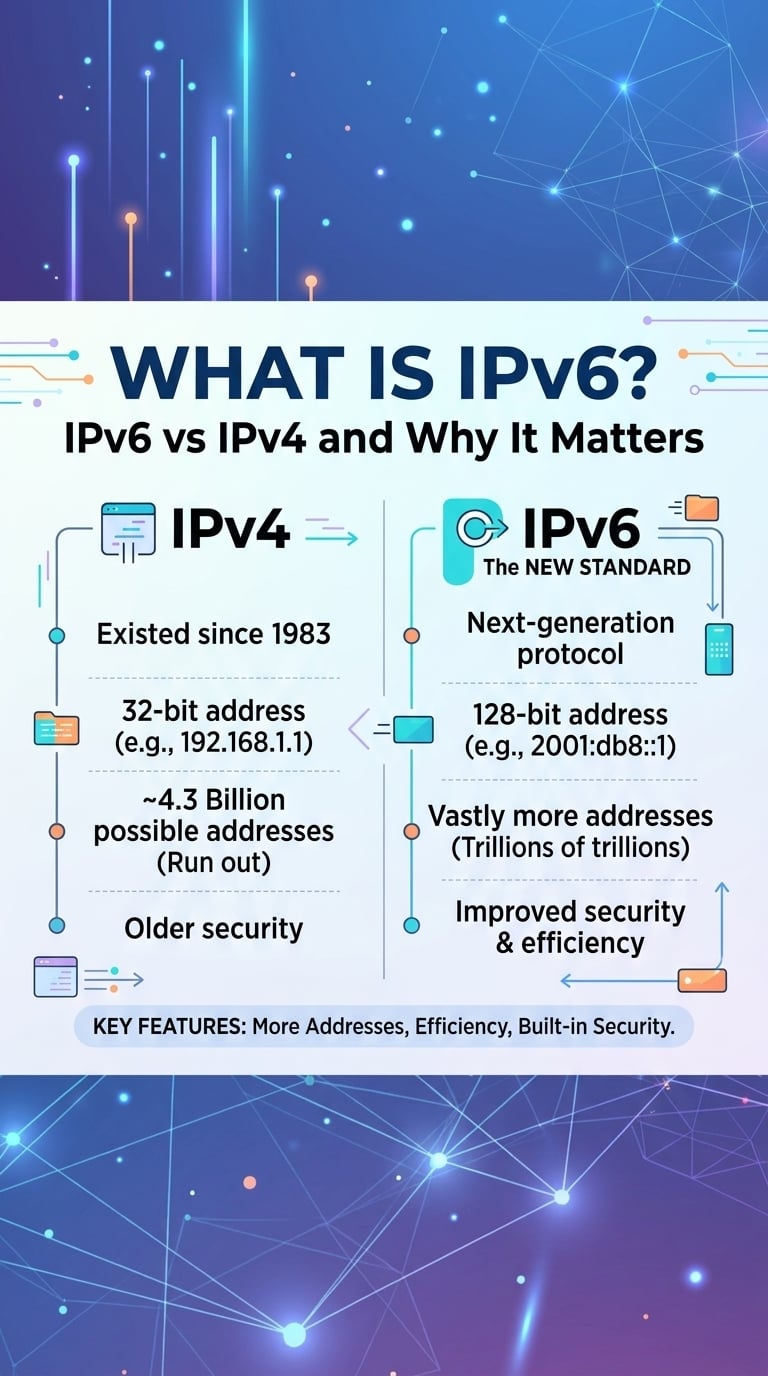
The short answer to what is IPv6: Internet Protocol version 6 is the network-layer protocol that replaces IPv4's 32-bit addresses (about 4.3 billion) with 128-bit addresses (about 3.4 × 10 to the 38th power), standardized in RFC 8200. It also simplifies the packet header, moves fragmentation to the sender, and removes the need for NAT.
IPv6 is no longer a future protocol. Public traffic measurements in 2025 put roughly 45 to 49 percent of users reaching major web services over IPv6, and mobile networks run well above that average because IPv4 addresses are scarce and expensive.
Beyond the address: what is IPv6 actually changing in the packet?
IPv6 changes four things operators feel in production: a fixed 40-byte header with optional extension headers, no header checksum, fragmentation performed only by the source host, and address resolution through ICMPv6 Neighbor Discovery instead of ARP. Each change shifts work from routers to endpoints and makes ICMPv6 mandatory rather than optional.
The fixed header lets routers forward without parsing a variable-length options field. Options moved into chained extension headers (Hop-by-Hop, Routing, Fragment, Destination Options), which many middleboxes and some hardware forwarding paths drop or punt to slow path, so real-world reliance on them stays low.
Fragmentation is the operational trap. Routers never fragment IPv6 packets; they send an ICMPv6 Packet Too Big message and the sender must reduce its packet size. The minimum link MTU is 1,280 bytes. Firewalls that block ICMPv6 wholesale create Path MTU black holes: the TCP handshake succeeds, then large responses stall.
Host configuration also changed. Stateless Address Autoconfiguration (SLAAC) lets a host build its own address from a router-advertised /64 prefix, and privacy extensions rotate that address regularly. A single client can therefore appear from many addresses inside one /64.
IPv6 vs IPv4: the differences that matter in production
| Attribute |
IPv4 |
IPv6 |
| Address size |
32 bits, dotted decimal |
128 bits, colon-separated hex |
| Header |
20 to 60 bytes, variable, with checksum |
Fixed 40 bytes, no checksum, extension headers |
| Fragmentation |
Routers or hosts |
Source host only; minimum MTU 1,280 bytes |
| Address resolution |
ARP (broadcast) |
Neighbor Discovery over ICMPv6 (multicast) |
| Configuration |
DHCP or static |
SLAAC, DHCPv6 or static |
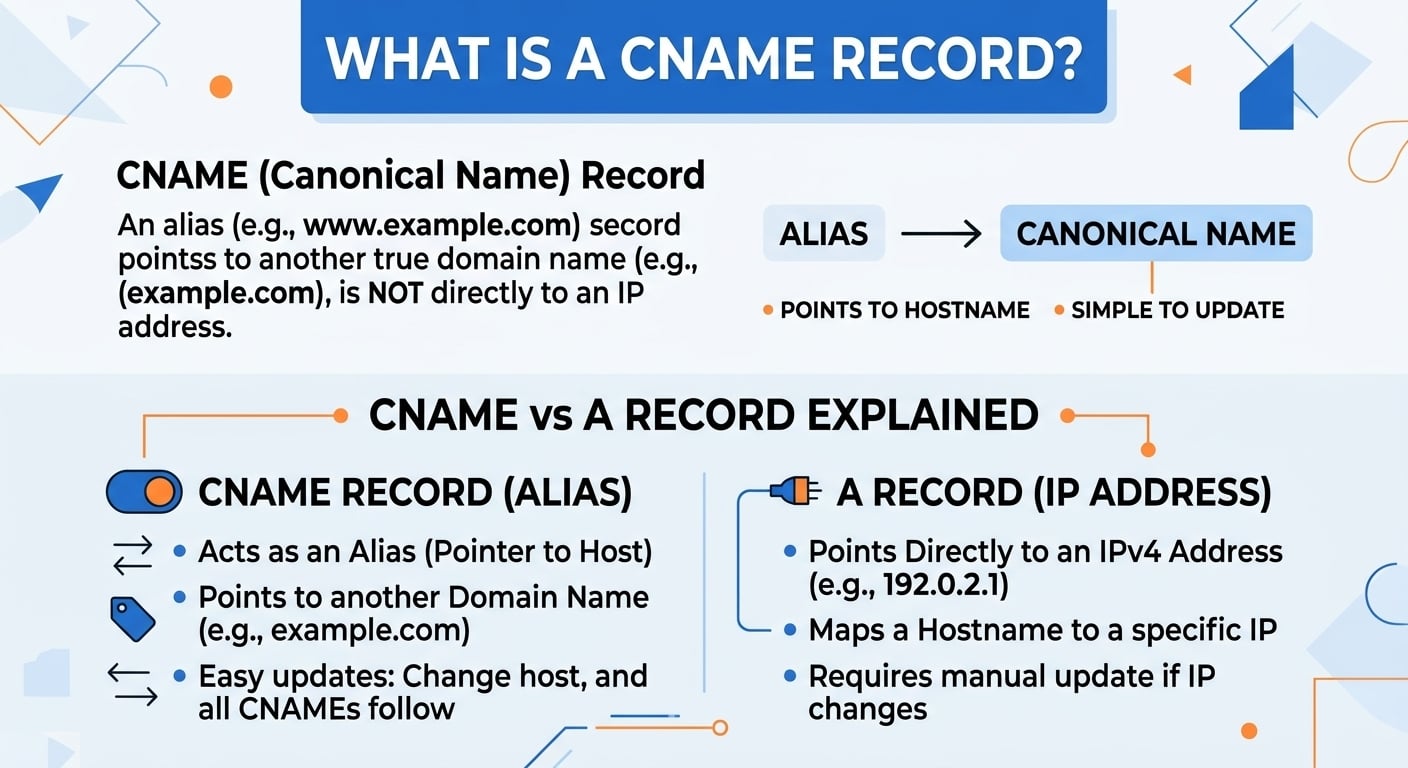
| DNS record |
A |
AAAA |
| Typical client identity unit |
Single /32, often shared via CGNAT |
A /64 prefix per subscriber or subnet |
The difference with the biggest operational impact is not address length but identity: an IPv4 address often represents dozens of users behind NAT, while an IPv6 /64 usually represents one household or device.
Where IPv6 sits in the stack
IPv6 lives at Layer 3 only. TCP, UDP, QUIC, TLS 1.3 and HTTP/2 run unchanged above it; what changes is the pseudo-header used in transport checksums, and the UDP checksum becomes mandatory because the IP header no longer carries one. Discovery happens in DNS, where a client asks for AAAA records alongside A records.
Everything that keys on addresses sits in the blast radius: access logs, geolocation databases, rate limiters, allowlists, abuse tooling and analytics that count unique visitors by IP. These systems were usually written for 32-bit integers and per-address identity.
IPv6 adoption: why mobile networks moved first
IPv6 adoption is highest on mobile because carriers add millions of subscribers and cannot buy enough IPv4 to number them. Large operators such as T-Mobile US run IPv6-only mobile cores, using NAT64, DNS64 and 464XLAT to reach the remaining IPv4-only services, while India's mobile traffic is predominantly IPv6.
The economics are simple arithmetic. A Carrier-Grade NAT (CGNAT) public IPv4 address has 64,512 usable ports above the well-known range. At an illustrative allocation of 2,000 ports per subscriber, one address serves only 32 subscribers, and a modern app opening hundreds of concurrent flows burns through that budget quickly. Every flow that goes native IPv6 skips the CGNAT box entirely, removing its state, logging and capacity cost.
Cloud pricing pushes the same way. Amazon Web Services has charged $0.005 per hour for every public IPv4 address since 2024, which is about $3.65 a month or $43.80 a year per address. Apple has required iOS apps to work on IPv6-only NAT64 networks since 2016, so client stacks are ready even where web servers lag.
What does dual stack mean for websites and CDNs?
Dual stack means a service publishes both A and AAAA records and accepts connections over IPv4 and IPv6 at the same time. Clients choose using Happy Eyeballs (RFC 8305), which prefers IPv6 but races IPv4 after roughly 250 ms, so a broken IPv6 path costs latency rather than an outage.
For most sites the CDN is where dual stack happens. The edge terminates IPv6 from clients and fetches from an origin that can remain IPv4-only, which removes the main excuse for not publishing AAAA. BlazingCDN serves IPv6 alongside HTTP/2 and TLS 1.3 on Anycast routing, and its geo and IP lists and rate limiting are included on every plan; the BlazingCDN IPv6 and delivery features list the full protocol set.
A realistic setup in words: the hostname cdn.example.com carries an A record pointing to the edge's IPv4 Anycast address and an AAAA record pointing to its IPv6 address in the 2001:db8::/32 documentation range. Verify by querying both record types with dig, then forcing an HTTPS request over each family and comparing status codes, TLS certificate and response size. Finally, confirm that ICMPv6 Packet Too Big messages pass every firewall between the edge and the client.
IPv6 vs. its commonly confused neighbors
IPv6 vs. dual stack: IPv6 is the protocol; dual stack is a deployment model that runs IPv6 and IPv4 side by side. An IPv6-only network has no native IPv4 at all.
IPv6 vs. NAT64: NAT64 is a translator that lets IPv6-only clients reach IPv4-only servers, paired with DNS64 to synthesize AAAA records. It is a transition mechanism, not part of IPv6 itself.
IPv6 vs. CGNAT: CGNAT stretches IPv4 by sharing one public address across many subscribers. It postpones IPv6 but adds per-flow state, port exhaustion and logging obligations.
Common IPv6 misconceptions corrected
- "IPv6 is slower." Path quality, not protocol, decides latency. On native paths IPv6 often avoids CGNAT and matches or beats IPv4.
- "Blocking ICMPv6 is safer." Dropping Packet Too Big and Neighbor Discovery breaks large transfers and local connectivity. Filter by type, not wholesale.
- "Rate limit per IP, as before." Per-/128 limits are trivial to evade inside a /64. Aggregate IPv6 limits and blocklists at /64 or wider.
- "Without NAT, IPv6 is exposed." NAT was never a firewall. A stateful firewall with default deny gives the same protection.
FAQ: IPv6 vs IPv4 and dual stack delivery
Is IPv6 faster than IPv4?
IPv6 is not inherently faster than IPv4, but it often performs as well or better on mobile networks. The gain comes from skipping CGNAT translation and its per-flow state, not from the protocol itself. Measure time to first byte for both address families from your real client networks before drawing conclusions for your own traffic.
Do I need IPv6 on my origin if my CDN supports it?
No, an origin can stay IPv4-only when the CDN terminates IPv6 at the edge. Clients connect over IPv6 to the CDN, and the CDN fetches from the origin over IPv4. You still need to handle IPv6 client addresses in forwarded headers, logs, geolocation and any application rate limiting that reads them.
What is the IPv6 adoption rate in 2025?
Public traffic measurements in 2025 show roughly 45 to 49 percent of users reaching major services over IPv6. Adoption varies widely by country and network type: mobile carriers in India and the United States run far above average, while many enterprise networks remain mostly IPv4. Your own logs are the only reliable figure for your audience.
Can IPv6 and IPv4 run at the same time on one website?
Yes, that dual stack setup is the standard way to deploy IPv6 on a website. You publish both A and AAAA records, and clients pick a family using Happy Eyeballs, which falls back to IPv4 quickly if IPv6 fails. Monitor both families separately so a broken IPv6 path does not hide inside aggregate metrics.
Run a dual stack audit on your delivery path this week
Split one week of access logs by address family and compare request share, error rate and time to first byte for IPv6 versus IPv4. Then check three things most audits miss: whether your rate limiter and blocklists aggregate IPv6 at /64, whether ICMPv6 Packet Too Big reaches your servers, and whether analytics count unique users by full IPv6 address. Each gap is a concrete ticket, useful whatever CDN you run.
If you deliver large static files, video segments or software builds and want an edge that publishes IPv6 on Anycast routing in front of an IPv4 origin, the BlazingCDN Anycast CDN for dual stack delivery page describes how the pull caching layer works.