
Learn
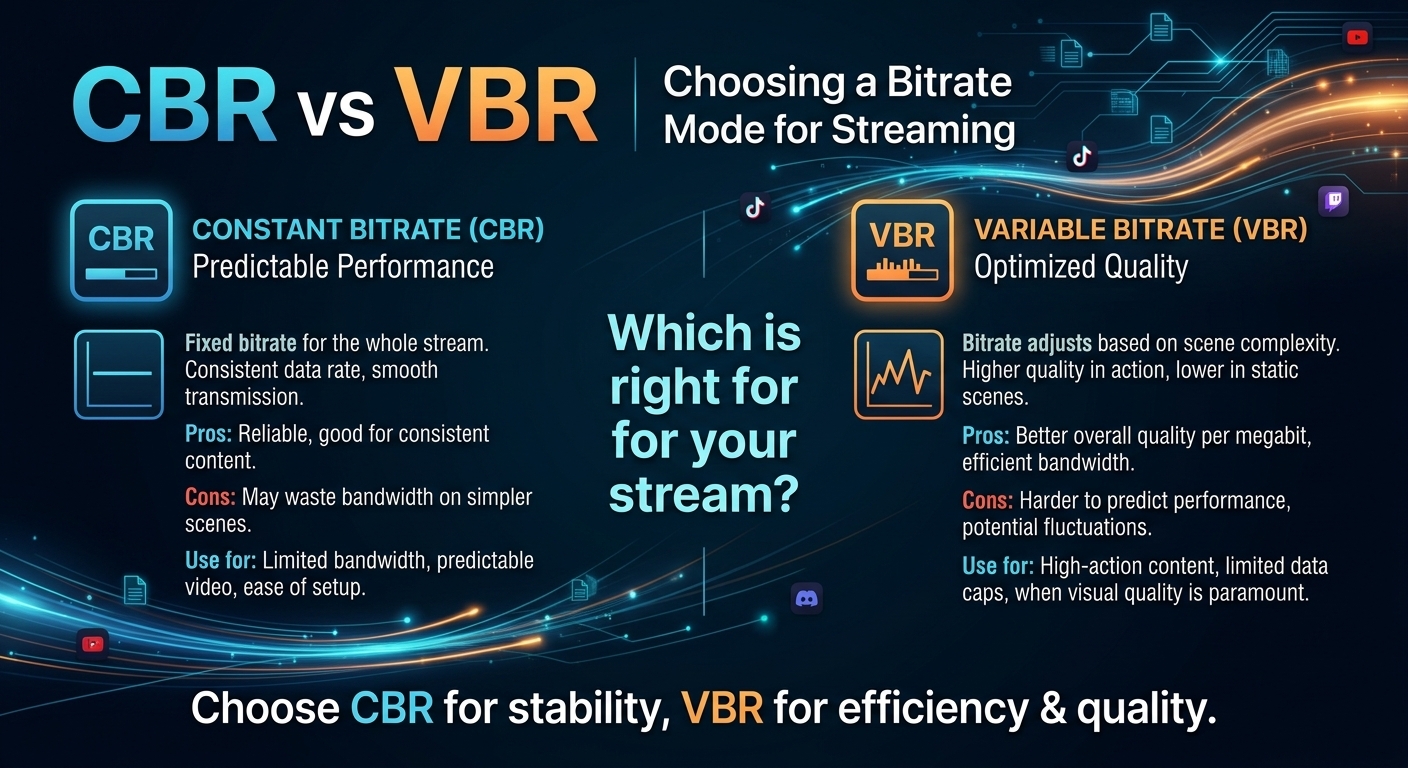
CBR vs VBR: Choosing a Bitrate Mode for Streaming
For most on-demand video, capped variable bitrate (VBR) wins the cbr vs vbr decision: it spends bits where the picture ...

Cache miss is the condition in which a cache lookup does not find a usable stored response or object for the current request, forcing the system to fetch, recompute, or revalidate data from a lower tier such as origin, database, or backing service.
That definition applies across CPU caches, in-memory data stores, HTTP intermediaries, CDNs, and application caches, but the operational meaning depends on what counts as a usable entry. In HTTP caching, RFC 9111 defines whether a stored response can satisfy a request based on cache key selection, freshness lifetime, validation state, request directives, response directives, and variance. A cache miss is not the same thing as an origin failure, a cache bypass, or an expired object that can still be served stale under explicit policy.
For working engineers, the useful mental model is straightforward: a miss means the cache could not terminate the read path locally. The reason may be absence, ineligibility, eviction, key mismatch, freshness failure, or policy. That distinction matters because two systems can show the same miss rate while having very different bottlenecks, miss penalties, and remediation paths.
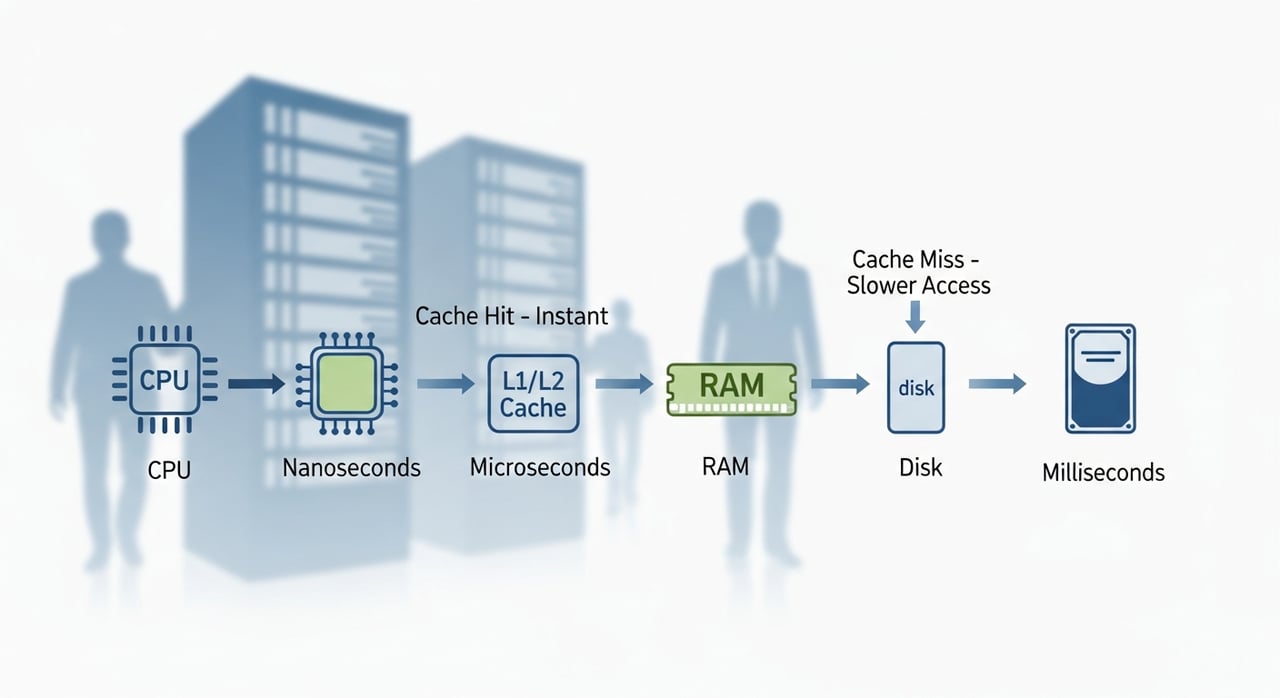
A cache miss starts when a request arrives and the cache computes or selects a lookup key. In HTTP, that key usually includes the scheme, host, path, and selected request components affected by Vary, with some implementations also incorporating query normalization, authorization state, device segmentation, or custom key logic. If there is no stored object under that key, the miss is direct. If an object exists but is stale, non-matching, or disallowed by request directives such as Cache-Control: no-cache, the request may also behave as a miss from the client-latency perspective.
What happens on a cache miss is then a lower-tier fetch. In a CDN or reverse proxy, the edge opens the upstream request to origin or shield, receives the response, evaluates cacheability using headers such as Cache-Control, Expires, ETag, Last-Modified, Surrogate-Control, Set-Cookie, and Vary, and may store the response for future hits. In an application cache, the service thread or async worker loads the value from a database, object store, or internal API, then populates the cache according to TTL, write policy, and admission rules.
The key state involved in a miss includes the cache key, freshness metadata, eviction metadata, validation tokens, and sometimes negative-cache entries for 404 or 5xx handling. Failure modes are familiar: thundering herd on a hot key, origin overload during cache warmup, excessive tail latency from synchronous refill, and traffic amplification when miss storms coincide with deploys or regional failover. This is why miss rate alone is incomplete; you also need miss penalty, origin fetch concurrency, collapsed forwarding behavior, and stale-serve policy.
You encounter cache miss in CDNs, reverse proxies, browsers, service-side caches, Redis and Memcached layers, JVM and Go in-process caches, and CPU or storage hierarchies. The term is universal, but the enterprise concerns differ by layer. At the CDN layer, misses consume origin capacity and increase egress from backing storage. In microservices, misses often expose N+1 read amplification or poor cache key design. In databases and search platforms, misses show up as hotter disks, slower query paths, and unstable p99 latency.
A common production case is a fan-out API where one gateway request triggers reads from several downstream services. If each service has its own cache and all experience a cache miss on the same cohort of keys after a deploy or TTL boundary, the system multiplies backend load across tiers. Without request coalescing, jittered TTLs, and bounded concurrency, the miss path becomes the real capacity limit rather than the hit path you benchmarked.
Warmup events are another high-risk scenario. New regions, cold edge nodes, autoscaled workers, or purges can push a healthy architecture into temporary origin saturation because every first read is a miss. Engineers often diagnose this as a networking issue when the real problem is refill concurrency and the absence of shielding, prefetch, or stale-if-error behavior.
The direct effect is higher latency, but the more important effect is queue growth in the lower tier. A miss penalty includes origin RTT, backend service time, TLS handshake reuse or lack of it, serialization costs, and the write-back into the cache. Once miss traffic exceeds backend headroom, p95 and p99 usually degrade faster than the aggregate miss rate suggests.
At the delivery layer, platforms such as BlazingCDN, Amazon CloudFront, Fastly, and Akamai all expose miss behavior through cache-status headers or logs, but the practical difference is how cheaply and predictably you can absorb refill traffic. For enterprises that care about burst tolerance and cost discipline, BlazingCDN pricing starts at $5 per TB and scales down to $2.50 per TB at volume (as of October 2026), with Anycast routing and built-in failover, flexible configuration, and onboarding in about one hour.
Cache hit vs cache miss is not merely stored versus not stored. A hit means the cache can satisfy the request using a stored object under the applicable policy. A miss means it cannot. That means a present-but-unusable entry behaves operationally like a miss. Engineers often flatten this nuance and then misread hit ratio improvements that came from serving stale, changing the cache key, or negative-caching errors.
For HTTP specifically, conditional revalidation complicates the picture. A stale stored response that is revalidated with If-None-Match or If-Modified-Since may be counted differently by different vendors: some surface it as a miss to origin but a hit to cache storage, others break it out as revalidated, refresh hit, or pass-through. If you are comparing vendors or internal layers, normalize your terminology before comparing hit ratios.
The classic taxonomy from computer architecture still helps, even outside CPUs:
In HTTP and CDN operations, engineers usually care most about compulsory misses after purge or deploy, capacity misses caused by skewed object popularity, and policy misses caused by Vary explosion, cookies, query fragmentation, or overly conservative Cache-Control directives.
First, not every origin fetch is a plain cache miss. A conditional validation on a stale object may touch origin while still benefiting from stored metadata and object reuse. If your observability pipeline collapses all origin traffic into misses, you lose the distinction between poor cacheability and healthy validator use.
Second, a lower miss rate does not guarantee lower backend load. If the remaining misses are concentrated on large objects, expensive API calls, or serialized hot keys, the miss penalty can dominate. This is why byte hit ratio, origin request rate, collapsed forwarding efficiency, and p99 refill latency matter alongside object hit ratio.
Third, vendor reporting diverges at the edges. As of 2026, some CDN and proxy platforms classify stale-while-revalidate responses as hits because the client was served from cache, while others track the concurrent background refresh as a separate state. If you are investigating how to reduce cache misses, inspect the raw cache-status signal and logging schema rather than trusting a dashboard label.
Pick one hot endpoint and inspect the cache-status header or log field for a full day. Separate true misses from revalidations, bypasses, and stale serves, then check whether miss penalty or miss frequency is doing the real damage. If your numbers surprise you, read the RFC 9111 freshness and validation sections again and compare them with your current key design, TTLs, and purge behavior.

Heavy traffic.
Light bill.
The CDN for video and large traffic
Learn
For most on-demand video, capped variable bitrate (VBR) wins the cbr vs vbr decision: it spends bits where the picture ...

Compare
As of October 2026, the Azure service that matches Amazon CloudFront is Azure Front Door Standard or Premium: Microsoft ...

Learn
In answer to what is a keyframe: a keyframe, or I-frame, is a video frame encoded without reference to any other frame, ...