Learn
Best Video Streaming CDN in 2026? 7 Providers
Best CDN for Video Streaming in 2026: 7 Providers Compared A single rebuffer event at the two-second mark costs you 8% ...
In March 2026, a major European streaming platform traced a 340 ms TTFB spike across Southeast Asia to a single misconfigured BGP community string. The fix took eleven minutes. The revenue impact, based on their own telemetry, exceeded €90,000. The routing method that both caused and resolved the incident was anycast. If you operate anything at the edge, understanding what is anycast at the BGP level — not the glossary level — is table stakes. This article gives you the mechanics, the failure modes that matter in production, a decision framework for anycast vs. unicast routing, and the tuning levers that separate a working deployment from a performant one.
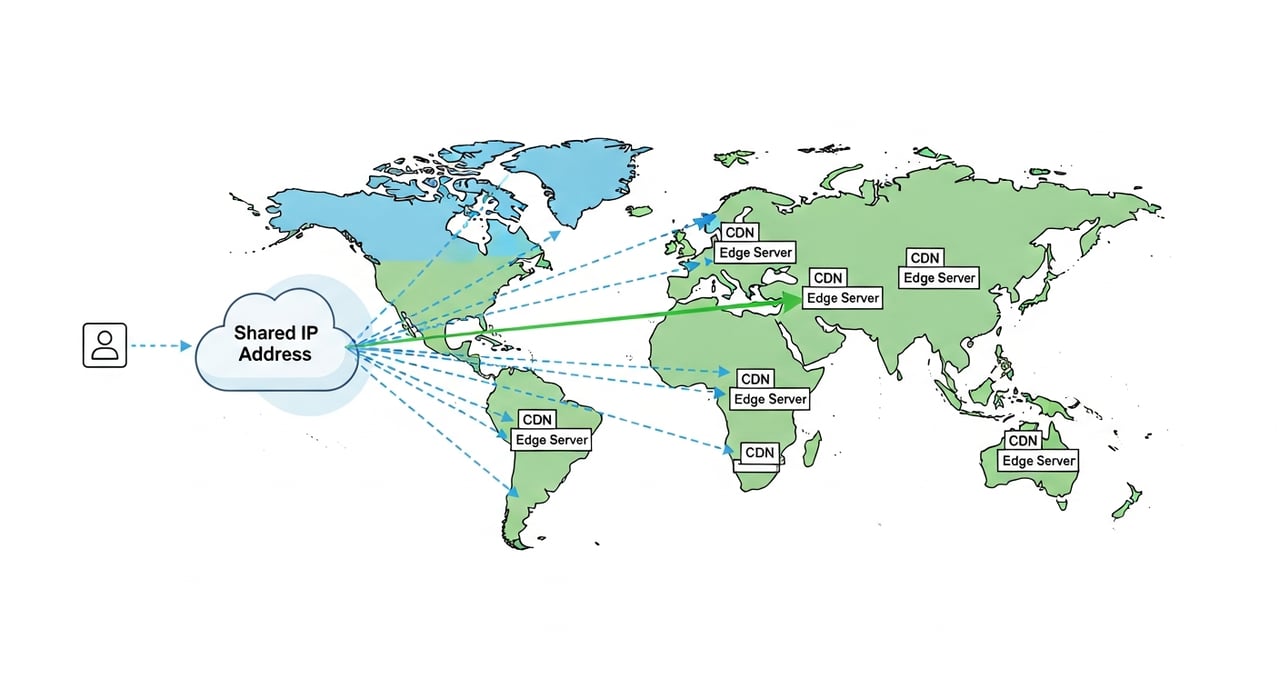
Anycast is a network addressing and routing methodology where an identical IP prefix is originated from multiple autonomous systems or multiple locations within the same AS. When a client sends a packet to that address, the internet's BGP routing fabric forwards it to the topologically closest origin — not necessarily the geographically closest one. The distinction matters enormously.
In a unicast model, one IP resolves to one host. In an anycast network, one IP resolves to many hosts, and BGP's best-path selection algorithm — factoring AS-path length, local preference, MED, IGP cost, and tie-breaking rules — determines where the packet lands. Every router along the path makes this decision independently, using its own RIB. That means two users in the same city, on different ISPs, can reach different anycast endpoints for the same destination address.
The mechanics are straightforward but the operational subtleties are not. Each edge site advertises the same /24 (or shorter) prefix via BGP to its upstream transit providers and peering partners. Routers across the internet propagate these announcements and select the best path per their local policy. Traffic converges on the "winning" announcement for each source network.
As of Q1 2026, the global BGP table exceeds 1.05 million prefixes. Convergence after a withdrawal event typically takes 30–90 seconds for well-connected prefixes, though dampening and MRAI timers can stretch this. For anycast operators, this means failover is not instant — it is "fast enough" for most use cases, but not for stateful protocols mid-flow. More on that below.
What determines which site a user hits:
The practical result: "nearest" in anycast routing is a BGP concept, not a geographic one. A CDN operating an anycast network must continuously measure real-user latency and adjust BGP announcements — prepending paths at sites that are attracting traffic they cannot serve well, and broadening announcements at underutilized sites.
The anycast vs. unicast decision is not binary. Most production CDN architectures use both, layered together.
| Dimension | Anycast | Unicast + DNS-based LB |
|---|---|---|
| Failover speed | 30–90 s (BGP convergence) | TTL-bound (often 30–300 s) |
| Stateful TCP flows | Risk of flow disruption on path change | Stable per-session (same unicast IP) |
| Configuration complexity | Single IP, BGP-level management | Per-region IPs, DNS health checks |
| DDoS absorption | Attack traffic distributed across all sites | Attack concentrates on resolved IP |
| Routing precision | Coarse (BGP best-path) | Fine (GeoIP, latency-based DNS) |
The hybrid approach most CDNs run in 2026: anycast for the initial DNS resolution and for short-lived HTTP transactions (static assets, API calls), with unicast fallback or EDNS Client Subnet steering for long-lived sessions like video streams and WebSocket connections. This avoids the TCP-reset problem that anycast introduces when BGP paths flap mid-connection.
Anycast CDN architectures solve three problems simultaneously. First, latency: by placing the same prefix at dozens or hundreds of locations and letting BGP select the shortest path, the median round-trip time drops. Measurements from public RIPE Atlas probes in Q1 2026 show that well-operated anycast CDNs achieve sub-20 ms median RTT to 80% of global eyeball networks. Second, availability: if a site goes down, its BGP session drops, the prefix is withdrawn, and traffic reconverges to surviving sites without any client-side intervention. Third, operational simplicity: a single IP in DNS records, TLS certificates, and application configs.
Anycast DNS is the most mature use case. All 13 root server letters use anycast, collectively operating over 1,700 instances as of early 2026. Public resolvers from Google and Cloudflare are anycast. But the same pattern now extends deep into CDN request routing: the edge address a browser connects to for HTTPS is increasingly an anycast address, with connection coalescing and QUIC connection migration helping mitigate the stateful-flow problem.
Most anycast explainers skip the failure scenarios. In production, these are the ones that generate pages:
When a path change moves an active TCP flow from one anycast site to another, the receiving site has no state for that connection. It sends a RST. For short HTTP/1.1 transactions, this is rarely noticed. For long-lived HTTP/2 streams, gRPC, or WebSocket connections, it causes user-visible errors. Mitigation in 2026 centers on QUIC's connection ID-based routing and consistent-hashing load balancers at each site that can absorb intra-site path changes.
Peering changes, transit de-provisioning, or a new IXP interconnect can silently shift which users land at which site. If the newly attracted traffic exceeds the site's cache warmth or compute capacity, performance degrades without any alerting unless you are monitoring per-site catchment populations. Best practice: instrument per-site unique-ASN counts and alert on significant deviations from baseline.
Anycast governs the forward path. Return traffic follows the unicast source-address route, which may traverse entirely different networks. A congested return path can degrade throughput even when the forward path is clean. Operators who measure only inbound latency miss this entirely.
Because anycast prefixes are globally announced from many origins, a BGP hijack of that prefix can be harder to detect — it looks like "just another legitimate announcement." RPKI ROV adoption, which crossed 55% of routed IPv4 space in 2026 measurements, is the primary defense.
If you run or evaluate an anycast CDN, these are the variables worth instrumenting:
For teams evaluating CDN providers in 2026, cost at scale is equally critical. BlazingCDN runs an anycast network engineered for high-throughput delivery — media, software distribution, SaaS assets — with volume-based pricing that scales from $4/TB at 25 TB/month down to $2/TB at the 2 PB tier. That pricing, combined with 100% uptime SLAs and the ability to absorb demand spikes without renegotiation, puts it in the same reliability class as Amazon CloudFront at a fraction of the cost. Sony is among its enterprise clients.
Anycast delivers a packet to one of many destinations sharing an address — the topologically nearest one. Multicast delivers a packet to all members of a group simultaneously. They solve fundamentally different problems: anycast is for request routing; multicast is for one-to-many distribution like IPTV.
Anycast works with both. UDP-based anycast (DNS, NTP) is simpler because each query is independent. TCP-based anycast is common in CDNs but requires careful engineering to handle flow disruption during BGP path changes. QUIC's connection-ID mechanism, increasingly adopted in 2026, mitigates this for HTTP/3.
DNS-based load balancing steers at resolution time and is bound by TTL caching. Anycast steers at the network layer continuously — every packet is routed by BGP's current best path. This means anycast reacts to path changes in seconds to minutes, while DNS changes propagate over minutes to hours depending on TTL.
Yes. A route leak can attract traffic intended for one anycast site to an unrelated network, causing a localized outage. RPKI with ROV validation, which now covers over 55% of routed IPv4 space as of 2026, is the primary mitigation. Operators should sign their prefixes and monitor ROA validity.
There is no universal number. What matters is peering density in your users' networks, not raw site count. A CDN with 40 sites at major IXPs and direct peering with top eyeball ASNs will outperform one with 200 sites behind a single transit provider. Measure real-user RTT, not marketing numbers.
Pick one of these and run it against your current CDN configuration before your next architecture review. Query your anycast-addressed edge from RIPE Atlas probes in your top five user markets and record the site each probe reaches — compare that to the site you expect. If more than 15% of probes land at the wrong site, your catchment model is stale and you are leaving latency on the table. Then pull your per-site TTFB percentiles from real-user monitoring and overlay them against the catchment map. The gap between where traffic goes and where it should go is the single highest-leverage optimization most teams have never measured.
Learn
Best CDN for Video Streaming in 2026: 7 Providers Compared A single rebuffer event at the two-second mark costs you 8% ...
Learn
Video CDN Providers Compared: BlazingCDN vs Cloudflare vs Akamai for OTT If you are choosing a video CDN for an OTT ...

Learn
Video CDN Pricing Explained: How to Stop Overpaying for Streaming Bandwidth Video already accounts for 38% of total ...