
<p><img src="https://matomo.blazingcdn.com/matomo.php?idsite=1&amp;rec=1" style="border:0;" alt="">
Skip to content

What Is an Enterprise CDN and Why It Matters for Large Businesses?

More than 50% of users will abandon a website if it takes more than 3 seconds to load, and every extra second can cut conversions by up to 7–10%, according to studies from Google and Akamai. For a large enterprise moving millions of dollars in transactions or ad impressions every day, that is not a UX inconvenience — it is a direct revenue leak. This is exactly where an enterprise CDN stops being a “nice-to-have” and becomes core infrastructure.

In this article, we’ll break down what an enterprise CDN really is, how it differs from a generic CDN plan, and why it has become a strategic layer for global businesses in ecommerce, media, SaaS, gaming, and beyond. Along the way, you’ll see how to evaluate providers, where costs can quietly explode, and how a modern platform like BlazingCDN fits into an enterprise architecture that demands both performance and financial discipline.

What Is an Enterprise CDN?

Most teams first encounter a content delivery network (CDN) as a simple way to speed up a site: static files are cached closer to end users, latency drops, and pages feel faster. That’s the basic CDN story.

An enterprise CDN is the evolution of that idea into a mission-critical platform tailored for large organizations. It’s not just about serving images faster; it’s about giving enterprises predictable performance, control, governance, and economics at massive scale.

Key characteristics of an enterprise CDN

  • Performance guarantees, not best-effort: Formal SLAs with strict uptime and availability commitments, backed by credits and escalation paths.
  • Deep integration capabilities: APIs, CI/CD integration, Infrastructure-as-Code support, and compatibility with complex multi-cloud or hybrid environments.
  • Enterprise-grade security & compliance: Features and processes aligned with requirements like PCI DSS, SOC 2, and data protection regulations.
  • Advanced configuration control: Granular cache rules, traffic routing, origin shielding, and versioned configuration management.
  • Volume-based economics: Pricing and contracts optimized for terabytes to petabytes of traffic, often with committed-use discounts and tailoring by region.
  • Strategic partnership, not just support tickets: Dedicated account managers, solution architects, and technical onboarding for complex migrations.

In other words, an enterprise CDN is an operational backbone — one that marketing, product, security, finance, and engineering all depend on in different ways. As you read further, keep asking yourself: is your current delivery stack treated as such, or is it still operating like a bolt-on plugin?

Why Enterprise CDNs Matter More for Large Businesses

For a small site, a two-second delay is an annoyance. For a global enterprise, it’s a risk factor that shows up in revenue, SLAs, and even stock performance. The larger the organization, the more a CDN choice compounds through every interaction, campaign, and product release.

1. Scale converts milliseconds into millions

Multiple industry reports quantify the financial impact of performance:

  • Google research has shown that when page load time increases from 1 to 3 seconds, the probability of bounce increases by 32%; at 1 to 5 seconds, it jumps by 90% (Think with Google).
  • Amazon famously reported that a 100-millisecond slowdown could cost 1% in sales.

Translate this to an enterprise operating a $500M/year ecommerce channel or a streaming platform selling high-value subscriptions: seemingly tiny latency improvements can add up to millions in saved or unlocked revenue. At that scale, shaving 200–300 ms off global delivery times is not a tuning exercise — it’s an investment with measurable ROI.

Ask yourself: if each 0.1 second of improvement could be correlated with revenue in your analytics, how would that change the priority you assign to your CDN strategy?

2. Enterprise complexity demands more than “one-size-fits-all”

Large organizations rarely have a single website or simple monolith. Instead, they operate:

  • Multiple brands and domains across countries and languages
  • Hybrid stacks mixing legacy on-prem systems, multiple public clouds, and third-party platforms
  • Distributed teams with different needs: marketing, growth, product, compliance, etc.

A generic CDN plan can accelerate static content, but it usually falls short when you need:

  • Fine-grained caching aligned with complex authorization logic
  • Routing that respects geographic, regulatory, or partner constraints
  • Custom edge logic for A/B testing, personalization, or localization
  • Separate environments for staging, QA, and production with controlled rollouts

Enterprise CDNs add these knobs and guardrails. They also integrate with observability stacks and deployment workflows so infrastructure teams treat the CDN as codified, reviewable configuration instead of a collection of manual tweaks.

Is your current CDN configuration documented and version-controlled — or is it living in an old dashboard only two people know how to operate?

3. Reliability and uptime are now board-level concerns

Outages of high-profile digital services regularly make headlines and can cost businesses millions per hour. Gartner has estimated the average cost of IT downtime at $5,600 per minute for large enterprises, though for major online retailers or streaming giants the real figure can be substantially higher.

When your edge delivery fails, you’re not just losing page views. You might be:

  • Breaking SLAs with B2B customers, triggering penalties
  • Interrupting live events or product launches
  • Damaging brand trust in markets you have spent years entering

This is why enterprises expect hardened reliability from their CDN partners. BlazingCDN, for example, is engineered for 100% uptime and delivers stability and fault tolerance on par with Amazon CloudFront, while remaining significantly more cost-effective — a crucial differentiator once traffic and budgets reach enterprise scale.

If your CEO asked tomorrow how resilient your content delivery architecture is under regional failures or sudden surges, would you be comfortable with the answer?

Core Capabilities of an Enterprise CDN

To understand why enterprise CDNs matter, it helps to break down the core capabilities they bring to your stack. Each one maps to a different stakeholder: performance for product teams, control for security, and predictability for finance.

Global acceleration for web, API, and media content

At its core, any CDN aims to reduce latency and offload origin infrastructure. For enterprises, this extends across:

  • Web assets: HTML, CSS, JavaScript, fonts, images, and downloadable content.
  • APIs and microservices: Edge caching of GET responses, route optimization, and intelligent retries.
  • Streaming media: On-demand video, HLS/DASH manifests and segments, VOD catalogs, and companion imagery or subtitles.

The benefits compound: as more traffic is served from the edge, origin servers handle fewer requests, making them more stable and often cheaper to operate.

How much origin traffic could you safely offload today if your CDN gave you more transparent controls and analytics?

Advanced caching logic and content control

Enterprise workloads rarely benefit from aggressive, blanket caching. Instead, they need nuanced rules:

  • Cache by headers: Supporting complex personalization strategies (for example, language, device, or feature flags) while still caching efficiently.
  • Granular TTLs: Setting different lifetimes for static assets, API responses, and rapidly changing content.
  • Negative caching: Temporarily caching 404/500 responses to avoid request storms on fragile origins.
  • Soft purges/instant invalidation: Quickly removing or updating content globally without waiting for TTL expiry.

These mechanisms allow large organizations to move from “best effort” caching to a deliberate caching strategy bound to product behavior and release cycles.

Are your current cache rules actively designed for your business logic, or are you still running largely on defaults?

Security, compliance, and governance

Enterprises care as much about what a CDN blocks as what it serves. Key capabilities include:

  • Transport security: Modern TLS configurations, HSTS support, and certificate management at scale.
  • Policy enforcement: IP restrictions, geo-based rules, and integration with identity providers or token-based access control.
  • Auditability: Detailed logging, traceability of configuration changes, and integration with SIEMs.

Enterprise CDN platforms typically provide role-based access control (RBAC) and approval workflows so that changes to caching or routing conform to internal governance standards instead of being adjusted ad hoc.

If auditors requested a six-month history of edge configuration and access logs, could you furnish it easily today?

Observability, analytics, and capacity planning

At scale, visibility becomes a primary feature. Enterprises need actionable views into:

  • Traffic volume by region, protocol, and content type
  • Cache hit/miss ratios and origin offload percentages
  • Latency distributions and error rates by geography
  • Behavioral patterns around key events, campaigns, or product releases

These metrics inform everything from marketing campaign planning to cloud capacity provisioning. Vendors that expose advanced analytics and API-based access let engineering teams feed that data into custom dashboards, anomaly detection systems, or cost optimization models.

Could you quantify exactly how your CDN impacted last quarter’s infrastructure bill and conversion rate, or is that still an intuition?

Enterprise CDN vs. Standard CDN: What’s the Real Difference?

On paper, many CDNs list similar features: caching, SSL, analytics, APIs. But for large organizations, the differences show up in how these features behave under pressure, integrate with existing workflows, and scale across business units.

Feature and capability comparison

Aspect Standard CDN Enterprise CDN
Support Email or shared support queues, best-effort response. Dedicated managers, 24/7 escalation, proactive monitoring.
SLAs & reliability Generic uptime guarantees, limited compensation. Strict SLAs, contractual uptime targets, financial credits.
Configuration management Basic dashboards, manual changes. Versioned configs, API/IaC support, change review workflows.
Security & compliance Standard TLS, limited enterprise attestations. Advanced policies, deeper logging, support for enterprise audits.
Pricing model Public per-GB pricing, limited negotiation. Custom contracts, volume discounts, regional tailoring.
Customization One-size-fits-all feature sets. Custom rules, edge logic, and environment setups per business unit.

The gap widens when traffic spikes, regulations change, or new products are launched on tight timelines. Enterprises often discover that a low-cost, self-serve CDN plan becomes expensive and inflexible the moment advanced needs appear.

Where on this spectrum does your current provider truly sit once you factor in your incident history and internal processes, not just the marketing page?

Business Impact: How an Enterprise CDN Translates into Measurable Outcomes

Understanding capabilities is helpful, but executives and budget owners care about outcomes. What changes when a large business adopts a strategically chosen enterprise CDN?

1. Improved customer experience and engagement

Faster experiences correlate strongly with better engagement, repeat usage, and satisfaction. Google’s mobile benchmarks have repeatedly highlighted that as load times improve, bounce and abandonment decrease sharply.

  • Ecommerce: Faster category pages, search results, and checkout flows improve conversion rates during high-intent sessions.
  • Media & streaming: Reduced startup delay and rebuffering lower churn and increase viewing time per session.
  • SaaS products: Responsive dashboards and smoother UI interactions directly impact perceived product quality.

An enterprise CDN doesn’t just accelerate assets; it ensures consistent performance across diverse networks and geographies — which is vital when your user base spans both major metros and regions with less predictable connectivity.

If you plotted performance by region, would your users in every strategic market enjoy similar experiences, or are some silently suffering degraded service?

2. Lower infrastructure costs and better origin efficiency

While CDNs are a line item on your budget, a well-optimized enterprise CDN can reduce overall infrastructure spend through:

  • High cache offload: Fewer requests hitting application servers and databases.
  • More predictable load patterns: Smoother traffic at the origin allows tighter autoscaling rules and rightsized instances.
  • Reduced bandwidth costs: Moving traffic from expensive cloud egress or data centers to more cost-efficient CDN transfer.

BlazingCDN, for instance, starts at just $4 per TB ($0.004 per GB), which is aggressively priced compared to many hyperscaler CDNs while still delivering reliability on par with Amazon CloudFront. For high-volume enterprises, the delta between $0.004 and typical public egress rates can easily translate into six- or seven-figure annual savings.

How much room do you have to negotiate your current delivery and egress costs — and what would that free up for product innovation if optimized?

3. Faster time-to-market and safer experimentation

A modern enterprise CDN can accelerate development and release cycles by:

  • Allowing new routes, headers, or caching policies to be deployed via CI/CD
  • Supporting blue-green or canary releases at the edge
  • Enabling regional or segment-specific rollouts without touching application code

This empowers product teams to experiment — new landing pages, localized campaigns, in-app features — while central infrastructure and security teams retain control over the underlying delivery framework.

Could your marketing or product team launch a region-specific experience this week without creating operational risk for the rest of your stack?

Industry-Specific Enterprise CDN Considerations

While the fundamentals of content delivery are consistent, each industry overlays its own constraints and opportunities. Tailoring your CDN strategy to your vertical helps avoid generic architectures that leave value on the table.

Ecommerce and retail

Retailers and marketplaces live and die by conversion rate, average order value, and seasonal peaks. Key considerations include:

  • Peak readiness: Black Friday/Cyber Monday, Singles’ Day, holiday campaigns — all with traffic spikes 5–10x normal.
  • Dynamic + static balance: Product pages with dynamic pricing and inventory but large static sections (images, reviews, recommendations).
  • Security and trust: Strict TLS, consistent performance at checkout, and robust handling of third-party scripts.

An enterprise CDN lets ecommerce teams aggressively cache catalog assets, images, and semi-static content while keeping cart and checkout flows tightly controlled. This reduces origin pressure during flash sales and helps maintain responsiveness when it matters most.

For retailers seeking to improve both margins and reliability, a cost-efficient provider like BlazingCDN offers a strong balance: pricing optimized for high-traffic storefronts, flexible configurations for campaigns, and 100% uptime engineered to keep revenue channels open even during intense seasonal demand.

Is your current CDN architecture explicitly designed for your biggest sales days, or just good enough for average Tuesdays?

Media, OTT, and streaming platforms

Streaming businesses care about three metrics above all: startup time, buffering ratio, and video quality. Netflix, YouTube, and other major players have publicly discussed how even small degradations in these metrics lead to lower viewing times and increased churn.

Enterprise CDN design for media typically focuses on:

  • Efficient video segment delivery: Optimized delivery of HLS/DASH segments close to users.
  • Manifest and API performance: Ensuring that playback manifests, DRM license calls, and metadata APIs remain low-latency under load.
  • Granular traffic steering: Directing viewers to the best-performing infrastructure dynamically.

Media companies looking for a CDN that aligns with their economics and operational tempo can leverage **BlazingCDN’s tailored solutions for media businesses**, combining stable, high-throughput video delivery with aggressive per-TB pricing and fast configuration changes in response to audience surges.

Do your streaming KPIs improve when you stress-test them in emerging markets, or do they reveal fragility that will matter as your audience grows?

SaaS and B2B platforms

SaaS companies face a dual challenge: they must serve reliability-conscious business customers while constantly shipping new features. A sluggish admin panel or analytics dashboard can be the difference between renewal and churn.

SaaS-focused CDN strategies typically emphasize:

  • Low-latency APIs: Reduced network overhead for high-frequency requests.
  • Static asset optimization: Aggressive caching of JavaScript bundles, styles, and dashboard assets.
  • Regional data strategies: Respecting data residency rules and customer preferences for where their traffic is processed.

Modern SaaS vendors increasingly adopt a “CDN-first” mindset: design experiences assuming that the edge is the primary touchpoint, with origins used primarily for business logic and persistent storage.

Are your product and infrastructure roadmaps aligned around what can be offloaded or accelerated at the edge, or is that still an afterthought?

Gaming and real-time experiences

Online and mobile games, along with esports platforms, require both high-throughput content distribution (patches, updates, downloadable content) and low-latency interactions. The experience degrades quickly when either suffers.

Key gaming CDN priorities include:

  • Efficient patch and asset delivery: Serving large files reliably to millions of users across platforms.
  • Consistent latency: Supporting real-time interactions, matchmaking, and live events.
  • Global rollout flexibility: Launching in new regions without completely re-architecting delivery.

Game companies seeking to minimize launch-day issues and reduce distribution costs can leverage enterprise-focused platforms like BlazingCDN, which combines high reliability with pricing tuned for bandwidth-heavy workloads, allowing studios to invest more of their budget in content and live operations rather than pure infrastructure.

Would your next major content update survive a 5x or 10x spike without driving up your cloud bill or creating painful download times for players?

Technical Architecture: How Enterprises Integrate a CDN

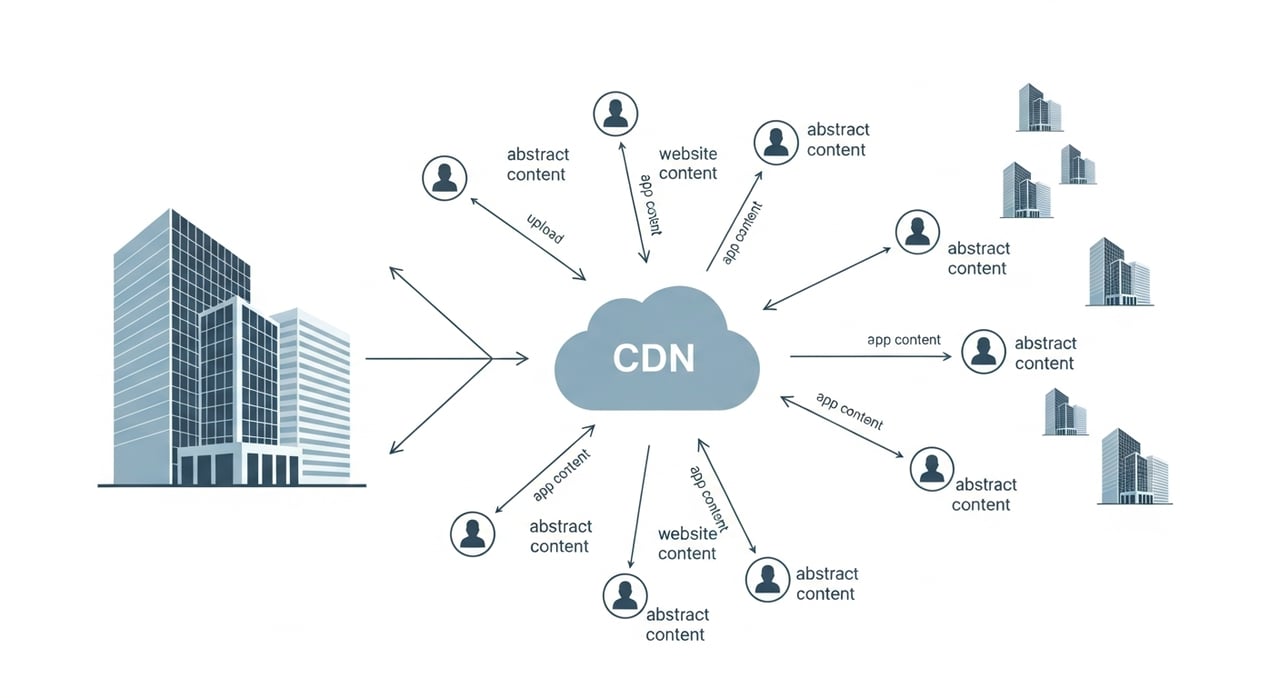
Moving from theory to practice, how does an enterprise CDN fit into a modern architecture? While specific topologies vary, a typical high-level design looks like this:

1. Users, networks, and the last mile

End users access applications via browsers, mobile apps, smart TVs, game consoles, or other connected devices. Networks vary widely: fiber, 4G/5G, corporate WANs, satellite links. The CDN acts as the first optimized entry point into your controlled delivery path.

2. Edge configuration and routing layer

At the edge, CDN configuration governs what happens next:

  • Routing decisions (HTTP/2, HTTP/3, connection reuse)
  • Caching behavior (TTL rules, variations, conditional requests)
  • Header manipulation and basic logic (language detection, redirects)

For enterprises, these rules are typically expressed as versioned configuration “artifacts,” deployed via CI/CD pipelines and subject to review and approval processes.

3. Origins and multi-cloud/hybrid backends

Behind the CDN live application servers, storage buckets, and microservices spread across one or more clouds and sometimes private data centers. Enterprise CDNs support:

  • Multiple origin definitions per service or hostname
  • Failover logic if one origin becomes unhealthy
  • Origin “shielding,” where a primary layer absorbs requests to protect fragile or costly backends

This architecture allows enterprises to modernize backends over time while keeping a stable, high-performing edge posture.

4. Observability, logs, and feedback loops

Logs and metrics from the CDN feed into centralized observability tools. Advanced setups correlate CDN data with application metrics, customer analytics, and financial dashboards. Over time, this allows organizations to:

  • Automatically detect anomalous traffic or performance patterns
  • Optimize cache configurations based on real-world behavior
  • Iteratively refine geography-specific or segment-specific delivery strategies

If your CDN disappeared from your observability graphs for a day, how blind would you be to what users are actually experiencing?

Evaluating Enterprise CDN Providers: What Really Matters

With many vendors in the market, it is tempting to look only at brand recognition or headline performance tests. Enterprises, however, need a more structured evaluation framework.

Performance and consistency

Look beyond average latency. Focus on:

  • Percentile-based metrics: 90th/95th percentile latency and throughput by region.
  • Stability: How performance behaves under peak loads or adverse network conditions.
  • Cold vs. warm cache behavior: Impact on first-time visitors and new content.

Third-party measurement platforms and synthetic testing can provide comparative insights, though internal tests with your own traffic patterns are essential.

Economic model and total cost of ownership

Per-GB pricing tells only part of the story. Consider:

  • Data transfer costs by region, especially for emerging markets
  • Charges for features such as logs, image optimization, or edge logic
  • Contract terms, minimum commits, and overage penalties

“Sticker price” CDNs can become unexpectedly costly when stacked with cloud egress and add-on fees. A provider such as BlazingCDN deliberately positions its pricing — from $4 per TB — to be predictable and competitive for enterprises that push massive volumes but still demand cloud-grade reliability.

Operational fit and usability

A technically powerful CDN that is difficult to manage will slow teams down. Evaluate:

  • API coverage and documentation quality
  • Integration options with Terraform, Ansible, or other IaC tools
  • Role-based access controls and audit trails
  • Learning curve for network and non-network teams alike

Can your team treat CDN configuration as code and integrate it into existing workflows, or are changes still manual and siloed?

Support, partnership, and roadmap alignment

Finally, enterprises need to understand:

  • How quickly support responds under real-world critical incidents
  • What proactive guidance and best practices the vendor offers
  • How often the platform evolves and whether it aligns with your multi-year roadmap

Ask for references, review real incident histories when possible, and ensure that your CDN provider is willing to act as a strategic partner rather than merely a commodity supplier.

If your traffic doubles or your architecture changes significantly in two years, will your chosen CDN be an enabler or a constraint?

BlazingCDN as a Modern Enterprise CDN Choice

Enterprises today are increasingly looking for CDN providers that offer the reliability and fault tolerance of the largest hyperscale services, but without the escalating, opaque pricing that often accompanies them. This is where BlazingCDN stands out.

Designed from the ground up for modern digital businesses, BlazingCDN delivers 100% uptime and fault tolerance on par with Amazon CloudFront, while maintaining a much more cost-effective model — starting at $4 per TB ($0.004 per GB). For high-volume enterprises in ecommerce, media, SaaS, and gaming, that combination of resilience and low unit cost makes it an attractive alternative, especially when budgets are scrutinized but performance expectations keep rising.

Beyond raw pricing, BlazingCDN emphasizes flexibility and rapid scaling: enterprises can tailor configurations to each product line or region, roll out changes quickly as demands shift, and avoid long, rigid contract lock-ins that don’t match agile product cycles. It is already recognized as a forward-thinking option by companies that value both reliability and efficiency — the same profile as some of the world’s leading consumer and entertainment brands — and it fits seamlessly into complex technology stacks via APIs and automation-friendly tooling.

If you are comparing providers side by side, the **BlazingCDN CDN comparison** resource is a practical starting point to benchmark performance, features, and cost structures against other major players in the market.

Moving Forward: Turn CDN from a Line Item into a Strategic Lever

For large businesses, an enterprise CDN is no longer just an infrastructure choice; it is a strategic lever that touches revenue, customer experience, security, and cost control all at once. The question is not whether you use a CDN, but whether you are using the right one in the right way.

  • Are you measuring performance and offload with enough granularity to make informed decisions?
  • Do your product and infrastructure teams treat the edge as a first-class part of your architecture?
  • Have you pressure-tested whether your current provider will still be the right fit when your traffic, geography mix, or regulatory landscape changes?

If any of those answers feel uncertain, this is the moment to re-evaluate your enterprise CDN strategy and explore options that align better with both your technical ambitions and budget realities.

Ready to turn your CDN from a passive cost center into a competitive advantage? Share this article with your engineering and product leaders, start a conversation about your current bottlenecks, and then take the next step: map your requirements against a modern, cost-effective platform like BlazingCDN and see how much headroom you can unlock in performance, reliability, and spend — before your next big launch puts your delivery architecture to the test.