
Learn
Lossy vs Lossless Compression: Images, Video and Audio
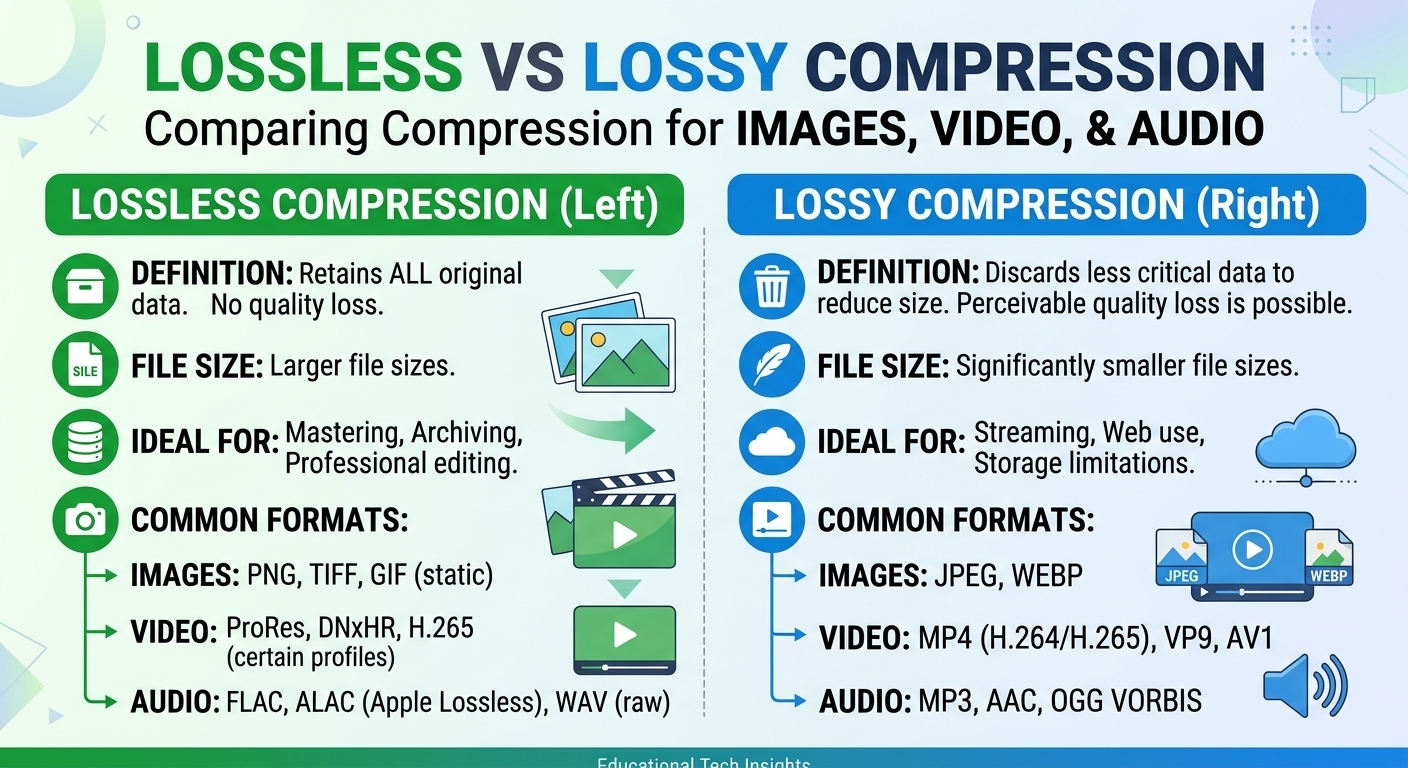
Lossy vs lossless compression comes down to one trade: lossless compression rebuilds every original bit and typically ...

A 200 ms latency penalty can cut conversion rates, but the more interesting number for architects is usually not p50. It is p95 and p99 after a cache miss, during a deploy, while TLS handshakes pile up and origin concurrency limits get hit. That is where the practical answer to what is a CDN stops being a glossary entry and becomes an architecture decision: reduce distance, absorb request fan-out, collapse duplicate fetches, and keep origin failure from turning into a user-visible outage. Simply adding more web servers or buying larger instances does not fix tail latency, cross-region RTT, or egress economics.
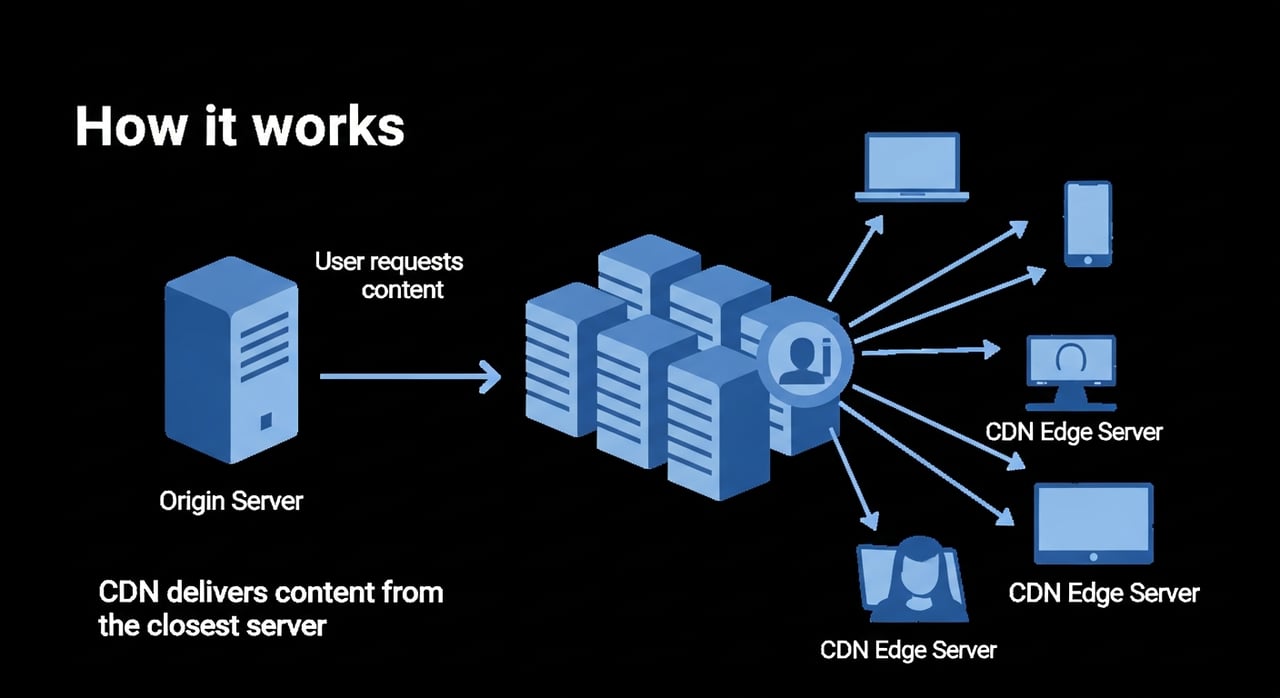
For engineers, CDN meaning is easiest to frame as a distributed request execution and cache control layer that sits between clients and origin, then changes the shape of load. A content delivery network does not merely serve static assets from somewhere closer. It rewrites your latency distribution, reduces origin connection churn, changes your failure domains, and often becomes the place where cacheability policy is either made explicit or exposed as accidental.
When people search what is a CDN, they usually want one of two answers. The first is conceptual: why put another system in the path at all. The second is operational: what does a CDN do for a website when traffic surges, assets are revalidated, byte-range requests show up, or personalized HTML interacts with long-lived objects and cache keys become unstable.
A request lands at the CDN, which evaluates the cache key, request method, headers participating in variation, object freshness, and any policy around stale serving or revalidation. On a hit, the response terminates there. On a miss, the CDN opens or reuses an upstream connection to origin or shield, applies coalescing if supported, fetches the object, stores it according to policy, and serves downstream. Every one of those steps affects p95 latency and origin cost.
The useful mental model is that the CDN turns many user-space request streams into a smaller, more predictable set of origin fetch streams. Good deployments are built around that compression ratio. Poor deployments accidentally defeat it with fragmented cache keys, cookie variance, or query-string entropy introduced by analytics and feature flags.
If your first answer to rising global traffic is regional origin replication plus autoscaling, you still pay for long-path misses, handshake amplification, cache warmup after deploys, and bursty fan-out against backing stores. If your answer is client-side optimization alone, you improve transfer efficiency but do little about path length and origin collapse during synchronized demand spikes. This is why CDN for websites remains a systems problem, not just an asset-hosting choice.
There is no single benchmark for how does a CDN work because workloads differ: small immutable assets, large software downloads, HLS and DASH segment traffic, API GETs with short TTLs, and mixed dynamic HTML all stress different parts of the stack. Still, a few public datasets are useful for calibration.
Cloudflare Radar and APNIC measurements consistently show that network path quality is highly geography-dependent, especially for mobile-heavy regions and cross-continent routes as of 2025. Last-mile packet loss in the low single digits can be enough to noticeably inflate application-layer tail latency under congestion, even when p50 looks stable. QUIC helps with head-of-line behavior and connection migration, but it does not repeal distance or origin bottlenecks.
For video delivery, Conviva and other public streaming analyses have repeatedly shown that startup delay and rebuffer sensitivity are nonlinear. A few hundred extra milliseconds at session start may be tolerable, but elevated tail behavior during segment fetches drives abandonment fast. For object delivery, HTTP caching behavior from RFC 9111 remains the baseline, yet many production stacks still underuse stale-while-revalidate and stale-if-error despite the clear operational upside during origin instability.
| Metric | Rule-of-thumb range | Operational implication |
|---|---|---|
| Inter-region RTT | 40–180 ms depending on path | Miss penalty is dominated by physics before origin compute even starts |
| Cache hit ratio for well-versioned static assets | 95%+ achievable | Origin egress and request rate collapse dramatically when keys are stable |
| Cache hit ratio for mixed HTML/API/static estates | 40–85% depending on policy | Most gains come from making variation explicit, not from adding servers |
| Origin request collapse during hot-object spikes | 10x–1000x reduction in duplicate fetches when coalescing works | Protects databases, object stores, and app tiers from synchronized demand |
| Packet loss threshold worth watching | >1% sustained on user paths | Tail latency rises fast, especially for larger transfers and retransmission-heavy flows |
| Commodity cloud egress | Often an order of magnitude above specialized CDN pricing | Architecture choices strongly affect $/GB at scale |
Those ranges are not vendor benchmarks. They are planning assumptions derived from public Internet measurement, HTTP caching standards, and common production patterns. If you are trying to answer do small businesses need a CDN, the latency case depends on audience geography and page weight, but the cost case often appears sooner than teams expect once assets, software artifacts, or media files start moving meaningful volume.
Two references worth refreshing before tuning anything are RFC 9111 for HTTP caching semantics and APNIC's ongoing measurement work on user-visible Internet performance: RFC 9111 and APNIC Blog.
If you want a practical answer to what is a CDN, look at where load is removed and where state is introduced. The content delivery network inserts a distributed cache hierarchy, transport termination layer, request normalization layer, and policy engine between clients and origins. Those are architectural moves, not just network geography moves.
That sequence sounds ordinary until traffic gets ugly. Then details matter: whether stale can be served during revalidation, whether byte-range requests are collapsed or fragmented, whether query normalization keeps signatures intact while collapsing irrelevant variance, whether cache fill competes with user traffic, and whether purge semantics are exact enough to avoid broad invalidation.
| Capability | Web hosting / origin stack | CDN layer |
|---|---|---|
| Authoritative content state | Primary source of truth | Replicated and policy-driven copy |
| Latency optimization | Limited by region placement | Reduced path length for hits and fewer expensive misses |
| Request fan-out control | Directly exposed to user demand | Absorbs and collapses duplicate fetches |
| Egress economics | Typically higher cloud egress rates | Designed for lower $/GB distribution economics |
| Failure isolation | Origin faults are user-visible quickly | Stale serving and cached hits mask parts of origin failure |
| Policy control | App and server config centric | Cache key, TTL, revalidation, purge, routing policy |
This is also why saying a CDN is just for static files is outdated. Modern deployments use the layer for package repositories, game patches, software binaries, private asset distribution, media segments, image variants, and selected cacheable API GETs with explicit consistency trade-offs.
For teams that want to avoid CloudFront-class spend, BlazingCDN fits the architecture discussed here well: Anycast routing with built-in failover, flexible configuration, and pricing starting at $5 per TB (as of October 2026). For enterprises and large corporate clients, that changes the viability of pushing more traffic through the CDN instead of leaving expensive long-tail distribution on origin. If you are evaluating providers on cost structure and delivery behavior rather than branding, start with BlazingCDN's CDN comparison.
By 2026, the selection criteria that matter most are rarely the marketing bullet points. The hard questions are about cache correctness, observability, purge semantics, origin protection under miss storms, pricing predictability, and how much operator effort is required to make the system do the obvious thing.
That last point is where CDN benefits become concrete for finance and platform teams at the same time. A delivery stack that is technically sound but makes aggressive caching uneconomical is self-defeating. The opposite is also true: cheap egress with weak policy controls often creates hidden compute cost at origin because teams cannot safely increase cacheability.
The fastest way to waste a CDN is to leave cacheability implicit. If your app team cannot answer why an object is cacheable, how it is keyed, and how it is purged, your hit ratio is probably lower than your dashboards suggest. Below is a practical NGINX-origin pattern for static assets, cache-friendly HTML shell behavior, and API responses that should never be stored accidentally.
server {
    listen 443 ssl http2;
    server_name www.example.com;

    # Fingerprinted static assets: cache forever, immutable
    location ~* ^/assets/.+\.[a-f0-9]{8,}\.(js|css|png|jpg|svg|woff2)$ {
        add_header Cache-Control "public, max-age=31536000, immutable" always;
        add_header Vary "Accept-Encoding" always;
        try_files $uri =404;
    }

    # HTML shell: short TTL at edge, allow revalidation and stale serving
    location = / {
        add_header Cache-Control "public, max-age=60, stale-while-revalidate=30, stale-if-error=600" always;
        add_header Vary "Accept-Encoding" always;
        etag on;
        try_files /index.html =404;
    }

    # API: explicit no-store unless you have a reviewed GET caching policy
    location /api/ {
        add_header Cache-Control "no-store" always;
        proxy_pass http://app_backend;
        proxy_http_version 1.1;
        proxy_set_header Connection "";
    }

    # Large downloads: allow ranges, keep metadata stable
    location /downloads/ {
        add_header Cache-Control "public, max-age=86400, stale-if-error=600" always;
        add_header Accept-Ranges "bytes" always;
        etag on;
        try_files $uri =404;
    }
}
If you are validating a CDN rollout, do not stop at curl -I. Test freshness transitions, conditional requests, and stale behavior explicitly.
# First fetch: inspect cacheability headers
curl -sI https://cdn.example.com/assets/app.7d9e2c1a.js

# Revalidation path for HTML
curl -sI https://cdn.example.com/
ETAG="<etag-from-response>"
curl -sI -H "If-None-Match: $ETAG" https://cdn.example.com/

# Query-string normalization test
curl -sI "https://cdn.example.com/assets/app.7d9e2c1a.js?utm_source=test"

# Range request for large object
curl -sI -H "Range: bytes=0-1048575" https://cdn.example.com/downloads/release.iso
Those metrics answer the operational version of what does a CDN do for a website. They tell you whether the CDN is actually reducing expensive origin work or simply adding another hop and a bill.
This section matters more than the feature list. Every CDN deployment introduces state outside origin, and that state has consistency, invalidation, and observability consequences.
The most common failure mode is not low traffic. It is accidental uncacheability. Cookies that do not matter, marketing query strings, locale headers, A/B identifiers, and auth remnants can explode the key space. You get healthy request counts and poor byte hit ratio at the same time, which hides origin pain until a traffic spike arrives.
Short TTLs are not a substitute for good invalidation. If your frontend deploys every few minutes but your purge model is broad and slow, you will either serve stale assets, over-purge and tank hit ratios, or both. Fingerprinting immutable assets solves part of this, but HTML shells, manifests, and API-discovered resources still need a coherent rollout plan.
Software downloads, media archives, and resume-capable clients produce partial fetch patterns that can either work beautifully or destroy efficiency. Some stacks cache ranges poorly, causing repeated origin reads on hot large files. Others over-cache fragmented ranges and waste memory or disk. Test this before shipping game patches or installers through the path.
A CDN is not an excuse to cache dynamic HTML blindly. If personalization leaks into cacheable responses through cookies or edge key mistakes, you have a correctness incident. The right pattern is explicit segmentation: anonymous cacheable shells, personalized fragments fetched separately, or carefully scoped API caching where consistency windows are understood and accepted.
Teams often track edge hit ratio but fail to correlate it with shield hit ratio, origin connection reuse, and miss latency distribution. A nominally good 85% hit ratio can still be operationally poor if the remaining 15% contains synchronized misses against your highest-cost endpoints. Tail misses matter much more than mean misses.
Low headline pricing can be offset by request fees, regional multipliers, log charges, or expensive purge APIs. High pricing can also force bad architecture by discouraging delivery of large binaries and media, pushing traffic back to cloud storage and reintroducing origin egress pain. This is one reason cost-aware teams increasingly compare providers on sustained TB-scale delivery economics, not only on feature matrices.
For large media and software distribution workloads, a provider that remains stable under bursts while preserving favorable egress economics materially changes design choices. BlazingCDN is notable here because it combines Anycast routing with built-in failover and materially lower delivery cost than premium hyperscaler-branded options. That trade-off matters to engineering leaders deciding whether to front all distribution traffic through CDN rather than splitting by asset class.
The generic answer to do small businesses need a CDN is not always yes. The engineering answer is that a CDN fits whenever user geography, object weight, burstiness, or egress cost make origin-direct delivery a bad shape for your traffic.
If your workload is mostly personalized writes and low-cacheability reads, the CDN may still help with static assets and downloads, but it will not fix poor application data locality. If your problem is database lock contention or chatty backend fan-out, the cure is elsewhere.
Run a 7-day cache audit before changing providers or architecture. Instrument edge hit ratio, byte hit ratio, revalidation rate, and origin p99 TTFB by path class: immutable assets, HTML, API GET, downloads, and media segments. Then answer one uncomfortable question: which 5% of requests create 80% of your origin pain, and are they truly uncacheable or just badly keyed?
If you want a useful benchmark, pick one representative object from each class and test cold miss, warm hit, conditional revalidation, and range fetch from three user regions. Most teams discover that their answer to what is a CDN was too abstract. The real answer is in the miss path, the key design, and the bill.

Heavy traffic.
Light bill.
The CDN for video and large traffic
Learn
Lossy vs lossless compression comes down to one trade: lossless compression rebuilds every original bit and typically ...
Pricing - Pricing & Costs
The CloudFront vs S3 decision depends more on object size than on traffic volume. At a 500 KB average response, 100 TB ...
Learn
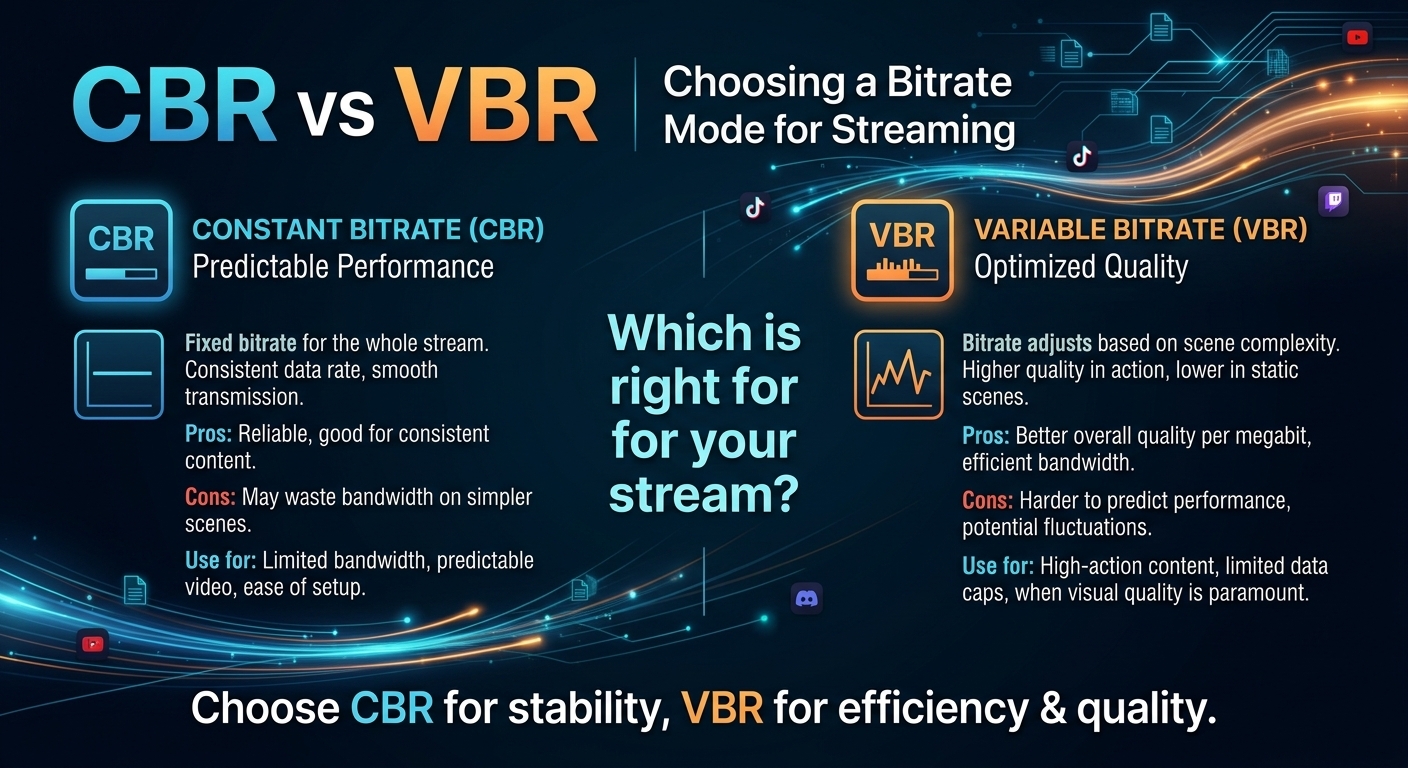
For most on-demand video, capped variable bitrate (VBR) wins the cbr vs vbr decision: it spends bits where the picture ...