<p><img src="https://matomo.blazingcdn.com/matomo.php?idsite=1&amp;rec=1" style="border:0;" alt="">
Skip to content

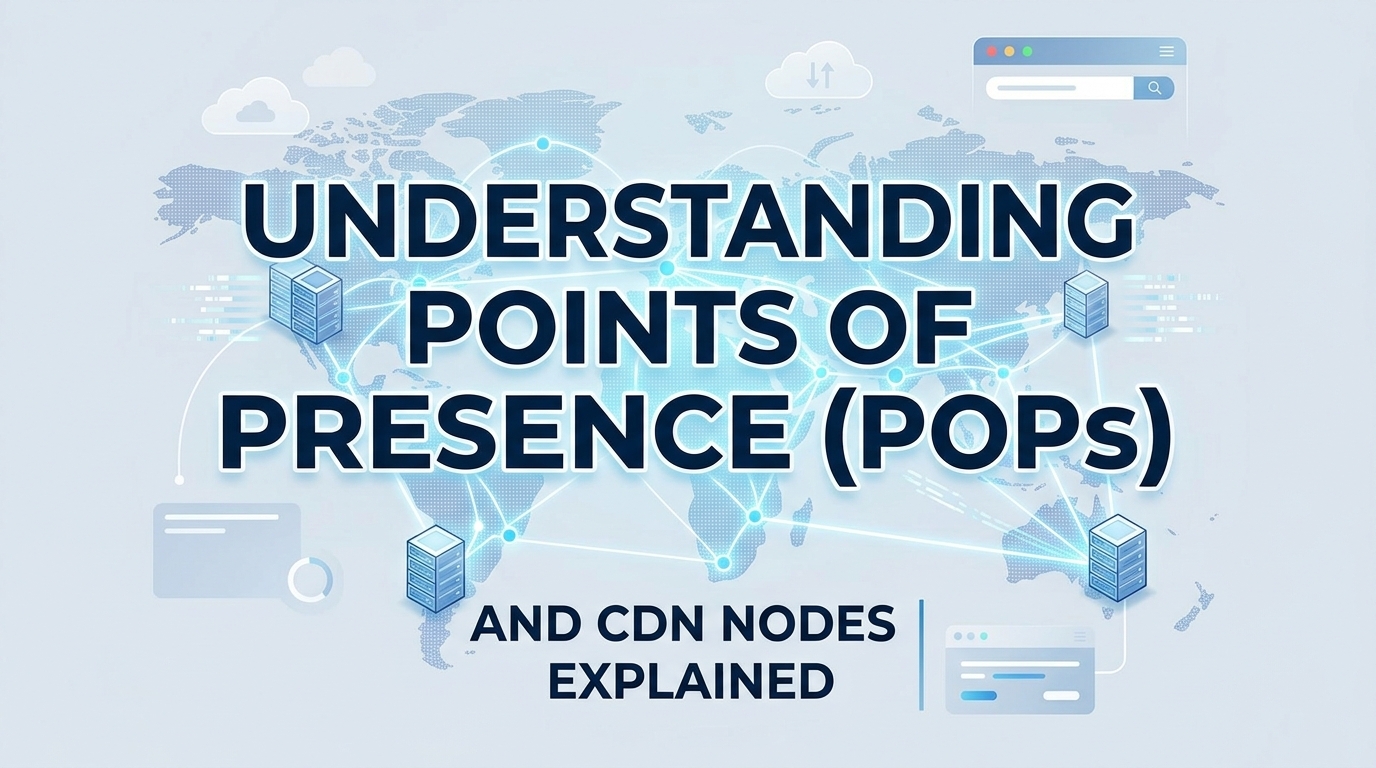
What Are CDN Nodes and Points of Presence (PoPs)?

When the BBC streamed the 2018 World Cup online, traffic spiked to over 3.2 terabits per second—and viewers still expected replays and live action to load in under a second. That kind of experience is only possible because thousands of invisible machines, called CDN nodes and Points of Presence (PoPs), quietly move packets closer to every screen on earth.

Users do not care what those machines are called; they just leave when things feel slow. Google found that 53% of mobile site visits are abandoned if a page takes longer than three seconds to load, and even a 100-millisecond delay can hurt conversion rates and engagement.1 Behind those lost visits are very real infrastructure choices: where you place CDN PoPs, how your nodes are configured, and how intelligently traffic is routed.

Yet for many technical leaders, “CDN node”, “edge server”, and “PoP” are fuzzy buzzwords rather than concrete architectural components. If you are scaling a video platform, SaaS product, or global e-commerce store, that fuzziness can translate directly into unnecessary latency—and wasted CDN spend.

This article demystifies CDN nodes and Points of Presence in practical, infrastructure-level terms. You will see how they are built, how they behave under real traffic, how different industries use them, and how to decide what kind of PoP footprint your business actually needs.

As you read, keep one question in mind: if a traffic spike 10x bigger than your last Black Friday hit tomorrow, would your current CDN edge architecture absorb it—or expose it?

What Is a CDN Really Doing Between Your User and Your Origin?

At a high level, a Content Delivery Network (CDN) is a geographically distributed layer that sits between your end users and your origin infrastructure (web servers, storage, APIs). Its job is simple to describe but hard to execute at global scale: deliver content quickly, reliably, and efficiently from the closest possible location.

Instead of every request traveling all the way to your origin data center, the CDN terminates connections at edge locations—its PoPs. Inside each PoP are multiple CDN nodes: caching servers, routing systems, TLS terminators, and control components that coordinate how traffic flows and how content is stored.

Modern CDNs do not just cache images or JavaScript. They accelerate APIs, handle large file downloads, optimize video delivery, terminate TLS, and enforce rules at the edge. For a typical enterprise website or application, a majority of HTTP(S) requests will never reach the origin when the CDN is properly tuned—saving both latency and infrastructure cost.

Before we dig into the internals of CDN nodes and PoPs, ask yourself: which percentage of your own traffic still hits origin today, and is that because of business logic—or because your edge architecture has not been pushed as far as it could be?

CDN Nodes vs Points of Presence (PoPs): Untangling the Terminology

Engineers and vendors often use “edge server”, “CDN node”, “PoP”, and “edge location” interchangeably, which leads to confusion when you are planning capacity or comparing providers. In practice, they refer to related but distinct layers of the CDN architecture.

What is a CDN PoP?

A CDN Point of Presence (PoP) is a physical presence in a specific metro area or data center campus. Think of it as a small data center footprint that contains racks of CDN hardware, network equipment, and connectivity to local ISPs and carriers. A single PoP may contain dozens or hundreds of CDN nodes.

PoPs are strategically placed where user demand, internet exchange density, and network economics intersect—for example, Frankfurt, Singapore, São Paulo, or Ashburn in the U.S. Each PoP serves traffic from nearby end users, based on routing policies and BGP announcements from the CDN.

What is a CDN node?

A CDN node is an individual server or virtual instance participating in the CDN’s distributed architecture. Different CDNs use slightly different internal roles and naming, but common node types include:

  • Edge cache nodes that store and serve content directly to users.
  • Mid-tier or regional cache nodes that aggregate traffic from several PoPs and reduce load on origin.
  • Origin shield nodes that act as a protective cache layer directly in front of your origin.
  • Control and management nodes that handle configuration propagation, statistics collection, and health monitoring.

Multiple CDN nodes live inside each PoP, and they cooperate to handle traffic, synchronization, and failover. When you hear a vendor mention “adding more edge servers” in a region, they are effectively scaling the number of nodes within existing or new PoPs.

Node roles inside and across PoPs

To make this more concrete, here is a simplified view of how different types of CDN nodes relate to PoPs and to your origin infrastructure:

Node Type Typical Location Primary Role Impact on Performance & Cost
Edge cache node Inside local PoP, close to users Serve cached content, terminate TLS, apply rules Reduces last-mile latency; highest impact on user-perceived speed
Mid-tier/regional cache Regional data centers Aggregate cache for several PoPs Improves cache hit ratio, reduces origin bandwidth and egress costs
Origin shield node One or few locations near your origin Single choke point for cache misses Protects origin during traffic spikes; simplifies origin scaling
Control/management node Core or regional facilities Configuration, routing, health checks, analytics Enables fast config changes, traffic steering, and observability

When evaluating CDNs, it is not enough to ask “how many PoPs do you have?” You also need to understand how nodes are layered and how cache topology is designed. A smaller number of well-placed PoPs with intelligent multi-tier nodes can outperform a larger but poorly architected footprint.

The next time a provider pitches their “global network”, will you know what questions to ask about the actual nodes inside those PoPs—and how they map to your traffic profile?

How a PoP Handles a User Request in a Few Milliseconds

Every time a user taps “Play” on a video or clicks “Checkout”, a chain of events unfolds across DNS, routing, and multiple CDN nodes. Understanding that sequence helps you debug issues and choose the right provider.

Step 1: DNS and Anycast steer the user to a PoP

When a browser needs to load your site, it first resolves your domain via DNS. For a CDN-enabled domain, DNS typically returns an Anycast IP address—an IP announced from many PoPs around the world. The internet’s routing system (BGP) then directs the request to the “closest” PoP according to network topology, not necessarily geography.

This is where a CDN’s peering strategy and presence at key internet exchanges matter. Two users in the same city can hit different PoPs depending on their ISP and how well the CDN is interconnected. If your audience is concentrated in specific regions, ensuring your CDN is well-peered with dominant ISPs there can shave tens of milliseconds off round-trip times.

Step 2: Edge nodes terminate the connection

Once the packet reaches the PoP, a load balancer or routing layer sends it to a particular edge node. That node terminates the TCP and TLS handshake, applies any configured rules (redirects, header rewrites, access controls), and decides how to satisfy the request.

Because TLS handshakes are expensive, CDNs invest heavily in optimized crypto libraries, session resumption, and HTTP/2 or HTTP/3 support at their edge nodes. For high-concurrency workloads like live sports streaming or large SaaS applications, poorly tuned TLS at the edge can become a bottleneck before your origin ever sees a packet.

Step 3: Cache lookup and potential origin fetch

The edge node checks its local cache for the requested object. If the object is present and fresh according to cache headers or edge rules, it can respond immediately. If not, the node may:

  • Request the object from a regional or mid-tier cache node.
  • Forward the request directly to an origin shield node.
  • Go straight to your origin, depending on configuration.

Each additional hop adds latency, but also improves cache efficiency and reduces origin load. For high-traffic assets—HLS/DASH segments, popular images, API responses—most of your users should be served directly from edge cache nodes once the cache is warmed.

Step 4: Response optimization at the edge

Before sending data back to the user, the edge node may compress content (Gzip/Brotli), re-encode images, coalesce multiple small requests, or apply security controls. Some CDNs can run edge logic (sometimes called serverless or workers) that customizes responses per user or per geography without touching your origin.

The upshot is that modern PoPs are not passive caches; they are programmable gateways. Your ability to shape behavior there—caching rules, TTLs, variations per path or header—directly influences both performance and infrastructure cost.

Looking at your current setup, do you know which share of your latency budget is lost before the request ever leaves the user’s ISP, and which is inside the CDN PoP itself?

The Different Types of CDN Nodes Inside a PoP

Not all CDN nodes inside a PoP are created equal. To design or choose the right architecture, it helps to understand the key roles you will typically find in a mature CDN deployment.

Edge cache nodes: your workhorses

Edge cache nodes do most of the heavy lifting. They store hot objects on SSDs or NVMe, serve them to users at line rate, and handle the majority of TLS connections. Modern nodes can push tens of gigabits per second each when properly tuned, with thousands of concurrent connections.

For content-heavy businesses—media, gaming, software distribution—edge cache node density matters as much as the number of PoPs. When traffic spikes, you want many servers in each PoP sharing the load, not a thin footprint that collapses under peak concurrency.

Mid-tier and regional nodes: scaling beyond a single PoP

Mid-tier or regional nodes typically sit in larger data centers that are more economical for bulk bandwidth. They do not talk to end users directly; instead, they aggregate misses from several PoPs in a region. This reduces origin egress, smooths out flash crowds, and improves cache hit ratios for moderately popular content.

For example, if your video platform suddenly has a viral clip across Europe, mid-tier nodes in Frankfurt or Amsterdam help ensure each segment is fetched from origin only a handful of times, even if millions of viewers across many PoPs start watching within minutes.

Origin shield nodes: protecting the source of truth

Origin shield nodes (sometimes called “shielding caches”) act as a final protective layer in front of your origin. Instead of every PoP requesting directly from origin on a cache miss, they all go through one or a few shield locations. This centralizes cache misses, improves hit ratios for cold objects, and significantly reduces origin connection churn.

Shields are particularly useful for monolithic origins, legacy application servers, or storage buckets that cannot easily auto-scale. Correctly configured, they can be the difference between a stable Black Friday and an origin meltdown when marketing launches a successful campaign.

As you map your own architecture, have you explicitly planned how many tiers of nodes your content should pass through—or are you relying on a provider’s defaults that may not match your traffic patterns?

Global PoP Strategy: How Many CDN Nodes Do You Really Need?

One of the most common questions infrastructure leaders wrestle with is, “How many PoPs are enough?” The truthful answer is: it depends less on the raw number a vendor quotes you, and more on where those PoPs are, how they are built, and who your users are.

Start with your user geography and latency budget

Plot your current user base and target growth regions on a map. Then, for each cluster, define an acceptable end-to-end latency budget—for example, 100 ms for interactive SaaS, 50 ms for competitive gaming, 300–500 ms for VOD streaming startup time.

From there, examine which metro areas and carrier networks matter most. A PoP in a capital city will not help your users if your CDN lacks strong peering with the ISPs that actually serve those regions. This is where working closely with your provider (and running real-world probes) beats reading marketing maps.

Content type drives PoP and node requirements

Different workloads place very different demands on CDN nodes and PoPs:

  • Static websites and marketing pages: Almost entirely cacheable; benefit from broad PoP coverage but modest node density.
  • Media streaming (HLS/DASH): Requires high throughput and steady egress; benefits from strong mid-tier caching for segments and manifests.
  • Transactional SaaS and APIs: Mixed static and dynamic content; sensitive to latency and tail latency; benefits from fast TLS, connection reuse, and edge logic.
  • Online gaming: Extremely latency-sensitive; often pairs CDNs for asset delivery with separate real-time networking stacks.

A media company might prioritize node capacity and bandwidth per PoP in key regions, whereas a SaaS provider may care more about the number of distinct PoPs close to business hubs and cloud regions.

Real-world example: streaming failures as PoP design lessons

High-profile streaming events have repeatedly shown how critical PoP architecture is. During the 2017 Mayweather vs McGregor fight, multiple pay-per-view streaming services suffered outages and severe buffering, triggering refunds and public backlash. Analyses after the fact highlighted under-provisioned edge capacity and insufficient redundancy across CDN partners as key issues.

By contrast, technology providers that plan PoP capacity with generous buffers, multi-CDN failover, and intelligent mid-tier design routinely handle traffic spikes several times larger than their previous peaks—without end users noticing more than a brief progress spinner.

When your next “event moment” arrives—be it a product launch, a viral clip, or a seasonal sale—will your PoP footprint and node capacity be sized for yesterday’s peak or tomorrow’s?

What CDN Outages Teach Us About Nodes and PoPs

Even the best-engineered CDNs occasionally experience disruptions, and those incidents offer valuable lessons on how PoPs and nodes should be architected for resilience.

In June 2021, a configuration bug at Fastly triggered a widespread outage that briefly took down major news sites, e-commerce platforms, and developer tools. The root cause was not underpowered hardware; it was how a single software change propagated across many edge nodes, revealing the importance of blast radius control and staged rollouts.

Similarly, previous BGP route leaks and misconfigurations impacting large providers have shown that Anycast announcements and PoP-level routing need strong safeguards. Enterprises that ride out such events with minimal user impact typically do three things well: diversify across regions and providers, understand where their traffic actually lands, and monitor user experience from the edge inward—not just from origin outward.

If your main CDN experienced a regional issue tomorrow, do you know which PoPs your critical users hit, how quickly traffic could fail over, and whether your application would degrade gracefully?

How Different Industries Use CDN Nodes and PoPs

While the underlying technology is similar, the way businesses design and consume CDN PoPs varies significantly across sectors. Understanding these patterns can help you benchmark your own strategy.

Media and streaming platforms

For broadcasters and OTT platforms, throughput and consistency matter more than raw request counts. PoPs must sustain multi-terabit-per-second streaming peaks with predictable quality of experience. Edge cache nodes are tuned for large file segments and long-lived TCP connections, while mid-tier caches aggregate popular shows and live event segments.

Leaders in this space often deploy aggressive cache-warming strategies before big events, pre-positioning manifests and critical segments in regional nodes. They also rely heavily on real-user monitoring to detect when particular ISPs or metro areas underperform, then steer traffic toward healthier PoPs.

SaaS and enterprise applications

SaaS vendors care deeply about latency for control-plane APIs, authentication, and in-app workflows. A few dozen milliseconds extra on each request can make complex dashboards or collaborative tools feel sluggish. Here, edge nodes function as smart gateways—terminating TLS, enforcing access controls, and applying edge logic to route dynamic requests efficiently back to carefully placed origin regions.

Some SaaS providers also use CDN PoPs to localize compliance-sensitive content—keeping logs, assets, or user-specific resources within specific jurisdictions to align with data residency requirements such as GDPR.

Gaming and interactive experiences

Game publishers and platforms lean on CDNs for fast distribution of patches, game assets, and downloadable content. A new release day might require pushing tens of gigabytes to millions of players across the globe, all within a narrow window.

Here, PoP design emphasizes both capacity (enough edge nodes with high egress throughput) and geographical spread near major gaming regions. Mid-tier caches ensure popular assets only hit origin a handful of times per region, while download concurrency is tightly managed to prevent saturation of specific PoPs.

Looking at your vertical—media, SaaS, gaming, or something else—are your CDN nodes and PoPs aligned with what actually matters to your users, or are you running on a one-size-fits-all configuration?

Monitoring and Tuning Your CDN PoPs for Real-World Performance

Designing a smart PoP strategy is only half the battle; keeping it healthy under real traffic is an ongoing discipline. The most successful teams treat their CDN as a living system, with observability and tuning on par with their application stack.

Key metrics to watch at the edge

At minimum, you should be tracking the following metrics per PoP or per region:

  • TTFB (Time to First Byte): Captured from real-user monitoring and synthetic tests, broken down by geography and ISP.
  • Cache hit ratio: Overall and by content category; low ratios may indicate misconfigured headers or insufficient TTLs.
  • Origin bandwidth and request rate: Sudden spikes signal cache evictions, config errors, or viral events.
  • Error rates (4xx/5xx): Distinguish between edge-generated and origin-generated errors.
  • Connection counts and CPU utilization per node: Where available, these highlight saturation risks before users feel them.

These signals, combined with logs that show which PoPs serve which users, form the foundation for meaningful optimization decisions.

Practical tuning levers

Small configuration changes can yield large performance gains when amplified across all nodes and PoPs. Common levers include:

  • Adjusting cache-control headers and edge TTLs for static assets.
  • Enabling Brotli compression for HTML, CSS, and JavaScript where supported.
  • Consolidating or optimizing image formats and using adaptive image delivery.
  • Moving non-essential scripts off the critical path with async/defer loading.
  • Deploying edge logic to handle redirects and localization without extra origin hops.

According to research by Google’s performance team, improving mobile page load times by just one second can significantly boost conversion rates and session lengths, especially in e-commerce and media.2 Applied at the PoP level, such gains quickly compound into tangible business results.

Do you currently have a regular cadence for reviewing PoP-level metrics and edge configuration—or does your CDN only get attention when something breaks loudly enough?

Where BlazingCDN Fits into Your CDN Node and PoP Strategy

For enterprises that need strong performance and predictable economics, the way a provider architects its CDN nodes and PoPs is only part of the equation. Cost structure, reliability guarantees, and operational flexibility matter just as much as raw speed benchmarks.

BlazingCDN is engineered as a modern, high-performance content delivery platform for demanding workloads—media streaming, software distribution, SaaS, and large-scale web properties. It delivers stability and fault tolerance on par with Amazon CloudFront while remaining significantly more cost-effective, starting at just $4 per TB of data transfer ($0.004 per GB) with 100% uptime. This pricing model is particularly attractive for enterprises pushing multi-petabyte volumes, where percentage differences in CDN cost translate into substantial savings.

Large digital brands that value both reliability and efficiency increasingly choose BlazingCDN as a forward-thinking alternative to legacy providers. They benefit from flexible configuration options, rapid scaling to meet sudden demand, and a commercial model that reduces infrastructure spend without forcing compromises on performance or operational control. To explore how these capabilities map to your own workloads, take a look at the BlazingCDN features page and compare them with your current delivery stack.

If you benchmarked your existing CDN today against a lower-cost, enterprise-grade alternative with similar reliability characteristics, how much room would you discover to improve both performance and budget?

Turn CDN Nodes and PoPs from Black Box to Competitive Advantage

CDN nodes and Points of Presence are no longer obscure infrastructure details left to vendors; they are strategic levers you can use to shape user experience, control costs, and build resilience into your digital business. The organizations that win on the modern internet are those that understand, measure, and continuously refine what happens at the edge.

Take the next week to do three concrete things: map where your traffic actually lands today, review PoP-level performance and cache efficiency, and identify one or two edge configuration changes you can A/B test. Share your findings with your product and business stakeholders—the gap between what you assume about your CDN and what is really happening is often surprisingly wide.

If this deep dive into CDN nodes and PoPs surfaced questions or ideas, turn that curiosity into action. Start an internal review of your edge architecture, run controlled experiments, and, if you are ready to explore alternatives, engage with CDN partners who can walk you through real-world benchmarks rather than generic marketing maps. Your users may never see the PoPs or nodes that serve them, but they will definitely feel the difference in every millisecond you save.

1 Google/SOASTA Research, "The Need for Mobile Speed," Think with Google, 2017, available at https://www.thinkwithgoogle.com/marketing-strategies/app-and-mobile/mobile-page-speed-new-industry-benchmarks/.

2 Akamai, "The State of Online Retail Performance," 2017, which analyzes how site speed impacts conversion rates and user engagement: https://www.akamai.com/blog/performance/state-of-online-retail-performance-2017.