
Learn
Lossy vs Lossless Compression: Images, Video and Audio
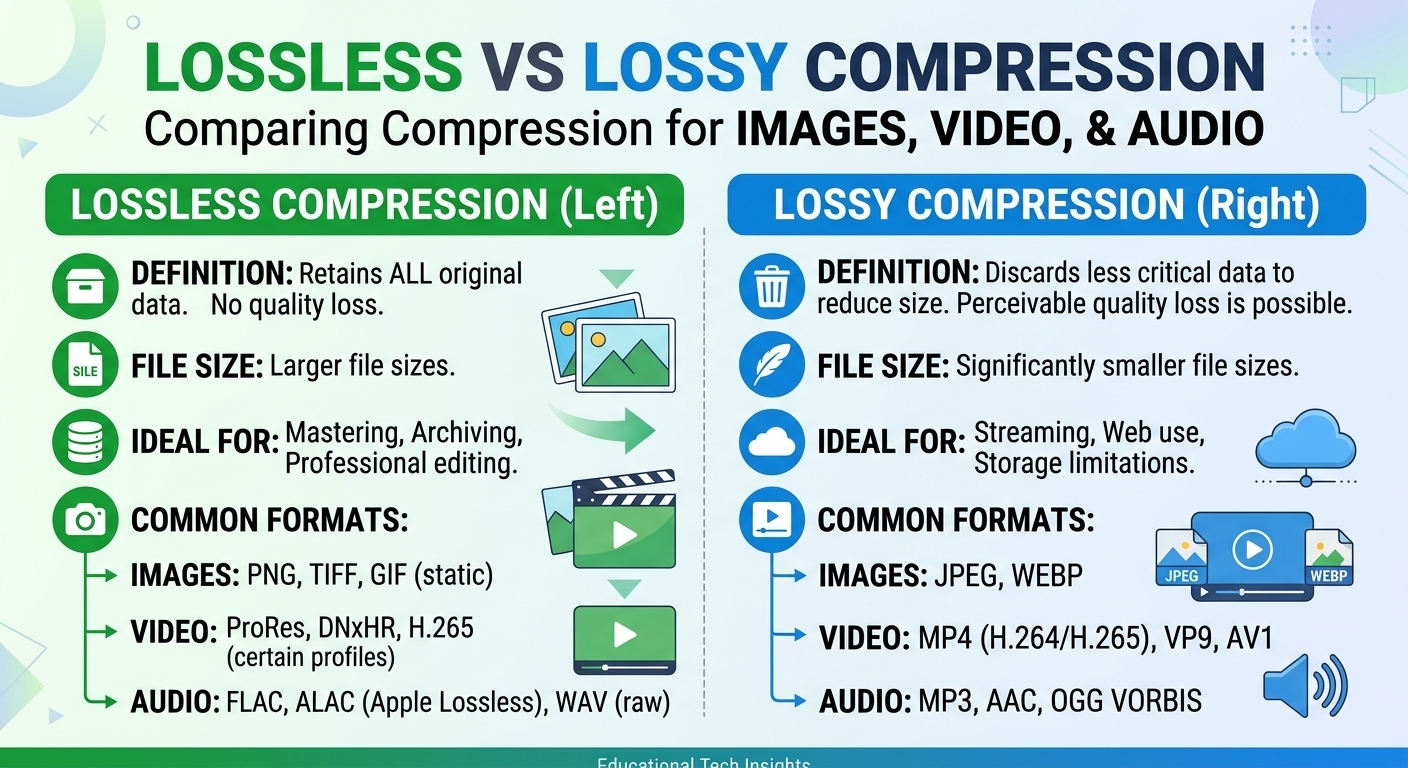
Lossy vs lossless compression comes down to one trade: lossless compression rebuilds every original bit and typically ...

In Q1 2026, platforms processing more than ten million uploads per day reported that unmoderated content reaching end users had a median dwell time of 38 seconds before first human review—yet propagation through cache hierarchies took under 200 milliseconds. That 38-second window is where brand damage, regulatory fines, and user trust erosion concentrate. Effective ai content moderation is no longer a policy question; it is an infrastructure problem. This article gives you the architecture patterns behind large-scale multimodal moderation pipelines as they exist in production today, the failure modes that trip up even well-funded teams, and a decision matrix for choosing where moderation intersects your delivery stack.
Two shifts define the current generation of automated content moderation systems. First, the EU's Digital Services Act (DSA) enforcement actions in late 2025 made sub-60-second takedown-or-flag SLAs a legal reality for Very Large Online Platforms. Second, foundation models that jointly embed text, image, audio, and video frames—what the industry calls multimodal content moderation—moved from research demos to production inference at costs below $0.0003 per asset for platforms running on-premises GPU clusters (as of Q1 2026 pricing from major cloud providers).
These two forces collapsed what used to be separate pipelines (text classifier, image classifier, video classifier) into a single inference graph. Unitary, a London-based company focused on contextual AI safety, has been operating one of the more visible implementations of this architecture. Their system ingests video alongside its audio track, on-screen text (OCR), and metadata, then produces a single policy-decision vector rather than per-modality scores. The practical advantage: sarcasm in a voiceover can prevent a benign protest image from being flagged, and a violent image paired with a news anchor voiceover can be routed to editorial review rather than auto-removed.
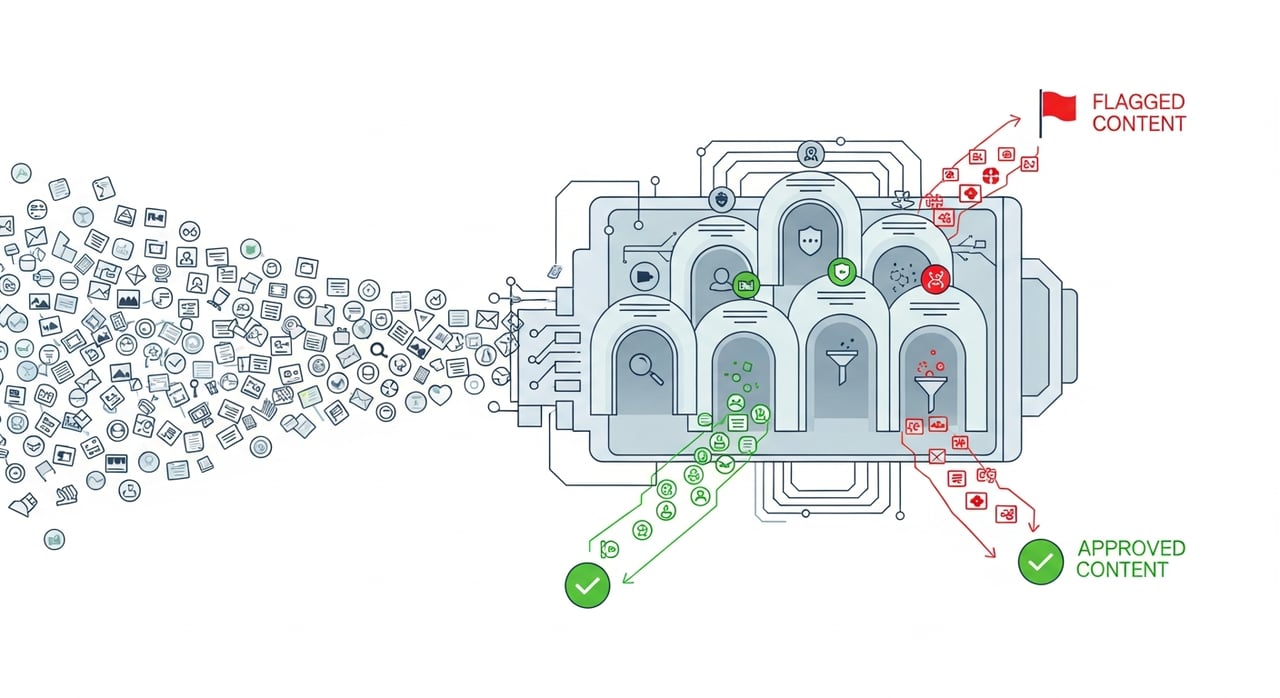
Most high-throughput moderation systems deployed in 2026 follow a three-stage architecture:
Content enters the pipeline at upload. A lightweight classifier (often a distilled model running on CPU or inference accelerators at the edge) assigns a coarse risk bucket—green, amber, red—within 50–150 ms. Green content proceeds to encoding and delivery immediately. Red content is held. Amber enters Stage 2.
Amber-bucket content is dispatched to GPU-backed inference workers. This is where video content moderation models analyze keyframes, audio transcription, OCR, and surrounding metadata jointly. Latency budgets here are typically 2–8 seconds for a 60-second clip. Unitary's pipeline operates in this tier, and their public documentation describes using transformer-based architectures that attend across modalities rather than ensembling separate model outputs.
Assets that land in a confidence dead zone—typically between the 0.40 and 0.70 probability thresholds for any policy violation category—route to human reviewers. As of 2026, best-practice teams target an escalation rate below 3% of total volume. Anything higher and the queue overwhelms human reviewers; anything lower and the model is likely suppressing borderline content that needs human judgment. This is where human-in-the-loop ai content moderation earns its value: not as a backstop for every decision, but as a calibration mechanism for model drift.
The critical design question is: at what point in the delivery path does moderation gating occur? Three patterns dominate:
| Pattern | Moderation Point | Latency Impact | Risk |
|---|---|---|---|
| Pre-cache gating | Origin, before cache key is written | +2–8 s on first request | Harmful content never enters cache |
| Async post-ingest | Parallel to encoding; purge on violation | Zero added latency, but ~5–30 s exposure window | Cached violative content may be served briefly |
| Edge-side classification | Inference at edge on cache miss | +100–500 ms (lightweight model only) | Requires GPU or accelerator at edge; limited model depth |
Most production systems in 2026 use a hybrid of the first two patterns: pre-cache gating for red-bucket content and async moderation with fast purge for amber content. The purge latency of your CDN becomes a moderation metric—if your provider cannot propagate a purge globally in under five seconds, your exposure window extends accordingly.
For platforms delivering high volumes of user-generated video and needing predictable purge behavior without the cost overhead of hyperscaler CDNs, BlazingCDN's media delivery infrastructure provides Anycast routing and purge at pricing starting at $5 per TB, down to $2.50 per TB at volume (as of October 2026), which materially changes the economics of serving moderated UGC at scale—especially when you factor in that moderation-driven purge-and-re-serve cycles inflate effective bandwidth.
This section is what most vendor marketing pages omit. These are the failure patterns engineering teams encounter once moderation pipelines reach production traffic:
Bad actors adapt faster than retraining cycles. In 2026, the most common evasion technique against multimodal content moderation is "modality splitting"—placing violative text in an image while the audio and video frame are benign. Models trained on joint embeddings handle this better than ensemble approaches, but drift is measurable quarter over quarter. Teams should track per-category precision and recall on a weekly cadence and maintain a holdout adversarial test set that is refreshed monthly.
Content legal in one jurisdiction triggers mandatory removal in another. A content moderation api that returns a single binary decision is insufficient. Production systems need to return a per-jurisdiction policy vector and let the delivery layer enforce geo-specific rules. This means your CDN's geo-routing and cache-partitioning capabilities become part of your compliance architecture.
A viral event can 10x upload volume in minutes. If moderation inference is synchronous and on the critical path, it becomes a bottleneck that degrades the upload experience for all users, not just those posting violative content. Circuit-breaker patterns that temporarily shift to async-only moderation during overload—accepting a wider exposure window in exchange for availability—are a pragmatic trade-off most platforms make.
When human reviewer decisions are fed back into model retraining without debiasing, cultural or individual reviewer biases get amplified. As of 2026, best practice is to require inter-annotator agreement from at least three reviewers across different geographic regions before a label enters the training set.
| Workload | Recommended Pattern | Moderation API Style | Escalation Target |
|---|---|---|---|
| Social media (text + image, high volume) | Async post-ingest with fast purge | Streaming / webhook | < 2% escalation rate |
| Live-stream / real-time video | Edge-side lightweight + origin deep model | Frame-sampling gRPC | < 1% (automated kill-switch for red) |
| E-commerce / marketplace listings | Pre-cache gating (latency tolerable) | Synchronous REST | < 5% (higher tolerance, lower volume) |
| Education / children's platforms | Pre-cache gating, zero-tolerance policy | Synchronous REST with mandatory HITL | 10–15% (safety over speed) |
This matrix is not prescriptive. Your specific regulatory exposure, user demographics, and content types will shift the thresholds. But it provides a starting framework for teams evaluating how to scale content moderation with AI without over-indexing on a single vendor's architecture.
Single-modality classifiers evaluate text, images, or audio independently and then combine scores via rules or a lightweight ensemble. Multimodal systems embed all modalities into a shared representation space and make a joint inference, which captures cross-modal context—such as sarcastic audio contradicting a violent image—that per-modality pipelines miss. As of 2026, multimodal approaches show 12–18% higher precision on context-dependent policy categories compared to ensemble methods.
For synchronous pre-cache gating, expect 2–8 seconds for video and 100–300 ms for text/image. Async patterns add zero user-facing latency but introduce an exposure window (typically 5–30 seconds) during which unmoderated content may be served. The right trade-off depends on your risk tolerance and regulatory obligations.
The moderation API must return jurisdiction-specific policy vectors, not a single global decision. Your CDN's geo-routing and cache-key partitioning enforce per-region rules at the delivery layer. DSA-regulated platforms in the EU require documented decision trails and user appeal mechanisms, which adds API surface beyond simple allow/block responses.
Inference costs as of Q1 2026 range from $0.0001 per text asset to $0.001 per 60-second video clip on cloud GPU instances. Self-hosted inference on current-generation accelerators reduces per-unit cost by 40–60% at volumes above 50 million assets per month, but requires dedicated ML ops capacity. The dominant cost at scale is often not inference but bandwidth for re-serving purged-and-replaced assets.
Require multi-annotator agreement (minimum three reviewers, geographically distributed) before any label enters the training set. Run per-demographic-group fairness audits on a quarterly cadence. Publish transparency reports with per-category false-positive rates segmented by language and region. No model eliminates bias entirely; the goal is measurable, auditable reduction.
If you operate a user-generated content moderation pipeline, here is a concrete action: measure your effective exposure window. Timestamp the moment an asset enters your CDN cache and the moment a moderation-driven purge completes globally. The delta is your exposure window. If it exceeds your regulatory SLA or your trust-and-safety team's stated tolerance, you have an architecture problem that no amount of model accuracy improvement will fix. Start there. The model is only as good as the delivery system enforcing its decisions.

Heavy traffic.
Light bill.
The CDN for video and large traffic
Learn
Lossy vs lossless compression comes down to one trade: lossless compression rebuilds every original bit and typically ...
Pricing - Pricing & Costs
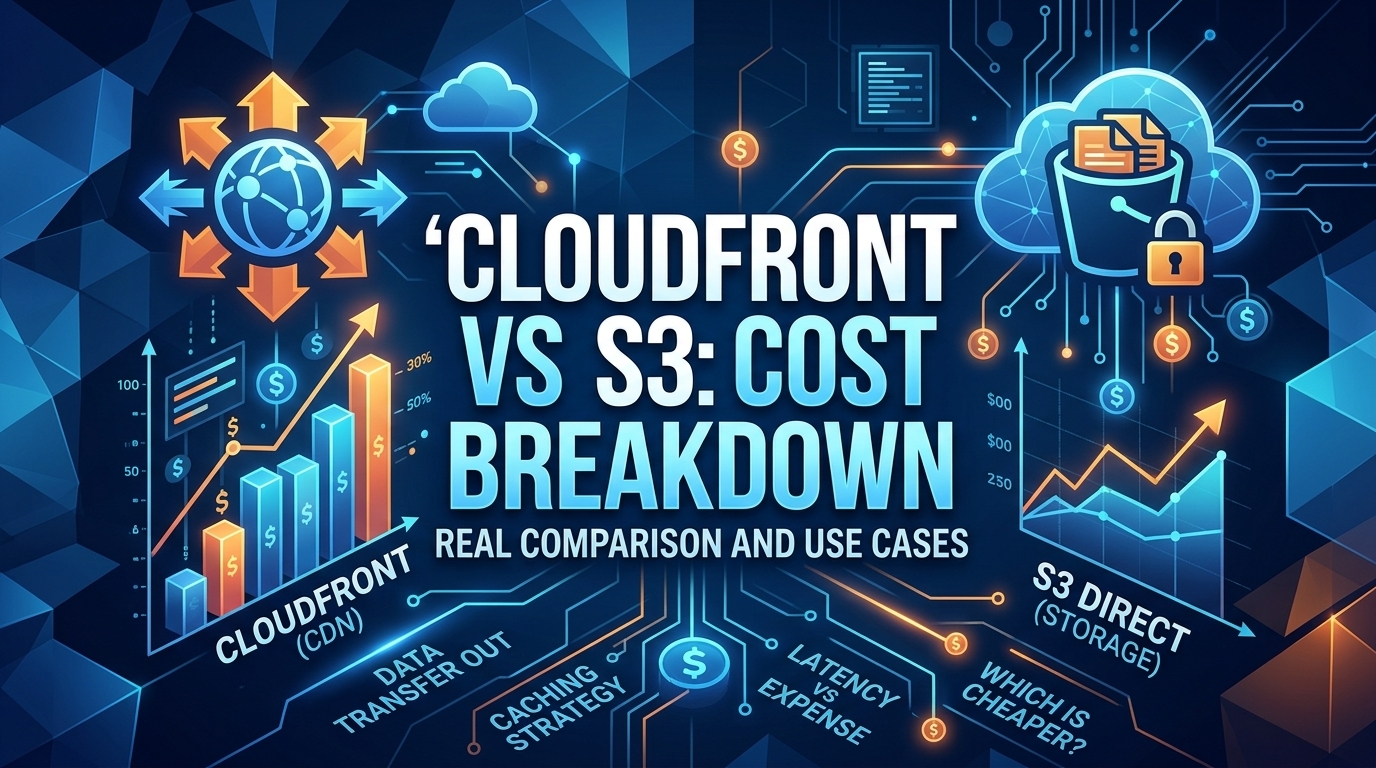
The CloudFront vs S3 decision depends more on object size than on traffic volume. At a 500 KB average response, 100 TB ...
Learn
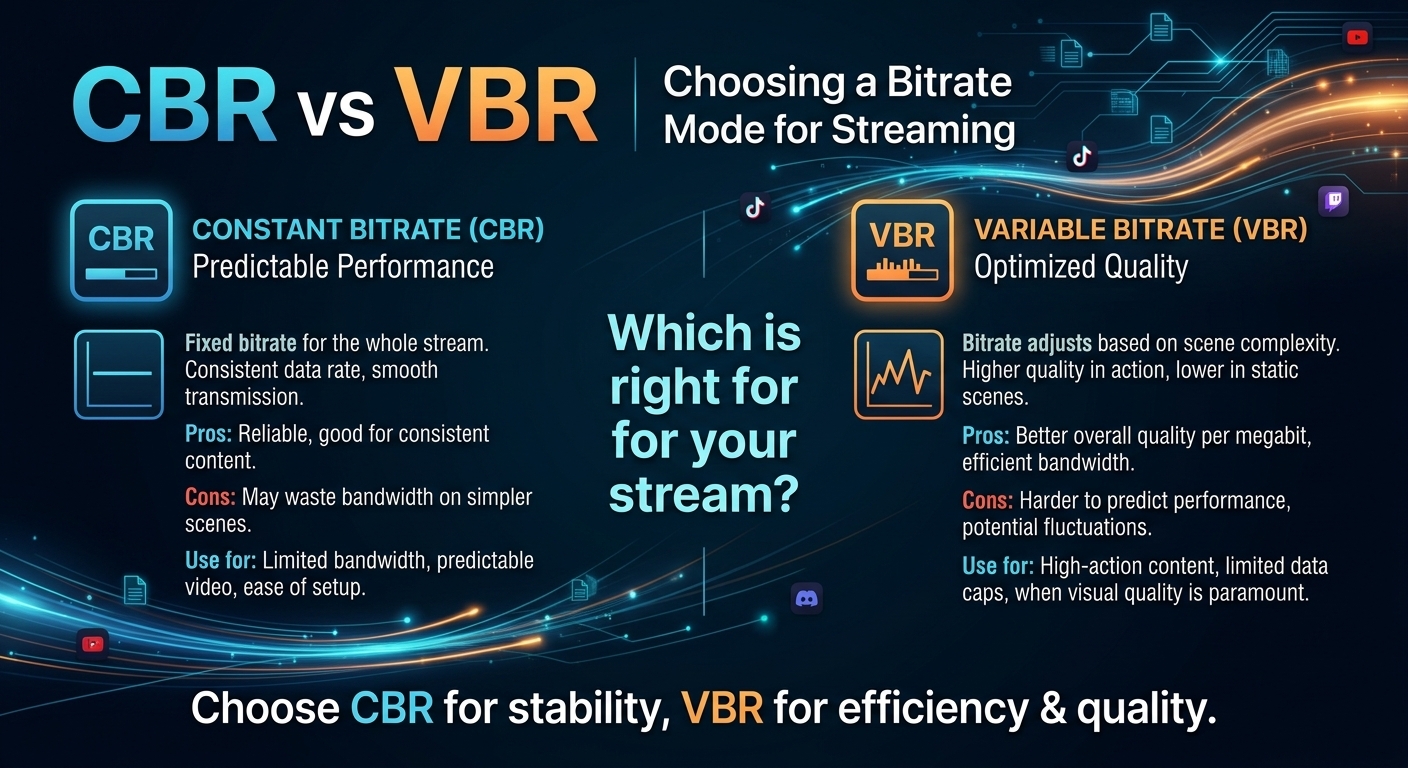
For most on-demand video, capped variable bitrate (VBR) wins the cbr vs vbr decision: it spends bits where the picture ...