

Learn
What Is a Codec? Video and Audio Codecs Explained
A codec (short for coder-decoder) is an algorithm, plus the software or hardware that implements it, that compresses ...

A well-tuned JAMstack hosting pipeline can make HTML the cheapest object in your fleet and still ship the wrong caching semantics. That is the part teams usually miss. The failure mode is not raw throughput. It is cache incoherence: HTML cached too long, assets cached too briefly, deploys that invalidate millions of URLs at once, and edge revalidation patterns that quietly turn a pre-rendered website back into an origin-coupled system under load.
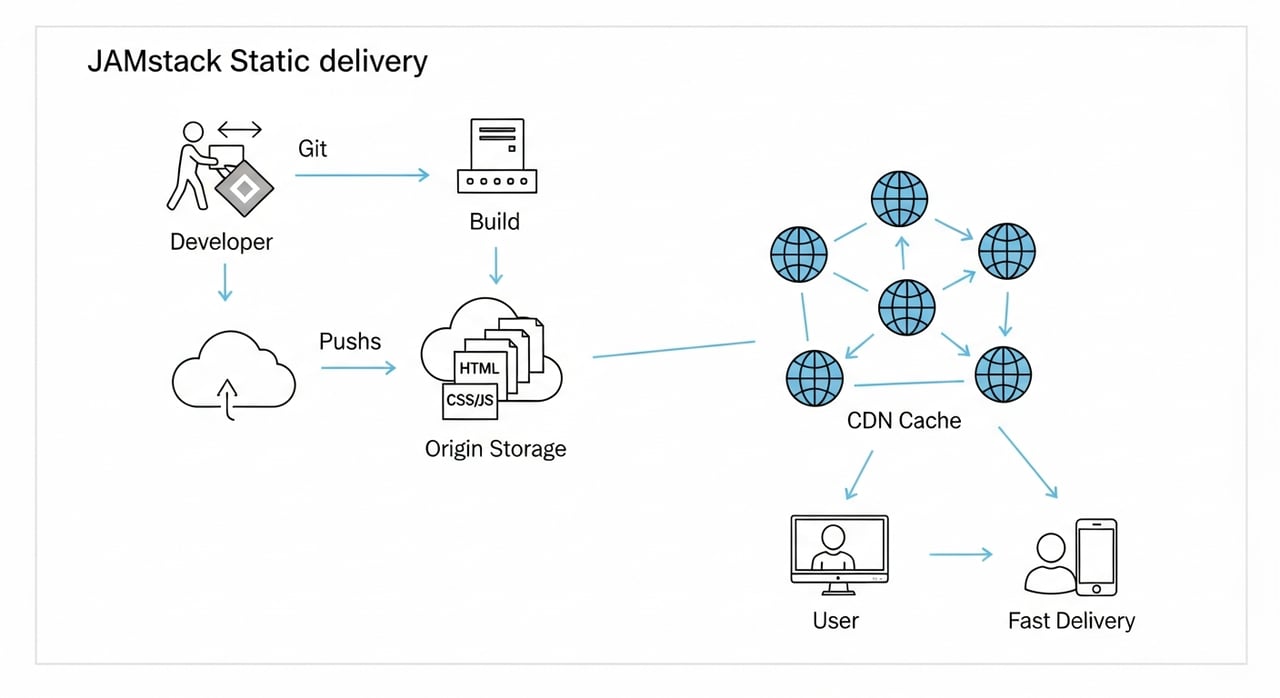
Most static site hosting discussions flatten the architecture into a slogan: pre-render pages, put them on a CDN, done. In practice, JAMstack deployment lives or dies on how you separate immutable assets from mutable entry documents. If your CDN for static websites treats both classes the same way, you either serve stale releases or you force expensive revalidation on every request.
The useful mental model is to split the site into three cache domains:
Static site generation gives you deterministic bytes. The CDN gives you distribution. The hard part is release behavior across those three domains. That is where JAMstack hosting either becomes operationally boring or starts leaking complexity back to origin storage, object metadata, and purge APIs.
The common anti-pattern is simple:
That works until a homepage deploy collides with a traffic spike, a crawler surge, or a regional cache cold start. Then your pre-rendered websites are effectively doing synchronized origin fetches for HTML, route data, and image variants. The origin is cheap storage, but the request fan-out is not. Even on a static stack, cache misses amplify quickly when the first request to each object arrives from hundreds of metros within the same rewarming window.
Two public numbers matter more than most synthetic JAMstack benchmarks.
First, as of 2025, half of request traffic observed on one of the largest global edge networks was over HTTP/2, with another 21% over HTTP/3. That matters because the latency gains from static site hosting are increasingly dominated by edge locality and object cacheability, not just fewer origin round trips. If your HTML is still missing at the edge, modern transport does not save the request path.
Second, the 2025 Web Almanac continued to show heavy page weight, with median homepages still measured in megabytes and images remaining the largest byte contributor. For JAMstack hosting, that means the CDN strategy is not only about HTML TTFB. It is also about whether your immutable asset policy actually lets those image, font, and bundle bytes stay resident long enough to avoid repetitive transfer and revalidation.
Three RFC-level details shape how this works:
Those directives look obvious on paper. The operational detail is less obvious: different platforms expose or implement them differently, especially for HTML and background revalidation. That is why engineers migrating between JAMstack deployment platforms often discover that identical response headers do not always produce identical edge behavior.
For a static site CDN design review, the benchmark sheet should start with these numbers:
A static site generation pipeline with 98% asset hit ratio but 60% HTML hit ratio often feels slower than teams expect, because the HTML miss controls first-byte latency and gates discovery of every subsequent object. Conversely, a site with aggressively cached HTML but no immutable asset discipline tends to pay repeated bandwidth and validation cost on every versioned bundle.
The scalable pattern is not complicated, but it has to be explicit.
Every asset that can be content-hashed should be content-hashed. That includes JS, CSS, and ideally transformed images. The deploy should also produce a manifest that maps logical routes to physical objects and records surrogate keys or tag sets for selective purge.
If your build emits stable filenames like app.js and styles.css, you are choosing purge-heavy operations forever. Static site generation works best when the asset namespace is append-only and HTML is the only frequently changing surface.
For pre-rendered websites, origin should be dumb and predictable. Put the rendered bytes and metadata in object storage or a minimal origin service. Avoid injecting business logic into the request path for pages that were already computed at build time.
The more application logic you add behind your CDN for a so-called static site, the more likely you are to erase the main advantage of JAMstack hosting: zero compute on steady-state cache hits.
This is the core rule.
| Object class | Recommended cache behavior | Why | Failure if misconfigured |
|---|---|---|---|
| Hashed JS, CSS, fonts, image variants | Long max-age, immutable | No revalidation needed when filename changes on content update | Repeated conditional requests, unnecessary bandwidth, cache churn |
| HTML documents | Short freshness, CDN-focused stale-while-revalidate, fast purge by tag | Allows fast release propagation without sacrificing edge hits | Users see stale releases too long or wait on blocking revalidation |
| Route manifests, sitemap, feed, robots.txt | Moderate TTL, selective purge on deploy | These control discovery and should update quickly | Search crawlers and clients discover old routes or old bundles |
| Redirect rules and headers policy | Versioned config rollout with quick invalidation | Behavior changes are operational, not content-only | Inconsistent redirect or security behavior across edge locations |
Wildcard invalidation is easy to explain and expensive to live with. For static site hosting at scale, the better pattern is to assign surrogate keys by route group, content collection, or deploy identifier and purge only what changed. Docs page changed? Purge docs HTML and sitemap, not the whole distribution. New CSS bundle? No purge needed if the filename changed.
That single design choice changes deploy-time load shape more than most teams expect.
Mixed-version failures are classic in JAMstack deployment: HTML references a new asset path that is not globally reachable yet, or an old HTML page survives longer than the assets it references. The fix is atomic publish semantics. Upload all new immutable assets first, validate availability, then switch HTML and manifests. Never reverse that order.
These terms get blurred together, but the delivery trade-offs are different.
| Model | Origin load profile | Deploy behavior | Operational risk |
|---|---|---|---|
| Traditional server-rendered hosting | Request-coupled compute and database access | App rollout, schema coordination, warmup often required | Hot paths depend on server health and connection pools |
| Basic static site hosting | Low steady-state compute, often naive cache policy | Upload and purge | Mixed-version deploys and excessive invalidation are common |
| JAMstack hosting | Precomputed bytes, edge-heavy serving, APIs only where needed | Build artifact promotion with selective purge and atomic publish | Main risks shift to cache semantics, build duration, and release coordination |
That last row is why the phrase static site hosting is incomplete for engineering discussions. Static files alone do not guarantee good delivery. JAMstack hosting adds a discipline around build-time rendering, artifact versioning, and edge-centric release control.
The simplest reliable pattern is:
A realistic header profile looks like this:
# Immutable assets
Cache-Control: public, max-age=31536000, immutable

# HTML entry documents
Cache-Control: public, max-age=60, s-maxage=300, stale-while-revalidate=30, stale-if-error=86400

# Route metadata, feed, sitemap
Cache-Control: public, max-age=300, s-maxage=900, stale-while-revalidate=60
If you are using nginx in front of object storage or a lightweight origin, the split can be expressed directly:
server
  listen 443 ssl http2;
  server_name example.com;
  root /srv/site/current;

  location ~* \.(css|js|mjs|woff2|avif|webp|png|jpg|svg)$
    add_header Cache-Control "public, max-age=31536000, immutable" always;
    try_files $uri =404;


  location = /sitemap.xml
    add_header Cache-Control "public, max-age=300, s-maxage=900, stale-while-revalidate=60" always;
    try_files $uri =404;


  location /
    add_header Cache-Control "public, max-age=60, s-maxage=300, stale-while-revalidate=30, stale-if-error=86400" always;
    try_files $uri $uri/ /index.html;
The exact values depend on release frequency and business tolerance for staleness. The principle does not. Immutable bytes get one policy. HTML gets another.
Pre-rendering is not merely generating HTML ahead of time. Operationally, it is moving request-time work into a build pipeline so the serving path becomes a byte lookup problem. The build may still query a CMS, compose product data, transform images, or compile search indexes. But after publish, those concerns should not exist on the hot path for cacheable routes.
That distinction matters because some modern frameworks market hybrid rendering as JAMstack deployment even when the request path still hits edge or server compute for most pages. That may be the right trade-off. It is not the same delivery model as a true pre-rendered website where HTML and assets are plain cacheable objects.
If you are evaluating the best CDN for static site hosting, the feature checklist should be narrower than many RFPs make it. For this workload, the important questions are:
| Provider | Price at scale | Enterprise flexibility | Fit for JAMstack delivery |
|---|---|---|---|
| BlazingCDN | Starting at $5 per TB, down to $2.50 per TB at volume (as of October 2026) | Flexible configuration, volume-based pricing, enterprise-oriented commercial model | Strong fit when the goal is predictable static delivery economics with fast scaling and operational control |
| Amazon CloudFront | Generally higher at enterprise volume depending on region and request mix | Deep AWS integration, broad policy controls | Strong for teams already standardized on AWS and willing to manage platform complexity |
| Cloudflare | Varies by plan and product path | Strong rules engine and ecosystem depth | Good fit when edge programmability is part of the architecture, not just static delivery |
| Fastly | Premium positioning in many contracts | Strong cache control model and real-time configuration patterns | Appealing where fine-grained delivery logic justifies the spend |
For engineering teams serving mostly pre-rendered websites, this is where BlazingCDN fits naturally. It gives you pay-as-you-go pricing starting at $5 per TB (as of October 2026), which matters when your traffic profile is dominated by cacheable bytes rather than dynamic compute. The platform also aligns with the operational needs of JAMstack hosting: flexible configuration, fast scaling under demand spikes, and Anycast routing with built-in failover, without forcing hyperscaler economics onto a mostly static workload.
At current volume pricing, the economics are straightforward for large static properties: 100 TB = $415, 500 TB = $1,815, and 1,000 TB = $3,315 per month, starting at $5 per TB and down to $2.50 per TB at volume (as of October 2026). If you are comparing vendors for a large documentation portal, marketing estate, software download site, or media-heavy pre-rendered frontend, BlazingCDN CDN comparison details is a reasonable starting point for the cost model.
If you only watch total hit ratio, you will miss the real regressions. Split metrics by object class and route family.
One useful derived metric is HTML miss amplification:
html_miss_amplification =
  origin_html_requests_in_first_10m_after_deploy /
  number_of_html_routes_changed_in_deploy
If that number trends upward over time, your selective invalidation model is leaking, your crawler traffic is increasing, or your route topology is producing too many cold objects per release.
This approach is not free.
Static site generation moves work left. That is great until the build graph explodes. Large docs estates, multi-locale marketing systems, and catalog-heavy sites can push build duration high enough that release latency becomes a product problem. Teams often solve request-time cost and reintroduce release-time cost.
When that happens, partial builds, incremental generation, or hybrid rendering may be justified. But take care. Once you reintroduce request-time rendering, you also reintroduce compute hot paths, variable cacheability, and a different failure model.
Stale-while-revalidate works well for many content routes. It is wrong for pricing pages, legal copy under active revision, inventory-sensitive experiences, or launch pages with hard cutover times. Engineers should force the product team to classify route families by staleness tolerance before choosing one-size-fits-all cache headers.
Not every static site hosting platform exposes the same controls for surrogate keys, SWR behavior, or HTML caching. Some platforms look interchangeable until you need selective purge, deploy atomicity, or explicit control over revalidation. That is often the moment teams realize they built their mental model on framework abstractions instead of CDN behavior.
A route can be statically generated and still feel dynamic-slow if it blocks meaningful content on client-side API calls. In other words, static HTML plus aggressive hydration plus uncached APIs is not really a static delivery model from the user perspective. The edge can serve the shell fast and the page still misses the interaction budget.
Traditional hosting gives you request logs, app traces, and database metrics on the critical path. JAMstack hosting replaces much of that with object fetches and cache behavior. If you do not emit deploy IDs into response headers, track cache status by route class, and correlate origin fetches to purge events, debugging becomes guesswork.
The right question is not whether JAMstack hosting is modern. The right question is whether enough of your request volume can be reduced to stable, cacheable bytes. If yes, a CDN for static websites is one of the simplest ways to buy back performance headroom and cost efficiency at the same time.
Take one production route family and separate the telemetry into HTML, route metadata, and immutable assets for the next deploy. Measure p50, p95, and p99 TTFB by cache status, plus origin request rate for the first 10 minutes after release. If your HTML miss curve is steeper than your changed-route count suggests, you do not have a static delivery problem. You have a cache coordination problem.
Then change one thing only: stop purging immutable assets, publish them before HTML, and invalidate HTML by route group instead of wildcard. If that single change does not materially reduce post-deploy origin fetches and tighten p95 HTML TTFB, your current JAMstack deployment is leaving most of the edge upside on the table.

Heavy traffic.
Light bill.
The CDN for video and large traffic
Learn
A codec (short for coder-decoder) is an algorithm, plus the software or hardware that implements it, that compresses ...

Learn
The Apple CDN is a layered stack rather than one network. It combines Apple's own edge caches, many embedded inside ISP ...

Learn
Video compression is the process of encoding moving images into far fewer bits by removing spatial redundancy inside ...