Learn
What Is H.264 (AVC)? The Codec Behind Most Online Video
H.264, also called Advanced Video Coding (AVC) or MPEG-4 Part 10, is a block-based video compression standard published ...
In Q1 2026, a major European broadcaster lost 23 minutes of live Champions League coverage across three geographies — not because an origin failed, but because nobody was watching the right CDN metric. Their cache hit ratio looked fine at 94%. Throughput dashboards were green. But P99 TTFB had been climbing for 40 minutes at a single edge cluster, and no alert fired because the threshold was set on P50. The incident cost an estimated €1.8M in SLA penalties and ad-revenue clawback. The fix took four lines of monitoring config. This article gives you the 11 metrics, the threshold values, and the multi-CDN decision matrix that would have caught that failure 37 minutes earlier. If you run cdn monitoring tools in production today, this is the 2026 playbook for instrumenting what actually matters.
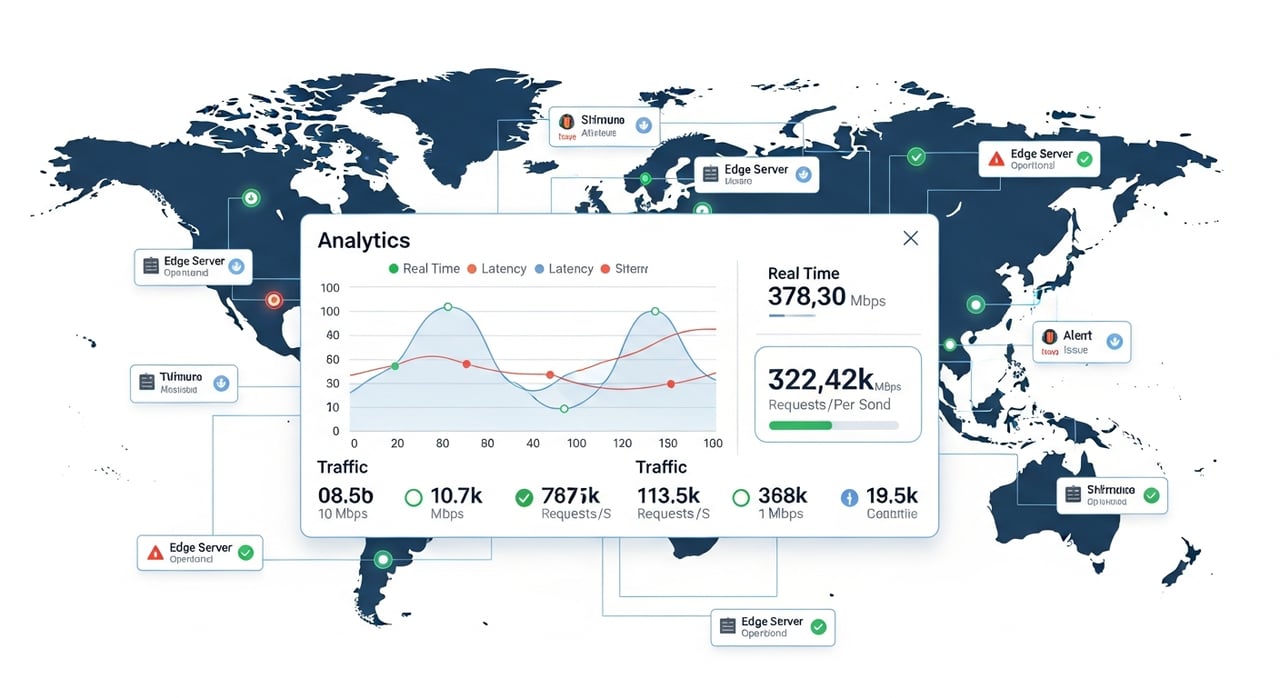
Edge architectures have shifted materially since 2024. HTTP/3 with QUIC is now the majority transport for mobile traffic — measured at 58% of mobile sessions as of March 2026. Edge compute workloads (Cloudflare Workers, Fastly Compute, Deno Deploy) mean your CDN is no longer just a cache; it is running business logic, and a latency regression there shows up differently than a stale-object problem. Meanwhile, multi-CDN deployments are now standard for any property above 10 Gbps peak. The monitoring surface has expanded, and the tools that worked in a single-CDN, cache-only world leave critical blind spots.
The 11 metrics below are organized into three tiers: delivery quality, cache efficiency, and operational health. Each includes a recommended alert threshold based on 2026 production norms.
P50 TTFB is a vanity metric. The tail is where users churn. For static assets, target P99 TTFB under 120 ms intra-continent and under 280 ms cross-continent (as of 2026 measurements on well-tuned deployments). For dynamic edge-computed responses, add 30–60 ms. Alert when P99 exceeds 2× your baseline for 5 consecutive minutes.
Even with high cache hit ratios, origin fetches happen — revalidation, POST passthrough, cache-busting query strings from ad tech. Instrument origin RTT separately from edge RTT. A 50 ms increase in origin RTT often indicates database contention or upstream throttling, not a CDN problem, but your CDN dashboards will show the symptom first.
Aggregate error rates hide signal. Split 4xx and 5xx. A spike in 403s often means a WAF rule change propagated incorrectly. A rise in 502s/504s points to origin health. Track 5xx specifically per edge region — a single unhealthy cluster can drive a 0.3% global error rate that masks a 12% regional failure.
Total throughput is a capacity-planning metric, not a quality metric. Per-region throughput trending is both. A 20% drop in throughput from Frankfurt while global numbers are flat means traffic is rerouting — possibly through a less optimal path. This is a leading indicator of DNS or anycast problems.
A single cache hit ratio number is nearly useless at scale. Segment by content type (video segments, images, API responses), by edge region, and by HTTP method. Video-heavy workloads should target 96%+ on segment cache hits as of 2026 (up from 93% in 2024, driven by improved prefetch logic in modern CDNs). API cache hits vary wildly — 40–70% is common for GraphQL responses with proper cache key normalization.
This metric emerged as operationally critical in 2025 and remains underinstrumented. When your CDN serves stale content during background revalidation, it keeps TTFB low but can mask origin failures. Track the ratio of stale-served responses to fresh-served responses. If stale-serve exceeds 15% of total cache hits for more than 10 minutes, your origin is likely degraded.
High eviction rates at specific edge nodes indicate undersized cache tiers or poor content segmentation. In multi-CDN setups, eviction rate differences between providers reveal which CDN allocates more edge storage to your workload. This metric directly impacts egress costs — every eviction is a future origin fetch.
With QUIC handling the majority of mobile sessions, TLS 1.3 0-RTT resumption should keep handshake times under 30 ms for returning visitors. Watch for P95 spikes above 100 ms — they indicate certificate chain issues, OCSP stapling failures, or edge nodes falling back to 1-RTT. As of 2026, certificate transparency log monitoring is also worth integrating into your CDN observability pipeline to catch mis-issuance early.
CDN monitoring tools that ignore the DNS layer miss a common latency source. Segment by public resolver (Google, Cloudflare, ISP-operated). A 200 ms P95 DNS resolution on a specific ISP resolver, invisible in global aggregates, can explain disproportionate bounce rates from a single market.
Synthetic monitoring tells you what performance should be. RUM tells you what it is. The delta between them is the metric. A growing gap means real-world conditions — congested last-mile networks, device performance degradation, client-side JavaScript blocking — are undermining your edge optimization. In 2026, aim to keep the RUM-synthetic TTFB delta under 40% for P75 sessions.
If you run two or more CDNs, measure the time from failure detection to traffic reroute completion. DNS-based failover typically adds 30–120 seconds depending on TTL. Client-side switching (via service worker or edge logic) can cut this to under 5 seconds. This metric is binary: either you measure it and rehearse it quarterly, or your multi-CDN architecture is a checkbox, not a reliability improvement.
Most teams pick cdn monitoring tools based on feature lists. The better approach is matching tools to your operational model. This matrix, based on 2026 tool capabilities, maps monitoring needs to deployment patterns.
| Deployment Pattern | Primary Need | Tool Category | Examples (2026) |
|---|---|---|---|
| Single CDN, cache-only | Cache analytics, error drill-down | Provider-native dashboards | Vendor built-in analytics |
| Single CDN, edge compute | Tail latency tracing, function-level metrics | APM with edge support | New Relic, Datadog |
| Multi-CDN, DNS failover | Cross-provider comparison, failover timing | Synthetic + RUM + CDN log aggregation | Catchpoint, ThousandEyes, Cedexis (now Citrix ITM) |
| Multi-CDN, client-side switching | Real-time performance scoring, sub-second rerouting | RUM-driven traffic management | Conviva (video), mPulse, custom OpenTelemetry |
| Hybrid (CDN + origin in same observability) | End-to-end trace correlation | Distributed tracing with CDN span injection | Grafana + Tempo, Datadog APM, Honeycomb |
The common mistake is buying a multi-CDN monitoring platform when you only run one CDN, or relying solely on provider-native dashboards when you actually need cross-provider apples-to-apples comparison. Match the tool to the architecture.
Real-time dashboards aggregate. Logs explain. In 2026, most CDN providers offer real-time log streaming to your own infrastructure — S3, GCS, Kafka, or direct OpenTelemetry ingest. The operational value comes from querying logs with context your dashboards strip away: specific client ASNs, individual cache keys, request header combinations that trigger edge logic branches.
A practical CDN log analytics pipeline in 2026 looks like this: stream logs from each CDN provider into a unified store (ClickHouse and Loki are the most common choices for this workload), normalize field names across providers, then build queries that answer operational questions — "which cache keys are evicted most frequently from the London cluster?" or "what is the 5xx rate for requests originating from AS16509 in the last hour?" These are questions no pre-built dashboard answers.
For teams running high-volume delivery — media streaming, large file distribution, game patch delivery — monitoring costs compound when your CDN itself is expensive. BlazingCDN uses volume-based pricing, starting at $5 per TB and down to $2.50 per TB at volume (as of October 2026). At 100 TB/month, the cost is $415, versus about $6,965 on Amazon CloudFront pay-as-you-go, which frees budget for better observability tooling. The platform offers flexible configuration and Anycast routing with built-in failover. Compare BlazingCDN pricing and features against other providers.
For static assets and video segments, target 96% or higher. For API and dynamic content with proper cache key normalization, 40–70% is realistic. Always segment by content type and edge region — a single global number hides actionable variance.
Use a vendor-neutral synthetic monitoring tool (Catchpoint, ThousandEyes) combined with RUM that tags each request with the serving CDN. Normalize log schemas across providers into a single analytics store so you can run cross-CDN queries without switching dashboards. Measure the same metrics — P99 TTFB, error rate, cache hit ratio — identically for each provider.
Synthetic monitoring executes controlled tests from known locations on a schedule. RUM captures actual user sessions with real devices and network conditions. The delta between the two is itself a diagnostic signal — a growing gap means real-world conditions are degrading performance beyond what controlled tests reveal.
Quarterly at minimum, with at least one annual test during a genuine traffic peak (not a maintenance window). Measure both detection time and reroute completion time. DNS-based failover should complete within 2× your TTL. Client-side switching should complete in under 5 seconds.
ClickHouse dominates for high-cardinality CDN log queries due to columnar storage efficiency. Grafana Loki works well for teams already in the Grafana ecosystem and who prioritize label-based filtering over full-text search. For teams ingesting over 10 TB/day of CDN logs, a Kafka buffer in front of either backend prevents ingest backpressure during traffic spikes.
Enable real-time log streaming to your own infrastructure. Most providers support this via syslog, HTTPS POST, or direct cloud storage delivery. Once logs are in your stack, use OpenTelemetry collectors to enrich them with trace context and feed them into your existing observability platform — Datadog, Grafana, Honeycomb, or a custom pipeline.
Pick two metrics from this list that you are not currently alerting on. For most teams, that will be P99 TTFB segmented by edge region and stale-while-revalidate hit rate. Instrument both, set conservative thresholds for one week to establish a baseline, then tighten. Run a failover drill if you have not done one in Q1 2026. Compare your RUM TTFB against your synthetic TTFB and compute the delta — if it exceeds 40% at P75, you have a client-side or last-mile problem that no CDN configuration change will fix. Start there.

Heavy traffic.
Light bill.
The CDN for video and large traffic
Learn
H.264, also called Advanced Video Coding (AVC) or MPEG-4 Part 10, is a block-based video compression standard published ...
Compare
At 100 TB a month, the published price gap between options for a CDN for static content is more than 16 times: ...
Learn
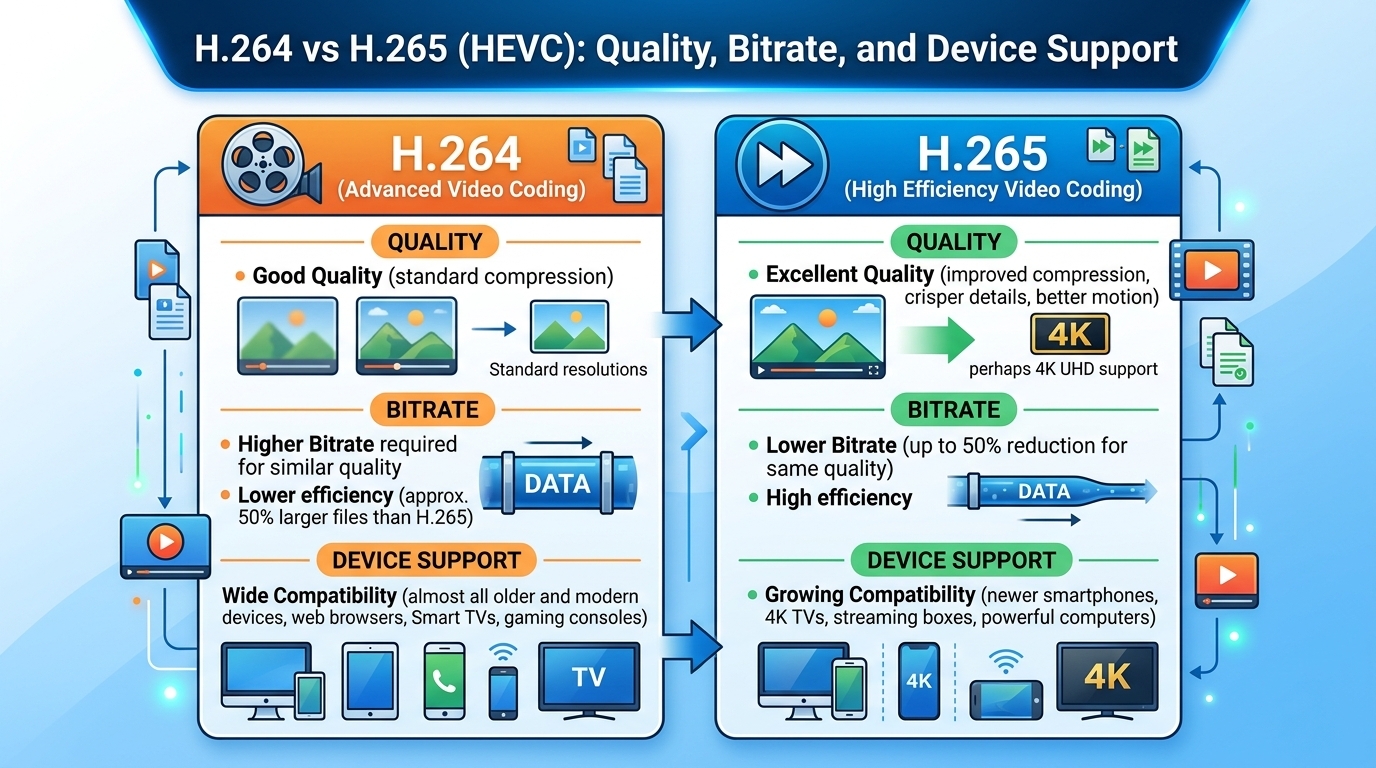
Evaluated October 2026: in the h264 vs h265 decision, HEVC (H.265) matches H.264 (AVC) quality at roughly 30 to 50 ...