Learn
What Is H.264 (AVC)? The Codec Behind Most Online Video
H.264, also called Advanced Video Coding (AVC) or MPEG-4 Part 10, is a block-based video compression standard published ...
In Q1 2026, four of the ten largest U.S. retail banks reported that conversational AI for banking now handles more than 40% of inbound customer interactions end-to-end, without a live-agent escalation. That is up from roughly 22% just eighteen months ago. The shift is no longer about whether a digital banking assistant adds value; the question is which architecture, integration depth, and delivery model actually survives contact with production traffic, compliance audits, and a customer base that expects sub-second response times on mobile.
This article gives you a concrete framework for evaluating banking AI agent platforms in 2026, with Kasisto's KAI as the primary case study. You will get an architectural breakdown of KAI's current stack, a deployment-model decision matrix you will not find in vendor marketing, a real look at latency and availability dependencies, and the integration patterns that separate a useful banking virtual assistant from a glorified FAQ bot.
Two forces converged this year. First, generative AI for banking matured past the demo stage. Foundation-model providers began offering fine-tuning APIs with data residency guarantees that satisfy OCC and GDPR requirements, which means banks no longer need to choose between capability and compliance. Second, core banking platforms (Temenos, Thought Machine, FIS) shipped native event-streaming interfaces in their 2025–2026 releases, giving AI agents for banking real-time access to transaction state without bespoke middleware.
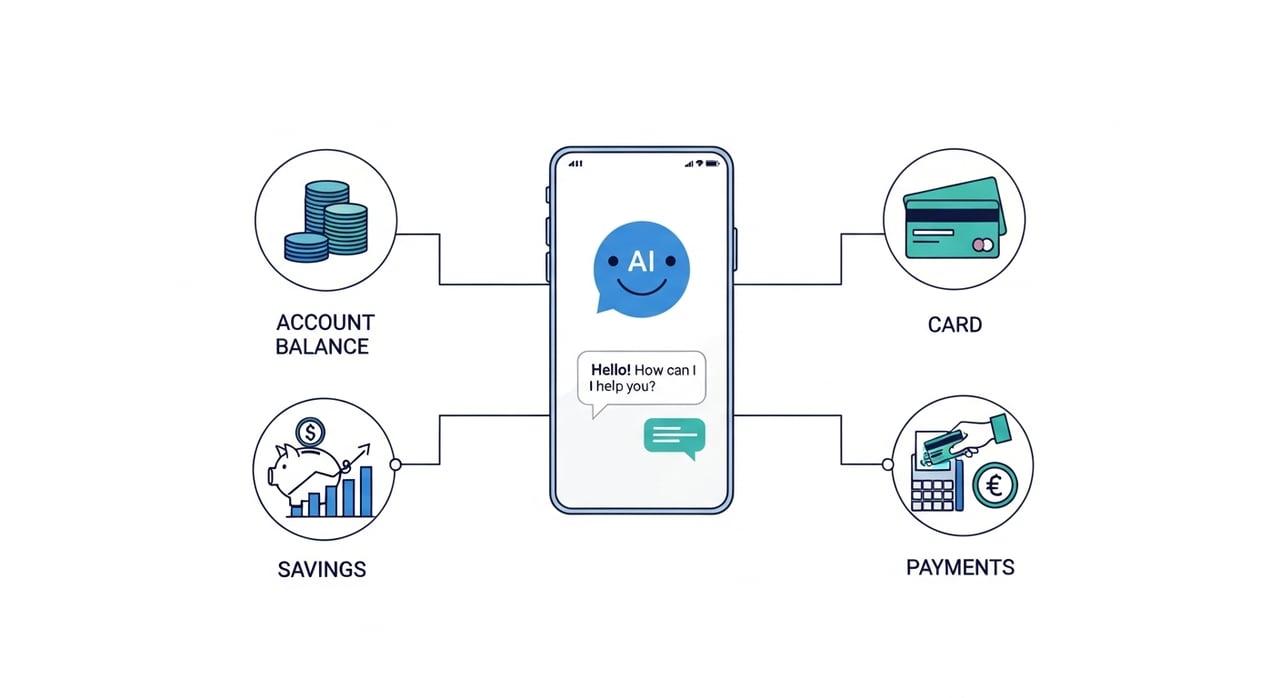
The result: a banking AI agent in 2026 can execute card locks, dispute initiations, and scheduled-payment modifications inside the same conversational turn where the customer describes the problem. That is a different animal from the intent-classification chatbots of 2023.
Kasisto's KAI platform, as of its May 2026 release, operates as a three-tier system. Understanding each tier matters because it determines what you can customize, what you inherit, and where latency hides.
KAI ships with a pre-trained financial-domain model covering retail banking, credit cards, lending, and wealth management intents. As of 2026, Kasisto claims coverage of over 1,800 banking-specific intents out of the box. The model is fine-tuned on anonymized interaction logs from its existing bank deployments, which gives it an accuracy edge on domain-specific entity extraction (account types, transaction descriptors, merchant names) compared to a general-purpose LLM.
This is where KAI connects to your core banking system, card processor, CRM, and knowledge base. The orchestration layer handles dialogue state, context carry-over across channels, and the critical live-agent handoff logic. A banking AI agent with live agent handoff that actually works requires the orchestrator to pass full conversation context, customer authentication state, and in-progress transaction details to the human agent's UI. KAI does this via a standardized handoff payload, though the quality of the handoff still depends heavily on the agent desktop integration.
KAI renders across mobile SDKs (iOS, Android), web widgets, IVR/voice channels, and messaging platforms. Omni-channel is table stakes. The real differentiator is session continuity: a customer who starts a transaction search on mobile and switches to web should land in the same conversational state. KAI supports this through a shared session store, but it requires the deploying bank to maintain a unified customer identity layer.
This is where most vendor evaluations go wrong. Banks fixate on model accuracy and ignore the deployment topology, which determines your latency floor, compliance posture, and total cost of ownership. Here is the decision matrix based on 2026 options:
| Factor | SaaS (Kasisto-hosted) | Private Cloud (Bank VPC) | On-Prem / Air-Gapped |
|---|---|---|---|
| Time to production | 30–60 days (personalized digital banking assistant in 30 days is realistic for SaaS) | 90–120 days | 6–9 months |
| Data residency control | Limited to Kasisto's hosting regions | Full control | Full control |
| Model update cadence | Continuous (Kasisto-managed) | Quarterly release trains | Manual, bank-controlled |
| Inference latency (p95) | 200–400ms (network-dependent) | 120–250ms | 80–180ms |
| Best for | Community banks, credit unions under $10B assets | Regional and mid-tier banks | Top-20 banks, sovereign requirements |
For conversational AI for community banks and credit unions, the SaaS model is usually the right call. The operational overhead of a private-cloud deployment rarely justifies itself below a certain interaction volume. Kasisto's SaaS tier crossed SOC 2 Type II recertification in January 2026 and added FedRAMP Moderate authorization to its roadmap for late 2026, which will matter for banks serving government-adjacent depositors.
No vendor talks about this. Here are the three failure patterns that surface repeatedly in production banking virtual assistant deployments, based on operational patterns observed across the industry in 2025–2026:
A customer authenticated via biometrics on mobile switches to web chat. The session store replicates, but the authentication token does not bridge. The AI assistant for transaction search and card management suddenly requires re-authentication mid-conversation. Fix: ensure your identity provider issues channel-agnostic tokens with a TTL that covers realistic multi-channel sessions (15–30 minutes).
Core banking event streams lag during payroll-processing windows (typically the 1st and 15th of each month). The conversational AI shows a balance that is minutes behind reality. Customers dispute the discrepancy. Fix: implement a "freshness indicator" in the UI and fall back to a synchronous API call when the event stream age exceeds your defined threshold.
When generative AI for retail banking customer service is used to answer product questions, the model occasionally fabricates eligibility criteria or promotional rates. This is a compliance risk, not just a UX problem. Fix: constrain generative responses to retrieval-augmented generation (RAG) against a curated, version-controlled knowledge base. KAI's 2026 release includes guardrails for this, but you need to validate them against your specific product catalog.
A conversational AI interface is a real-time application. Every round-trip between the client and the inference endpoint adds perceived lag. For the channel-delivery tier, static assets (UI frameworks, brand assets, onboarding flows) and API gateway caching benefit directly from edge delivery. Banks running KAI's web widget serve the widget bundle and associated assets through a CDN to keep initial load times under 1.5 seconds on 4G connections.
For banks evaluating CDN options alongside their AI platform rollout, BlazingCDN's SaaS delivery infrastructure provides the stability and fault tolerance of Amazon CloudFront at a fraction of the cost. Pricing starts at $4 per TB for lower-volume deployments and scales down to $2 per TB at 2 PB+ commitments, which matters when you are serving widget bundles and knowledge-base assets to millions of banking sessions per month. The 100% uptime guarantee and fast scaling under demand spikes (think: month-end traffic surges) make it a practical choice for financial services delivery workloads.
The metrics that matter have shifted. Containment rate (percentage of conversations resolved without human escalation) is still tracked, but the leading indicator banks now watch is "intent-to-resolution latency": the elapsed time from the customer's first message to the completion of the action they requested. As of Q1 2026, top-performing KAI deployments report intent-to-resolution times under 90 seconds for card management actions and under 120 seconds for transaction disputes. These numbers are meaningful because they directly correlate with CSAT and repeat digital engagement.
Yes. Kasisto's SaaS model handles model hosting, updates, and monitoring. The bank's team focuses on integration with its core banking APIs and defining business rules. A personalized digital banking assistant in 30 days is achievable for SaaS deployments with standard core banking integrations.
KAI's orchestration layer generates a structured handoff payload that includes the full conversation transcript, customer authentication status, detected intent, and any in-progress transaction state. The receiving agent desktop must consume this payload via Kasisto's handoff API. The quality of the experience depends on how deeply the bank integrates this into its agent workspace.
KAI's 2026 release uses retrieval-augmented generation constrained to a bank-curated knowledge base. Responses are grounded in retrieved documents, and the platform flags low-confidence answers for human review. Banks should validate these guardrails against their own product catalogs and regulatory requirements before going live.
KAI supports voice via IVR integration and is compatible with speech-to-text engines from major cloud providers. Voice adds latency (STT processing plus inference plus TTS rendering), so p95 response times are typically 1.5–2.5 seconds. That is acceptable for phone-based interactions but noticeable compared to text channels.
Banks with over 500,000 digital banking customers typically report positive ROI within 9–14 months of production launch, driven primarily by reduced call center volume and increased digital self-service adoption. Smaller institutions may take 18–24 months due to lower absolute interaction volumes.
Pull your last 30 days of customer interaction logs from your contact center and digital channels. Categorize the top 50 intents by volume and resolution complexity. Map each intent against KAI's published intent coverage and your core banking system's API surface. The gap between those two sets is your real integration scope. That gap, not the vendor demo, is what determines your deployment timeline. If you have already deployed a banking virtual assistant, measure your intent-to-resolution latency at the 95th percentile and compare it against the benchmarks above. That single metric will tell you more about your deployment's health than any dashboard your vendor provides.

Heavy traffic.
Light bill.
The CDN for video and large traffic
Learn
H.264, also called Advanced Video Coding (AVC) or MPEG-4 Part 10, is a block-based video compression standard published ...
Compare
At 100 TB a month, the published price gap between options for a CDN for static content is more than 16 times: ...
Learn
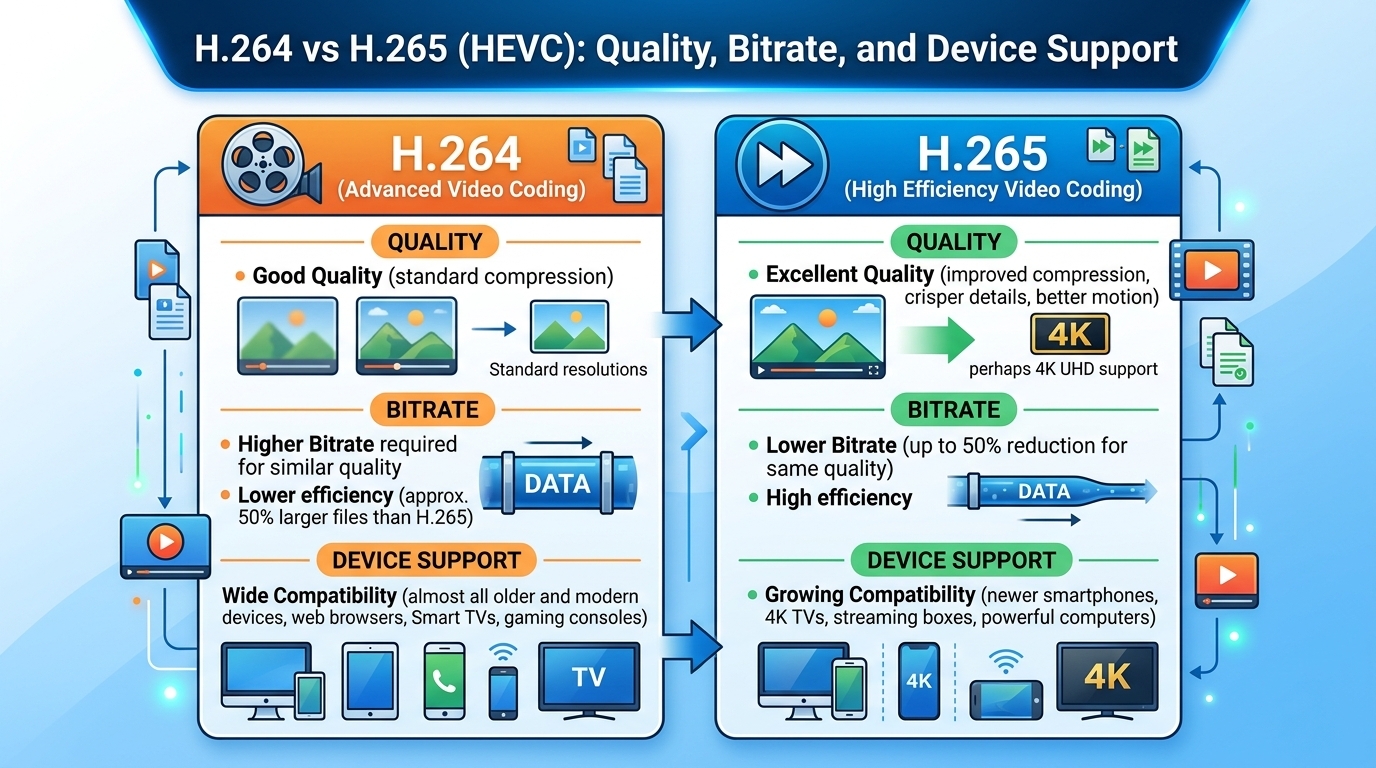
Evaluated October 2026: in the h264 vs h265 decision, HEVC (H.265) matches H.264 (AVC) quality at roughly 30 to 50 ...