
Learn
Lossy vs Lossless Compression: Images, Video and Audio
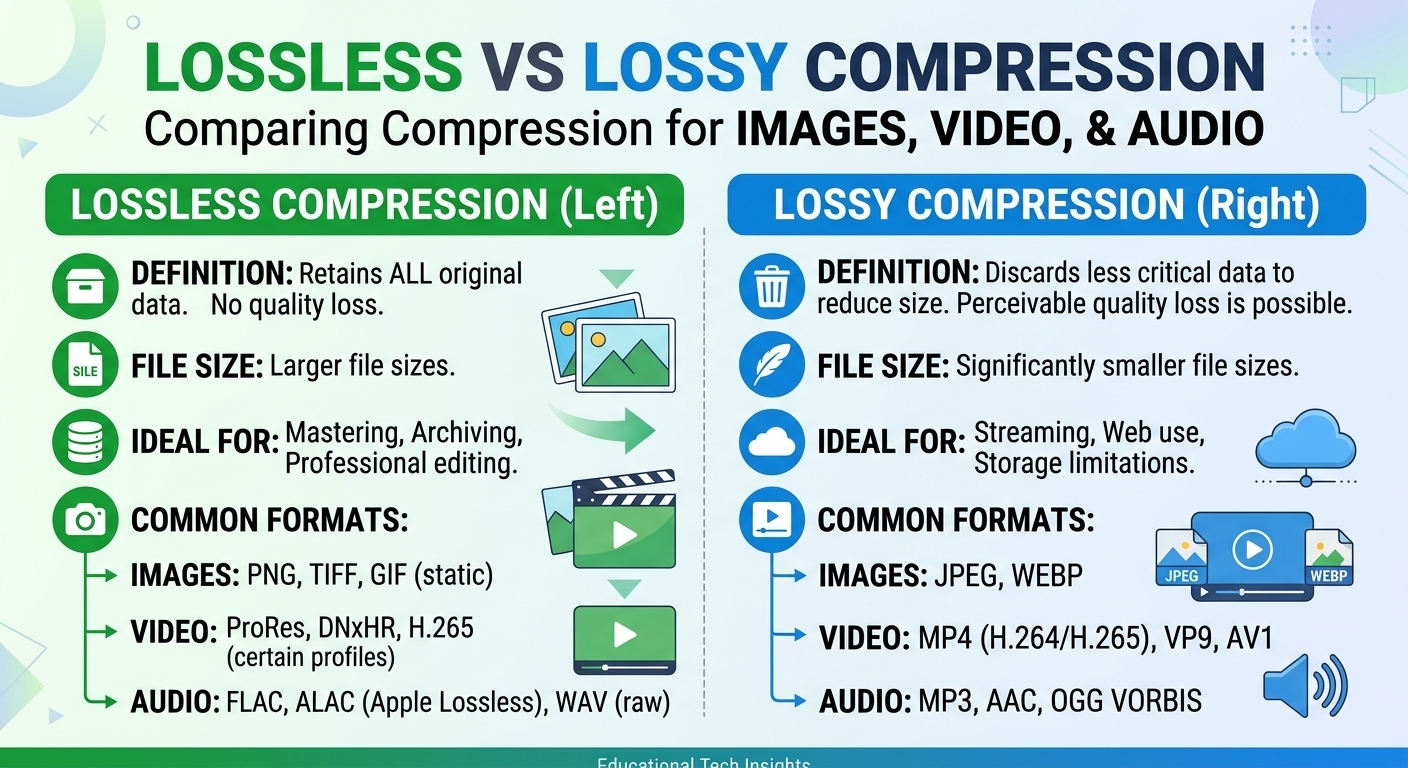
Lossy vs lossless compression comes down to one trade: lossless compression rebuilds every original bit and typically ...
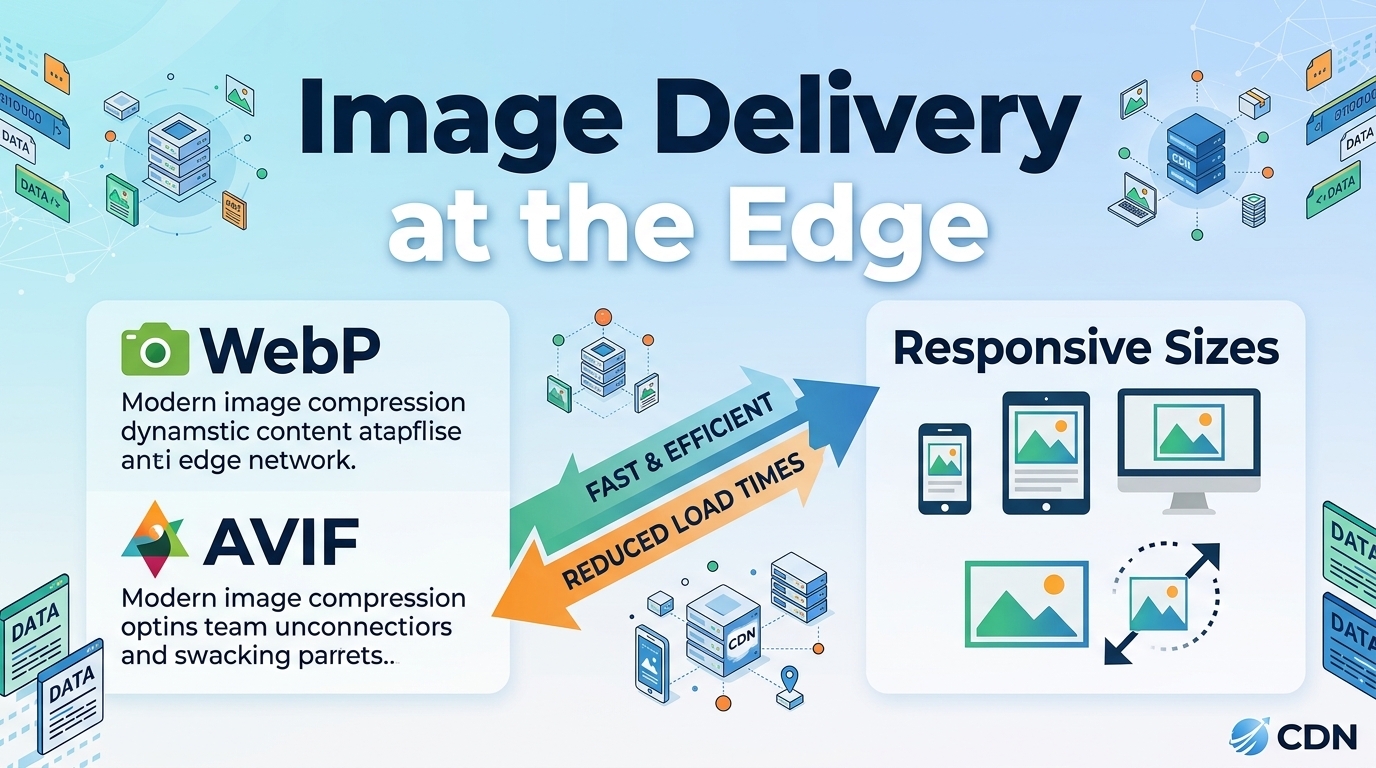
An image CDN should serve AVIF to the roughly 93–95% of browsers that decode it as of 2026, WebP to most of the rest, and JPEG as a last resort, at a width close to the rendered slot. Done naively, that means one source image fans out into thousands of cache objects and your hit ratio collapses. Done correctly, you normalize the Accept header to three format buckets and quantize widths to about nine steps. That caps every source at 27 variants, keeps edge hit ratios in the high 90s, and still cuts image bytes by 40–60% against unoptimized JPEG.
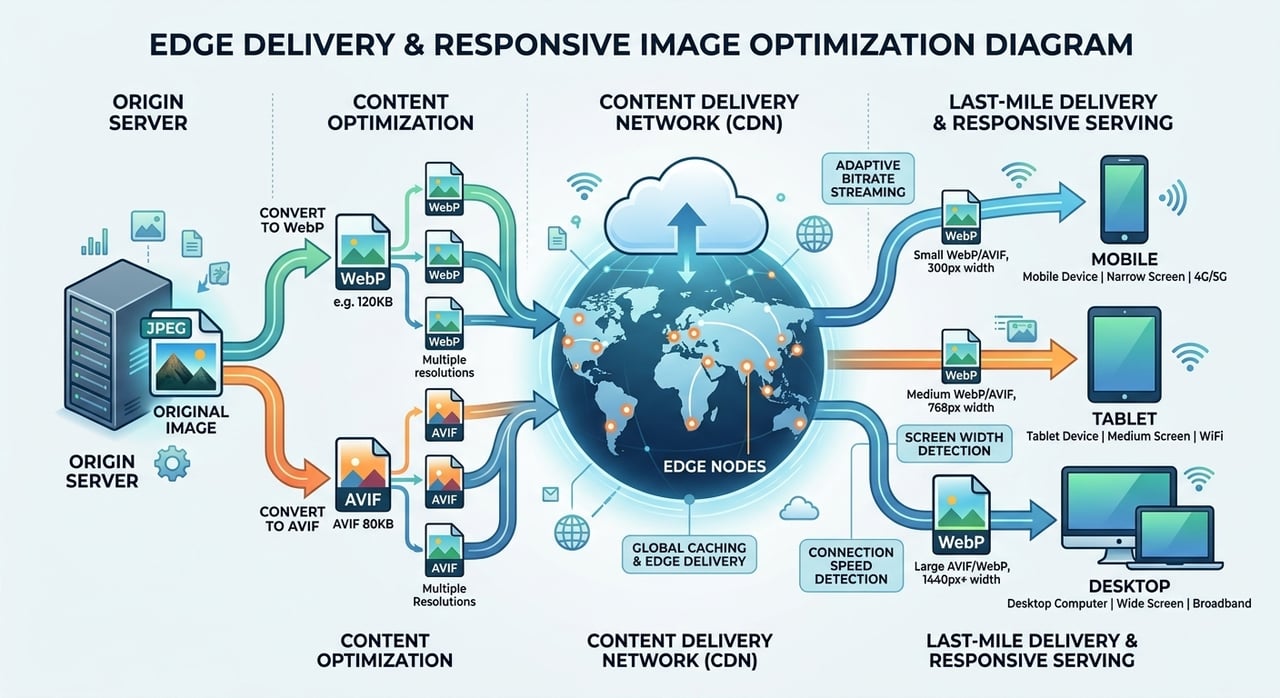
Each transformation dimension multiplies the object count. Three dimensions matter: format, width, and device pixel ratio (DPR). Quality is sometimes a fourth. If width comes straight from a client hint or an unbounded URL parameter, a single hero image can realistically be requested at hundreds of distinct widths across a device fleet.
Raw Accept headers make it worse. Chromium, Safari, and Firefox each send different Accept strings for image requests, and those strings change between browser versions. Vary on the raw header and a mid-sized site sees dozens of distinct values for the same URL. Each value becomes a separate cache entry holding byte-identical content.
Assume one image receives 10,000 requests per day at a given edge cache, and each distinct variant costs exactly one cold miss per TTL window. This is a simplified model, not a benchmark:
The long tail is what hurts. Every cold miss is a transform, and transforms are expensive. AVIF encoding commonly costs several times the CPU of an equivalent WebP encode at comparable speed presets, and can reach hundreds of milliseconds for large sources. A fragmented cache turns image optimization at the edge into a CPU cost center with p99 latency to match.
You have two viable designs. They carry different cache behavior.
Markup negotiation uses a picture element whose source entries declare type image/avif and image/webp, falling back to a plain JPEG. Each format gets its own URL, so no Vary header is needed and every cache in the path behaves predictably. The cost is heavier HTML, plus a template change for every image slot.
Header negotiation keeps one URL and has the edge choose the format from the Accept header. Templates stay simple. The CDN must normalize the header into its cache key, and it must emit Vary: Accept so downstream caches and browsers do not cross-serve formats.
For most teams, header negotiation with strict normalization is the better default, because it works on legacy markup and third-party embeds. Use markup negotiation when you do not control the cache key logic of every layer in front of users.
| Request signal | Normalization rule | Cache key contribution |
|---|---|---|
| Accept header | Contains image/avif maps to avif; else contains image/webp maps to webp; else jpeg | One of 3 tokens; the raw header is discarded |
| Requested width in path | Round up to the nearest step in 320, 480, 640, 768, 1024, 1280, 1600, 1920, 2560 | One of 9 widths |
| Width above source intrinsic size | Clamp to intrinsic width and never upscale | Collapses oversize requests into one entry |
| DPR or client hints | Multiply into width before rounding, with DPR capped at 2 | None separately |
| Quality | Fixed per format server-side and not client-controllable | None |
The key insight from these rules: everything the client sends is folded into two small enumerations, format and width step, before it can reach the cache key.
Put width in the path, for example a w640 segment ahead of the filename, rather than in a query parameter. Some cache layers ignore or reorder query strings. Make the srcset w descriptors in your templates list exactly the nine allowed widths, so browsers request only widths that already exist in cache. A sizes attribute that reflects the real layout matters as much as the formats themselves.
Client hints such as Sec-CH-Width and Sec-CH-DPR remain Chromium-only in 2026 and require an Accept-CH opt-in. Treat them as an optimization for one engine family, not as the primary width signal.
As of 2026, AVIF is decodable in roughly 93–95% of browsers in global use, including Chrome, Firefox, and Safari 16 and later, and typically produces files 20–30% smaller than WebP at matched perceptual quality. An image CDN that normalizes the Accept header to three format buckets and quantizes widths to nine steps caps each source image at 27 cached variants, compared with thousands under free-form resizing.
That last point is where storage hardware matters. BlazingCDN runs its edge on NVMe SSD storage with flexible configuration, which helps keep a multiplied variant set resident instead of evicted; its edge caching and image delivery features are worth checking against your variant budget.
This design fits catalogs with thousands to millions of images, such as ecommerce, media, and user-generated content, where traffic concentrates on a hot set and transform CPU is a real line item. It fits less well for small marketing sites with a few dozen images. There, pre-generating AVIF and WebP at build time and using markup negotiation is simpler, and it needs no edge logic at all.
Pull 24 hours of edge logs for image paths and compute distinct cache keys per source image. Then compare the image hit ratio to your overall hit ratio. If keys per image exceed 30, or image hit ratio trails the site average by more than 3 points, adopt the three-bucket Accept rule and the nine-width allow-list, align your srcset to those widths, and re-measure after one full TTL cycle. Track transform CPU seconds and image bytes per page view before and after. Those two numbers will tell you whether AVIF is paying for itself on your traffic.

Heavy traffic.
Light bill.
The CDN for video and large traffic
Learn
Lossy vs lossless compression comes down to one trade: lossless compression rebuilds every original bit and typically ...
Pricing - Pricing & Costs
The CloudFront vs S3 decision depends more on object size than on traffic volume. At a 500 KB average response, 100 TB ...
Learn
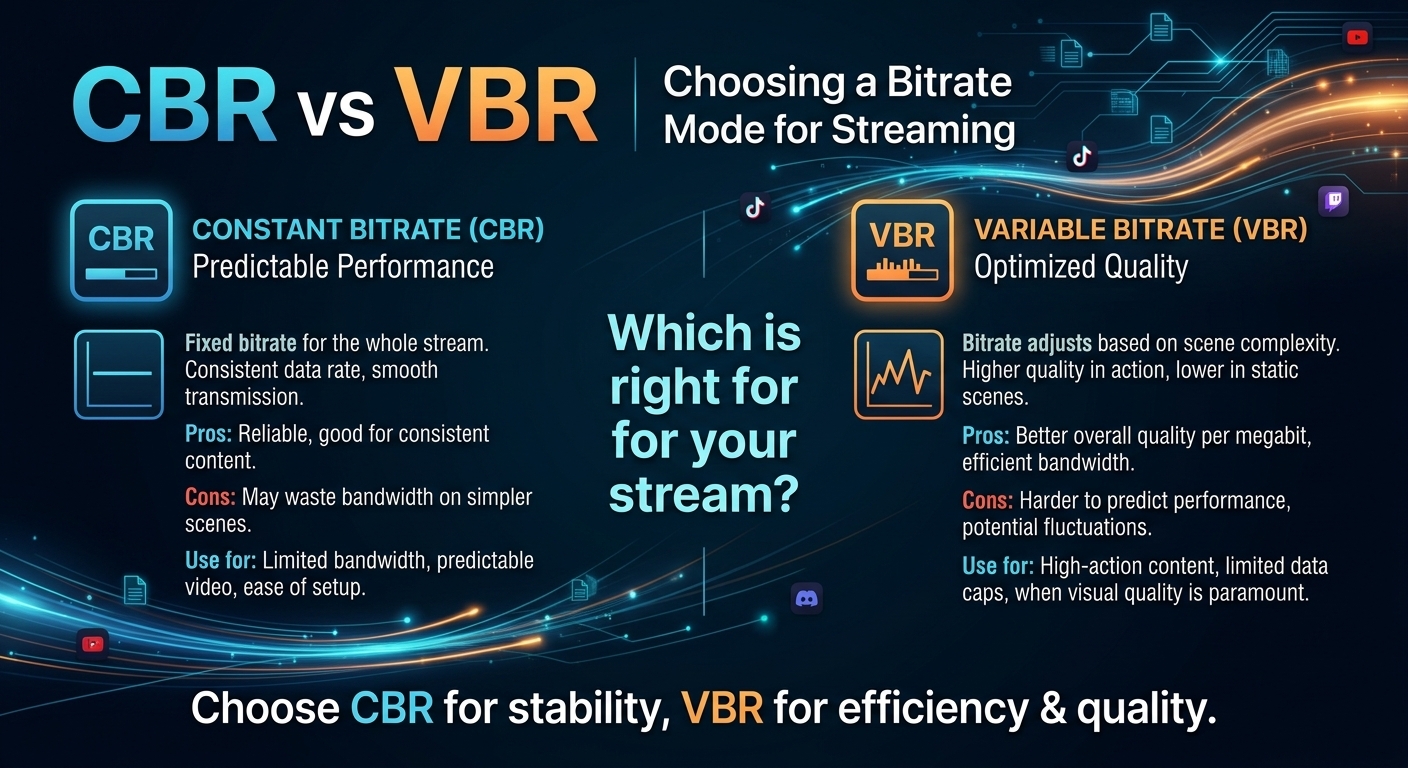
For most on-demand video, capped variable bitrate (VBR) wins the cbr vs vbr decision: it spends bits where the picture ...