
Learn
Lossy vs Lossless Compression: Images, Video and Audio
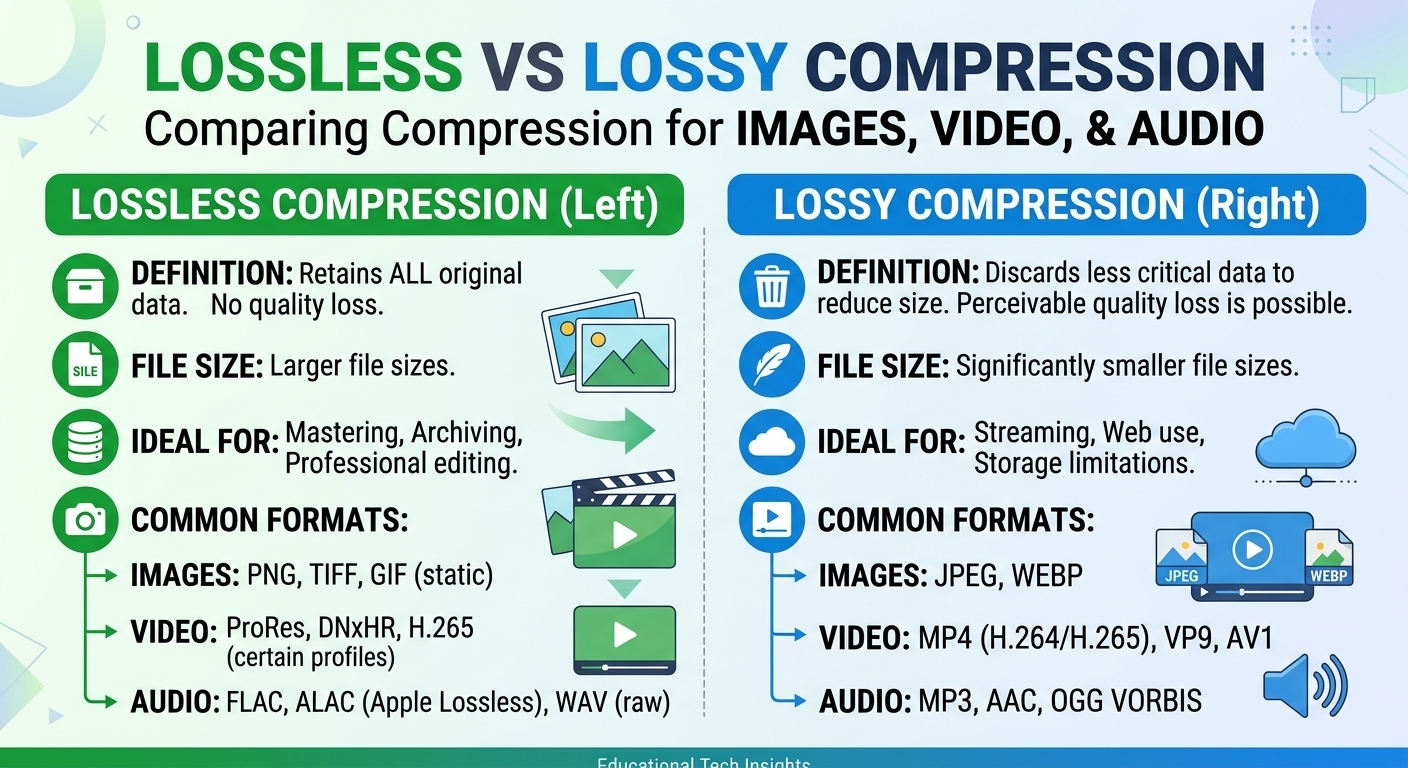
Lossy vs lossless compression comes down to one trade: lossless compression rebuilds every original bit and typically ...
In Q1 2026, the global cost of online video piracy reached an estimated $75 billion annually, according to industry tracking from the Motion Picture Association. That figure is up roughly 15% from 2024 estimates. Yet the attack surface has shifted: the majority of premium video leaks now originate not from client-side screen capture but from compromised delivery tokens and replay attacks against CDN edge nodes. Video content security in 2026 demands more than DRM wrappers bolted onto aging infrastructure. It requires a layered architecture where rights verification, delivery enforcement, and forensic traceability operate as a single system. This article delivers a concrete framework for integrating blockchain-based rights management with CDN-level security controls, including a decision matrix for choosing the right combination of techniques per workload profile, a failure-mode analysis the current top-10 results do not cover, and specific threshold values for when each layer justifies its operational cost.
DRM alone has never stopped determined piracy. Widevine L3 was broken publicly in 2020 and its key extraction attack surface has only widened since. As of early 2026, Widevine L1 remains generally sound on certified devices, but the real vulnerability has moved downstream: session token theft, HLS/DASH manifest scraping, and unauthorized CDN pull requests that sidestep the DRM handshake entirely. A blockchain layer addresses the rights-and-provenance gap. A properly configured CDN edge addresses the delivery-and-enforcement gap. Neither substitutes for the other.
The useful application of blockchain in video security is narrow and specific. It is not about storing video on-chain. It is about three functions that distributed ledgers handle better than centralized databases:
The operational cost of on-chain writes has dropped significantly. Polygon PoS transactions cost fractions of a cent in 2026. Ethereum L2s like Arbitrum and Base settle for under $0.01 per transaction in normal conditions. The economic barrier that made blockchain video security impractical in 2022 is largely gone.
Blockchain cannot prevent screen recording. It cannot enforce client-side HDCP. It does not replace segment-level encryption. Teams that deploy blockchain expecting it to function as DRM will be disappointed and will have wasted engineering cycles. Its value is upstream (rights management) and downstream (forensic accountability), not at the playback layer.
The CDN is where policy becomes enforcement. In 2026, the baseline capabilities that matter for secure video delivery are:
These are not exotic features. They are table stakes for any CDN serving premium video in 2026. The differentiator is how cheaply and reliably a provider delivers them at scale.
Not every video stream justifies the same investment. A decision matrix helps engineering teams allocate budget and complexity where the risk warrants it.
| Workload Profile | DRM Required? | Blockchain Layer Value | CDN Token Auth | Forensic Watermark |
|---|---|---|---|---|
| Live sports PPV | Yes (L1) | High — tokenized access, real-time rights verification | Mandatory, sub-10s TTL | Critical |
| SVOD catalog (films/series) | Yes (L1/L3) | Medium — rights registry, licensing audit trail | Mandatory | High value for early-window titles |
| Enterprise training / LMS | Optional | Low — internal content, limited piracy risk | Required for access control | Rarely justified |
| AVOD / free tier | No | Low — content is monetized via ads, not exclusivity | Optional (bot mitigation only) | Not justified |
| UGC platform | No | Medium — content ID and provenance for DMCA defense | Rate-limited tokens for abuse prevention | Selective (flagged content) |
The matrix makes one thing clear: blockchain adds the most value where content has a narrow exploitation window (live events, early-window premieres) and where post-leak forensics directly translate into revenue recovery or legal action.
No architecture is complete without understanding how it fails. These are the failure modes that production teams building blockchain-backed video piracy protection need to design around.
If the CDN edge validates access tokens against a cached blockchain state root, there is a propagation window during which a revoked token still works. For most L2 chains in 2026, finality is under 2 seconds, but the CDN cache refresh interval may be 30–60 seconds. A revoked subscriber can pull segments during that gap. Mitigation: implement a revocation sidecar that pushes invalidations to edge caches out-of-band from the blockchain finality cycle.
If two or more users collude and compare their individually watermarked streams, they can identify and remove the differing bits. This is a known attack against A/B watermarking schemes. Anti-collusion codes (Tardos codes, Boneh-Shaw constructions) increase resistance but require longer watermark payloads, which can introduce perceptible quality degradation at aggressive embedding strengths. The engineering tradeoff is measurable: teams should benchmark VMAF scores with and without watermark embedding at their chosen strength and set a quality floor.
A vulnerability in the rights-management smart contract could allow an attacker to mint unauthorized access tokens at scale. Unlike a centralized database, a deployed smart contract is immutable by default. Upgradeable proxy patterns (UUPS, transparent proxy) mitigate this but introduce governance complexity and a different class of trust assumptions. Formal verification of access-control logic is worth the upfront cost for high-value catalogs.
The blockchain component adds three cost categories: on-chain transaction fees, indexer/node infrastructure, and engineering integration time. As of Q2 2026, a reasonable estimate for a mid-size OTT platform processing 10 million access-token mints per month on Polygon PoS is under $5,000/month in gas fees. Indexer infrastructure (running a subgraph or equivalent) adds another $500–$1,500/month depending on query volume. The larger expense is engineering: expect 2–4 months of senior engineering time for initial integration, plus ongoing maintenance.
For a platform losing $2–5 million annually to piracy (a common estimate for mid-tier SVOD services), the ROI calculation favors deployment if the blockchain layer enables even a 5–10% reduction in unauthorized redistribution. The CDN cost is the more predictable variable. Platforms processing 100–500 TB of video delivery per month can secure enterprise-grade CDN delivery starting around $3–4 per TB. BlazingCDN's media delivery platform offers pricing that scales from $5/TB at lower volumes down to $2.50/TB at volume (as of October 2026), with signed URLs for the kind of access control this architecture requires. That cost profile competes directly with CloudFront while leaving budget headroom for the blockchain integration layer.
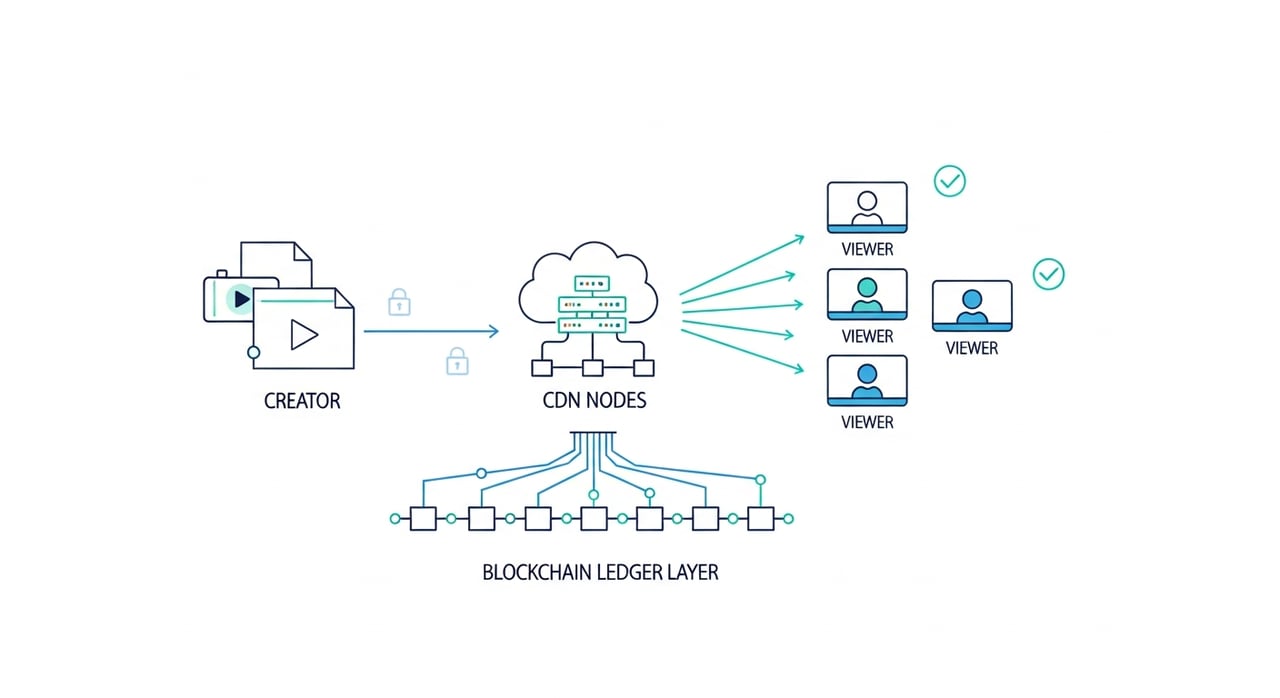
Blockchain operates at the rights-management and forensic layers, not at the playback encryption layer. It provides an immutable record of who holds distribution rights and which viewer was issued which access token. DRM still handles segment-level encryption and device attestation. The two systems address different attack surfaces.
CDN-level piracy prevention relies on short-lived token authentication, geo and ASN-based access restrictions, and per-segment request logging. These controls prevent unauthorized clients from pulling encrypted segments even if they possess a valid DRM license, and they generate the telemetry needed for forensic investigation after a leak.
Direct on-chain validation per request is impractical at video segment scale. The standard pattern is to cache the current state root or a Merkle proof at the edge and validate locally, refreshing every 15–60 seconds. This adds sub-millisecond overhead to each segment request. Initial token issuance (the on-chain write) happens once per session, not per segment.
The term "blockchain DRM" is misleading. Blockchain does not perform DRM functions (encryption, license serving, device attestation). What is production-ready in 2026 is using blockchain as a rights registry and access-token infrastructure alongside conventional DRM systems like Widevine, FairPlay, and PlayReady. Several live sports and premium SVOD platforms run this architecture in production today.
The features that matter most as of 2026 are HMAC-signed short-TTL tokens, mutual TLS between edge and origin, ASN-aware geo-fencing, per-segment access logging with session reconstruction, and configurable cache key policies that prevent manifest manipulation. Any CDN that lacks configurable token TTLs below 30 seconds is a poor fit for premium content.
The blockchain rights registry stores per-title territorial licensing windows. The CDN edge reads the viewer's token, checks claimed territory against the on-chain rights data (via cached state root), and enforces geographic restrictions at the segment level. This eliminates the common gap where a CDN geo-fence and a rights database disagree due to propagation delay or misconfiguration.
If your platform serves premium video content and you have not yet measured your token replay exposure, start there. Pull a 24-hour sample of your CDN edge logs. Count how many unique tokens issued more segment requests than a single viewer session should produce. Calculate the percentage of your total bandwidth consumed by those anomalous sessions. That number is your current piracy surface area at the delivery layer, and it tells you exactly how much value a tighter token-auth and blockchain-backed credential system would recover. If the number is above 3%, you have a project to prioritize.

Heavy traffic.
Light bill.
The CDN for video and large traffic
Learn
Lossy vs lossless compression comes down to one trade: lossless compression rebuilds every original bit and typically ...
Pricing - Pricing & Costs
The CloudFront vs S3 decision depends more on object size than on traffic volume. At a 500 KB average response, 100 TB ...
Learn
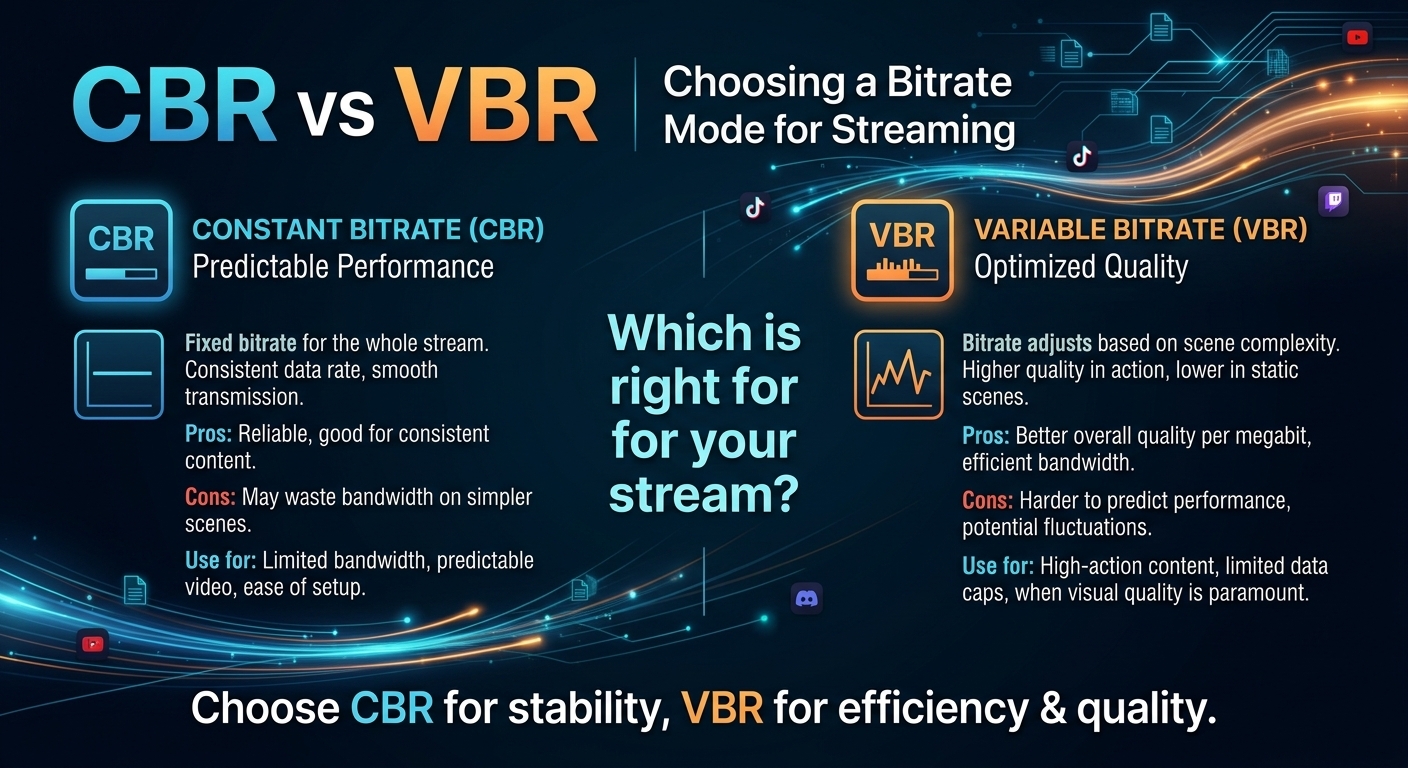
For most on-demand video, capped variable bitrate (VBR) wins the cbr vs vbr decision: it spends bits where the picture ...