
Learn
Video CDN vs Standard CDN: Why Video Streaming Needs a Different Setup
Video CDN vs Standard CDN: Why Video Streaming Needs a Different Setup In 2025, Sandvine reported that video ...

By 2025, IDC estimates that connected devices worldwide will generate over 175 zettabytes of data per year — more than 6.5 terabytes for every person on Earth. If even a fraction of that has to travel back and forth to centralized clouds before users see a result, the next generation of the internet simply won’t work.
This is why edge computing and CDNs are colliding into a new architecture: an internet where content, compute, and intelligence live as close to users as possible. Not in a single data center. Not even in a single cloud region. But everywhere.
In this article, we’ll unpack how edge computing and CDNs are converging, why it matters for streaming, gaming, SaaS, and enterprise workloads, and how you can start building for this next-gen internet today.
For more than a decade, the dominant pattern was simple: migrate applications and data to a centralized cloud, then scale vertically and horizontally inside that environment. CDNs sat at the periphery, mostly caching static assets like images, CSS, and JavaScript to reduce bandwidth costs and offload traffic from origin servers.
That model is straining under three simultaneous pressures:
Gartner predicted that by 2025, 75% of enterprise-generated data will be created and processed outside a traditional centralized data center or cloud, up from just 10% in 2018 (Gartner). That shift is exactly where edge computing and modern CDNs intersect.
As you think about your own architecture, what percentage of your application logic and data still assumes that every request must round-trip to a central cloud region?
Classic CDNs were built for a web where pages were mostly static and user interaction was simple. The main goals were:
Over the last decade, several forces pushed CDNs far beyond simple caching:
In response, CDN providers added features like:
This is what many now call an “edge CDN” or “edge platform” — a network that not only distributes content, but also runs logic, enforces policies, and shapes traffic as close to users as possible.
Think about your stack: are you still treating your CDN as a thin caching layer, or as a programmable edge where you can move real application logic?
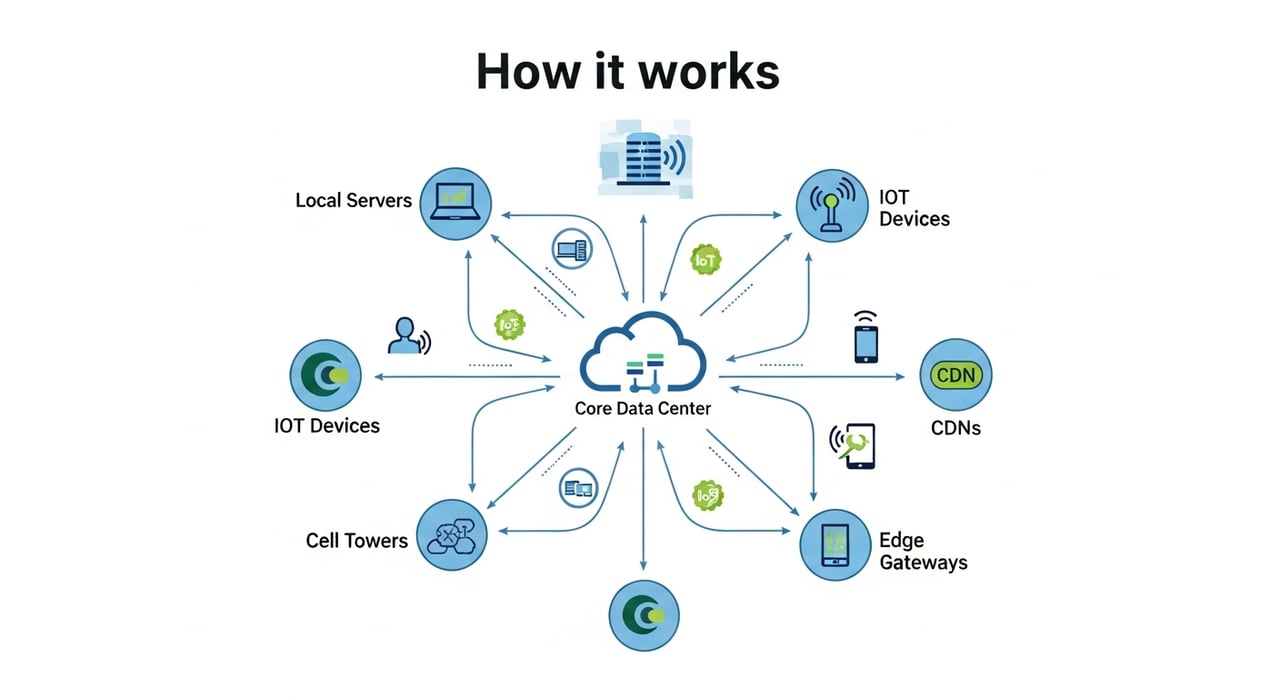
The terms “edge computing” and “CDN” are often used interchangeably, but they aren’t identical. It helps to distinguish three concepts:
| Capability | Traditional CDN | Edge Computing Platform | Edge CDN / Edge Platform |
|---|---|---|---|
| Primary Use Case | Static & semi-static content delivery | General-purpose compute near data sources | Dynamic content + logic at the delivery layer |
| Programmability | Basic rules, limited scripting | Full application runtimes | Serverless-style functions focused on HTTP |
| Typical Consumers | Websites, media sites, static assets | IoT, industrial, AI, analytics | Streaming, gaming, SaaS, APIs, eCommerce |
| Latency Sensitivity | Medium | High | Very high (sub-100 ms end-to-end) |
When you evaluate vendors, are you buying a classic CDN, an edge computing platform, or a hybrid edge CDN that lets you push logic directly into the delivery path?
To understand why edge computing and CDNs are converging, it’s helpful to look at the five pillars that modern digital experiences depend on.
Every physical hop across the internet adds latency. Even with fiber, a round-trip from London to a U.S. East Coast region can exceed 100 ms — before any application processing time.
Edge CDNs dramatically reduce this by terminating connections and often executing logic close to users. For example, global streaming platforms that place manifests and authorization logic at the edge commonly see startup times drop by hundreds of milliseconds compared to centralized-only architectures.
Where in your user journey would shaving 100–300 ms off response times measurably increase engagement or revenue?
When HD and 4K video, large binaries, or frequent API responses all traverse back to centralized origins, bandwidth becomes one of the largest operational costs.
Modern CDNs minimize this through:
By combining caching with edge compute — for example, assembling personalized responses at the edge using cached fragments — enterprises can reduce origin egress by 50–90% in high-traffic scenarios.
Do you currently treat bandwidth as a fixed cost, or as something you can meaningfully optimize with the right edge strategy?
For mission-critical applications, downtime isn’t an option. Large-scale incidents in single cloud regions have repeatedly shown the fragility of centralized architectures.
Edge-enabled CDNs can maintain availability by:
Done well, this architecture provides a level of stability indistinguishable from always-on cloud regions — even during traffic spikes or regional issues.
If your primary cloud region went partially offline for 30 minutes, how much of your application could still be served from the edge?
As data sovereignty regulations tighten, enterprises increasingly need to keep certain data regional while still delivering globally consistent user experiences.
Edge computing and CDNs help by:
This lets organizations build globally unified products while respecting local compliance and performance constraints.
Which parts of your data model must stay regional by policy or regulation — and have you mapped where those decisions are enforced in your stack?
Users expect tailored experiences — recommendations, localization, account-specific content — without accepting slower page loads or buffering.
Edge CDNs make this feasible by:
The result is Netflix-like responsiveness, but for almost any digital product — from eCommerce catalogs to SaaS dashboards.
Are your personalization strategies constrained by origin performance today, or are you already exploiting compute at the edge?
To see how this plays out, it’s helpful to look at how leading companies have already embraced edge architectures — not as a buzzword, but as an operational necessity.
Video streaming giants like Netflix, Disney+, and regional OTT providers rely heavily on CDNs and edge technologies to deliver content with minimal buffering. While architectures differ, several patterns are consistent:
Many broadcasters who have moved to edge-centric workflows report double-digit improvements in start-up time and reduction in rebuffering incidents, which directly correlates with higher viewing time and reduced churn.
What parts of your content pipeline could move from centralized processing to edge caching, transformation, or authorization?
Fast-paced multiplayer titles like Fortnite, Call of Duty: Warzone, or battle royale mobile games live and die by latency. While core game state may still reside in specialized game servers, CDNs increasingly handle:
Several large publishers have publicly discussed using edge-accelerated distribution to reduce patch-time bottlenecks and smooth global launches — turning what used to be multi-day rollouts into near-simultaneous worldwide events.
If you run games or interactive apps, how much friction do updates and downloads create today — and could edge delivery transform that experience?
SaaS providers and API-first companies increasingly face a paradox: their customers are globally distributed, but their core infrastructure is often regionally concentrated. This leads to:
Modern edge CDNs solve these issues by:
As a result, companies can offer “local-feeling” SaaS experiences without standing up full stacks in every geography.
Where are your slowest customers located, and what portion of their perceived latency could be solved at the edge instead of by duplicating entire infrastructures?
Industrial and consumer IoT deployments — from smart factories to connected vehicles — generate massive streams of data that are often time-sensitive. Waiting for a cloud round-trip to take action (e.g., shut down a machine, adjust temperature, trigger alerts) can be unacceptable.
Enterprises increasingly process and filter data at or near the edge, forwarding only what’s necessary to centralized analytics systems. Edge CDNs can sometimes play a role here too, especially when:
Cisco’s Annual Internet Report highlighted that video, gaming, and IoT together will continue to dominate IP traffic growth, further underscoring the need for distributed processing (Cisco Annual Internet Report).
Which parts of your telemetry and analytics pipelines truly require central processing — and which could be filtered or decided at the edge to save bandwidth and improve responsiveness?
Implementing edge computing with CDNs isn’t just a product choice; it’s an architectural shift. Several patterns show up repeatedly in successful deployments.
Rather than every edge location talking directly to your origin, origin shielding introduces an internal layer of caching and protection:
This pattern is particularly powerful when combined with edge logic that normalizes requests (headers, query parameters) to avoid cache fragmentation.
Have you analyzed your cache keys, TTLs, and origin shield configuration recently to see how much origin traffic is truly necessary?
Serverless functions or rules running at the edge can:
This lets you run A/B tests, feature flags, or progressive rollouts without redeploying application servers — and without adding extra latency to user requests.
What decisions are you currently making in your application layer that could safely move to an edge function or rule set?
Historically, many teams assumed that APIs couldn’t be cached because they were dynamic. In practice, a large share of API traffic is either:
With careful cache key design and short TTLs, organizations have successfully cached significant portions of their API traffic at the edge, dramatically reducing origin load and response times.
Have you classified your APIs by cacheability and experimented with conservative edge caching for safe segments?
Modern frontend architectures often combine static pre-rendering, client-side hydration, and edge rendering. For example:
This hybrid model can outperform both purely server-side and purely client-side approaches, especially on constrained devices or high-latency connections.
Are you still rendering everything in a central region, or are you exploring edge rendering and micro frontends to localize experiences?
As you evaluate CDN and edge partners, it’s important to look beyond marketing terms and focus on tangible capabilities.
Enterprise workloads care about consistency as much as peak performance. An edge-ready CDN should provide:
Ask vendors for real benchmarking data for your regions and workloads, not just generic performance charts.
The value of edge computing comes from the ability to embed logic into the delivery path. Look for:
Assess whether your existing CI/CD pipeline can integrate with edge configuration and code deployments without friction.
For large enterprises and high-traffic platforms, reliability and cost structure are as critical as raw performance. This is where specialized providers like BlazingCDN stand out.
BlazingCDN is built as a modern, high-performance CDN and edge delivery platform, delivering stability and fault tolerance on par with Amazon CloudFront while remaining more cost-effective — a crucial advantage for enterprises pushing petabytes of traffic every month. With a proven 100% uptime track record and a transparent starting cost of just $4 per TB ($0.004 per GB), it allows organizations to scale globally without surprise egress bills eating into margins.
Because of its flexible configuration model and focus on performance-critical workloads, BlazingCDN is an excellent fit for media platforms, game publishers, SaaS providers, and software companies that need to scale quickly under unpredictable load while keeping costs predictable. Many forward-thinking corporations already rely on BlazingCDN when they want both cloud-level reliability and sharper economics than legacy hyperscaler CDNs typically offer.
To explore how an edge-ready CDN can fit into your architecture, you can review the detailed capabilities on BlazingCDN’s feature overview and map them against your current performance, reliability, and cost pain points.
When you compare providers, do you only benchmark raw speed, or do you also evaluate uptime history, fault tolerance design, and long-term cost per TB at your expected scale?
You don’t need a full re-architecture to start benefiting from edge computing and next-gen CDNs. A phased approach can deliver quick wins while you learn.
Begin by profiling your application:
This audit typically reveals “low-hanging fruit” where modest cache and routing changes significantly improve performance.
Do you have a clear, metric-driven view of which parts of your stack are most sensitive to latency and origin failures?
Next, refine how you use your CDN today:
These adjustments alone can reduce origin load and bandwidth costs, setting the stage for deeper edge compute adoption.
Have you recently tested new cache strategies in a controlled experiment to quantify their impact?
Once your caching and routing are mature, identify specific edge logic candidates:
Start small, with one or two endpoints or flows, and measure their impact on latency, error rates, and origin utilization.
Which user-facing journeys would benefit most from making decisions closer to the user instead of in your core region?
As your team gains confidence, you can expand edge usage:
At this stage, the CDN is no longer just an optimization layer — it’s part of your core application architecture.
Are your platform and SRE teams aligned on how edge capabilities fit into your long-term architecture roadmap?
The shift toward edge computing and advanced CDNs isn’t theoretical — it’s visible every time a live sports stream doesn’t buffer, a global SaaS dashboard feels fast from any continent, or a massive game update rolls out without melting servers.
Enterprises that embrace this model early gain three compounding advantages: better user experiences, lower infrastructure costs, and greater resilience against regional outages and regulatory shocks. Those that wait will be forced to catch up while under competitive and operational pressure.
Take an honest look at your current stack: where are users still paying the price of unnecessary distance, centralized bottlenecks, or legacy delivery strategies? Which parts of your roadmap — from streaming to APIs to real-time analytics — would benefit most from moving closer to the edge?
If this article sparked ideas, share it with your engineering and product teams, start a conversation about your edge strategy, and sketch out a pilot project you can deploy in the next 90 days. And when you’re ready to validate that strategy with a CDN built for the next generation of the internet, explore how BlazingCDN’s high-performance, cost-effective edge delivery can help you turn that architecture into reality.
Learn
Video CDN vs Standard CDN: Why Video Streaming Needs a Different Setup In 2025, Sandvine reported that video ...

Learn
Video CDN Architecture: How to Deliver HD and 4K Streams at Any Scale Why video streaming CDN designs fail long before ...
Learn
Best Video CDN Providers in 2026: Ranked by Bitrate, Latency, and Price Video still dominates network economics. ...