
Learn
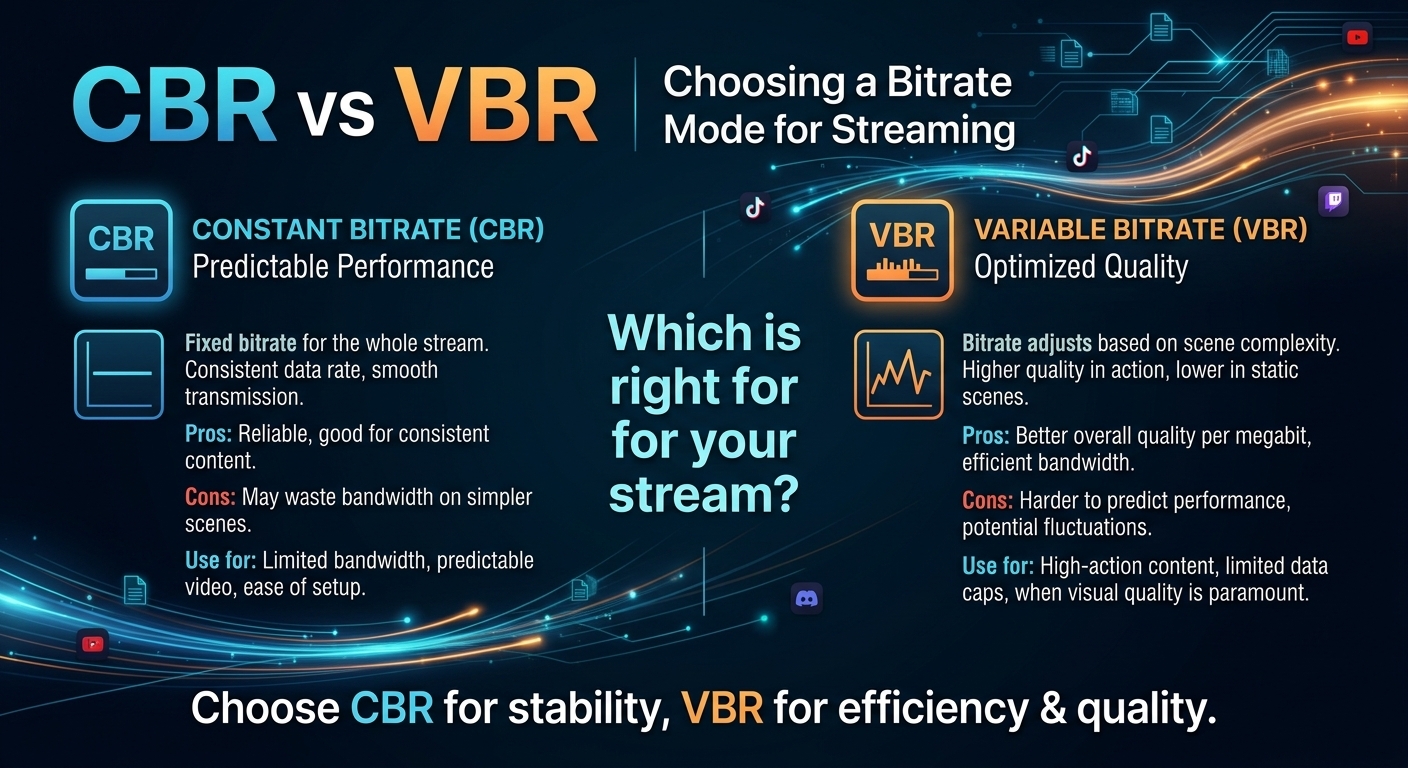
CBR vs VBR: Choosing a Bitrate Mode for Streaming
For most on-demand video, capped variable bitrate (VBR) wins the cbr vs vbr decision: it spends bits where the picture ...

Milliseconds of delay can cost millions of dollars. Google’s research has shown that as page load time goes from 1 to 3 seconds, the probability of a user bouncing increases by 32%1 — and for high-traffic streaming or SaaS platforms, that translates directly into lost revenue and churn. Yet in the middle of this performance arms race, many teams still stumble over a surprisingly basic question: what exactly is the difference between a content delivery network (CDN) and a content delivery platform (CDP)?
If your RFPs, vendor decks, and internal architecture diagrams all mix these terms interchangeably, you are not alone. Vendors increasingly market “content delivery platforms” even when they primarily operate CDNs, while multi-layer distribution stacks blur lines between infrastructure and orchestration. The risk is practical, not academic: misunderstanding these terms can lead you to overpay, overcomplicate your stack, or adopt the wrong tool for your growth stage.
This article cuts through the jargon. We’ll deconstruct what “content delivery platform” usually means in practice, how it compares to a traditional CDN, and how enterprises in streaming, gaming, SaaS, and software distribution can make smart, cost-efficient decisions — with concrete checklists and architecture examples you can reuse tomorrow.
As you read, keep one question in mind: if you had to explain your delivery architecture to your CFO in one slide today, could you clearly justify where a CDN ends and a platform begins?
Before defining anything, it’s worth asking: why did the distinction between a content delivery platform and a content delivery network become so blurry in the first place?
Over the last decade, internet traffic has changed dramatically. Video alone accounts for the majority of global downstream traffic according to Sandvine’s Global Internet Phenomena report2, with services like Netflix, YouTube, Disney+, and regional OTT players all competing for the same eyeballs and bandwidth. To keep up, providers started layering more intelligence on top of simple caching: multi-CDN routing, real-time analytics, just-in-time packaging, ad insertion, and advanced traffic steering.
Marketing followed technology. “Network” started to sound too narrow for vendors offering analytics dashboards, APIs, workflow tools, and integrations. “Platform” felt bigger, more strategic — a word comfortable in boardroom slides. So many CDN providers repositioned themselves as “content delivery platforms,” even when the heart of their product remained the global cache and delivery network.
At the same time, a new category of vendors emerged that didn’t run their own global delivery infrastructure at all, but orchestrated traffic across multiple CDNs, ISPs, and cloud environments. These companies used the same “content delivery platform” label, even though they were clearly not CDNs in the traditional sense.
The result: two very different things — infrastructure and orchestration — often use the same words on their websites. If your procurement or engineering teams aren’t precise with terminology, you can end up evaluating apples against oranges in your RFPs or building architectures that are harder (and more expensive) to operate than necessary.
As you look at your current vendors, ask yourself: are we buying raw delivery capacity, or are we buying orchestration and analytics on top of other CDNs — or both?
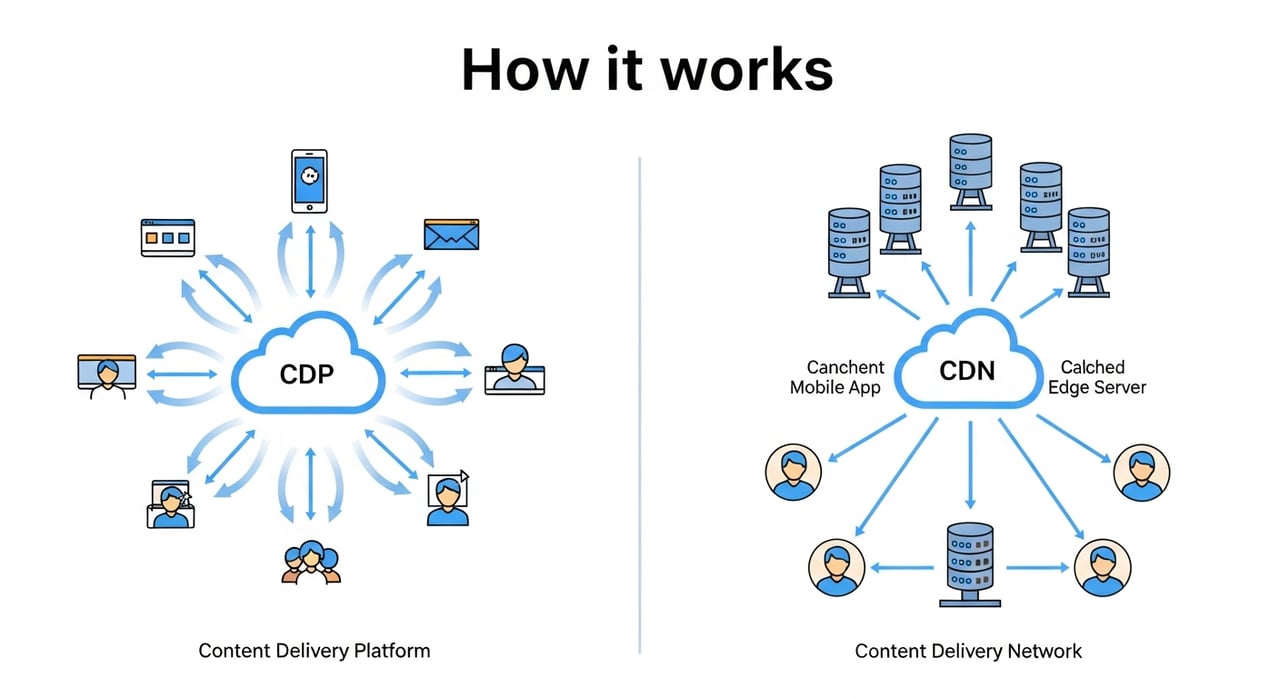
Let’s start with the more established term. A content delivery network (CDN) is primarily about infrastructure: a distributed system of edge servers that cache and deliver content (web pages, images, APIs, video segments, game assets, software binaries, downloads) close to end users to reduce latency, improve reliability, and offload origin servers.
Although different providers offer different features, most CDNs share several core capabilities:
In short, a CDN makes your content faster, more reliable, and less expensive to deliver than serving it directly from a single origin, by using distributed infrastructure and smart caching strategies.
You see CDNs in action everywhere:
In all of these scenarios, the CDN sits relatively close to the user, moving bits efficiently and reliably. It’s the “highway system” your content travels on, optimized for capacity, speed, and uptime.
Looking at your architecture diagrams today, can you clearly see which components are pure delivery infrastructure and which ones are application logic or control planes sitting above it?
When people talk about a content delivery platform, they usually mean something broader than just a network of edge servers. A CDP typically refers to a layer of orchestration, control, and added services that may sit on top of one or more CDNs (sometimes including the vendor’s own CDN, sometimes not).
The exact features vary widely by vendor, but there are common patterns.
A CDP often includes one or more of the following:
In this sense, a content delivery platform is less about the individual roads and more about the traffic control system that decides which road to use, when to reroute, and how to monitor the journey end to end.
Not every organization needs a sophisticated content delivery platform. Typically, CDPs make the biggest difference for:
These organizations care not just about the speed of a single CDN, but about how to coordinate different networks, optimize cost-performance trade-offs, and gain deep operational visibility.
As your own platform scales, do you see more value in adding yet another CDN, or in adding smarter control over the CDNs and infrastructure you already use?
With the basic definitions in place, we can compare a content delivery platform and a content delivery network across key dimensions. This is where the terminology becomes practically useful for procurement, architecture, and budget planning.
| Dimension | Content Delivery Network (CDN) | Content Delivery Platform (CDP) |
|---|---|---|
| Primary focus | Efficient, reliable delivery of content from edge servers to end users. | Orchestrating, monitoring, and optimizing delivery across one or more underlying CDNs and infrastructures. |
| Abstraction level | Infrastructure-level: network, caching, protocols. | Control-plane level: routing logic, policies, analytics, integrations. |
| Typical users | Web teams, DevOps, SREs, platform engineers. | Platform architects, traffic engineering teams, operations, product owners. |
| Vendor responsibility | Operating and scaling the global delivery network. | Coordinating multiple CDNs and/or clouds; providing visibility and control. |
| Scope of features | Caching, routing, TLS termination, basic logs and metrics, optimizations. | Multi-CDN switching, QoE analytics, business-rule engines, integrations, advanced workflows. |
| Who owns underlying CDNs? | The CDN vendor itself. | May own a CDN, may integrate several third-party CDNs, or both. |
| Procurement impact | Capacity-based contracts (per TB/GB, requests). | Often subscription or platform fees plus underlying CDN costs. |
In other words, a CDN is usually something you plug your traffic into, while a content delivery platform is something you use to decide how and where that traffic should flow — especially when multiple delivery networks are involved.
Looking at this table, where does your current “content delivery solution” actually sit — and are your RFPs and internal docs using the right term for it?
Real-world offerings don’t always fit neatly into textbook definitions. Many modern CDNs include some platform-like features, and some platforms bundle their own CDN capacity. Understanding this overlap helps you avoid being misled by marketing language.
Several CDN providers now ship:
As these capabilities matured, some vendors began calling their offerings “edge platforms” or “content delivery platforms,” even though they still operate fundamentally as single CDNs. The platform label reflects optionality and flexibility more than a change in the underlying infrastructure model.
On the other side, multi-CDN orchestration vendors may not operate their own global cache network at all. Instead, they plug into multiple third-party CDNs via APIs and provide:
They are true content delivery platforms in the sense of coordination and visibility, but they are not CDNs by themselves. You still need underlying CDN contracts to move the bits.
This overlap means you must look past labels and interrogate architecture diagrams and billing models. The more precise your questions, the easier it becomes to compare solutions on equal footing.
When you meet with vendors, are you asking them explicitly: “Which parts of this solution are your own network, and which parts are orchestration over third-party CDNs?”
Now the strategic question: does your organization need a standalone CDN, a full content delivery platform, or a combination of the two? The answer depends on your scale, risk tolerance, and the complexity of your traffic.
For many enterprises, especially those still scaling, a well-chosen CDN can cover 80–90% of their needs without the overhead of a separate platform layer. This is often true when:
In these cases, picking a CDN that offers strong performance, transparent pricing, built-in failover, and flexible configuration is more impactful than investing immediately in a separate multi-CDN orchestration platform.
Enterprises that prioritize cost efficiency without sacrificing reliability often find that modern providers like BlazingCDN are designed for cost-conscious delivery. With a starting price of $5 per TB, down to $2.50 per TB at volume (as of October 2026), BlazingCDN is designed for organizations that want predictable spend alongside enterprise-grade performance.
A full CDP starts to make sense when:
Here, a content delivery platform can turn a “sprawl of CDNs” into a coherent, governed system with clear accountability and levers to optimize cost and quality.
Looking at your roadmap over the next 12–24 months, do you expect more value from simplifying with one best-fit CDN, or from coordinating several at once with a platform layer on top?
The CDN vs CDP decision becomes clearer when you ground it in concrete verticals. Let’s walk through how different industries can approach content delivery strategy — and where a provider like BlazingCDN fits into the picture.
Large streaming platforms — from global giants to regional sports and news services — face three core challenges: peaks (live events), geographic reach, and QoE consistency. Many use a combination of one or two primary CDNs plus a backup or regional partner.
For most broadcasters and OTT services, a high-performance CDN with strong reliability and transparent pricing covers typical VOD libraries, day-to-day live channels, and catch-up TV. A full CDP layer is often reserved for platforms with extremely high concurrency or complex rights and monetization requirements.
BlazingCDN is particularly attractive here because it combines Anycast routing with built-in failover and pay-as-you-go pricing. That cost delta matters when you’re serving multi-petabyte video catalogs or streaming premium live events; shaving even a fraction off your per-GB rate can translate into six- or seven-figure annual savings.
If you operate a streaming or media service, how precisely do you quantify the trade-off between adding another CDN versus optimizing your primary one?
SaaS platforms and digital products depend on low-latency API calls, fast asset delivery, and minimal cold-start times for critical workflows. Most of their traffic is HTTP(S), with relatively predictable patterns and frequent deployments.
In this environment, a well-tuned CDN is usually the backbone of performance: caching static assets, optimizing TLS handshakes, and accelerating edge delivery of SPAs and micro-frontends. A separate content delivery platform may not be necessary unless you’ve grown into a multi-CDN posture or run across several clouds and regions with strict SLOs.
Many SaaS providers choose to consolidate traffic on a single, modern CDN with aggressive pricing to keep unit economics healthy. BlazingCDN’s cost structure — starting at $5 per TB, down to $2.50 per TB at volume (as of October 2026) — enables teams to scale globally without constantly renegotiating bandwidth contracts.
As your SaaS grows, are you overcomplicating delivery early with multi-CDN setups, or are you squeezing maximum value from one strong CDN first?
Online games, app stores, and software vendors face intense, short-lived traffic spikes during launches and patch days. A successful update rollout might mean delivering tens of terabytes or more in a matter of hours, often to latency-sensitive users.
Here, a robust CDN is non-negotiable for distributing large binaries quickly and reliably. Many game publishers start with one CDN and only move to a content delivery platform once they are operating at a truly global, multi-title scale where every millisecond of download time and every cent per GB counts.
BlazingCDN’s combination of enterprise performance and aggressive per-TB pricing makes it an optimal fit for these workloads. It allows game and software companies to handle unpredictable spikes, quickly scale to meet demand, and keep infrastructure costs aligned with revenue — a crucial balance in an industry where user expectations and file sizes keep rising.
When you plan your next major release window, do your bandwidth and delivery costs feel like a predictable line item or a potential financial shock?
Regardless of whether you adopt a pure CDN, a CDP, or a hybrid model, there are two metrics every enterprise should obsess over: performance and unit economics.
Performance isn’t just a vanity metric; it’s tied to business outcomes. According to Google’s web performance research, even modest increases in page load time can sharply increase abandonment rates1. For streaming and gaming, small degradations in startup time or buffering can drive users to competitors or reduce engagement time.
A capable CDN reduces latency, smooths out congestion, and protects your origin infrastructure from traffic spikes. When performance problems occur, they should come from your application logic or last-mile networks — not from your delivery backbone.
On the cost side, bandwidth and delivery charges are often among the largest line items for high-scale digital businesses. A difference of a few tenths of a cent per GB can accumulate into millions of dollars annually when you’re delivering petabytes of content.
This is where BlazingCDN fits enterprises that want favorable economics for static delivery. With Anycast routing, built-in failover, and a starting cost of $5 per TB, down to $2.50 per TB at volume (as of October 2026), BlazingCDN offers a delivery backbone specifically tuned for cost-conscious, high-scale operators — from media companies to SaaS and game publishers.
For teams comparing capacity-based contracts, BlazingCDN keeps things transparent through its simple, usage-driven model; you can explore options in detail on the BlazingCDN pricing page and quickly forecast how shifting traffic would impact your budget.
Looking at your own P&L, do you treat delivery costs as a fixed inevitability, or as a strategic lever you can optimize without compromising reliability?
Once you’re clear about whether you’re shopping for a CDN, a content delivery platform, or both, the next step is to evaluate vendors systematically. Use the following checklist as a starting point for RFPs and technical due diligence.
The more explicitly you frame your evaluation around these questions, the less likely you are to be distracted by branding or overlapping feature sets.
When you look at your current vendor list, which partners clearly fit your long-term architecture — and which are there mostly because of historical inertia?
At this point, “content delivery platform vs content delivery network” should feel less like a semantic puzzle and more like a strategic choice about layers in your architecture. A CDN is your delivery backbone; a CDP, where needed, becomes your control tower.
For many enterprises, especially in media, SaaS, gaming, and software distribution, the immediate ROI often comes from optimizing the backbone first: consolidating on a modern CDN with excellent reliability, aggressive pricing, and flexible configuration — and only then deciding whether an additional platform layer is justified by scale and complexity.
BlazingCDN was built precisely for that moment. It offers Anycast routing with built-in failover and a straightforward, pay-as-you-go model starting at $5 per TB, down to $2.50 per TB at volume (as of October 2026), which helps keep delivery strategy simple without overengineering multi-layer stacks from day one.
If you’re ready to turn terminology clarity into a competitive edge, start by mapping your current delivery flows, identifying where you truly need orchestration versus raw capacity, and then pressure-testing your assumptions with your team. Where could a simpler, stronger CDN underpin your growth — and where, later, might a platform layer unlock even more control?
The next step is yours: review your architecture, run the numbers, and explore how a modern CDN can reshape your economics and performance. If you want to see what that looks like in practice, dive deeper into how BlazingCDN supports custom enterprise-scale deployments with its flexible custom enterprise CDN infrastructure offering — then share this article with your engineering and product leaders and start the conversation about what “content delivery” should really mean for your organization.
So, as you look at your roadmap for the next year, ask yourself: will you let confusing terminology dictate your architecture, or will you use it as a catalyst to design a faster, leaner, and more resilient delivery stack?
1 Google/SOASTA Research on mobile page speed and user behavior, summarized at web.dev.
2 Sandvine, Global Internet Phenomena Report – insights into traffic share by application and category, available at sandvine.com.

Heavy traffic.
Light bill.
The CDN for video and large traffic
Learn
For most on-demand video, capped variable bitrate (VBR) wins the cbr vs vbr decision: it spends bits where the picture ...
Compare
As of October 2026, the Azure service that matches Amazon CloudFront is Azure Front Door Standard or Premium: Microsoft ...

Learn
In answer to what is a keyframe: a keyframe, or I-frame, is a video frame encoded without reference to any other frame, ...