

Learn
Video Resolutions Explained: From 360p to 8K
Video resolutions run from 360p (640 x 360, about 230,000 pixels) to 8K (7680 x 4320, about 33.2 million pixels), a ...
On November 18, 2025, a malformed bot-management feature file caused one of the largest CDNs on the planet to return 5xx errors worldwide for several hours. For the affected users, the fastest CDN became the slowest one. That incident shows the main point of this comparison. As of 2026, the median latency gap between Fastly, Akamai, Cloudflare and Amazon CloudFront in North America and Western Europe is usually smaller than the gap between a 92% and a 98% cache hit ratio on your own traffic.
Choosing the fastest CDN in 2026 depends on three things: where your users are, the shape of your objects, and how much you pay per terabyte. This article gives you:
No single provider is fastest everywhere. Each one wins in a specific kind of region or workload:
As of 2026, the published footprints are:
The number of locations predicts P95 latency in underserved regions. It predicts almost nothing about P50 in Frankfurt.
The table below summarizes relative standing drawn from aggregated public RUM panels, based on H1 2026 snapshots. These panels measure small-object fetch latency from real browsers. We report relative bands instead of millisecond values for two reasons:
| Region (H1 2026) | Akamai | Cloudflare | CloudFront | Fastly |
|---|---|---|---|---|
| North America | Top tier | Top tier | Top tier | Top tier |
| Western Europe | Top tier | Top tier | Top tier | Top tier |
| East Asia / Japan | Top tier | Strong | Strong | Strong |
| South and Southeast Asia | Top tier | Top tier | Strong | Variable |
| Latin America | Strong | Top tier | Strong | Variable |
| Africa / Middle East | Strong | Top tier | Variable | Variable |
Methodology box. The bands reflect median and P95 small-object latency from public RUM panels between January and June 2026. "Variable" means the provider's median is competitive, but its P95 spreads widely by country. Keep three limitations in mind. RUM panels measure edge hits, not origin fetches. They underweight large-object throughput. They cannot see your cache hit ratio. Updated H2 2026 bands will be added when the next panel snapshots publish. To reproduce the comparison, run your own RUM beacon against identical test objects of about 20 KB and 2 MB on each vendor for at least 14 days. Record P50, P95 and P99 TTFB plus throughput, segmented by ASN and not just by country.
Synthetic probes run from data centers, so they reward peering density close to cloud regions. Real users sit behind mobile carriers and CGNAT. There, HTTP/3 over QUIC matters more than POP count: 0-RTT resumption and connection migration show up in P99, not P50. All four vendors ship HTTP/3 by default as of 2026. The real differences lie in congestion control tuning and how each vendor handles QUIC when a UDP-hostile network forces fallback to TCP.
Akamai's ISP-embedded caches remain its structural advantage for million-viewer live events: they keep segments inside the eyeball network and cut jitter. The trade-offs are contract-only pricing, slower self-service configuration, and EdgeWorkers limits that frustrate teams used to Workers-style development.
The Akamai vs CloudFront question usually comes down to origin location. When your origin sits in S3, MediaPackage or an Application Load Balancer, CloudFront's regional edge caches and Origin Shield collapse cache-miss latency and egress cost. CloudFront Functions and KeyValueStore now handle most header and routing logic without Lambda@Edge cold starts.
Fastly Compute (formerly Compute@Edge) runs Wasm with near-zero startup overhead. Purge completes globally in roughly 150 ms. Together, these make Fastly the strongest option for SSAI manifest rewriting and high-churn APIs. Its main gap is footprint density outside North America, Europe and developed Asia-Pacific markets.
Cloudflare's anycast network across 330+ cities gives it the flattest global latency curve. Workers plus Stream make it the fastest path from zero to production. Two caveats apply. Large-scale video delivery generally requires Stream or an Enterprise agreement. And the late-2025 global incidents are a reminder that a single control plane is a correlated failure domain.
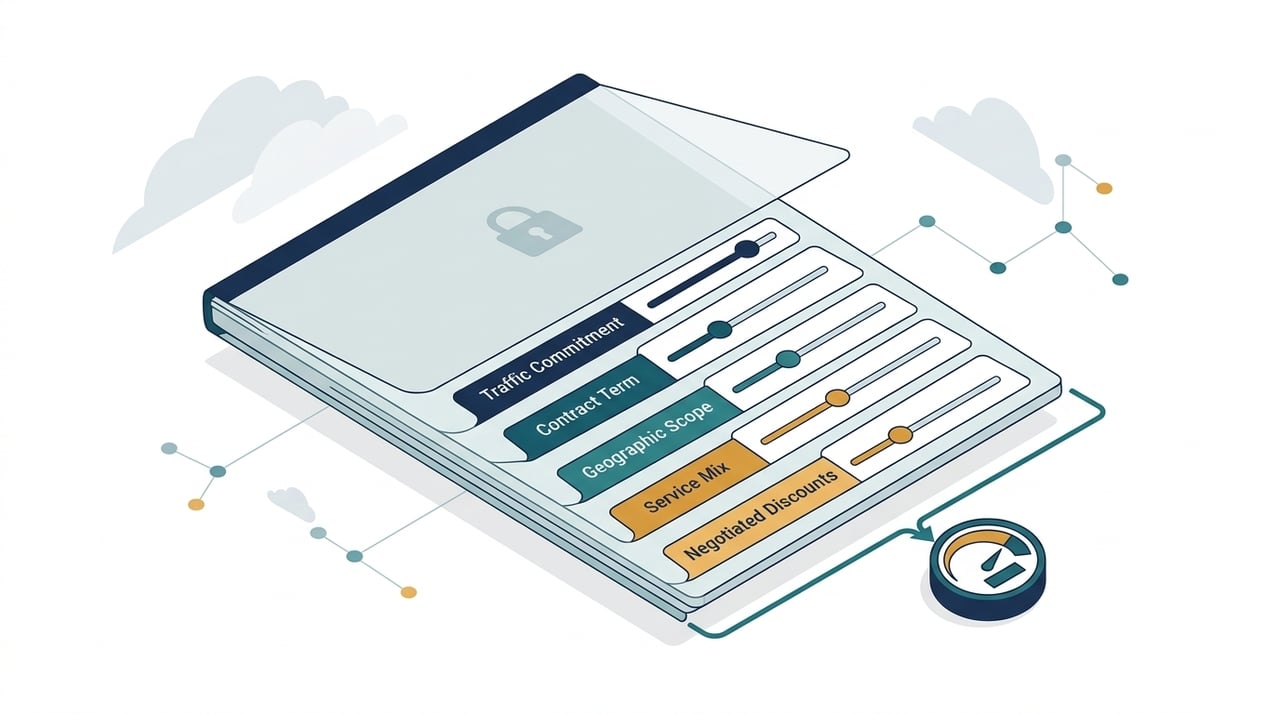
Speed is the entry ticket. Cost per TB decides the contract. The table uses public list prices as of 2026 for North America and Europe egress only, excluding request fees. Negotiated enterprise rates will be lower.
| Provider | Pricing model | 100 TB/mo | 500 TB/mo | 2 PB/mo |
|---|---|---|---|---|
| BlazingCDN | Published volume tiers, $5/TB down to $2.50/TB | $415 | $1,815 | From $2.50/TB, quoted individually |
| Amazon CloudFront | Tiered list, $0.085/GB down to $0.020/GB; flat-rate bundles for smaller sites | ~$7,050 | ~$24,050 | ~$64,000 |
| Fastly | Usage list historically ~$0.12/GB entry tier; packages and commits common | Negotiated, often above CloudFront list | Negotiated | Negotiated |
| Cloudflare | Plan-based (Pro, Business at $200/mo, Enterprise); Stream about $1 per 1,000 minutes delivered | Enterprise for video | Enterprise | Enterprise |
| Akamai | Contract-only commits; no public per-GB list | Negotiated | Negotiated | Negotiated, low cents/GB at PB commits |
The CloudFront figures follow the published tiers:
Private pricing agreements typically cut these rates substantially at PB scale. Even so, a gap of an order of magnitude against specialist CDNs is common.
That gap is where BlazingCDN fits. It competes in the high-volume, cost-at-scale league alongside Bunny.net, CDN77, Gcore and Medianova, not head-to-head with Akamai's ISP footprint or Cloudflare's security stack. It runs on Anycast routing with built-in failover, NVMe SSD edge caches and roughly one-hour onboarding. It costs $2.50 per TB at volume (as of October 2026). For segment-heavy VOD and large-file delivery that does not need a Wasm runtime, BlazingCDN's media delivery infrastructure is worth running through the same RUM test as the incumbents.
| Workload profile | First pick | Second pick | Deciding metric |
|---|---|---|---|
| High-volume VOD, 500 TB+ per month | BlazingCDN | CloudFront (AWS origin) | Cost per TB at equal rebuffer ratio |
| Global live sports, 1M+ concurrent viewers | Akamai | Multi-CDN with steering | P99 segment TTFB during peak |
| SSAI and manifest personalization | Fastly | Cloudflare Workers | Compute P99 plus purge time |
| AWS-native pipeline (MediaLive, IVS) | CloudFront | BlazingCDN for offload | Origin egress plus miss latency |
| Small team, turnkey encode and deliver | Cloudflare Stream | CloudFront plus MediaConvert | Time to production |
| Emerging-market audiences | Cloudflare or Akamai | CloudFront | P95 latency by ASN |
The pattern we see most often in 2026 is a split architecture. A feature-rich CDN handles HTML, APIs and edge logic. A cost-optimized CDN carries the bulk segment and binary bytes, where 90% or more of egress volume lives.
No vendor is fastest in every region. In North America and Europe, Fastly, Akamai, Cloudflare and CloudFront sit within a few milliseconds of each other at median. Cloudflare and Akamai tend to lead on P95 in emerging markets because of footprint density.
Akamai is stronger for massive live events because its ISP-embedded caches reduce last-mile jitter. CloudFront is usually better when your packaging and origin already run on AWS, since regional edge caches and Origin Shield reduce miss latency and egress.
Serve identical small and large test objects from each vendor and collect RUM from real users for at least two weeks. Compare P50, P95 and P99 TTFB and throughput by ASN, then weigh the results against your actual cache hit ratio and cost per TB.
All four providers support HTTP/3 by default as of 2026, so it no longer separates them on paper. The differences show up in tail latency on lossy mobile networks and in how gracefully each vendor falls back to TCP when UDP is blocked.
Not necessarily for cacheable, high-volume content, where hit ratio and cache capacity dominate delivery performance. The trade-offs usually lie in edge compute features and footprint in specific regions, which is why testing on your own traffic matters.
Pick your top 20 ASNs by traffic. Put one representative HLS segment and one 20 KB API response behind two CDNs, and beacon P95 TTFB and throughput from real sessions for 14 days. Then divide the monthly invoice by delivered terabytes. If the P95 delta is under 10 ms and the cost per TB differs by 5x or more, you have your answer for bulk bytes. What does your P99 look like on your worst-performing ASN today?

Heavy traffic.
Light bill.
The CDN for video and large traffic
Learn
Video resolutions run from 360p (640 x 360, about 230,000 pixels) to 8K (7680 x 4320, about 33.2 million pixels), a ...

Learn
cdnjs is an open-source public JavaScript CDN that serves more than 4,000 libraries (2025 index size) from Cloudflare's ...
Learn
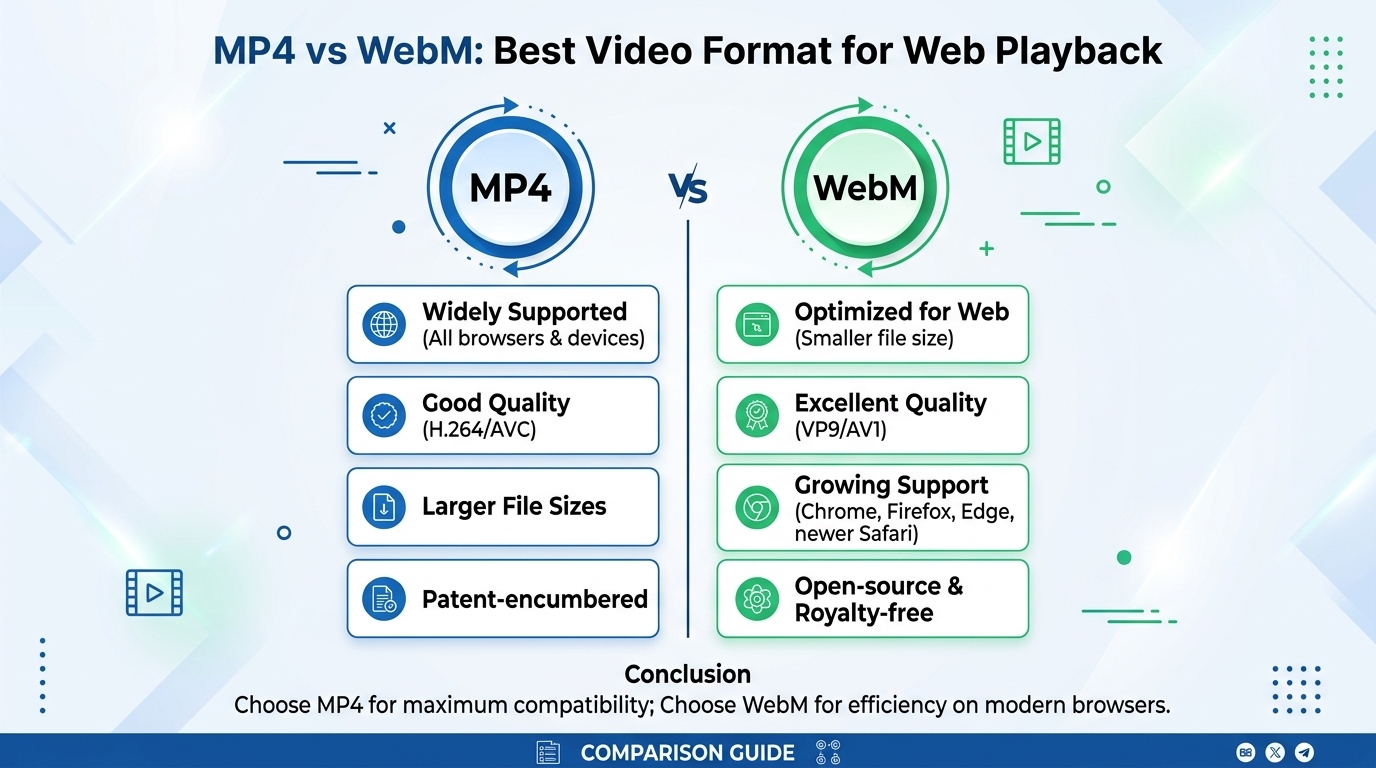
For web playback in 2026, ship MP4 (H.264 video, AAC audio) as the universal baseline and add WebM (VP9 or AV1) as a ...