
Compare
jsDelivr vs unpkg vs cdnjs in 2026: Which Free CDN Is Fastest
jsDelivr vs unpkg vs cdnjs in 2026: Fastest Free CDN Benchmark In our Q1 2026 measurements, jsDelivr delivered an 18 ms ...
If you are choosing between Cloudflare and Akamai in 2026, the real question is usually not which brand is bigger. It is which platform better fits your traffic shape, security posture, procurement model, and migration constraints. This comparison covers two vendors because they are still the pair most often shortlisted for enterprise CDN, WAF, edge delivery, and broader application security evaluations, especially in RFPs where global reach, purge behavior, SLA language, and total cost of ownership all matter.
This article evaluates Cloudflare vs Akamai across measurable criteria: public pricing signals, enterprise deal shape, cache and delivery characteristics, purge controls, WAF and security operations fit, edge compute portability, contract friction, and migration cost. It does not try to rank every adjacent product in SASE, developer platform tooling, or full managed security services. If your buying committee is really deciding on Zero Trust network access, SOC augmentation, or bot management as the primary purchase, you need a different scorecard.
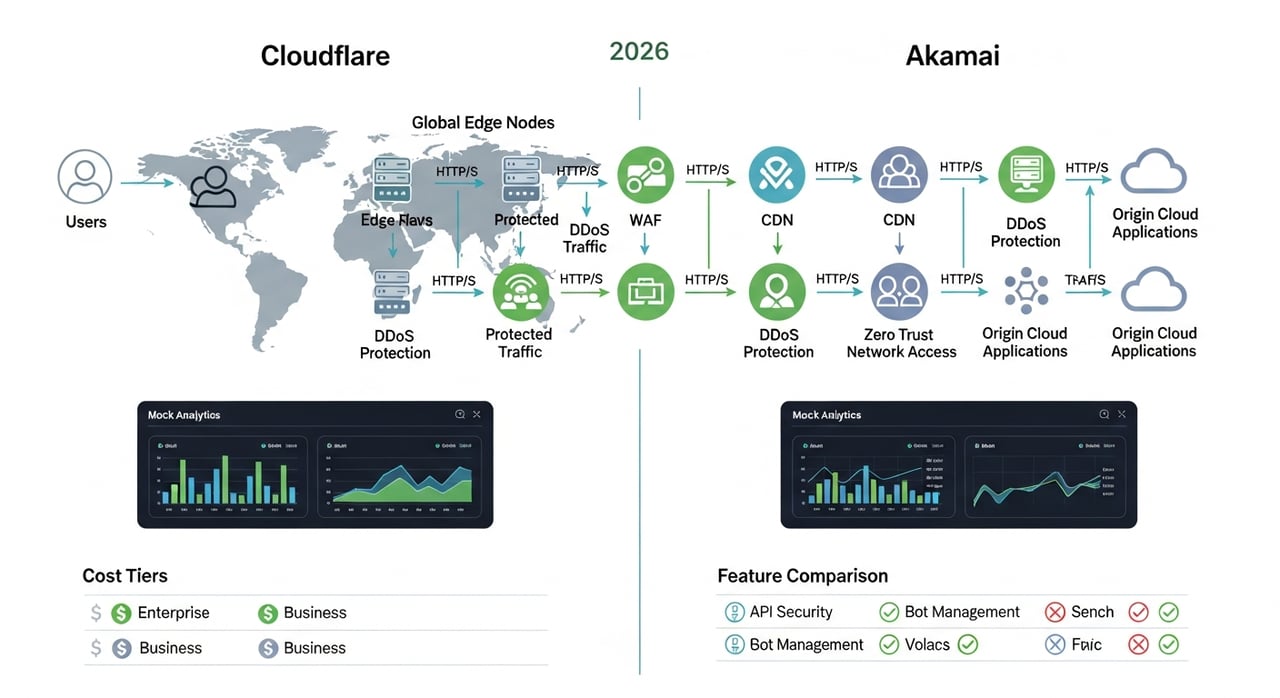
For this cloudflare vs akamai comparison, I weighted the criteria the way most enterprise platform teams do during vendor selection: delivery and cache behavior 25%, security controls 20%, pricing and TCO 20%, operability 15%, edge/runtime and integration fit 10%, contractual and support terms 10%. If your workload is mostly API traffic with low cacheability, reduce delivery weight and increase security and runtime weight. If you are buying for high-volume video or software distribution, increase delivery and pricing weight and reduce edge runtime weight.
The measurable inputs used here are the ones architects can actually defend internally: publicly visible list pricing where available, documented SLA terms where public, support and enterprise packaging signals, known purge and cache invalidation capabilities, configuration model complexity, runtime lock-in exposure, and market-observed enterprise contracting patterns as of 2026. Where public numbers do not exist, I say so explicitly rather than backfilling with guesses. This article is published by BlazingCDN, but BlazingCDN is not one of the two vendors in the main comparison and is mentioned only near the end as a contextual alternative.
There are data gaps. Akamai enterprise pricing is largely quote-based. Cloudflare publishes much more list pricing for self-serve plans, but enterprise pricing is still custom. Neither vendor publishes a clean apples-to-apples global effective $/GB table for enterprise contracts across all regions, commits, security bundles, and overage patterns, so any cloudflare vs akamai pricing discussion has to focus on pricing structure and procurement behavior, not fake precision.
Architects evaluating akamai vs cloudflare are usually buying one of four things: a global CDN contract, a combined CDN plus WAF platform, a path toward edge compute and request manipulation, or a board-defensible consolidation move that reduces the number of delivery and security vendors. Cloudflare and Akamai can both satisfy those goals, but they do so with very different operating models.
Cloudflare is structurally simpler to adopt when you want one control plane for DNS, CDN, WAF, DDoS mitigation, API protection, and edge logic, with fast onboarding and less legacy product sprawl. Akamai is structurally stronger when you need very deep enterprise controls, established procurement comfort, broad media delivery heritage, and teams that are already staffed for a more segmented and policy-heavy configuration model.
This cloudflare vs akamai enterprise review focuses on web and application delivery, WAF, edge controls, procurement complexity, and TCO. It does not cover every media workflow, every managed service option, or every acquired product family. That matters because Akamai in particular has a broad portfolio, and some organizations buy it through long-standing account structures that bundle capabilities in ways a public comparison cannot cleanly normalize.
Cloudflare is the more unified platform of the two. Its major attraction in enterprise deals is operational consolidation: one console, one policy surface, one API posture across delivery, DNS, WAF, bot controls, and edge logic. For teams trying to reduce configuration drift across multiple vendors or retire separate point products, that simplicity is often the first reason Cloudflare makes the shortlist.
Cloudflare’s architecture is built around a globally distributed edge with a strong bias toward software-defined controls exposed through APIs and a relatively consistent policy model. In practical terms, engineers tend to feel that in day two operations: faster onboarding for new apps, easier rule replication, and less need to understand multiple inherited product lines before making a change.
One engineering detail that matters in 2026: Cloudflare’s edge and developer tooling have pulled more application teams into the platform than classic CDN teams expected. That creates a subtle lock-in vector. Once Workers, custom request handling, and application-level security rules are embedded in release processes, replacing only the CDN becomes easier on paper than in practice.
Cloudflare tends to win when a platform team wants a combined CDN, WAF, DNS, and edge logic stack with lower operational overhead. It also tends to win when the buyer wants a modern API-first operating model and fast policy iteration. If your team values unified controls more than highly specialized media and legacy enterprise workflow depth, Cloudflare is usually the cleaner fit.
Cloudflare vs akamai waf discussions also often favor Cloudflare when security and platform teams want one shared rule environment and tighter integration between app delivery and security policy. That does not automatically mean stronger protection in every deployment. It means fewer seams in day-to-day operation.
Cloudflare is not always the cheapest enterprise option once you layer in advanced security, higher support levels, and custom contract requirements. List pricing can create a perception of lower cost, but enterprise packaging often moves the comparison from list price to negotiated bundle economics. Buyers should also verify how much of their current logic would move into vendor-specific edge runtime code, because that increases switching cost later.
For very large organizations with entrenched Akamai operations, Cloudflare can also lose on internal migration friction. Not because it lacks features, but because replacing mature property configurations, custom cache key logic, and established security workflows is expensive in engineer time and change-management risk.
As of 2026, Cloudflare publishes self-serve pricing for lower tiers but enterprise pricing remains custom-quoted. That means cloudflare vs akamai pricing comparisons at enterprise scale are usually about commit tiers, included security entitlements, support response commitments, overage treatment, and multi-product bundling. In many evaluations, Cloudflare looks financially attractive when the buyer is consolidating several vendors into one contract. It can look less attractive when compared as a pure CDN line item against an aggressively negotiated incumbent deal.
Akamai remains the reference incumbent for many large enterprises with global delivery requirements, mature media distribution estates, and conservative procurement processes. It is often selected less for product novelty and more for organizational familiarity, commercial flexibility in large accounts, and confidence that unusual workload shapes can be modeled inside a long-standing enterprise agreement.
Akamai’s strength is breadth and depth accumulated over years of serving large content, commerce, and media workloads. In practice, teams often experience that as very granular controls, mature traffic engineering options, and broad support for complicated enterprise configurations. The trade-off is complexity. Akamai environments can be powerful, but they are rarely the faster path for a lean team that wants to move quickly with minimal specialist knowledge.
An engineering fact worth calling out: Akamai’s portfolio breadth can work against platform standardization efforts. Different teams inside one enterprise may still interact with different operational surfaces, account structures, or service workflows depending on how the relationship evolved. That is not always visible during vendor demos, but it shows up during governance and audit work.
Akamai usually wins when the buying organization is already heavily invested in its delivery and security ecosystem, has specialized requirements around media and large-scale distribution, or needs commercial and contractual structures shaped around a large incumbent relationship. It is also a strong fit where procurement and risk teams put a premium on continuity with an existing enterprise vendor and are willing to accept higher operating complexity.
Which is better for enterprise CDN, Cloudflare or Akamai? For organizations with large existing Akamai estates, deeply customized property behavior, and internal teams who already know the platform, Akamai can be the lower-risk answer even if it is not the simpler product. Keeping an incumbent is often a rational engineering decision when migration risk dominates feature delta.
The common Akamai drawbacks are operational complexity, slower perceived velocity for teams used to modern developer-centric workflows, and less pricing transparency. In cloudflare vs akamai enterprise evaluations, Akamai can also look expensive when compared against newer buying models that bundle delivery, security, and developer capabilities under a cleaner contract. For net-new platform builds, the cognitive load of adopting Akamai can be meaningfully higher.
Cloudflare vs akamai cdn comparisons also expose a practical issue: Akamai can be excellent for very large-scale delivery, but many teams do not need all of the configurability they end up paying for and administrating. If your architecture is straightforward and your team wants rapid iteration, that depth can become overhead.
As of 2026, Akamai pricing for enterprise customers is primarily custom-quoted. Public rate cards are not sufficient for enterprise evaluation, and real deals vary by commit, geography, included services, term length, support, and incumbent leverage. That means is Cloudflare cheaper than Akamai for enterprise is the wrong first question. The better question is whether Cloudflare or Akamai produces lower total cost of ownership after support, migration labor, bundled security, commit risk, and contract flexibility are included.
| Criterion | Cloudflare | Akamai |
|---|---|---|
| Enterprise pricing transparency | Partial. Self-serve tiers public; enterprise custom quote. | Low. Enterprise custom quote. |
| Primary commercial model | Bundled platform deal across delivery, security, DNS, edge services. | Custom enterprise contract with service-specific commercial structure. |
| Quoted CDN egress rate at enterprise scale | No public data for enterprise-specific effective rate. | No public data for enterprise-specific effective rate. |
| CDN plus WAF operating model | Unified control plane is a major strength. | Capable but often more segmented operationally. |
| WAF policy consistency across apps | Generally easier to standardize with shared rule workflows. | Strong capabilities, but standardization can require more specialist administration. |
| Purge and invalidation controls | Strong API-driven purge workflows; verify volume limits in contract. | Mature enterprise controls; verify behavior by property type and contract tier. |
| Edge logic and request manipulation | Strong modern developer experience; higher runtime lock-in risk if heavily adopted. | Powerful, but generally less streamlined for application teams. |
| Configuration complexity | Lower for most net-new teams. | Higher, especially in mature multi-property environments. |
| Best fit for incumbent enterprise estates | Good when consolidating vendors and modernizing operations. | Very strong when already deeply deployed. |
| Best fit for net-new platform build | Strong. | Conditional. Best when specialized requirements justify complexity. |
| Public latency percentile data for direct apples-to-apples enterprise comparison | No public data in a directly comparable enterprise contract context. | No public data in a directly comparable enterprise contract context. |
| Support and account model | Enterprise support available; validate P1 SLA and escalation path. | Enterprise account management is a traditional strength; validate exact response commitments. |
| Likely TCO pattern | Often favorable when consolidating multiple edge and security functions. | Often favorable when retaining incumbent estate and avoiding migration cost. |
Moving between Cloudflare and Akamai is rarely a DNS flip plus a cache warm-up. The real work is in policy translation, test harness creation, observability updates, rollout governance, and contract timing. The hidden costs usually exceed the visible ones.
For Cloudflare-to-Akamai migrations, the critical path often includes translating Workers logic, custom WAF rule semantics, cache key behavior, origin request transforms, and logging pipelines. For Akamai-to-Cloudflare migrations, the hard part is usually inventorying everything that has accreted over years of property management: redirect logic, header manipulation, auth integrations, purge workflows, and exceptions owned by multiple teams.
Reasonable planning ranges for medium-to-large enterprises are 6 to 16 engineer-weeks for a controlled migration of a modest multi-property estate, and much longer if you have significant edge logic, compliance review, or dozens of business-owned domains. The number depends on current architecture, but the critical path is usually: inventory current behaviors, build equivalence tests, dual-run on a limited traffic slice, validate logs and alerts, and only then switch production traffic.
Lock-in risks are specific, not abstract. Cloudflare lock-in usually accumulates through proprietary edge runtime code, integrated security workflows, and application teams depending on platform-native request manipulation. Akamai lock-in usually accumulates through deeply customized property configurations, vendor-specific rule models, historical account structures, and specialist operator knowledge that does not transfer cleanly.
If your scorecard says the primary driver is not edge programmability depth or incumbent account continuity, but cost-efficient enterprise delivery with predictable operations, it is worth looking at BlazingCDN as a separate lane in the process. It is a modern, reliable, cost-effective CDN that can deliver stability and fault tolerance comparable to Amazon CloudFront while remaining significantly more cost-effective for enterprises and large corporate clients, with flexible configuration, fast scaling under demand spikes, and 100% uptime as a core positioning point.
For teams focused on egress economics, pricing starts at $4 per TB and scales down to $2 per TB at 2 PB+ commitment levels. That makes it relevant in TCO-driven discussions where the shortlist has become too centered on bundled security platforms rather than the economics of delivery itself. If that is your situation, review BlazingCDN compared to major providers before finalizing the RFP.
Run a 30-day proof of concept that answers three questions with your own workload, not vendor demo traffic. First, measure effective cache hit ratio and origin offload under your real cache keys and purge patterns. Second, test rule deployment, rollback, and false-positive handling for your top five WAF scenarios. Third, ask both vendors for the exact enterprise pricing shape at your actual commit tier, including overages, support, and any required bundles.
If procurement is already involved, add one clause request now: the right to benchmark and exit if the vendor misses agreed purge, support-response, or logging-latency thresholds during acceptance. That single clause forces a more honest discussion than any slide deck. If your team is stuck on one dimension of the cloudflare vs akamai decision, make that the benchmark first and let the result narrow the field.
Compare
jsDelivr vs unpkg vs cdnjs in 2026: Fastest Free CDN Benchmark In our Q1 2026 measurements, jsDelivr delivered an 18 ms ...

Compare
Imagine a bustling global marketplace where digital content flows as smoothly as traffic in a well-orchestrated city. ...

Learn
AWS CloudFront Pricing in 2026: Cost per TB Breakdown At 50 TB/month of egress from US edge locations, your AWS ...