Learn
Lossy vs Lossless Compression: Images, Video and Audio
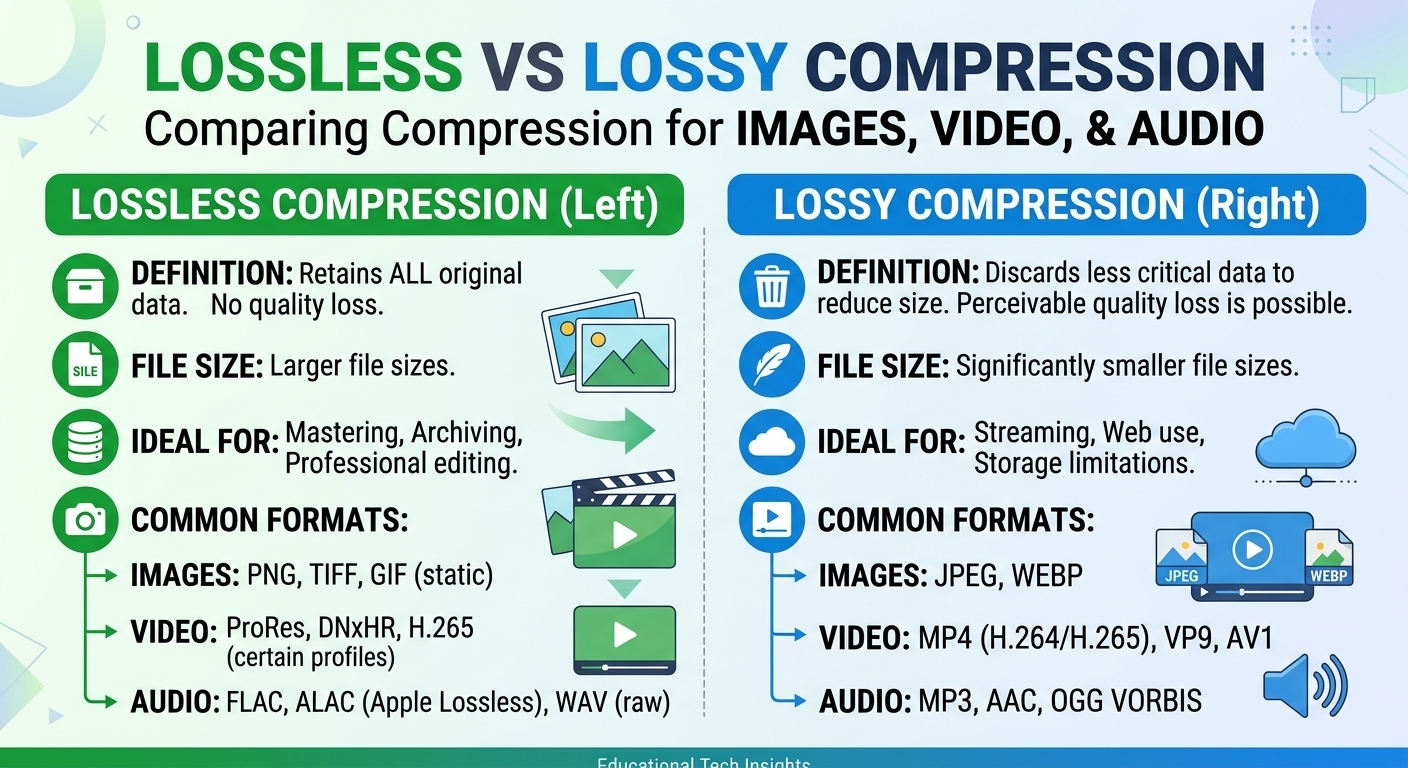
Lossy vs lossless compression comes down to one trade: lossless compression rebuilds every original bit and typically ...
In Q1 2026, Akamai reported that its ML-driven traffic management layer rerouted 38% of requests away from congested paths before user-facing latency exceeded P95 thresholds. That single stat captures where the AI-powered CDN market sits right now: inference at the edge is no longer experimental. It is load-bearing infrastructure. Yet most engineering teams still operate CDNs with static TTL policies, manual origin failover playbooks, and cache hierarchies tuned by gut feel rather than gradient descent. This article breaks down seven automation patterns that distinguish production-grade intelligent content delivery in 2026, gives you a decision matrix for choosing where to invest engineering time first, and walks through a failure-mode analysis the current page-1 results ignore entirely.
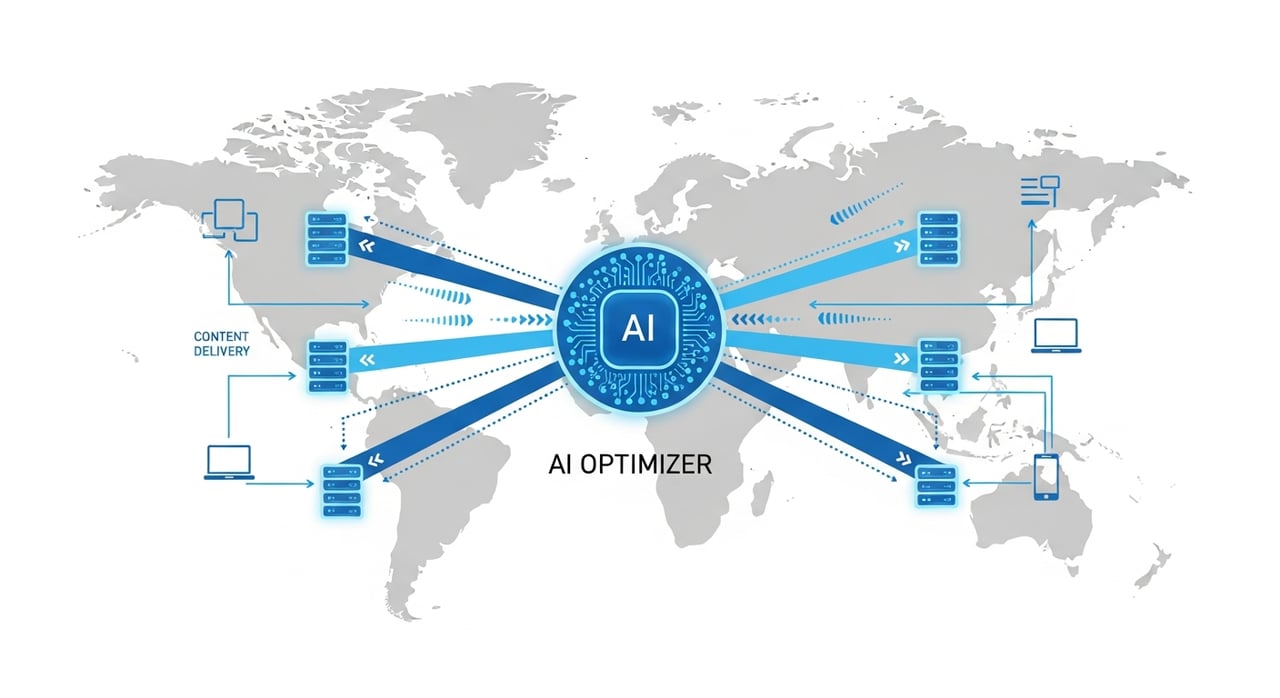
Two infrastructure shifts made 2026 the inflection year. First, edge compute runtimes matured enough to run quantized transformer models under 50 ms cold-start. Cloudflare Workers, Fastly Compute, and Deno Deploy all shipped ONNX or WASM-based inference support by late 2025. Second, the cost of GPU-hours at the edge dropped roughly 40% year-over-year as AMD MI300X and NVIDIA L4 silicon saturated the inference-optimized tier. The economics now favor running a lightweight model at every PoP rather than backhauling telemetry to a central brain. The result: AI-driven content delivery is shifting from centralized control-plane optimization to distributed data-plane decision-making.
Static TTL-based invalidation wastes bandwidth on cold misses that could be predicted. Production systems in 2026 use LSTM or Temporal Fusion Transformer models trained on request logs, calendar signals, and upstream CMS publish events to pre-populate edge caches 30–120 seconds before demand materializes. Netflix's Open Connect team disclosed in early 2026 that predictive warming reduced origin fetches by 22% on title-launch days. The pattern works best for catalog-driven workloads: media, e-commerce, news.
Anycast gets you to the nearest PoP. It does not get you to the best PoP. AI-driven CDN routing layers now factor in real-time PoP load, backbone congestion from BGP telemetry, and even client-side network quality estimates derived from TCP RTT and TLS handshake timing. Google's global load balancer has done this for years internally; as of 2026, third-party CDN vendors expose similar knobs through policy APIs that accept custom scoring functions.
For video and streaming engineers, the 2026 shift is per-session ABR decisions driven by edge-local models rather than manifest-level ladder definitions. The model observes buffer health, codec negotiation results, and viewport size, then selects or even generates the appropriate rendition on-the-fly using hardware-accelerated transcoding. Conviva's 2026 State of Streaming report measured a 31% reduction in rebuffer events for publishers that adopted edge-side ABR inference.
Rate-limit thresholds are a guess. Intelligent CDN security layers in 2026 replace them with unsupervised anomaly detection—isolation forests, autoencoders—trained continuously on each PoP's traffic baseline. When the model detects distributional shift beyond a learned envelope, it triggers challenge pages, traffic shaping, or upstream signaling within single-digit milliseconds. The critical advantage over threshold-based systems: zero manual tuning when traffic naturally scales 10× during a product launch.
Not all objects deserve equal cache residency. ML-based eviction policies in 2026 weigh object size, request frequency, time-to-revalidate cost, and downstream revenue impact to assign per-object priority scores. Think of it as a learned replacement for LRU/LFU hybrids. Early adopters report 8–15% cache-hit-ratio improvements on mixed workloads (API responses + static assets + personalized fragments) without increasing cache storage.
Origin shields traditionally fail over on binary health checks. AI-based cache optimization for content delivery networks now models origin degradation as a continuous signal: rising TTFB variance, increasing 5xx ratio, TLS handshake slowdowns. A regression model projects when the origin will breach SLA, and the CDN shifts traffic to a secondary origin or serves stale-while-revalidate content before the failure becomes user-visible. This pattern eliminates the 30–60 second detection gap that plagues interval-based health probes.
Personalization historically meant cache-busting. In 2026, edge functions run lightweight recommendation models or feature-flag evaluators against user context (geo, device, cohort ID from a first-party cookie), assembling personalized responses from cached fragments. The origin never sees the request. This is how major e-commerce platforms deliver sub-100 ms personalized pages at scale, and it fundamentally changes the cache-hit math for dynamic content.
Not every team needs all seven patterns. The matrix below maps each pattern to the workload profile where it delivers the highest marginal return, based on conversations with platform engineering teams operating at 50 TB/month and above (as of Q1 2026).
| Pattern | Best-Fit Workload | Implementation Complexity | Expected Impact |
|---|---|---|---|
| Predictive Cache Warming | Media, e-commerce catalogs | Medium | 15–25% origin offload gain |
| ML Request Routing | Global SaaS, gaming | High | 10–20% P99 latency reduction |
| Adaptive Edge ABR | Live/VOD streaming | High | 25–35% rebuffer reduction |
| Anomaly-Driven DDoS | All (especially bursty traffic) | Medium | Eliminates manual threshold tuning |
| Content-Aware Eviction | Mixed API + static workloads | Low–Medium | 8–15% CHR improvement |
| Predictive Origin Failover | Multi-origin, multi-cloud | Medium | Near-zero user-visible origin failures |
| Edge Personalization | E-commerce, SaaS dashboards | High | Transforms dynamic content into cacheable |
Start with the pattern that addresses your highest-cost operational pain. For most teams, that is either predictive cache warming (if origin egress is your biggest bill) or anomaly-driven DDoS (if you are still babysitting rate-limit configs during every traffic spike).
The top-10 results for "AI-powered CDN" uniformly sell the upside. None of them discuss how these systems fail. Here is what goes wrong in production.
Predictive caching models trained on steady-state traffic perform poorly during Black Friday, game launches, or breaking-news events. The distribution shift causes the model to warm the wrong objects, wasting cache capacity precisely when it matters most. The fix: maintain a separate event-mode model trained on historical spike data and trigger it via an external signal (deploy hook, calendar event, manual override). Automatic drift detection via KL-divergence monitoring on the input feature distribution is the 2026 best practice.
If your ML routing layer shifts traffic away from a PoP because it measures high latency, that PoP's load drops, its latency improves, the model shifts traffic back, latency rises again—oscillation. Damping mechanisms (exponential moving average on routing weights, minimum-traffic constraints per PoP) are essential. Without them, you get worse P99 than static Anycast.
When you add a new PoP, your edge-local models have zero training data. Falling back to a global default model is acceptable for routing decisions but dangerous for anomaly detection, where the per-PoP baseline is the entire signal. The standard approach: replicate a model from a geographically similar PoP and retrain within 24–48 hours of sufficient local data.
Running inference at the edge adds compute cost on top of bandwidth. For teams delivering 100 TB/month or more, the CDN vendor choice becomes a multiplier on the total automation budget. A vendor charging $0.01/GB leaves little headroom for edge compute experiments. One charging $0.003/GB or less changes the calculus entirely.
BlazingCDN is worth evaluating in this context. Pricing starts at $5 per TB and scales down to $2.50 per TB at volume (as of October 2026); 500 TB per month totals $1,815, so the bandwidth savings can directly fund edge AI workloads. For teams that want Anycast routing with built-in failover and an origin shield without the hyperscaler price tag, it fills a gap that matters when you are also budgeting for inference compute.
Rule-based systems react to conditions that an engineer anticipated. ML models generalize across observed patterns and adapt to novel conditions—traffic shapes, device mixes, origin degradation curves—without manual rule updates. The measurable difference in 2026 production deployments is typically 10–20% better cache-hit ratios and 15–30% lower P95 latency on dynamic workloads.
Yes, for recurring patterns (time-of-day, day-of-week, scheduled events). Accuracy degrades on truly novel spikes (viral content, unplanned incidents). Best practice as of 2026 is hybrid: ML handles predictable variance, and an event-trigger system handles known launches. Unpredictable virality still requires reactive autoscaling as a safety net.
There is no single best. The answer depends on whether you need edge compute (Cloudflare, Fastly), video-specific optimization (AWS CloudFront + MediaTailor), or cost-efficient bandwidth at scale with flexible configuration (BlazingCDN). Evaluate based on your ratio of static-to-dynamic traffic, your origin architecture, and your egress budget.
Keep models small—quantized to INT8 or lower, under 10 MB. Run inference asynchronously where possible (cache warming, prefetch decisions) and synchronously only for request-path decisions (routing, personalization). Target sub-5 ms inference time. WASM-compiled ONNX models on modern edge runtimes consistently hit this threshold as of Q1 2026.
It replaces static eviction policies (LRU, LFU) with learned scoring functions that weigh object popularity, size, revalidation cost, and business value. The model assigns a priority score per cached object and evicts the lowest-scored items first. In production, this yields 8–15% higher cache-hit ratios on heterogeneous workloads without additional storage.
Pick one pattern from the matrix above. Before you build anything, instrument the baseline metric it would improve: origin fetch rate for predictive warming, P99 latency distribution per PoP for ML routing, rebuffer ratio per session for edge ABR. Run the baseline for two weeks. If the variance alone reveals optimization headroom greater than 10%, you have a business case. If not, move to the next pattern. The fastest way to waste six months of platform engineering time is to deploy AI-driven CDN automation against a metric you never measured in the first place. Measure first. Model second. Ship third.

Heavy traffic.
Light bill.
The CDN for video and large traffic
Learn
Lossy vs lossless compression comes down to one trade: lossless compression rebuilds every original bit and typically ...
Pricing - Pricing & Costs
The CloudFront vs S3 decision depends more on object size than on traffic volume. At a 500 KB average response, 100 TB ...
Learn
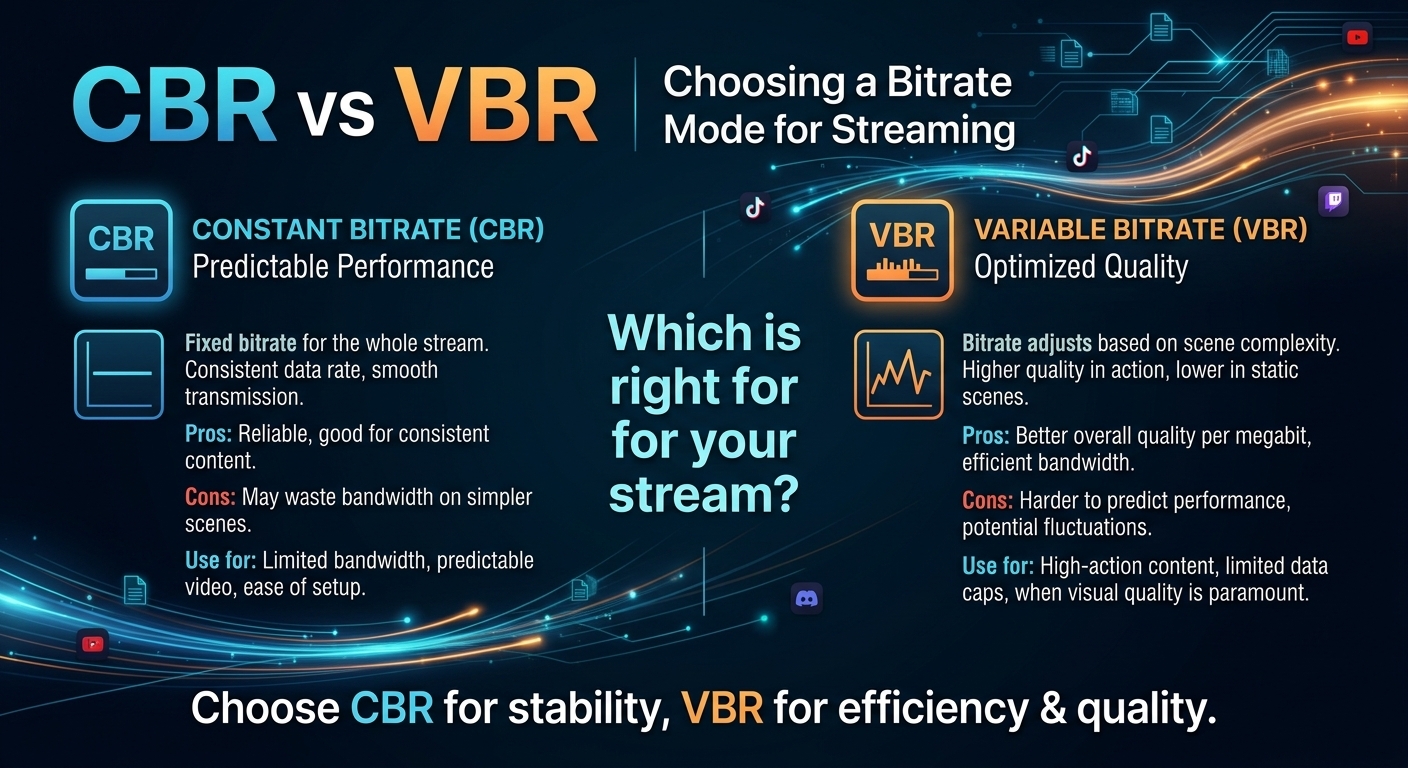
For most on-demand video, capped variable bitrate (VBR) wins the cbr vs vbr decision: it spends bits where the picture ...