Learn
What Is H.264 (AVC)? The Codec Behind Most Online Video
H.264, also called Advanced Video Coding (AVC) or MPEG-4 Part 10, is a block-based video compression standard published ...
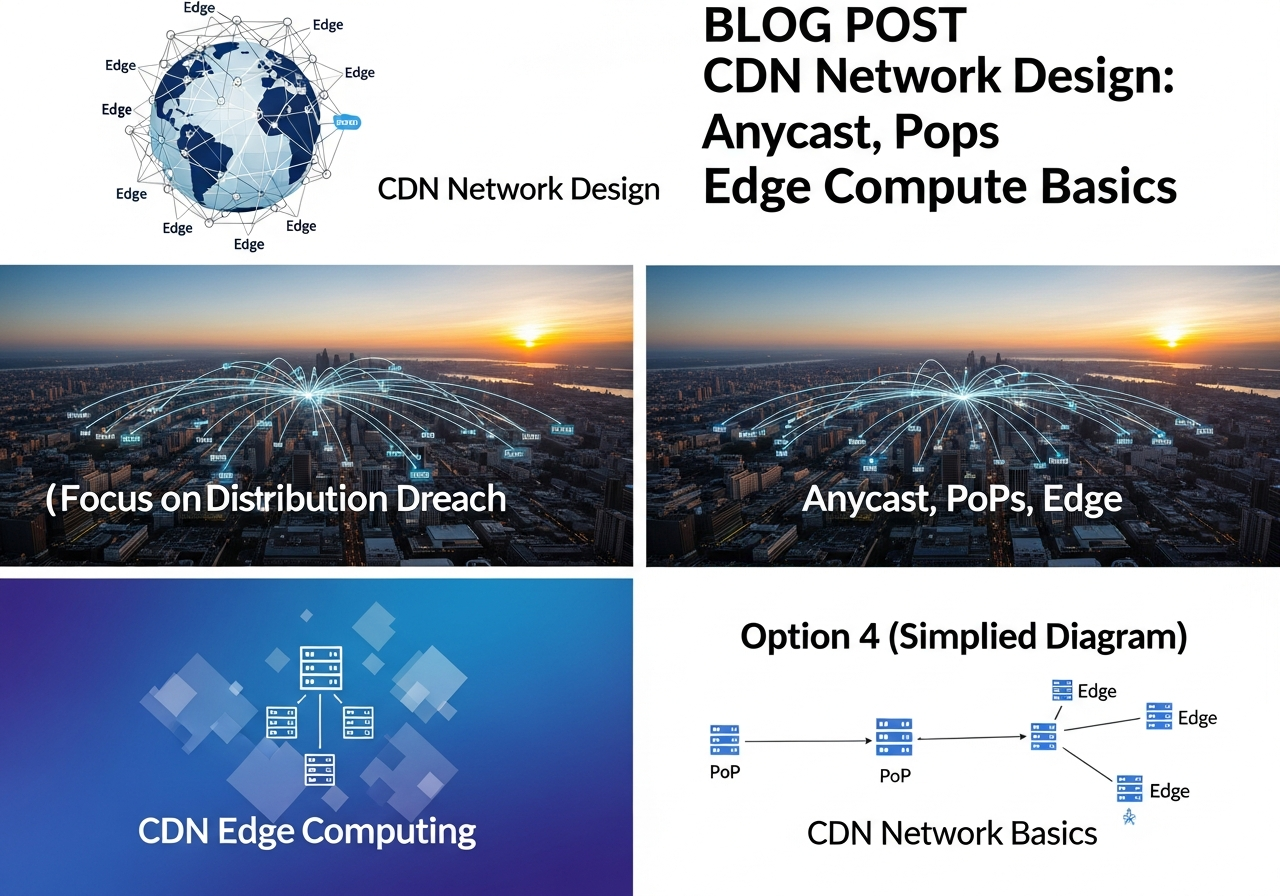
In Q1 2026, median global page-load latency for sites served without a CDN sat at 3.8 seconds. Sites behind a well-architected CDN with anycast and edge compute cut that to 0.9 seconds—a 76% reduction measured across mobile and desktop. The delta is not news. What is news: the gap between a mediocre CDN architecture and a properly designed one now accounts for more latency variance than the gap between CDN and no-CDN. Your choice of PoP topology, anycast policy, and edge compute placement matters more in 2026 than whether you use a CDN at all. This article gives you a concrete playbook: how anycast routing decisions map to failure domains, how PoP placement strategy has shifted with 2026's traffic patterns, where edge compute pays for itself and where it doesn't, and a workload-profile decision matrix you won't find in any vendor's docs.
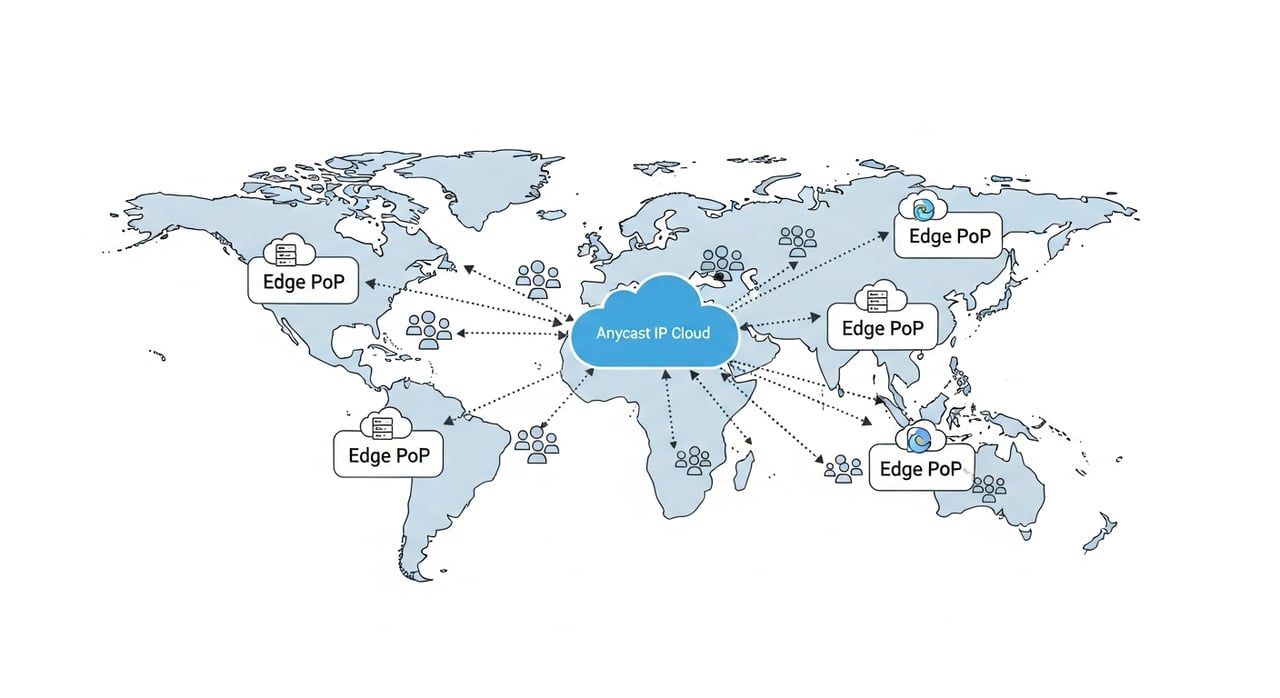
Anycast assigns a single IP address to multiple nodes, letting BGP converge on the topologically closest one. That much hasn't changed. What has changed is how operators define "closest." Pure hop-count proximity is increasingly unreliable as a latency proxy. In 2026, tier-1 CDN operators are layering real-time latency telemetry and packet-loss signals on top of BGP to bias anycast announcements toward the genuinely fastest path, not just the shortest AS path.
The operational implication is significant. A naive anycast deployment in a region with asymmetric peering—Southeast Asia and parts of Latin America are the canonical examples—can route users to a node that is topologically close but 40–60 ms slower than an alternative two hops further away. Production-grade CDN architecture now demands continuous measurement loops: synthetic probes from eyeball networks feeding back into BGP community tagging or, in more advanced setups, into ECMP weight adjustments at the PoP level.
Anycast's resilience story is well understood—if a node dies, BGP reconverges. The less-discussed metric is withdrawal propagation time. As of early 2026, median BGP withdrawal propagation across the global default-free zone is roughly 60–90 seconds, with a long tail extending past three minutes depending on route dampening policies upstream. During that window, a fraction of users hit a black hole. The mitigation pattern that has gained traction is pairing anycast with health-checked DNS failover at a shorter TTL (15–30 seconds), so the DNS layer catches failures before BGP fully reconverges. This dual-plane approach reduces effective downtime from minutes to low tens of seconds.
The conventional wisdom—place PoPs in Ashburn, Frankfurt, Singapore, and call it done—was adequate when traffic was dominated by desktop web browsing originating from a handful of metros. In 2026, three shifts force a rethink of CDN architecture at the PoP layer.
Mobile-first traffic distribution. Mobile devices now generate over 62% of global CDN traffic (up from roughly 58% in 2024). Mobile users are more geographically dispersed than desktop users, and they connect through radio access networks with highly variable last-mile latency. A PoP 20 ms closer eliminates a meaningful fraction of the variance budget.
Regional data-gravity regulations. The EU's Data Act enforcement that took effect in late 2025, Brazil's updated LGPD guidelines, and India's DPDP rules all create zones where certain response payloads must be computed and cached within-region. PoP placement is no longer purely a latency optimization; it's a compliance constraint.
5G MEC adjacency. Operators deploying multi-access edge compute at 5G aggregation sites are opening peering to CDN providers willing to colocate. PoPs placed at MEC sites see sub-5 ms round-trip times to the handset—an order of magnitude below traditional metro PoPs. For latency-sensitive workloads like real-time bidding or live interactive streaming, MEC-adjacent PoPs are becoming table stakes.
More PoPs is not always better. Each PoP introduces operational overhead: monitoring, certificate rotation, cache coherence traffic, and local vendor relationships. The 2026 trend among operators designing serious CDN architecture is fewer, larger "super PoPs" in tier-1 metros paired with lightweight cache-only PoPs in tier-2 and tier-3 cities. Super PoPs run edge compute workloads, handle origin-shield duties, and terminate TLS for complex configurations. Lightweight PoPs serve cache hits and forward misses upstream. This tiered model keeps the cache-hit ratio above 95% at the edge while concentrating compute spend where it's economically justified.
Edge compute at CDN locations has moved past the hype phase. In 2026, the question is no longer "should we run code at the edge?" but "which code, and at what cost?" The economics are straightforward: edge compute cycles cost 2–5× more per CPU-second than centralized cloud equivalents. The latency savings justify the premium only when the round-trip to a centralized region would violate a hard latency SLA or when the data needed for the computation already lives at the edge.
Request-routing logic, A/B test assignment, token validation, geolocation-based content customization, and real-time image/video transformation are strong candidates. They're stateless or near-stateless, they operate on data available in the request or local cache, and they benefit directly from eliminating a round-trip to origin.
Anything requiring strong consistency across regions—inventory checks, payment processing, writes to a primary database—should stay centralized. Running these at the edge adds complexity without meaningful latency improvement, because the edge function ends up making a synchronous call to the origin anyway. The round-trip you saved on the client side reappears as an edge-to-origin call, plus you've added a failure domain.
This matrix maps common workload profiles to the CDN architecture pattern that fits. It's the kind of decision framework that saves weeks of back-and-forth with vendors.
| Workload | Anycast Policy | PoP Tier | Edge Compute | Key Metric |
|---|---|---|---|---|
| VOD streaming (high bitrate) | Latency-biased anycast | Super PoP + cache PoPs | Manifest manipulation only | Rebuffer ratio < 0.5% |
| Live interactive streaming | Latency-biased + MEC peering | MEC-adjacent PoPs required | Yes—transcode, remix | Glass-to-glass < 1 s |
| SaaS API delivery | Standard anycast | Super PoPs in top-10 metros | Auth token validation, rate limiting | P99 TTFB < 80 ms |
| Global e-commerce | Latency-biased anycast | Tiered: super + cache | Personalization, geo-pricing | LCP < 1.5 s (mobile) |
| Multiplayer gaming | Latency-biased + UDP anycast | MEC-adjacent or metro PoPs | Matchmaking, session state | RTT < 30 ms regional |
| Software/update distribution | Standard anycast, throughput-optimized | Cache PoPs at scale | Minimal—delta patching at most | Throughput > 500 Mbps sustained |
The top-10 results for "cdn architecture" in 2026 cover the happy path well. None of them discuss what breaks. Here are three failure modes we've seen repeatedly in production.
A misconfigured upstream provider announces your anycast prefix with a shorter AS path. Traffic for an entire region shifts to a node that may not even be yours. Mitigation: sign your prefixes with RPKI ROAs and monitor BGP looking glasses continuously. As of Q1 2026, RPKI ROV adoption among the top 20 transit providers is above 80%, making ROA-based protection increasingly effective.
A PoP restarts with a cold cache. Thousands of concurrent requests for the same objects all miss simultaneously and slam the origin. The fix is request coalescing (also called request collapsing): the PoP deduplicates concurrent cache misses for the same key and issues a single origin fetch. Every serious CDN supports this, but it's not always enabled by default.
Serverless edge runtimes (V8 isolates, Wasm, or container-based) have cold-start penalties ranging from 2 ms (isolates) to 300+ ms (containers). If your edge function handles the critical path, a cold start can blow your P99 latency budget. The mitigation is pre-warming: keep a minimum number of instances hot at every PoP where traffic is expected. Monitor cold-start rates as a first-class SLI.
CDN spend at scale is dominated by bandwidth egress. In 2026, the major hyperscalers charge $0.05–$0.08 per GB at moderate volumes, dropping to around $0.02 per GB at very high commitment tiers. For organizations pushing hundreds of terabytes monthly—media companies, game studios, software distributors—this cost line item is large enough to warrant architectural attention.
Operators like BlazingCDN offer a different cost curve: starting at $5 per TB, scaling down to $2.50 per TB at volume (as of October 2026). That pricing comes with Anycast routing and built-in failover, a meaningful margin difference for enterprises moving serious volume. For large-scale media or software delivery workloads, the cost at 500 TB ($1,815 per month) frees up budget that can be redirected into origin hardening or edge compute experimentation.
Anycast assigns the same IP address to multiple geographically distributed nodes. When a client sends a request, BGP routing directs the packet to the topologically nearest node. Modern CDN implementations augment this with real-time latency and loss telemetry to override BGP when topology doesn't reflect actual performance.
A PoP is a physical site—typically in a carrier-neutral data center—where CDN servers are deployed. Each PoP contains cache storage, networking gear, and potentially edge compute capacity. As of 2026, large CDN operators run between 200 and 400 PoPs globally, though the trend is toward fewer, more capable super PoPs supplemented by lightweight cache nodes.
"Edge location" and "PoP" are often used interchangeably, but some providers distinguish them. An edge location may refer specifically to a cache-only node, while a PoP can include origin-shield, compute, and peering functions. The distinction matters when planning which workloads run where.
Use edge compute when the operation is stateless, the data it needs is already at the edge (in cache or in the request), and the latency saved by avoiding a round-trip to origin is material to your SLO. If the function requires a synchronous call back to a centralized database, edge compute adds a failure domain without net latency gain.
RPKI (Resource Public Key Infrastructure) lets you cryptographically sign Route Origin Authorizations for your anycast prefixes. Upstream providers performing Route Origin Validation will reject unauthorized announcements of your prefix, preventing route leaks and hijacks from diverting your CDN traffic.
For static content workloads, a cache-hit ratio above 95% at the edge is standard for a mature CDN deployment in 2026. Dynamic or personalized content will be lower. The key lever is cache key design—overly specific keys fragment the cache and tank hit rates. Audit your Vary headers and query-string handling before adding PoPs.
Pull your CDN's real-time analytics for the past 30 days. Identify the three PoPs with the highest cache-miss rate and the three with the worst P99 TTFB. Cross-reference those lists. If the same PoP appears on both, you likely have a cache key fragmentation problem or an undersized origin shield upstream of it. Fix that single PoP and measure the impact on your global P50 and P99 before touching anything else. One precise fix outperforms a fleet-wide config change every time. If you've run this exercise and found something surprising, post it—the engineering community learns more from production anomalies than from architecture diagrams.

Heavy traffic.
Light bill.
The CDN for video and large traffic
Learn
H.264, also called Advanced Video Coding (AVC) or MPEG-4 Part 10, is a block-based video compression standard published ...
Compare
At 100 TB a month, the published price gap between options for a CDN for static content is more than 16 times: ...
Learn
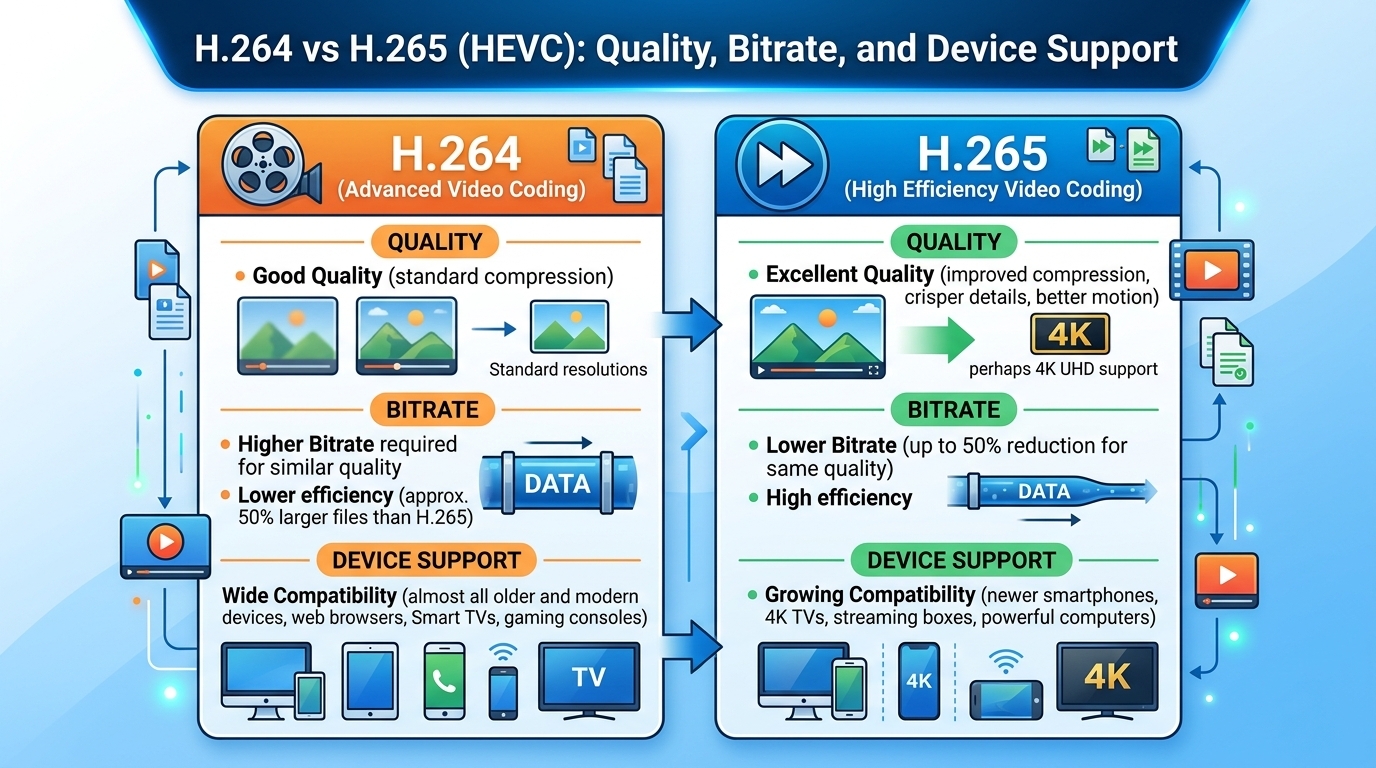
Evaluated October 2026: in the h264 vs h265 decision, HEVC (H.265) matches H.264 (AVC) quality at roughly 30 to 50 ...