

Learn
What Is H.264 (AVC)? The Codec Behind Most Online Video
H.264, also called Advanced Video Coding (AVC) or MPEG-4 Part 10, is a block-based video compression standard published ...

Every fraction of a second can dictate millions in profit or loss within the finance sector. Did you know that according to data from the NASDAQ, a delay of just five milliseconds in high-frequency trading algorithms can sway the balance of power on Wall Street? Though this latency is often invisible to end-users, behind every secure trade, real-time stock quote, and mobile bank tap lies a robust, optimized Content Delivery Network (CDN).
For the finance industry, a CDN is not just a luxury—it's an operational necessity. While most people associate CDNs with streaming video or static website speed, in the world of financial data delivery, CDNs silently protect transactions, enforce compliance, and provide the razor-thin margins of speed prized by banks and exchanges worldwide.
As you navigate this guide, you’ll uncover why specialized CDNs are indispensable for modern finance, and how global firms are leveraging this technology to secure data and outpace their competitors. Ask yourself—how confident are you in your institution’s data speed and safety?
Preview: Understand the financial stakes behind every millisecond and why generic CDN solutions can leave vulnerabilities in your high-stakes transactions.
The financial services ecosystem spans retail banking apps, stock exchanges, digital wallets, real-time reporting tools, insurance platforms, and more. Each handles volumes of sensitive, time-critical information—think real-time trading data, customer credentials, or regulatory filings. But why does the sector require more than an off-the-shelf CDN?
Without a tailored CDN, these requirements expose institutions to operational risks, legal penalties, and diminished user trust. Consider this: In 2022, the global cost of a data breach for financial services averaged $5.97 million, the highest across all industries (IBM Cost of a Data Breach Report 2023).
Would a generic, video-focused CDN stack withstand such regulatory and reputational scrutiny? Or could it be the weakest link in your digital finance strategy?
Preview: Dive into the high-speed world where latency is currency, and see how top-tier CDNs deliver the edge finance firms demand.
Picture a global trading floor where millions are won or lost in the blink of an eye. In this arena, speed is not just a competitive advantage; it’s a massive risk mitigator and a regulatory compliance factor.
When institutional investors at JP Morgan or Goldman Sachs execute buy/sell orders, they rely on real-time quote accuracy. According to Refinitiv, even a delay of 100 milliseconds can mean the difference between profit and loss on volatile stock or Forex markets. Latency disruptions during the 2010 "Flash Crash" starkly demonstrated this risk, contributing to $1 trillion in temporary market capital evaporating within minutes (Refinitiv Algorithmic Trading Report).
Ask yourself: Is your trading, banking, or fintech platform suffering from invisible “digital drag” due to sub-optimal content routing? What would it mean if every customer-facing transaction was even 10% faster?
Preview: Explore why financial data security goes far beyond SSL and why a CDN’s multilayered defenses are pivotal against evolving threats.
Security is non-negotiable in global finance. Banks, exchanges, and fintechs hold highly sensitive customer identities, account info, and transaction logs—all prized by cybercriminals. According to the Accenture Global Cybercrime Study, over 19% of financial enterprises experienced a significant security breach in 2022 alone.
Security effectiveness depends on the weakest component in the delivery stack. Would your current solution repulse a coordinated credential-stuffing attack or API abuse at peak market hours? Or is your security perimeter still reliant on legacy edge systems?
Preview: Demystify how leading CDNs align data delivery with cross-border privacy, recordkeeping, and audit mandates.
The financial sector is among the most regulated globally—caught between the need for velocity and obligations around data privacy and residency. In the EU alone, violations of the GDPR can cost up to 4% of annual global turnover.
Is your current CDN delivering compliance confidence or creating audit timetables bottlenecks? What would be the reputational cost of a cross-border privacy violation?
Preview: Real stories from the frontline of finance, where CDN deployment improved security, user experience, and trading efficiency.
Consider one of Europe's largest retail banks, which in 2021 suffered a publicized outage when a sudden spike in mobile banking traffic overwhelmed their legacy data center, freezing payments for thousands. The aftermath drove a re-architecture based on an enterprise-grade CDN, enabling distributed content caching, prioritized transactional API delivery, and automated failover. The result? A 37% reduction in API response times and zero downtime on Black Friday—the biggest day of the year for mobile payments (Source: Finextra).
A global multi-bank trading platform faced persistent latency spikes in Asia-Pacific, impacting client execution quality. Migrating key endpoints to a specialized CDN with localized edge compute cut mean order-to-execution times by 48%, ultimately regaining the trust of high-frequency trading clients (Source: Bloomberg).
| Challenge | CDN Solution | Outcome |
|---|---|---|
| API slowdown during market spikes | Edge-based rate limiting & real-time cache updates | -22% user drop-off, Improved stability |
| Data residency compliance failures | Geo-restricted content isolation | No regulatory incidents, Simplified audits |
| Credential abuse & bot attacks | Token-based access, IP intelligence | Halted abuse, 25% fewer fraud attempts |
Could your business weather a surge in digital traffic or a region-specific regulatory audit as smoothly? Or are existing solutions creating operational bottlenecks and user frustration?
Preview: Walk through a battle-tested blueprint for secure, compliant, and ultra-fast financial data acceleration.
How mature is your existing CDN deployment checklist? Are critical paths mapped—or is there reliance on “default” security settings?
Preview: Discover how modern providers like BlazingCDN uniquely address the needs of financial giants and fintech disruptors alike.
BlazingCDN was architected to empower organizations where performance, security, and compliance cannot be compromised. Large retail banks, brokerages, and next-generation payment platforms trust BlazingCDN to fuel their edge—backed by advanced features tailored specifically for financial services, including end-to-end encryption, regionalized data routing, and configurable real-time audit logs.
For a closer look at how enterprise finance workloads benefit, see the full feature set at BlazingCDN Features.
If your finance organization is seeking a high-performance, secure CDN specially tuned for critical, real-time workloads, learn how BlazingCDN offers customizable enterprise CDN infrastructure designed for compliance and uptime at a global scale.
Preview: Explore innovations shaping tomorrow's financial content acceleration and defense strategies.
The financial CDN stack of the near future will be smarter, more automated, compliance-aware, and transparent. Are you preparing your infrastructure to adapt, or will impending regulation and threat evolution outpace your capabilities?
Every click, transaction, and trade in the digital finance world is a moment of risk—or an opportunity for competitive advantage. Is your institution ready to deliver seamless, secure, and super-fast service to users at any global location? Or are unseen delays and vulnerabilities holding you back?
If you’re seeking a CDN partner who truly understands enterprise finance challenges, it's time to contact our CDN experts for a personalized roadmap to secure, low-latency data delivery. Share your thoughts below—what are your institution's greatest content delivery challenges? Let’s build the backbone of tomorrow’s finance, together.

Heavy traffic.
Light bill.
The CDN for video and large traffic
Learn
H.264, also called Advanced Video Coding (AVC) or MPEG-4 Part 10, is a block-based video compression standard published ...
Compare
At 100 TB a month, the published price gap between options for a CDN for static content is more than 16 times: ...
Learn
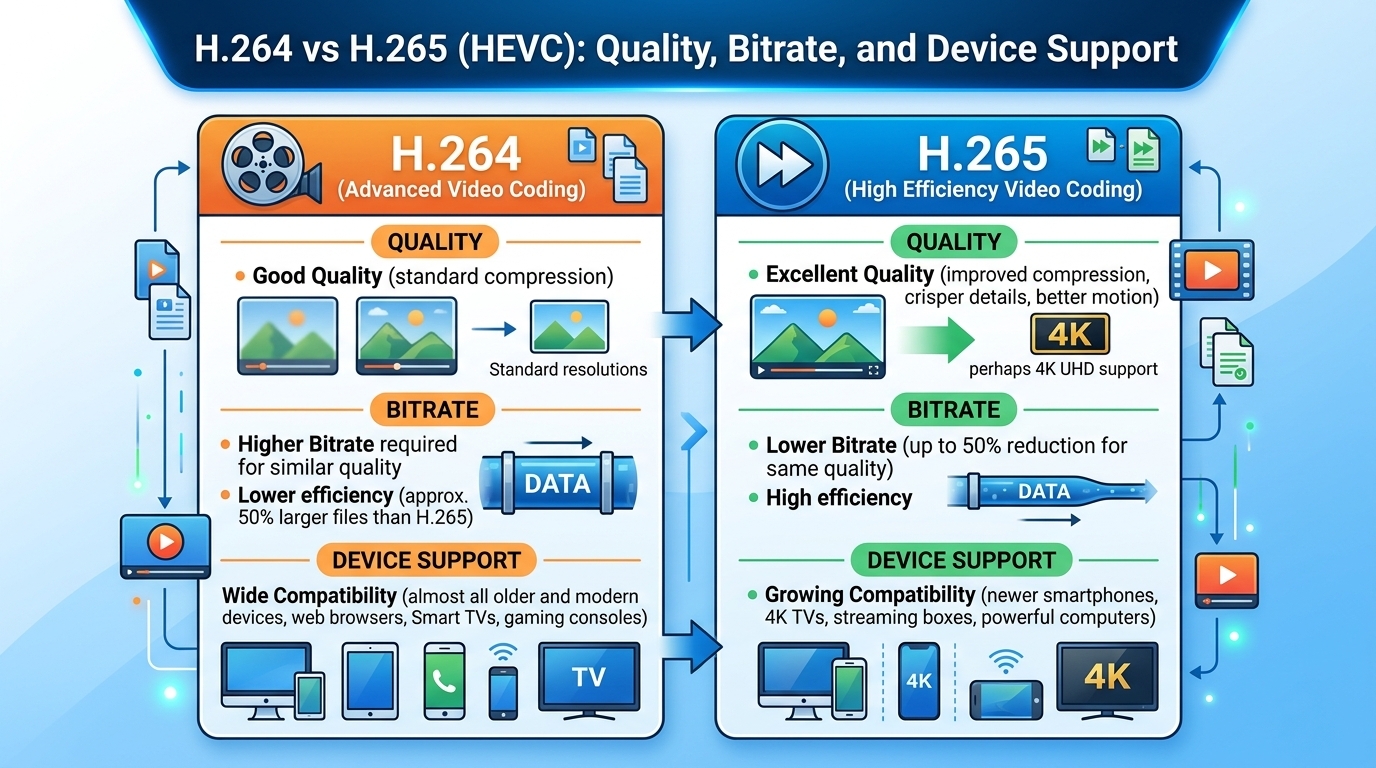
Evaluated October 2026: in the h264 vs h265 decision, HEVC (H.265) matches H.264 (AVC) quality at roughly 30 to 50 ...