

Learn
What Is H.264 (AVC)? The Codec Behind Most Online Video
H.264, also called Advanced Video Coding (AVC) or MPEG-4 Part 10, is a block-based video compression standard published ...
In March 2026, a major European news publisher pushed a correction to a headline seen by 11 million readers. The old headline persisted at 38% of edge locations for over four minutes because their purge pipeline relied on a single-URL invalidation loop iterating sequentially across zones. Four minutes. For a story about election results. The CDN cache purge API call itself took 80 milliseconds; the orchestration around it was the bottleneck. This article gives you the operational playbook for API-driven cache purge automation in 2026: the call patterns that actually work at scale, the failure modes that will bite you at 2 a.m., the diagnostics to prove your purge landed, and a decision matrix for choosing between URL, prefix, tag, and surrogate-key invalidation strategies based on your workload profile.
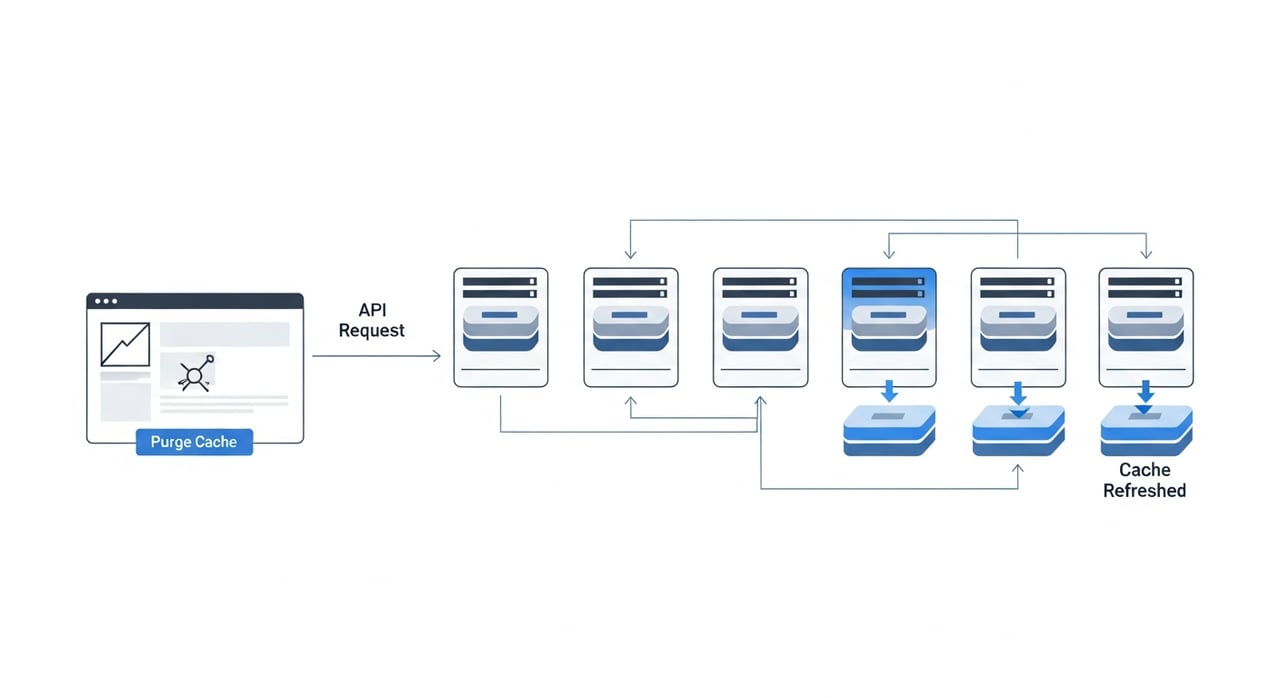
As of Q1 2026, the median deployment frequency among teams running continuous delivery is 8.4 deploys per day per service. Each deploy that touches a cached asset—CSS bundles, API responses, image variants, HTML fragments—requires invalidation at the edge. Manual dashboard purges died years ago. What's changed in 2026 is the expectation: purge latency under 500 ms globally is now the baseline, not a premium feature. If your CDN cache invalidation API can't clear content across every node in that window, you're shipping stale bytes to a percentage of users on every single release.
The economic argument is equally sharp. Stale product pricing pages cost e-commerce operators measurable revenue per minute of exposure. Stale API responses behind a CDN cause mobile apps to render incorrect state, generating support tickets. The cache purge API is no longer "nice to have DevOps hygiene"—it's a reliability primitive alongside health checks, circuit breakers, and feature flags.
Choosing the right invalidation granularity determines your blast radius, your API call volume, and your purge propagation time. Here is how each strategy compares in 2026 production environments:
| Strategy | Best For | API Calls at Scale | Blast Radius | 2026 Adoption |
|---|---|---|---|---|
| Purge by URL | Single-asset corrections, hotfixes | 1 call per URL; grows linearly | Minimal | Universal |
| Purge by prefix/path | Directory-level deploys (/static/v42/*) | 1 call per prefix | Medium | Wide |
| Cache tag purge | Content-type or entity-level grouping | 1 call per tag; O(1) regardless of object count | Precise | Growing fast |
| Surrogate key purge | API-backed pages with shared entities | 1 call per key; fan-out handled by CDN | Surgical | Standard for headless CMS |
| Purge everything | Major redesigns, emergency recovery | 1 call | Total | Emergency only |
The 2026 shift: cache tag purge API and surrogate key purge API adoption has roughly doubled since 2024 among teams running headless CMS architectures. The reason is straightforward—when a single product entity appears on 200 pages, purging by URL means 200 API calls. Purging by surrogate key means one.
The integration point matters more than the API call itself. In 2026, the three dominant patterns for triggering a CDN cache invalidation API call from a deployment pipeline are:
Regardless of the trigger, the API call itself should be idempotent, authenticated with a scoped token (never a root key), and wrapped in retry logic with exponential backoff. Batch endpoints that accept arrays of URLs or tags in a single request reduce round-trip overhead significantly—most CDN purge APIs now accept 30 to 500 items per batch call as of 2026.
This is the section most CDN purge guides skip entirely. In production, purge failures are not rare—they're routine at sufficient scale. Here are the failure modes we see in 2026 deployments:
A diagnostic procedure every team should run quarterly: trigger a purge for a known test asset, then poll the asset from at least five geographically distributed vantage points, recording the timestamp when each returns a cache MISS. Plot the propagation curve. If your p95 purge propagation exceeds 2 seconds, investigate.
Three metrics define whether your cache invalidation API integration is actually working:
For teams evaluating CDN providers with strong API-driven cache purge capabilities, BlazingCDN's feature set is worth benchmarking. It supports purge via a straightforward REST API. BlazingCDN pricing starts at $5 per TB and scales down to $2.50 per TB at volume (as of October 2026), which makes it a strong fit for media, SaaS, and gaming workloads where purge volume correlates directly with delivery volume.
The industry expectation as of mid-2026 is sub-500 ms for the API acknowledgment and under 2 seconds for full global propagation to all edge nodes. If your provider consistently exceeds 5 seconds for global propagation, that's below the current baseline and worth re-evaluating.
No. Tag-based and surrogate-key purges only work on objects that were cached with the relevant headers present in the origin response. Objects cached before you added those headers must be invalidated via URL, prefix purge, or natural TTL expiry. Plan a one-time cleanup purge when introducing tagging.
Add a post-deploy step that extracts changed file paths from the Git diff, maps them to CDN URLs or cache tags, and issues an authenticated POST to your CDN's purge endpoint. Use a scoped API token stored as a repository secret. Wrap the call in retry logic with a 2-second backoff. Most providers return a purge ID you can log for audit purposes.
Use content-addressable asset filenames (hash-in-URL) for static assets so they never need explicit purging. For HTML and API responses, use cache tags tied to the specific entities that changed, and purge only those tags. This avoids the "purge everything" antipattern, which spikes origin load and degrades cache hit ratio for minutes after every deploy.
Only during emergency recovery—a cache poisoning incident, a major security patch affecting all responses, or a fundamental change to your caching architecture. In all other cases, scoped purges (by URL, prefix, or tag) are strictly preferable because they preserve cache hit ratios for unaffected content.
Don't trust the API 200 alone. After issuing the purge, fetch the target asset from at least five geographically distributed probes and inspect the Age and X-Cache response headers. A cache MISS with Age: 0 confirms the purge landed at that node. Automate this as a post-purge validation step in your pipeline.
This week, pick one production service that triggers CDN cache purge API calls and instrument the three metrics above: change-to-live latency, stale-serve rate, and purge API error rate. Run the five-region propagation probe described in the failure-modes section. If your p95 propagation time is under 2 seconds and your stale-serve rate is under 0.1%, you're in good shape. If not, you now have the diagnostic framework to find the bottleneck. What propagation numbers are you seeing in your environment? Drop your results in the comments—real data from real deployments is how we all get better at this.

Heavy traffic.
Light bill.
The CDN for video and large traffic
Learn
H.264, also called Advanced Video Coding (AVC) or MPEG-4 Part 10, is a block-based video compression standard published ...

Compare
At 100 TB a month, the published price gap between options for a CDN for static content is more than 16 times: ...
Learn
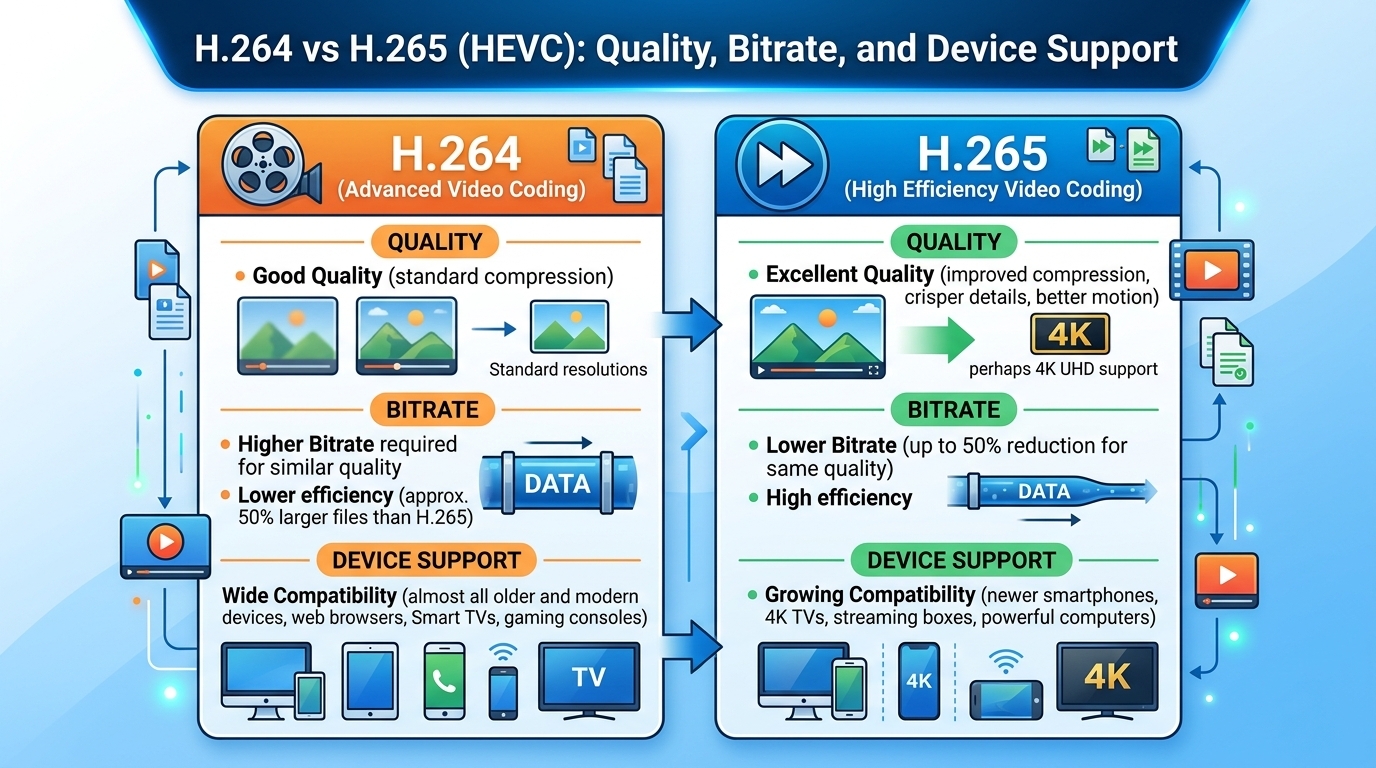
Evaluated October 2026: in the h264 vs h265 decision, HEVC (H.265) matches H.264 (AVC) quality at roughly 30 to 50 ...