
Learn
Lossy vs Lossless Compression: Images, Video and Audio
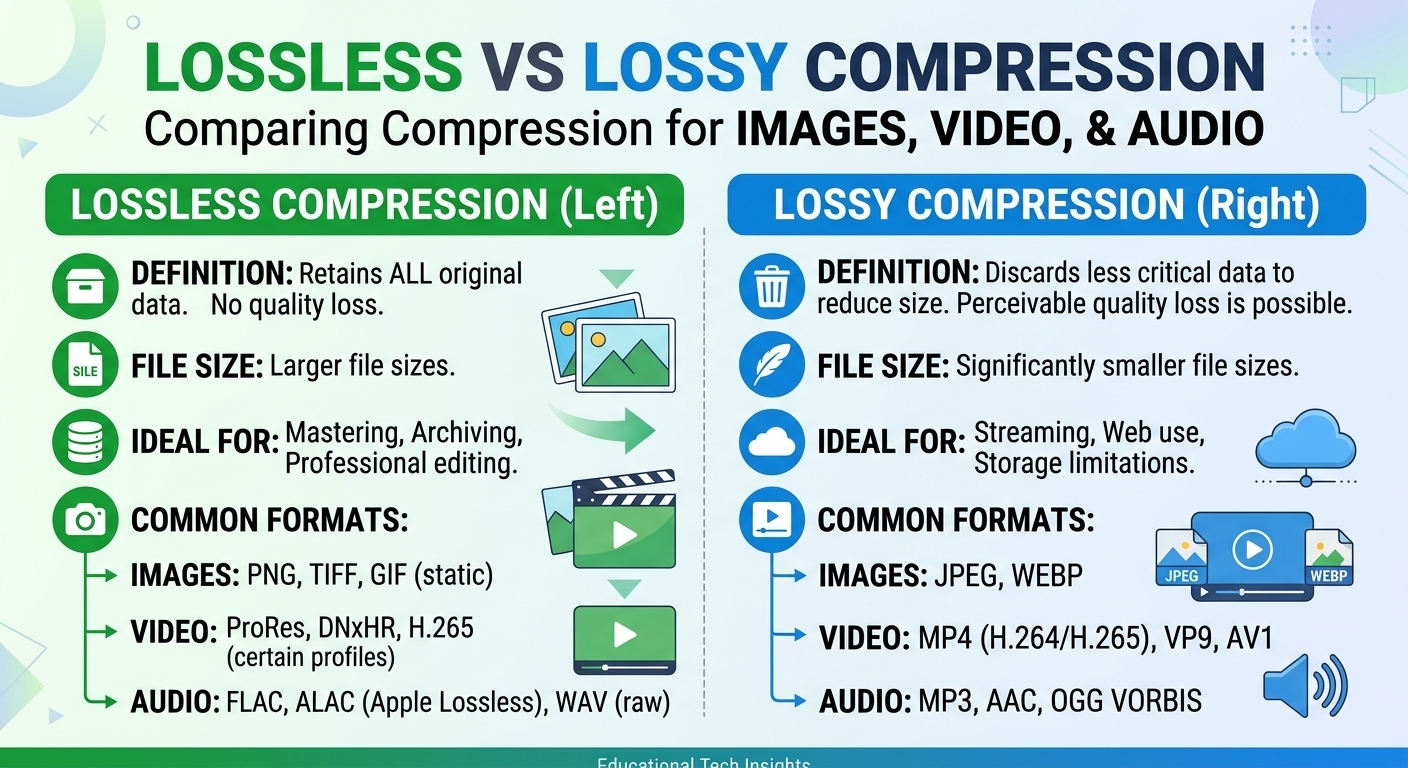
Lossy vs lossless compression comes down to one trade: lossless compression rebuilds every original bit and typically ...
The real decision in a BunnyCDN vs Cloudflare evaluation is not which brand is larger. It is whether your mid-market team needs a lower-cost delivery layer with straightforward storage and media economics, or a broader edge platform that can consolidate CDN, DNS, security controls, and application logic under one contract. This article compares two vendors, Bunny.net and Cloudflare, because they are frequently shortlisted by teams replacing default cloud CDN setups, rationalizing WordPress and SaaS delivery costs, or building a video and download delivery stack without moving straight to Akamai-class enterprise spend.
The scope here is narrow by design. We are evaluating CDN delivery, cache controls, purge behavior, edge storage and video relevance, pricing shape, operational fit, and switching cost for mid-market buyers. We are not doing a full security platform review, not scoring managed WAF depth, not comparing every edge runtime capability, and not covering private backbone design in detail. That narrower scope is what most procurement and architecture teams need for a first-pass shortlist.
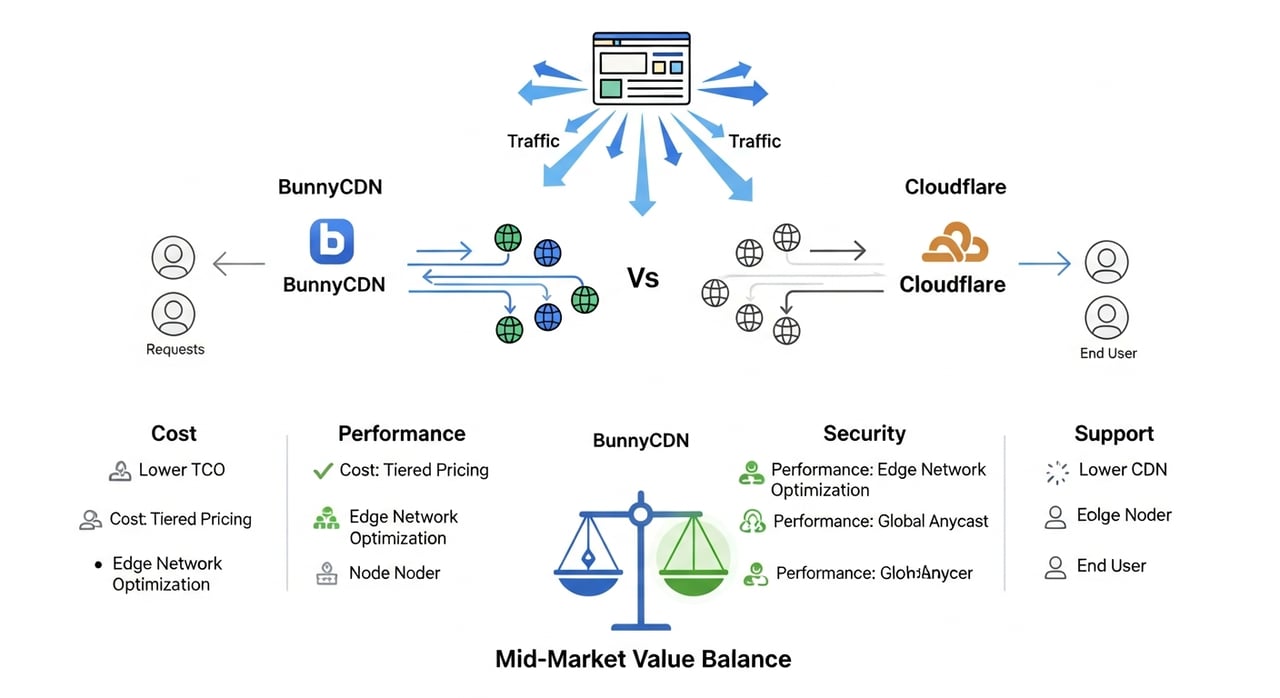
For this bunnycdn vs cloudflare comparison, the scorecard is built around measurable criteria that matter in a mid-market RFP: public $/GB or flat-plan economics at specific traffic bands, cache hit ratio levers, purge scope and time model, storage and video packaging cost shape, edge logic portability, uptime and SLA disclosures, and the amount of platform sprawl each option can remove. Where performance is discussed, the useful metric is not a vague claim of speed but whether the vendor consistently offers low tail latency and acceptable cache efficiency in the regions your users actually hit.
If you need a weighting model, start with this one for a general web and media workload: 30% pricing and TCO, 20% cache and purge operations, 15% performance consistency, 15% platform consolidation value, 10% migration risk, and 10% support and SLA terms. If your workload is WordPress or ecommerce, increase cache-control and purge weighting. If it is video delivery or software downloads, increase egress, storage, and commit-tier weighting. If you are already deep into edge compute and bot controls, increase platform consolidation weighting toward Cloudflare.
The analysis uses publicly available product and pricing documentation as of 2026, product behavior documented by the vendors, and broad public internet performance datasets where they are useful directionally. Some dimensions have no vendor-neutral public number that can be compared cleanly, especially real production tail latency under a given cache key strategy and enterprise support responsiveness. Where no public data exists, this article says so. One disclosure: this blog is published by BlazingCDN, which is not one of the two vendors compared in the main analysis.
Bunny.net is usually shortlisted because its pricing is legible. For CDN delivery, storage, image handling, and video workflows, the commercial model is generally easier for a mid-sized team to forecast than a platform assembled from multiple security and edge products. The practical engineering upside is that architects can map traffic classes to cost quickly, especially for static content, software downloads, VoD libraries, and origin offload projects.
One detail many buyers miss: Bunny.net is not just a low-cost pull CDN. Its object storage and video-oriented workflow options can materially change the end-to-end cost model if your current stack splits CDN, origin storage, and media packaging across separate providers. That matters in cloudflare vs bunnycdn discussions where Cloudflare often looks attractive on broad platform scope but less predictable once you need add-on functionality across plans and product lines.
Where Bunny.net genuinely wins is cost transparency, especially for teams asking, is bunnycdn cheaper than cloudflare for mid-sized websites. In many common cases, yes. It is frequently cheaper for mid-sized websites and media-heavy properties when you are primarily buying delivery and storage rather than a large bundle of application security and edge services. It also tends to fit teams that want to keep architecture simple: standard CDN, origin shield logic, storage, optimizer, and video delivery without a long platform enablement cycle.
Where it falls short is breadth. If your roadmap includes consolidating DNS, Zero Trust access controls, programmable edge logic, heavy traffic steering, and a large ruleset inventory into one vendor, Bunny.net is not aiming at that same control-plane scope. Mid-market teams often like that simplicity. Larger platform teams may see it as a limitation.
Pricing summary as of 2026: Bunny.net retains public pricing for core services and is generally usage-based, which makes the bunnycdn pricing vs cloudflare conversation easier to run in procurement. Exact effective rates depend on geography, storage class, feature mix, and whether your account has negotiated terms.
Cloudflare’s commercial model makes more sense when the CDN is only one line item in a broader architecture decision. If you already want to standardize on Cloudflare for DNS, application security, edge compute, image optimization, access control, and traffic governance, the effective TCO can be better than comparing CDN egress rates in isolation. That is the strongest argument in a bunny.net vs cloudflare shortlist.
A subtlety many teams miss: Cloudflare has several pricing shapes at once. Some capabilities sit inside flat plans, some are usage-based, some are enterprise-only, and some become economical only when you consolidate enough adjacent functions to offset higher apparent CDN cost. For procurement, that means your apples-to-apples comparison can break if one team models only bandwidth while another team assumes avoided spend on DNS providers, bot tooling, or edge platforms.
Cloudflare wins when your mid-market company wants one policy plane across application delivery, traffic management, and security-adjacent controls, or when your team is already writing Workers and the CDN decision is really an edge platform decision. It also wins where your board or compliance group prefers fewer vendors, even if the pure content-delivery economics are not the lowest on the page.
It falls short for buyers who want delivery economics to stay simple and directly tied to egress, storage, and cache performance. In cloudflare vs bunnycdn evaluations, this is usually the inflection point: if the business case depends on minimizing delivery cost for 10 TB to low hundreds of TB per month, Cloudflare often requires more careful plan modeling to avoid surprises than Bunny.net.
Pricing summary as of 2026: Cloudflare offers public plans for parts of the stack, but enterprise pricing is custom-quoted and the real commercial outcome depends heavily on bundled products, support tier, and contract structure.
Bunny.net is a practical fit for teams that want a CDN-first platform with attached storage and media capability, without buying into a larger edge operating model. That makes it attractive for agencies, SaaS companies, ecommerce platforms, software distribution, and streaming-adjacent workloads that need disciplined cost control.
The platform centers on CDN zones, storage zones, optimization services, and video-related workflows. The architecture is relatively easy for small platform teams to understand and operate. That has real value in mid-market environments where the same people own origin behavior, cache policy, and procurement.
A concrete engineering fact worth noting: Bunny.net’s product mix lets teams collapse origin and delivery for some workloads faster than expected, because storage-backed zones can remove an extra infrastructure hop that many teams keep by habit. For software downloads and static asset estates, this is often a faster path to lower origin load than retuning an existing multi-service stack.
It wins on cost clarity and operational simplicity. If the project is a public website, WordPress estate, media library, asset distribution layer, or download service and the main question is bunnycdn vs cloudflare for wordpress performance and cost, Bunny.net often lands well because teams can get strong cache offload without paying for a broader application platform they may never use.
It also has a strong case for cloudflare vs bunnycdn for video delivery and edge storage when the buyer wants practical storage-linked delivery economics rather than a broad edge application framework. For VoD catalogs, image-heavy sites, and static media repositories, that can be the difference between a predictable monthly bill and a harder-to-explain blended spend model.
It is not the best choice if your target architecture requires deep edge application logic, broad Zero Trust integration, or a single control plane spanning many network and security functions. You can absolutely build around Bunny.net, but you will compose more of the surrounding stack yourself.
Support and enterprise governance depth also depend more on your agreement tier than on a large default enterprise ecosystem. Mid-market buyers should validate escalation paths, account engineering access, and incident communication expectations before assuming parity with larger platform vendors.
The main commercial advantage is transparent usage-based pricing across delivery-centric services. That makes Bunny.net easier to model for 10 TB, 50 TB, or 100 TB scenarios than many broader edge vendors. For many teams evaluating bunnycdn vs cloudflare pricing for 10tb traffic, that simplicity is the first reason Bunny.net remains in the room.
Cloudflare is best understood as an edge platform whose CDN is one component, not as a narrow delivery vendor. That framing matters because a cloudflare alternative bunny.net comparison can look skewed if you compare only static delivery rates while ignoring consolidation benefits or edge-runtime dependencies already present in your stack.
Cloudflare combines CDN delivery with DNS, programmable edge logic, traffic rules, image services, and a large portfolio of security and network services. For mid-market platform teams, the appeal is one administrative model and one globally distributed control plane for many internet-facing functions.
A concrete engineering fact many architects underestimate: once Workers, rulesets, custom cache behavior, and Cloudflare-native observability are used heavily, the migration cost out of Cloudflare rises sharply even if raw content delivery remains standards-based. The lock-in is usually not in HTTP caching itself. It is in the adjacent workflow logic and policy expression that accumulates around the edge.
It wins when your company wants platform consolidation. If your current architecture uses separate vendors for DNS, edge logic, image optimization, traffic controls, and delivery, Cloudflare can reduce operational overhead enough to justify a less delivery-centric pricing model. This is why should mid-market companies use bunnycdn or cloudflare is often answered by org design, not only by traffic volume.
Cloudflare also wins when edge programmability is already part of your product. If release pipelines, personalization logic, auth handling, or request transformation depend on Workers and rulesets, replacing Cloudflare with a pure delivery-first CDN will usually increase complexity somewhere else.
Cloudflare is less appealing when the business problem is narrowly defined as low-cost, high-cacheability delivery with storage or video attached. In those cases, platform breadth can become procurement drag. Teams pay in evaluation time, contract complexity, or product sprawl even if they never turn on much of the extra functionality.
The other shortcoming for mid-market buyers is modeling certainty. Public plan language does not always translate neatly into a single TCO figure for your workload, especially if enterprise features are in scope. That does not mean it is overpriced. It means your finance and engineering teams need a tighter workload model before signing.
Cloudflare’s pricing can be efficient when multiple products are consolidated under one vendor and poor when evaluated as a delivery-only line item. In a strict bunnycdn pricing vs cloudflare exercise, Cloudflare tends to need more assumptions and more contract-specific clarification.
| Criterion | BlazingCDN | Bunny.net | Cloudflare |
|---|---|---|---|
| Primary fit | Cost-optimized enterprise CDN | Delivery, storage, media, straightforward CDN economics | Broad edge platform with CDN plus adjacent services |
| Public entry pricing shape as of October 2026 | Starting at $5 per TB, down to $2.50 per TB at volume | Public usage-based pricing available for core services | Mixed flat-plan and enterprise custom pricing |
| 10 TB pricing clarity | High | High | Medium to low, depends on plan and bundled products |
| Storage-linked delivery | Not the focus of this article | Yes | Available through broader platform services, less delivery-centric in buying model |
| Edge compute dependency risk | Low to medium | Low for delivery-focused deployments | High once Workers and rulesets become core |
| Best commercial case | High-volume egress with commit discounts | Mid-market delivery and media workloads needing pricing predictability | Teams consolidating multiple edge and traffic services |
| Purge timing at scale | No public data in scope | No clean public benchmark suitable for direct comparison | No clean public benchmark suitable for direct comparison |
| Public tail-latency comparison for identical workloads | No public data in scope | No public data | No public data |
| Support and SLA transparency | Contract-driven | Tier-dependent, validate during procurement | Tier-dependent, stronger in enterprise contracts than in self-serve assumptions |
| Operational complexity for lean teams | Low | Low | Medium, rises with platform adoption |
If your team keeps asking should mid-market companies use bunnycdn or cloudflare, the shortest honest answer is this: choose Bunny.net for delivery-centric economics and operational simplicity, choose Cloudflare for edge-platform consolidation and programmable control. Those are different buying motions, not minor variations of the same product.
Moving between these vendors is usually easy at the DNS and pull-zone level and harder at the policy and application layer. A basic migration for static content, standard cache keys, TLS, and origin failover is often a 1 to 3 engineer-week project including validation, log review, and rollback planning. The critical path is rarely the CDN endpoint itself. It is cache behavior parity, purge workflow changes, and any surrounding platform features embedded in CI/CD or CMS hooks.
Bunny.net to Cloudflare gets expensive when the move is really toward Workers, custom rules, and consolidated traffic policy. Expect re-instrumentation of observability, updates to deployment workflows, and retraining for edge logic ownership. For a lean platform team, this can push the project into 3 to 6 engineer-weeks even before application teams rewrite any request-handling logic.
Cloudflare to Bunny.net gets expensive for the opposite reason. If you use Cloudflare mostly as a CDN, the migration is manageable. If you use Workers, vendor-specific cache keys, transform rules, or Cloudflare-native request processing in production, the migration is not a CDN swap. It is a partial application replatform. In those cases, 4 to 10 engineer-weeks is a more realistic planning range, with the exact number driven by how much business logic lives at the edge.
Lock-in risks to call out explicitly in an RFP include proprietary edge runtimes, custom rule engines, log and analytics schemas tied to vendor APIs, cache-key abstractions that do not map cleanly across providers, and CMS integrations built around vendor-specific purge endpoints.
For teams that have finished this comparison and want a cost-first benchmark point before moving to procurement, BlazingCDN compared to major providers is worth reviewing alongside Bunny.net and Cloudflare. It is a modern, cost-effective CDN that fits the same mid-market decision space, with Anycast routing, built-in failover, and pay-as-you-go pricing for enterprises and large corporate clients.
That is most relevant if your evaluation is dominated by egress economics and contractual flexibility. BlazingCDN pricing starts at $5 per TB and scales down with volume to $2.50 per TB (as of October 2026), with flexible configuration and fast scaling during demand spikes.
Run a 30-day proof of concept with your real workload, not a synthetic landing page. Split traffic by content class: HTML, static assets, images, downloads, and video segments. Measure cache hit ratio, origin offload, purge completion behavior, support response time, and the fully loaded monthly bill shape at 10 TB and your projected 12-month peak.
If you are leaning Cloudflare, ask for contract language that fixes overage treatment and support SLA terms before your edge footprint expands into adjacent products. If you are leaning Bunny.net, ask the vendor to validate your purge, logging, and storage-linked delivery requirements against a representative workload rather than a generic sales checklist. That single exercise will make the bunnycdn vs cloudflare decision much easier to defend in front of procurement and the board.

Heavy traffic.
Light bill.
The CDN for video and large traffic
Learn
Lossy vs lossless compression comes down to one trade: lossless compression rebuilds every original bit and typically ...
Pricing - Pricing & Costs
The CloudFront vs S3 decision depends more on object size than on traffic volume. At a 500 KB average response, 100 TB ...
Learn
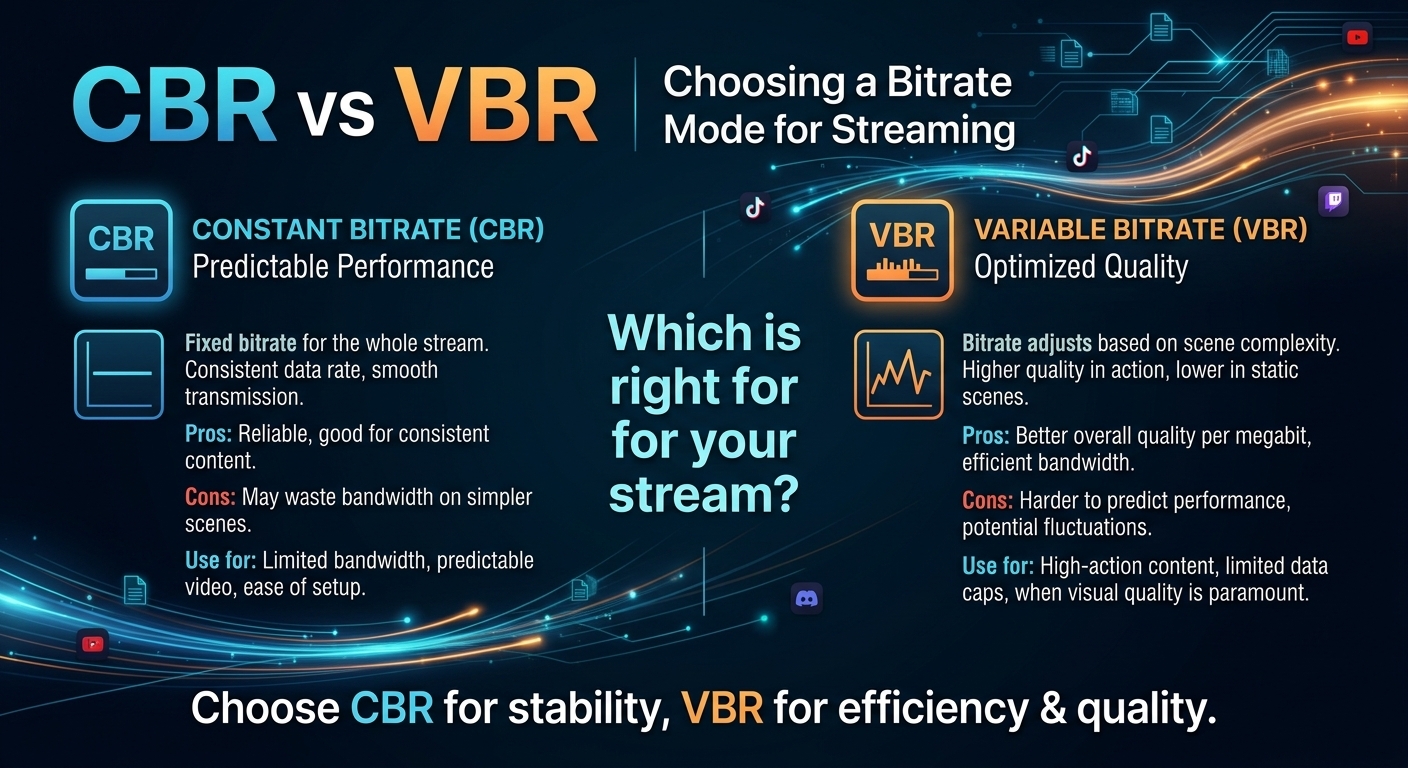
For most on-demand video, capped variable bitrate (VBR) wins the cbr vs vbr decision: it spends bits where the picture ...