Table of Contents A Surprising Truth: The Hidden Cost of Poor Video Streaming Why a European Video...
Best CDN for Video Streaming Platforms: Seamless OTT and Live Video Delivery
More than 65% of global downstream internet traffic is already video, according to Sandvine’s Global Internet Phenomena report, and that share keeps growing every year. Yet users still abandon streams in seconds when playback stutters or the picture turns into a mosaic of blurry blocks. The paradox is simple: streaming has eaten the internet, but not every CDN has caught up with what OTT and live video really need.
If you run a video streaming platform, sports OTT service, e-learning portal, or live event business, your choice of CDN is no longer just an infrastructure decision. It directly shapes your audience’s emotions: excitement during a championship final, trust in your brand during an investor webcast, or frustration when the stream freezes at the worst possible moment. This article unpacks how to choose the best CDN for video streaming platforms, with a deep dive into seamless OTT and live video delivery – plus a practical look at where modern providers like BlazingCDN fit in.
As you read each section, ask yourself: if millions of viewers joined your stream in the next 10 minutes, would your current CDN help you win that moment – or become the weakest link?
Streaming has already won the internet – but experience still lags
Think back to the last time you tried to watch a major live event online – a global sports final, a big concert, or a highly anticipated game launch stream. Chances are, you saw social feeds full of complaints: buffering wheels, streams crashing right before a decisive play, or huge delays compared to broadcast TV. These are not isolated glitches; they are the visible symptoms of delivery architectures that were never fully tuned for modern-scale video.
Sandvine’s 2023 report shows that video accounts for well over half of all internet traffic worldwide, driven by giants like Netflix, YouTube, Amazon Prime Video, and regional OTT services. At the same time, research from companies like Mux has demonstrated that even a one- or two-second increase in video startup time can sharply increase abandonment and cut total viewing time. Viewers don’t care how complex your encoding ladder is or how many regions you serve – they simply close the tab if playback does not “just work.”
Leading platforms have reacted by building or adopting highly specialized content delivery architectures. Netflix famously rolled out its own Open Connect infrastructure, while others rely on multiple commercial CDNs, fine-tuned caching rules, and detailed QoE analytics. The common thread is simple: streaming at scale demands a CDN tuned specifically for video, not just generic file delivery.
So as video takes over the internet, the critical question becomes: is your CDN strategy evolving as fast as your audience’s expectations?

What “seamless” OTT and live streaming really means
“Seamless streaming” is one of the most overused phrases in our industry. To make it useful, we need to turn it into measurable, operational goals. For a CDN serving OTT and live video, seamlessness can be broken down into a few critical viewer-centric metrics.
Key quality-of-experience (QoE) metrics you should obsess over
- Video startup time: How long it takes from hitting play to seeing the first frame. Under 2 seconds feels snappy; beyond 5 seconds, abandonment climbs fast.
- Rebuffering ratio: The percentage of viewing time spent in buffering. Leading streaming platforms push this below 0.5–1% for VOD and as low as possible for live.
- Average bitrate / resolution: How often viewers get HD or UHD vs being stuck in 480p due to poor last-mile throughput.
- Latency for live: The delay between “real time” and what viewers see on their screen. Traditional HLS/CMAF might sit at 20–30 seconds; optimized low-latency HLS/DASH can go under 5–8 seconds, and ultra-low-latency workflows can target sub-1-second for interactive use cases.
- Join concurrency and stability: How your platform behaves when tens or hundreds of thousands of viewers press play within a short window.
A “best CDN for video streaming” is one that moves these metrics in the right direction, consistently, across regions and networks. It is not just about raw speed tests; it is about predictable, emotionally invisible performance – so good the viewer never thinks about it.
When you look at your current stats, would a first-time viewer describe your stream as effortless, or as “good enough – when the network behaves”?
How a CDN powers video streaming behind the scenes
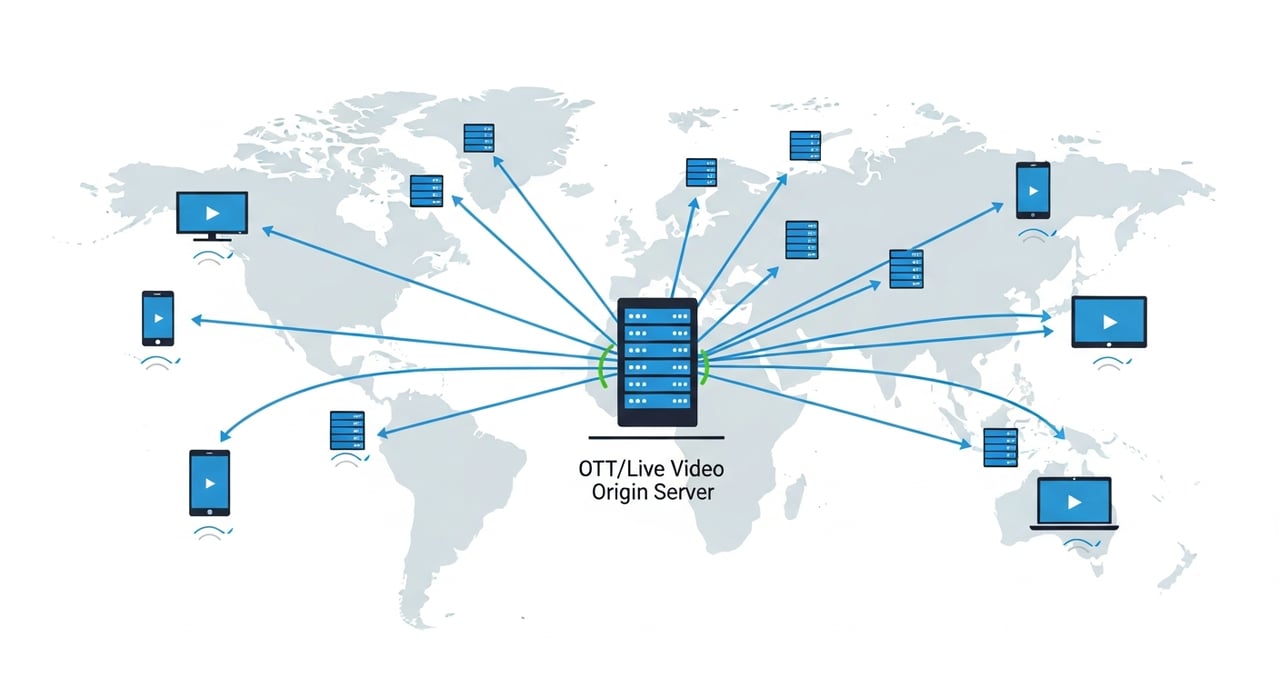
At a high level, a CDN for video streaming does one simple thing: it moves your video closer to your viewer. But under the hood, several pieces must work in harmony to make OTT and live delivery reliable.
From origin to edge: the basic flow
- Ingest and encoding: Your encoders or packagers produce HLS/DASH segments (or CMAF chunks) at multiple bitrates.
- Origin storage: These segments are stored on an origin server or storage bucket, which acts as the “source of truth.”
- CDN edge: The CDN retrieves the first requests from the origin, caches the content, and serves subsequent viewers directly from its own infrastructure.
- Client logic: The player uses adaptive bitrate algorithms to request the appropriate segments from the CDN based on real-time network conditions.
When the CDN is optimized for video, it minimizes origin load, reduces the number of cache misses, and keeps throughput high enough that even viewers on constrained networks can watch without stalls.
Why “generic” CDNs often fail video workloads
Some CDNs are designed primarily for static assets like images, scripts, or small downloads. Video stresses different parts of the system:
- Long sessions and high sustained throughput per user.
- Massive concurrency during premieres, live sports, or limited-time events.
- Complex caching patterns due to multi-bitrate ladders and frequently updated manifests.
- Sensitivity to small changes in latency and throughput, which directly impact buffering and startup time.
The best CDN for OTT and live video builds for these realities: fine-grained caching, smart TCP/QUIC optimizations, aggressive TCP slow start tuning, and careful handling of video-specific headers and cache keys.
When you map this flow onto your current architecture, is your CDN an active performance partner in the chain – or just a generic delivery pipe strapped on at the end?
Key criteria when choosing the best CDN for video streaming platforms
Picking a CDN for a video platform is not the same as choosing a CDN for a brochure website. Below are the dimensions that matter most for OTT and live workloads, with practical tips and trade-offs.
1. Real-world performance: throughput, not just latency
For video, raw throughput (how many megabits per second can be delivered steadily) is usually more important than a single-hop latency measurement. Your viewers care about watching 1080p or 4K without buffering, not shaving 5 ms off a ping.
Look for:
- Consistent high throughput in your key markets, even at peak times.
- HTTP/2 and HTTP/3 (QUIC) support to improve multiplexing and resilience on flaky last miles.
- TLS 1.3 for faster handshakes and more efficient secure sessions.
Practical tip: run player-side throughput tests across different regions and ISPs during prime time. Correlate those measurements with CDN logs to see where bottlenecks appear.
If you plotted your viewers’ effective bitrates on a map, would you like what you see – or would entire regions look permanently stuck in SD?
2. Startup time and cache efficiency
Slow video startup is often a sign of poor cache efficiency or suboptimal origin connectivity. When the first segment requests miss the cache, the CDN must pull them from origin, adding precious seconds.
Evaluate:
- Cache hit ratio for video objects: Track this separately from other traffic types.
- Support for video-friendly cache keys: Proper handling of query strings, cookies, and headers that affect manifests vs media segments.
- Options for pre-warming or prefetching segments ahead of big events to reduce cold starts.
Practical tip: for scheduled live events, coordinate with your CDN to pre-test manifests and ensure initial segments are reachable and quickly cached as soon as they are published.
How many of your startup delays today are really CDN cache misses in disguise?
3. Scalability for flash crowds and live events
OTT libraries usually see relatively predictable usage. Live events are different: millions of viewers may join within minutes, then disappear just as fast. A suitable live streaming CDN must be engineered for those “arrival storms.”
Questions to probe:
- Can the CDN sustain sudden spikes of tens or hundreds of gigabits per second in your target regions?
- How does it behave when all viewers request the same few segments simultaneously (e.g., beginning of a sports stream)?
- What is the track record during real high-profile events (large sports tournaments, national elections, award shows)?
Practical tip: before signing long-term contracts, run realistic load tests that mimic your expected concurrency profile rather than just synthetic traffic.
If your next viral stream doubles your expected peak traffic overnight, are you confident your current CDN will scale without last-minute firefighting?
4. Support for modern OTT and live protocols
A video-centric CDN must play nicely with today’s streaming formats and the ones your roadmap will require next year.
Core requirements include:
- HLS and MPEG-DASH with correct handling of byte-range and chunked transfer for CMAF-based workflows.
- Low-latency HLS/DASH support, including tuned TCP/QUIC and caching behavior for shorter segments and partial segments.
- Progressive download and MP4 for legacy devices where needed.
- WebSocket or WebRTC-friendly delivery paths if you run ultra-low-latency or interactive streaming (auctions, betting, e-sports co-watching, classrooms).
Practical tip: validate that your CDN correctly respects cache-control headers for manifests vs segments, supports range requests, and does not inadvertently cache personalized manifests where they should remain dynamic.
Is your CDN flexible enough to support your next-generation live or low-latency formats without another costly migration?
5. Content protection, DRM signaling, and tokenization
Major OTT platforms must protect content while keeping friction low for legitimate viewers. A CDN is not a DRM system, but it must integrate cleanly with these components.
Look for capabilities like:
- Secure TLS delivery with modern cipher suites.
- URL tokenization and signed URL support to prevent simple hotlinking and unauthorized sharing.
- Flexible header and cookie handling so that DRM license and entitlement logic can live at your application layer without breaking caching.
Practical tip: design your tokenization and entitlement so that the CDN can still cache media segments broadly, while access checks happen at the manifest or application level where necessary.
When you add up all the layers of your security model, does the CDN enable your strategy – or force ugly shortcuts that weaken it?
6. Observability and analytics for video traffic
Successful streaming operations teams are relentless about observability. They correlate CDN logs with player analytics, ISP data, and support tickets to quickly detect and resolve issues.
For the CDN part, you should demand:
- Near real-time logs and metrics for HTTP status codes, cache hits/misses, throughput, and response times.
- Granular breakdown by region, ASN, and URL patterns so you can see where your QoE is degrading.
- Easy export into your observability stack (e.g., SIEM, time-series databases, or log analytics platforms).
Practical tip: instrument your player to emit session-level QoE metrics, then correlate spikes in rebuffering or startup time against CDN regions or specific paths in your logs.
When the next incident hits at 8:02 p.m. on a Friday, will your team have the visibility to pinpoint “CDN vs everything else” in minutes or hours?
7. Commercial flexibility and cost per GB
For high-traffic OTT and live businesses, CDN egress is often one of the largest line items in the P&L. The right provider must deliver both technical excellence and predictable economics.
Compare:
- Effective cost per GB or per TB in your core regions, at your realistic volume tiers.
- Overage and burst pricing for unplanned spikes (launch campaigns, viral clips, unscheduled news events).
- Contract flexibility for adding regions, changing traffic patterns, or introducing multi-CDN without heavy penalties.
Practical tip: model your cost for a “bad but plausible” scenario – for example, traffic doubling overnight for a week. See which CDN remains viable, not just at your average month.
If your marketing team asked to stream twice as many live events next quarter, could you say yes immediately – or would CDN cost and contract terms be the first blocker?
OTT vs live: different delivery challenges, different CDN priorities
Both OTT VOD and live streaming rely on strong CDNs, but their patterns and risks look very different. Understanding these differences helps you evaluate which providers are truly optimized for your traffic mix.
OTT and VOD platforms: long-tail libraries and sustained demand
OTT libraries combine large catalogs with always-on usage. Key patterns include:
- Long-tail content: Many titles with relatively low concurrent viewers, but which still must start quickly when requested.
- Peak evening usage: Prime-time demand in each region, often aligned with local time zones.
- Personalized catalogs and recommendations: Caching must focus mainly on media segments while leaving metadata highly dynamic.
For these workloads, the CDN must excel at cache efficiency across huge libraries, strong mid-to-long session throughput, and predictable performance in residential networks.
Live streams: concurrency spikes and latency sensitivity
Live sports, news, music, and gaming events add extra tension:
- Sharp join spikes: Viewers join right before the match or keynote, often within minutes.
- Synchronization with broadcast: Viewers compare delays with linear TV or real-time social media.
- Global concurrency: Major events happen once, worldwide; any CDN failure makes headlines.
This is where meticulous capacity planning, load-shedding strategies, and low-latency optimizations shine. Many platforms also adopt multi-CDN setups for their most important events, routing traffic dynamically based on performance.
Looking at your own roadmap, will your next major bottleneck hit your on-demand catalog – or your largest live events – and is your CDN ready for that specific challenge?
Comparing leading CDNs for streaming workloads
Enterprise buyers typically consider a handful of large, well-known CDNs plus newer, more cost-efficient entrants when designing their streaming stack. Each category has its own strengths.
| Provider type | Typical strengths for video | Potential trade-offs |
|---|---|---|
| Hyperscale cloud CDNs (e.g., tied to major cloud platforms) | Good integration with cloud compute and storage; strong reliability; broad global reach; familiar to DevOps teams already in that ecosystem. | Pricing can become high at scale; less flexibility in commercial terms; sometimes slower to add media-specific optimizations compared to specialist providers. |
| Legacy large CDNs | Long history with major broadcasters and OTT platforms; proven track record on huge events; deep operational experience. | Complex contracts; higher cost per GB for mid-sized players; less transparent self-service tooling in some cases. |
| Modern, performance-focused CDNs (including BlazingCDN) | Competitive pricing, often much lower cost per TB; modern protocol support; agile feature delivery; strong fit for digital-native companies and fast-growing OTT services. | Perceived as "newer" by some enterprises, requiring careful due diligence on reliability and support – though leading examples now demonstrate stability comparable to long-established players. |
For many organizations, the right answer is not a single vendor but a carefully tuned mix: a primary CDN plus one or two alternates for risk mitigation and performance routing. Multi-CDN management platforms, DNS-based routing, or in-house traffic steering based on real-time QoE metrics are increasingly common among serious streaming providers.
In your own architecture, are you treating CDN as a commodity checkbox – or as a strategic layer where provider choice and multi-CDN design can directly improve viewer happiness and margins?
Where BlazingCDN fits into modern OTT and live delivery
BlazingCDN is an example of a new generation of CDNs built specifically for high-volume, media-heavy workloads. It combines the stability and fault tolerance you would expect from an enterprise-grade platform like Amazon CloudFront with a much more aggressive cost profile – starting at just $4 per TB ($0.004 per GB) and backed by a 100% uptime track record.
For OTT and live video platforms, that combination matters in three very practical ways:
- Economics that scale with your success: As your audience and bitrate ladder expand, bandwidth costs stay predictable and significantly lower than many legacy or hyperscale options, giving you room to invest in better content and product features.
- Reliability worthy of mission-critical events: BlazingCDN’s architecture is designed for high availability and resilient delivery paths, which is why it is already trusted by large enterprises and demanding media brands that cannot afford downtime during flagship events.
- Flexibility for fast-moving teams: Engineering and operations teams can fine-tune caching rules, headers, and compression strategies to match their exact HLS/DASH workflows, while still relying on straightforward, transparent pricing and support.
That makes BlazingCDN especially attractive for organizations such as subscription OTT services, live sports and entertainment platforms, e-learning providers with video-heavy courses, and software or game companies distributing large media assets alongside their applications. They can reduce infrastructure costs, scale quickly to meet peaks in demand, and still deliver viewer experiences on par with the biggest names in streaming.
To see how this looks in practice for broadcasters, OTT platforms, and media businesses, you can explore BlazingCDN’s dedicated solutions for media companies, which outlines media-optimized delivery options tailored to large libraries and high-concurrency events.
When you compare this combination of reliability and cost with your current provider, how much additional room would you gain in your budget and performance envelope by switching or introducing BlazingCDN into a multi-CDN strategy?
Implementation checklist: from CDN trials to production-grade streaming
Knowing what matters in a streaming CDN is one thing; turning that knowledge into a concrete decision is another. Use the following checklist to move from theory to an actionable evaluation plan.
Step 1: Map your traffic and business goals
- Quantify your current and projected monthly egress (VOD vs live).
- Identify your key regions and ISPs – where do you make or lose money?
- Clarify your latency requirements for live (broadcast-like vs ultra-low-latency).
- Define cost targets: maximum acceptable cost per TB for the next 12–24 months.
Ask yourself: if your streaming traffic tripled in the next two years, would you be able to sustain it with your current economics?
Step 2: Shortlist 2–4 CDNs that fit your profile
- Include at least one “default” option (e.g., your current provider or your cloud provider’s CDN).
- Add at least one modern, cost-effective alternative like BlazingCDN for comparison.
- Ensure each candidate supports your required streaming protocols and tokenization patterns.
Challenge your shortlist: are you including providers just because they are familiar names, or because they demonstrably align with your QoE and cost goals?
Step 3: Run focused technical trials, not generic tests
Design POCs that mirror your real workloads, including:
- Popular VOD titles with mixed bitrates and long-tail content.
- Simulated or real live events with expected peak concurrency.
- Multiple device types and networks (mobile vs fixed, different ISPs).
Measure:
- Video startup time, rebuffering ratio, and average bitrate per region.
- Cache hit ratio, 4xx/5xx error rates, and throughput at the CDN level.
- Impact on origin load and infrastructure costs.
During these trials, keep asking: which CDN behaves best when conditions are messy – congested evenings, mobile networks, and unexpected spikes – not just in clean lab setups?
Step 4: Evaluate operational fit and support
Technical performance is critical, but so is how the CDN fits into your daily operations:
- How fast and easy is it to change caching rules or headers for specific paths?
- What is the quality and speed of support during your trial and early rollout?
- Can you integrate logs and metrics into your existing observability stack without friction?
Probe deeply here: if you hit a video-specific edge case – say, a manifest behavior in low-latency HLS – will the CDN’s engineers understand your problem space, or will you be explaining streaming basics on every ticket?
Step 5: Lock in sustainable economics
Once you identify top contenders technically, negotiate commercial terms that reflect your growth:
- Secure tiered pricing that keeps cost per TB attractive as you scale.
- Ensure flexibility for adding regions, traffic types, or multi-CDN flows.
- Model scenarios around marketing pushes, new device launches, or expansion into new geographies.
Run the numbers: with a starting rate around $4 per TB, how much more experimentation – extra live events, 4K rollouts, free trials – would a provider like BlazingCDN enable at the same budget you already spend?
Step 6: Gradual rollout and multi-CDN readiness
Finally, resist the temptation to flip all traffic at once. Instead:
- Begin with a portion of your VOD catalog or secondary live events.
- Gradually move flagship content once confidence is high.
- Keep the door open for multi-CDN, even if you start with a single primary provider.
The goal is not just to pick a new CDN, but to build a streaming delivery architecture that can adapt quickly as your audience, content strategy, and devices change.
Looking at this checklist, which step would bring you the biggest insight right now – and what is stopping you from starting that step this week?
Turn your CDN into a competitive advantage
In an era where video already dominates the internet, “good enough” delivery is a myth. The best CDN for video streaming platforms is not just one that keeps your site online; it is the one that quietly transforms every play button into a smooth, high-quality, emotionally satisfying experience – whether that is a student clicking into a live class, a fan watching a championship final, or a new customer exploring your product demo.
Modern providers like BlazingCDN prove that you no longer have to choose between enterprise-grade reliability and aggressive cost efficiency. With a 100% uptime track record, stability and fault tolerance comparable to Amazon CloudFront, and pricing starting at just $4 per TB, BlazingCDN gives OTT, live streaming, and media-heavy platforms the room they need to grow, experiment, and win audience loyalty without being constrained by bandwidth bills.
If you are serious about seamless OTT and live video delivery, now is the time to audit your existing CDN setup, benchmark it against what specialized streaming CDNs can offer, and consider how a modern, cost-effective platform like BlazingCDN could fit into your next architecture iteration. Share this article with your team, challenge your current assumptions about CDN performance and pricing, and start a concrete test plan: your next big live event or product launch may depend on decisions you make in the coming weeks.
What is the very next step you will take – running a side-by-side test, analyzing your QoE metrics in more depth, or reaching out to a provider like BlazingCDN to discuss how your OTT or live platform can deliver flawlessly at scale?