Learn
Best Video Streaming CDN in 2026? 7 Providers
Best CDN for Video Streaming in 2026: 7 Providers Compared A single rebuffer event at the two-second mark costs you 8% ...

Milliseconds are worth millions: research by Deloitte, commissioned by Google, found that improving mobile site speed by just 0.1 seconds boosted retail conversions by up to 8.4% and travel conversions by 10.1% (source). For many growing businesses, the silent killer behind sluggish pages isn’t the application itself — it’s an aging CDN that can’t keep up.
Most teams only notice their content delivery network when something breaks dramatically: a launch that crashes, a stream that buffers endlessly, a region that suddenly slows down. But long before those disasters, there are quieter, tell-tale signals that your business has already outgrown its CDN provider — and those signals directly affect revenue, engagement, and customer trust.
This article walks through five of the most important signs that your current CDN is holding you back, using real-world performance benchmarks and patterns seen across high-traffic media, SaaS, and gaming platforms. For each sign, you’ll get practical diagnostic questions, data points to track, and a clear picture of what to do next.
As you read, keep one question in mind: if your CDN performance improved by even 100–200 milliseconds, what would that mean for your sign-ups, purchases, or ad revenue over the next 12 months?
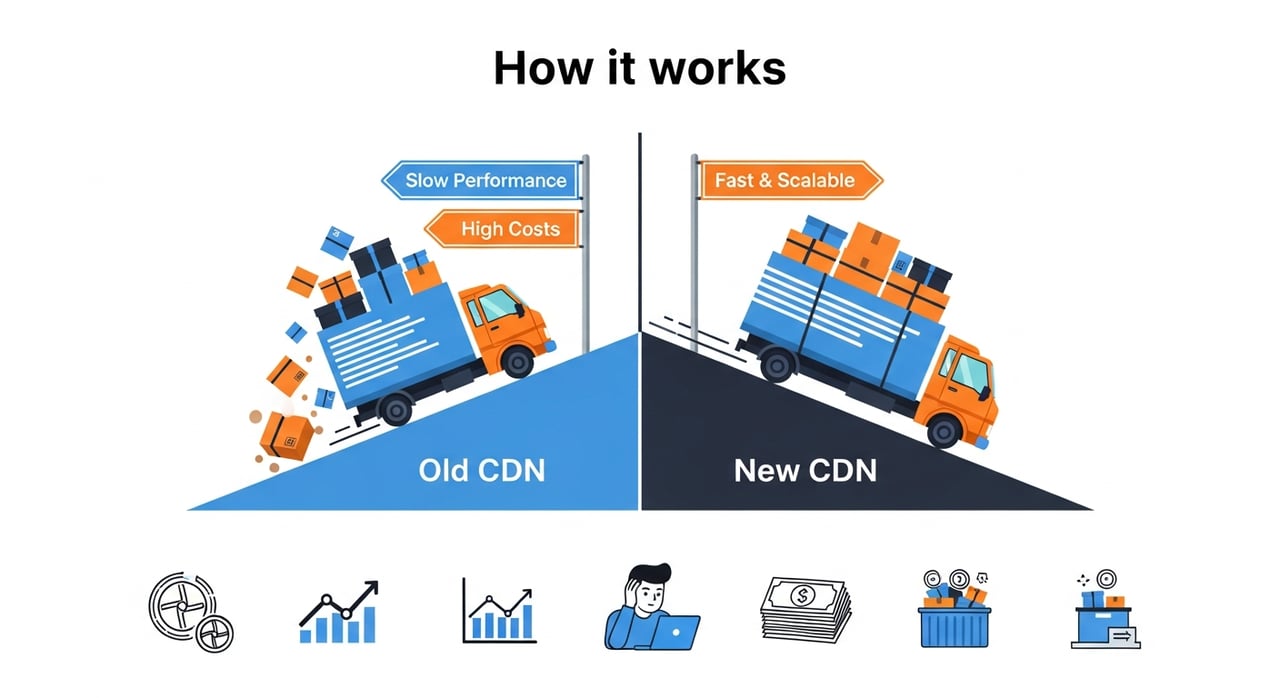
When teams evaluate a CDN provider the first time, the bar often sounds like this: “As long as it’s faster than origin and doesn’t go down, we’re fine.” That mindset works at 1 million monthly users. It usually fails at 10 million.
Three macro trends explain why:
In this environment, “good enough” CDN performance is often good enough only for yesterday’s traffic. The sections that follow will help you spot when that tipping point has already arrived — and what to do before it becomes a crisis.
As you scan these signs, ask yourself: are customers feeling pain from your CDN before your monitoring tools do?
On paper, everything looks stable: your uptime graphs are green, error rates are low, and your CDN’s status page shows no incidents. Yet during promotions or releases, you see a familiar pattern:
Technically, your CDN “handled” the traffic. Commercially, the event underperformed.
Several large-scale studies show how sensitive users are to relatively small slowdowns:
In real-world terms: if your time to first byte (TTFB) and LCP climb during traffic spikes because your CDN edges or routing are saturated, you’re leaving revenue on the table even if your platform doesn’t “go down.”
To determine whether your CDN provider is the limiting factor during surges, analyze:
If you consistently see performance sag specifically at high traffic, your business has effectively outgrown the capacity or routing efficiency of your current CDN setup.
Ask yourself: are your biggest marketing moments limited more by your creativity — or by what your CDN can reliably handle?
For many scale-ups, the second sign appears in finance before it appears in engineering: monthly CDN invoices that grow faster than user or revenue metrics, combined with opaque pricing structures that make forecasting difficult.
Common symptoms include:
As you grow, the problem isn’t just that your CDN is expensive — it’s that the cost per delivered GB or per user session isn’t improving with scale, and the billing model makes it hard to align infrastructure spend with business goals.
Many traditional CDN contracts were designed for a world where bandwidth was scarce and traffic patterns were relatively predictable. They often come with:
Modern CDN economics should look very different: transparent per-TB pricing, predictable bills across regions, and meaningful economies of scale as you grow.
| Aspect | Signs You’ve Outgrown Your CDN | What a Modern Enterprise CDN Should Offer |
|---|---|---|
| Cost per TB | Stagnant or rising despite higher total traffic; discounts only at very high tiers. | Declining cost per TB as usage grows, with clear, public pricing starting in the low single-digit dollars per TB range. |
| Billing predictability | Frequent overages; hard to model costs for new regions or features. | Straightforward regional pricing and minimal surprise fees, making it easy to forecast expansion. |
| Feature access | Charged individually for logs, routing tweaks, or optimizations. | Most performance-critical features bundled for enterprise users, without punitive add-ons. |
| Multi-CDN flexibility | Commit clauses discourage or penalize using a second CDN. | Contracts that comfortably support multi-CDN or phased migration strategies. |
When your egress bills are rising faster than your user base, it’s a strong sign that your original CDN deal was tuned for a smaller business — and now actively resists the scale you’ve reached.
Challenge for your team: if your traffic doubled next quarter, could you estimate your CDN bill within ±10% today?
As organizations mature, their product and infrastructure teams demand more than basic caching. They need fine-grained control over how content is served, transformed, and observed. Hitting a “glass ceiling” on configurability and visibility with your CDN is a classic indicator that you’ve outgrown it.
Some of the most frustrating ceilings appear as:
For modern media, SaaS, and gaming products — where experimentation and rapid iteration are essential — these limitations quickly translate into slower release cycles and more guesswork.
At scale, small misconfigurations or blind spots can have outsized impact:
An enterprise-grade CDN should make it trivial to:
If your team routinely says, “We think it’s the CDN, but we can’t prove it,” you’ve hit a maturity gap in your provider’s tooling and transparency.
Ask yourself: when something feels slow in a particular region or on a particular device, can you see exactly why within minutes — or are you still troubleshooting by gut feeling and support tickets?
Growing companies rarely stay regional for long. Streaming platforms expand into new territories, SaaS tools pick up customers in new countries, and games build communities across continents. At that point, “fast where we launched first” is no longer enough — you need consistently low latency and high reliability around the world.
Regional performance problems rarely show up in aggregate dashboards. Instead, they appear as:
Sometimes, your CDN simply has weaker presence or suboptimal routing into particular regions. Other times, contractual or technical limitations make it hard to prioritize performance improvements where your business is growing fastest.
For different sectors, regional inconsistency has very specific consequences:
Modern, global businesses need a CDN strategy that treats every important region as first-class, not as an afterthought once problems appear.
Question to consider: if you plotted performance (LCP, video rebuffering, download speed) by your top 10 revenue countries, would the chart show a business expansion strategy — or a patchwork of compromises driven by your CDN’s strengths and weaknesses?
At some point, the most critical sign isn’t raw performance or cost — it’s whether your CDN enables or blocks your product roadmap. As your organization becomes more sophisticated, you may find that:
This innovation drag is especially damaging in industries where user expectations are shaped by the very best performers: ultra-responsive consumer apps, top-tier streaming services, and competitive online games. If your CDN can’t keep pace with modern patterns, your product will start to feel outdated even if your core functionality is strong.
Another dimension of this problem is how tightly coupled you’ve become to your current provider’s limitations:
In contrast, modern CDN strategy, especially at the enterprise level, assumes that providers must earn their place continually — and that you should always have the flexibility to diversify or switch without a multi-year replatforming project.
Ask yourself: if your product team pitched a bold new experience that demanded aggressive edge logic or world-class performance, would your CDN be a catalyst — or the first thing everyone worries about?
If multiple signs above feel uncomfortably familiar, your business has almost certainly outgrown its original CDN provider. The good news: you don’t need to jump straight into a risky “big bang” migration. Instead, treat CDN modernization as a staged, data-driven transformation.
Before looking at alternatives, build a clear, quantitative picture of your current state:
This baseline serves two purposes: it clarifies which problems matter most, and it provides a yardstick against which to evaluate new providers.
Not every organization needs the same delivery capabilities. However, for most scaling enterprises, a modern CDN strategy should support:
Translate these needs into concrete requirements and success metrics. For example, you may define that in your top five markets, LCP should be under 2.5 seconds on median connections, and your cost per TB should not exceed a certain threshold.
Rather than migrating everything at once, set up controlled tests with one or more alternative CDNs:
This approach lets you validate performance and cost claims under your own workload, rather than relying solely on marketing materials or synthetic benchmarks.
Performance and cost are necessary, but not sufficient. At enterprise scale, the day-to-day experience of working with your CDN provider is equally important:
These factors determine whether your CDN becomes a quiet, reliable backbone — or a recurring operational headache.
When enterprises look beyond their first CDN provider, they increasingly seek a blend of top-tier reliability, modern features, and rational economics. This is exactly where BlazingCDN positions itself: as a high-performance, globally capable content delivery network that delivers stability and fault tolerance on par with Amazon CloudFront, while remaining more cost-effective — a critical advantage for large enterprises and corporate clients moving serious volumes of content.
BlazingCDN focuses on serving demanding verticals such as media and entertainment, software distribution, gaming, and SaaS platforms. For these industries, the ability to reduce infrastructure costs, scale quickly to absorb traffic surges, and fine-tune delivery behavior is not a “nice to have” — it’s a competitive requirement. With 100% uptime in production deployments and a starting cost of just $4 per TB (that’s $0.004 per GB), it enables organizations to unlock premium delivery performance without absorbing hyperscaler-level pricing.
From an architectural standpoint, BlazingCDN emphasizes flexible configuration, deep analytics, and a partnership-driven approach: enterprises can shape routing, caching, and optimization strategies that match their specific workloads, rather than conforming to a one-size-fits-all template. This makes it a strong candidate not only as a primary CDN, but also as part of a multi-CDN strategy where resilience and price-performance both matter.
If cost predictability and ROI are high on your agenda, it’s worth running the numbers using the publicly available tiers on the BlazingCDN pricing page and comparing them against your current provider’s effective cost per delivered TB.
While the five signs above are common across many organizations, the way you prioritize and address them depends heavily on your domain. Here’s how to think about “outgrowing your CDN” in a few major sectors.
For media companies, the business is directly tied to stream quality and start time. A few sector-specific priorities when reassessing your CDN:
BlazingCDN is particularly relevant here because it combines enterprise-grade reliability with aggressive pricing, allowing media businesses to handle high-volume video delivery without runaway egress costs, while still matching the stability expectations set by incumbents like Amazon CloudFront.
Software companies and SaaS providers face a different performance profile: frequent API calls, dashboard loads, and asset-heavy front-ends accessed from corporate networks and mobile devices worldwide. Key CDN considerations include:
An adaptable CDN like BlazingCDN can help SaaS providers and software platforms roll out globally while retaining tight control over delivery behavior and spend, ensuring that performance keeps pace with market expansion instead of trailing it.
In gaming, player patience is notoriously short: slow patch downloads, laggy content delivery, or unstable launch-day performance quickly turn into negative reviews and churn. For studios and publishers, an upgraded CDN strategy should prioritize:
A cost-effective yet robust CDN such as BlazingCDN is well-suited to serve multi-gigabyte game assets and patches worldwide, keeping both download times and bandwidth bills under control while maintaining the performance bar set by the largest players in the industry.
If you recognize yourself in these five signs — performance sagging at peak moments, opaque and rising bills, limited control and insight, regional inconsistencies, and a delivery layer that slows innovation — your business hasn’t just “outgrown” its CDN. You’ve reached a point where content delivery should become a strategic advantage, not just a background service.
The path forward is clear, and it’s within reach:
Now is the moment to act. Share this article with your engineering, product, and finance leaders, and ask them bluntly: “Which of these five signs are we already seeing?” Then, start exploring what a next-generation CDN strategy could do for your launch calendar, your customer experience, and your margins.
Have a specific scenario — a global launch, a new streaming product, or a spike-prone game update — where you suspect your CDN might be the bottleneck? Map out the metrics you’d want to improve, and start a conversation with your team today about testing a modern, cost-efficient alternative that can actually grow with your business.
Learn
Best CDN for Video Streaming in 2026: 7 Providers Compared A single rebuffer event at the two-second mark costs you 8% ...
Learn
Video CDN Providers Compared: BlazingCDN vs Cloudflare vs Akamai for OTT If you are choosing a video CDN for an OTT ...

Learn
Video CDN Pricing Explained: How to Stop Overpaying for Streaming Bandwidth Video already accounts for 38% of total ...