
Learn
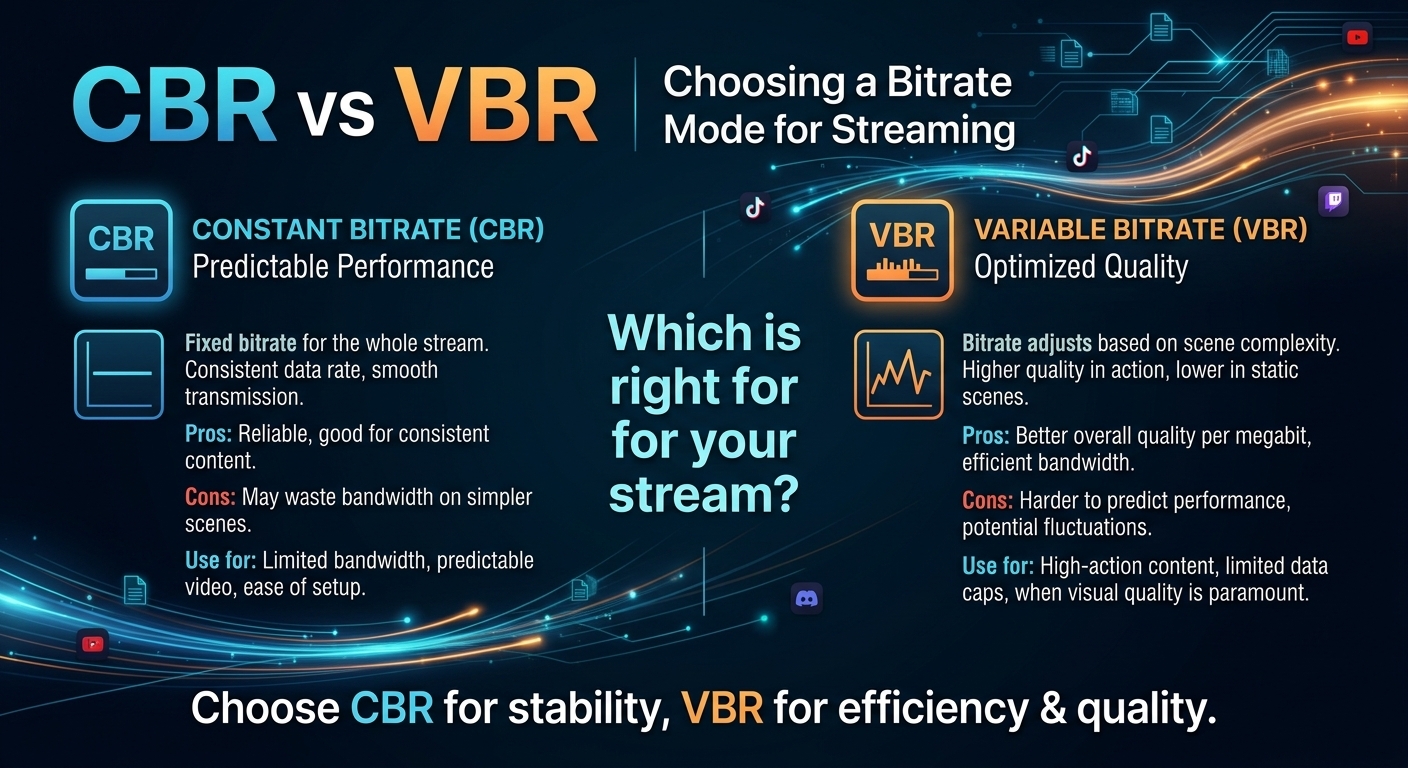
CBR vs VBR: Choosing a Bitrate Mode for Streaming
For most on-demand video, capped variable bitrate (VBR) wins the cbr vs vbr decision: it spends bits where the picture ...
In Q1 2026, median global TTFB for sites behind a CDN dropped to 68 ms, down from 82 ms a year prior. Yet the gap between the fastest and slowest providers in our tracking set widened to 140 ms at the P95. Choosing among the best CDN providers now matters more than it did twelve months ago, because the floor has risen but the ceiling has not. This article gives you three things: a transparent scoring methodology, a 10-provider breakdown updated for 2026 traffic patterns and pricing, and a workload-profile decision matrix you will not find in any other comparison piece. If you are evaluating CDN services for a production migration, a multi-CDN expansion, or a cost rationalization project, this is the reference.

Every comparison needs a disclosed methodology or it is just a listicle. We scored each provider across seven dimensions, weighted for what matters at scale:
| Dimension | Weight | What We Measured |
|---|---|---|
| P50/P95 Latency | 20% | Synthetic TTFB from 40+ global vantage points, Q1 2026 |
| Throughput at Scale | 15% | Sustained single-object throughput (Gbps) on 1 GB test files |
| Cache Hit Ratio | 15% | Reported CHR across long-tail asset catalogs (10M+ objects) |
| Edge Compute | 15% | Runtime options, cold start, memory limits, language support |
| Integration Ease | 10% | Time to first cached response, API coverage, IaC support |
| Support Quality | 10% | Escalation path depth, median resolution time, TAM availability |
| Total Cost of Ownership | 15% | Bandwidth at 100 TB/mo, log fees, TLS cert costs, security add-ons |
We excluded providers that have been acquired and absorbed into another platform (Edgio's assets were acquired by Akamai in late 2024; StackPath wound down its CDN operations). The 2026 list reflects providers you can actually contract with today.
Still the largest network by edge capacity. In 2026, Akamai operates over 4,200 locations across 130+ countries. Their edge compute platform (EdgeWorkers) now supports sub-50 ms cold starts after the March 2026 runtime upgrade. The tradeoff remains price: committed-use contracts at scale typically land between $0.01 and $0.02/GB depending on region, and the configuration surface area is enormous. Best suited for enterprises with dedicated Akamai operations staff.
Cloudflare continues to push the workers-first model. With Workers now supporting up to 128 MB of memory per isolate (as of January 2026) and R2 storage integrated into the edge cache hierarchy, they are the default choice for teams that want programmable delivery without managing origin infrastructure. Free-tier latency is competitive through ~50 TB/month; beyond that, enterprise pricing negotiation is required and often opaque.
Fastly's Compute platform, built on Wasm, remains the strongest option for sub-millisecond cache purge (150 ms global average, 2026 measurement) and custom VCL logic. Their network is smaller than Akamai's or Cloudflare's, but throughput per-node is exceptionally high. Video and media customers value their real-time log streaming and origin shielding. Pricing is transparent and usage-based, typically $0.008–$0.012/GB at volume.
Deep integration with the AWS ecosystem makes CloudFront the path of least resistance for teams already running on AWS. The 2026 addition of embedded CloudFront Functions V2 (with KV store access) narrows the gap with Cloudflare Workers for simple edge logic. Pricing at scale (committed savings plan, 2026 rates) starts around $0.006/GB for the first 10 TB in North America and climbs in underserved regions. The biggest cost trap remains cross-region origin fetch pricing.
Google Cloud CDN benefits from Google's private backbone (B4/B2) for origin-to-edge transit, which gives it strong P95 latency numbers between GCP origins and edge. The 2026 release of Media CDN as a separate, streaming-optimized product adds large-object chunked delivery and mid-stream bitrate switching at the edge. Pricing is comparable to CloudFront. The limitation is ecosystem lock-in: it works best as a GCP-native service.
For teams that want a pay-as-you-go CDN without CloudFront-level cost, BlazingCDN is a contender for video streaming and large-file delivery, with flexible configuration and fast scaling under demand spikes. The pricing model is where they differentiate most: starting at $5/TB, scaling down to $2.50/TB at volume (as of October 2026). At 100 TB/month, that is $415 versus about $6,965 on CloudFront pay-as-you-go. If TCO is a primary decision driver and you deliver at volume, BlazingCDN's comparison page breaks down the numbers against major providers.
Bunny.net continues to overperform relative to its size. With per-region pricing as low as $0.005/GB in Europe and North America and a clean API, it attracts mid-market SaaS companies and indie game studios. Their Bunny Optimizer (image processing at edge) and Stream product (HLS/DASH transcoding) have matured considerably in 2026. The gap versus larger providers shows up in Asia-Pacific and LATAM tail latency.
Gcore's 180+ location network is strongest in Europe, CIS, and MENA regions where other providers have thin coverage. Their 2026 addition of L4 load balancing at edge and integrated DDoS scrubbing makes them attractive for gaming workloads. Pricing is mid-range, and their managed Kubernetes edge platform is a differentiator for teams deploying stateful services at the edge.
Azure Front Door replaces the deprecated Azure CDN (standard/premium) as Microsoft's primary delivery platform in 2026. It combines CDN, L7 load balancing, and WAF in a single service. For shops already deep in the Azure ecosystem, the integration with Entra ID, Private Link origins, and Azure Monitor is unmatched. The cost model is complex: you pay separately for routing rules, acceleration, and security. At 100 TB/month, expect to negotiate aggressively.
KeyCDN is the budget pick for static-asset-heavy sites that do not need edge compute. At $0.04/GB on pay-as-you-go (as of 2026), they are not the cheapest at volume, but their simplicity and zero minimum commitment make them useful for development environments and staging. Production use at scale requires evaluating their smaller network footprint against your user geography.
Picking a CDN from a ranked list is insufficient. The right provider depends on what you are delivering, to whom, and under what constraints. This matrix maps five common workload profiles to the providers best suited for each:
| Workload Profile | Key Constraint | Best Fit (2026) | Runner-Up |
|---|---|---|---|
| Global SaaS app (API + static) | Edge compute, low P95 | Cloudflare | Fastly |
| High-volume video/streaming | Throughput, cost per TB | BlazingCDN | Google Media CDN |
| AWS-native microservices | Ecosystem integration | CloudFront | Akamai |
| Gaming (EU/CIS/MENA focus) | Regional latency, L4 LB | Gcore | Bunny.net |
| Enterprise multi-CDN (compliance-heavy) | Vendor breadth, support SLAs | Akamai | Azure Front Door |
The matrix is not prescriptive. Use it as a shortlist generator, then validate with synthetic and RUM measurements from your own user base.
Three shifts in the first half of 2026 are worth calling out because they change the calculus for anyone re-evaluating their CDN stack:
Consolidation. Edgio's Chapter 11 filing in late 2024 and subsequent asset sale to Akamai removed a mid-market competitor. StackPath's CDN wind-down followed. The practical effect is fewer independent options and stronger pricing power for survivors.
Edge compute convergence. Cloudflare Workers, Fastly Compute, and CloudFront Functions V2 now offer roughly equivalent capability for stateless request-level logic. The differentiation has moved to state management at edge: KV stores, durable objects, and edge-local SQL. If your workload needs edge state, evaluate that layer specifically.
Bandwidth pricing pressure. Average CDN bandwidth pricing at 100 TB/month dropped approximately 12% year-over-year in 2026 across the providers we track. The pressure is coming from providers like BlazingCDN and Bunny.net forcing hyperscalers to offer steeper committed-use discounts. If you have not renegotiated your CDN contract in the last 12 months, you are almost certainly overpaying.
There is no single best provider across all workloads. For edge compute-heavy SaaS, Cloudflare and Fastly lead. For high-volume video delivery where cost per TB dominates, BlazingCDN and Google Media CDN are strongest. For AWS-native shops, CloudFront wins on integration friction alone. Match the provider to your workload profile, not to a generic ranking.
Run synthetic TTFB tests from at least 30 vantage points that mirror your real user geography. Use tools like Catchpoint or ThousandEyes with a 1 KB, 100 KB, and 10 MB test object to capture both connection setup and throughput characteristics. Pair synthetic data with 7 days of RUM from your production traffic for a complete picture.
At traffic volumes above 200 TB/month, multi-CDN typically pays for itself through improved availability and per-region latency optimization. Below that threshold, the operational overhead of traffic steering, cache key normalization, and log aggregation across providers often exceeds the benefit. Start with a primary and a cold-standby secondary before committing to active-active.
At 100 TB/month with a 12-month commit, the market range in Q1 2026 is $2–$8/TB depending on provider, region mix, and feature requirements. Hyperscaler CDNs (CloudFront, Google Cloud CDN) cluster around $5–$8/TB. Independent providers like BlazingCDN ($3/TB at 500 TB) and Bunny.net ($5/TB in EU/NA) sit at the lower end. Always model total cost including log storage, security features, and overage charges.
If the migration results in slower TTFB or increased downtime during the cutover, yes. If the new provider delivers equal or better Core Web Vitals scores, the impact is neutral to positive. Use a weighted DNS cutover (10/90 split) over 48 hours to validate performance before full migration. Monitor LCP and CLS in Search Console for two weeks post-migration.
Log delivery fees, real-time log streaming surcharges, per-certificate TLS costs, origin shield charges, purge API rate limits, and security add-on bundles are the most common surprises. Request an itemized cost breakdown at your projected traffic volume before signing. Some providers bundle these into the bandwidth rate; others charge each separately, inflating the effective per-GB cost by 20–40%.
Pick your top three candidates from the matrix above. Deploy the same 100 KB test object on all three with identical cache-control headers. Run a 48-hour synthetic test from the 10 regions where your P75 traffic originates. Compare P50 and P95 TTFB, measure cache hit ratio after warm-up, and calculate your all-in monthly cost at current traffic plus 30% headroom. That exercise will tell you more about which provider fits your stack than any article, including this one. If your numbers surprise you, share them with your team and revisit your CDN contract before the next renewal cycle.

Heavy traffic.
Light bill.
The CDN for video and large traffic
Learn
For most on-demand video, capped variable bitrate (VBR) wins the cbr vs vbr decision: it spends bits where the picture ...
Compare
As of October 2026, the Azure service that matches Amazon CloudFront is Azure Front Door Standard or Premium: Microsoft ...

Learn
In answer to what is a keyframe: a keyframe, or I-frame, is a video frame encoded without reference to any other frame, ...