
Learn
TLS 1.3 and 0-RTT at the Edge: The Real Handshake Cost
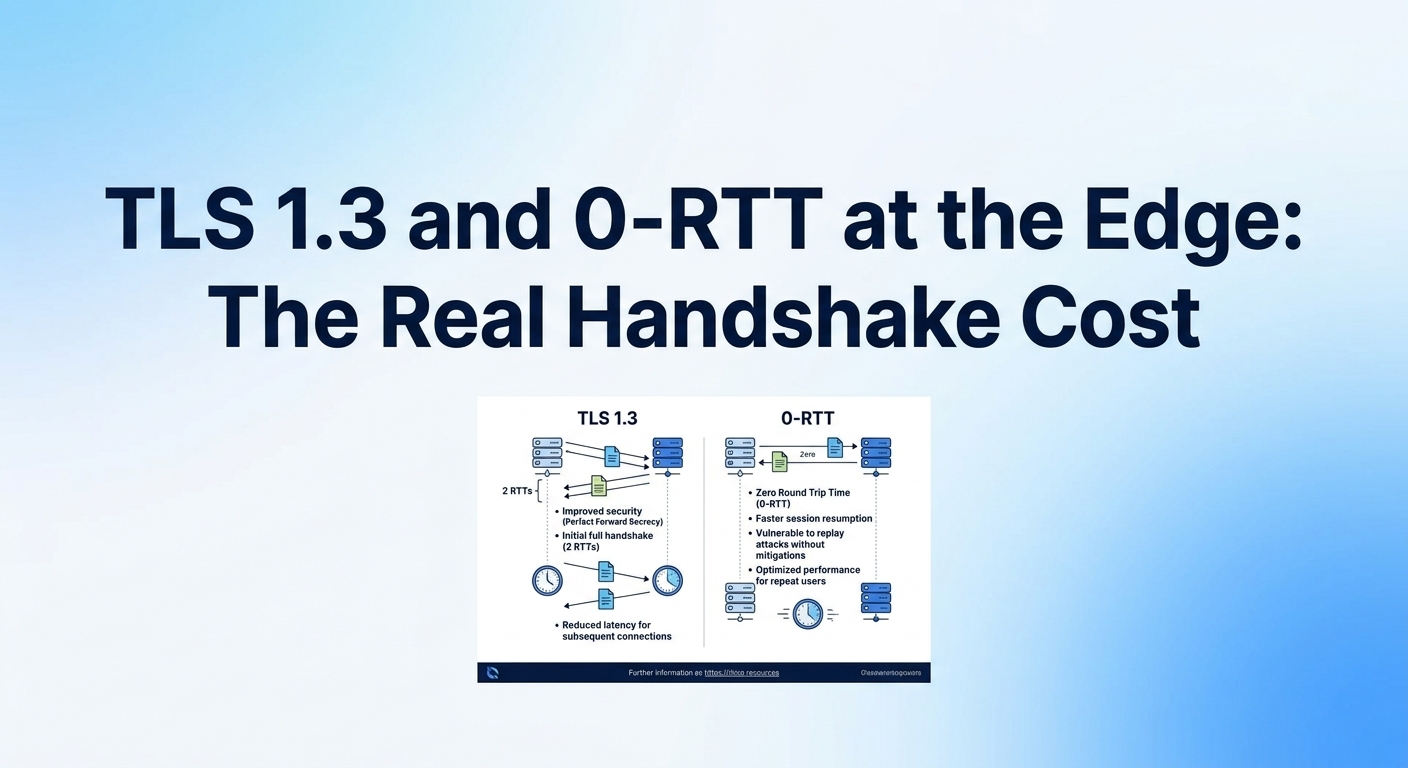
TLS 1.3 removes exactly one round trip from a full handshake compared with TLS 1.2, and 0-RTT removes one more on ...
A 90 GB day-one patch shipped to 4 million concurrent clients is 360 PB of egress in roughly six hours. At CloudFront-style list pricing that single event bills north of $25 million before any negotiated discount; at a volume CDN contract closer to $2–3 per TB it lands under $1 million. That delta is why choosing a CDN for games is a distribution architecture decision, not a procurement checkbox. This piece gives you the 2026 numbers: patch sizes, chunk-size tuning for delta updates, cache-hit thresholds that actually matter, a workload decision matrix, and the cost-per-TB math across the vendors that compete for game download traffic.

Three things moved since the 2024–2025 planning cycle, and each one changes how you size a game CDN.
First, install footprints stopped shrinking. AAA titles routinely land between 120 GB and 200 GB on disk as of 2026, driven by uncompressed high-frequency audio stems, 4K virtual texture pools, and shipping multiple ray-tracing BVH variants. Studios that adopted aggressive on-device recompression cut this by 20–35%, but the median has not fallen.
Second, delta patching is now the default rather than the differentiator. Every major storefront supports block-level or content-defined chunking. The practical consequence: your CDN traffic profile shifted from a few enormous objects to millions of small-to-mid chunks, typically 256 KB to 4 MB. Cache-hit ratio on a chunked patch corpus behaves differently than on monolithic archives, and most 2023-era CDN configs are still tuned for the latter.
Third, egress pricing bifurcated. Hyperscaler CDN list pricing for the first 10 TB sits around $85 per TB in North America and Europe as of 2026, with committed enterprise contracts pulling that to roughly $17–40 per TB at petabyte volumes. Volume-focused CDNs publish $2–8 per TB with no negotiation. For game distribution — high volume, low margin per byte, spiky — that gap dominates every other selection criterion.
Install size is a one-time acquisition cost per player. Patch traffic is recurring and it compounds. A live-service title pushing biweekly updates at 8–15 GB effective delta per player, against a 3 million MAU base, generates 24–45 PB per month of steady-state download traffic. That is the number that determines your contract tier — not the launch spike, which is loud but brief.
The shape that works in 2026 has not changed radically, but the tuning has.
Content-defined chunking with a target of 1 MB and a 512 KB–4 MB window is a reasonable default, but it is a trade-off you should measure against your own build history. Smaller chunks improve dedup ratio between consecutive builds — we have seen 15–25% better delta efficiency moving from 4 MB to 1 MB targets on texture-heavy titles. Smaller chunks also multiply request count, which raises TLS and HTTP overhead and, on some CDNs, per-request billing.
The practical test: replay your last ten patches through both chunker configurations offline, and compute delivered bytes plus request count for each. Multiply request count by your CDN's per-10k-request rate. Below roughly 1 MB, the request overhead usually eats the dedup gain unless your clients are aggressively parallelizing on HTTP/2 or HTTP/3 with a single connection.
Pre-warm 45–90 minutes before unlock, not 10. Warming is itself origin-fill traffic, and a compressed warm window creates the exact origin stampede you are trying to avoid. Warm the mid-tier first, then let edges pull from shield. Prioritize by expected regional concurrency, not alphabetically by PoP.
One detail that bites teams repeatedly: preload the manifest and the first 2 GB of the critical-path chunks — the executable, the boot-sequence assets, the first playable region. Players judge launch quality by time-to-first-playable, not total download time. Titles that ship a play-while-downloading layer can shift the perceived download from 90 minutes to 6.
Here is a comparison at 500 TB per month, a realistic figure for a mid-size live-service title. All figures are list or published pricing as of 2026; enterprise commits move these.
| Provider | Effective $/TB at 500 TB | Notes for game delivery |
|---|---|---|
| BlazingCDN | ~$3.00 | $1,500/mo for 500 TB, $0.003/GB overage. NVMe SSD edge helps chunk-heavy read patterns. Flat rate, no regional multipliers. |
| Bunny.net | ~$5–10 | Genuinely strong developer ergonomics and per-region granularity. Regional pricing tiers mean APAC and LATAM cost materially more than EU. |
| CDN77 | ~$4–8 | Solid large-file throughput and a good track record with software distribution. Pricing is quote-based above modest volumes. |
| Gcore | ~$6–12 | Strong footprint in regions others underserve, plus adjacent game-server hosting. Higher blended rate. |
| Fastly | ~$20–50 | Best-in-class instant purge and edge compute. Priced for interactive and streaming workloads, not bulk binary egress. |
| CloudFront / hyperscaler CDN | ~$17–85 | Deep integration with S3 origins and IAM. Regional egress multipliers of 2–3× in South America and India are a real budget hazard. |
Run this against your own traffic mix before believing any of it. The number that matters is blended cost per delivered TB across your actual regional distribution, including origin-fill, storage, and request charges — not the headline rate for your cheapest region.
If the goal is bulk patch and DLC egress at predictable cost, BlazingCDN's game distribution setup is worth putting in your bake-off. It targets 100% uptime with fault tolerance comparable to Amazon CloudFront while running at a fraction of the per-TB cost, scales through demand spikes without renegotiation, and onboards in about an hour. Pricing starts at $5 per TB ($0.005/GB) at the entry tier and steps down to $2 per TB ($0.002/GB) at 2 PB per month, which is the range where hyperscaler egress starts consuming a visible share of a live-service P&L.
| Workload | Primary selection criterion | Threshold to hit |
|---|---|---|
| Launch-day full install | Sustained per-client throughput and burst headroom | p50 above 60 Mbps per client in top-5 regions; origin-fill under 5% in hour one |
| Biweekly delta patches | Cost per TB and small-object cache-hit ratio | Blended under $5/TB; chunk CHR above 97% after 30 minutes |
| Long-tail back catalog | Cold-object origin cost and storage tiering | Origin-fill under 15%; shield collapse working on cold pulls |
| Store catalog, manifests, config | Edge compute and purge latency | p99 under 10 ms; global purge under 5 s |
| Emerging-market rollout | Regional price parity and peering quality | No more than 1.5× the EU rate; p99 completion within 2× of p50 |
These are the ones that cost real money, ranked by how often they show up in post-launch reviews.
Pull CHR segmented by object-size bucket first. If large objects are hitting and small chunks are missing, you have a key or range problem. Then check origin-fill bandwidth as a percentage of delivered bytes; a spike above 10% means the shield is not collapsing concurrent misses. Then look at p99 minus p50 completion time by region. A widening gap with flat CHR points to last-mile or peering saturation rather than cache behavior, and the fix is traffic steering, not configuration.
Vendor-supplied numbers are measured on ideal payloads. Run your own, on your own content.
Multi-CDN is worth the operational overhead above roughly 500 TB per month, where a second provider gives you both failover and pricing leverage. Below 100 TB, the routing complexity, split cache-hit ratios, and doubled config surface usually cost more than they save.
For bulk patch and DLC egress, volume-priced providers in the $2–8 per TB range — BlazingCDN, CDN77, Bunny.net, Gcore — deliver the same bytes as hyperscaler CDNs at a fraction of the cost. Choose based on regional price parity for your actual player distribution and on measured small-object cache-hit ratio, since chunked delta patches stress caches differently than monolithic files.
At 500 TB per month in 2026, expect roughly $1,500 with a volume CDN, $2,500–5,000 with a mid-tier provider, and $10,000–40,000 with hyperscaler CDN pricing depending on commit level and region mix. At 2 PB per month the spread widens further, with volume providers reaching about $2 per TB.
Above 97% within 30 minutes of a patch going live, and above 99% at steady state. Content-addressed immutable chunks with year-long TTLs should approach the theoretical maximum. Anything below 95% usually indicates cache-key fragmentation from signed URLs or query strings rather than genuine cache pressure.
Yes, starting 45–90 minutes before unlock, warming the mid-tier or shield first and letting edges pull from it. Prioritize the critical-path assets that gate time-to-first-playable. Compressed warm windows create the same origin stampede that pre-warming exists to prevent.
Generally above 500 TB per month, where you gain failover and real pricing leverage against both vendors. Below 100 TB, split cache-hit ratios and doubled configuration surface typically cost more in engineering time and origin-fill than the redundancy is worth.
Model blended cost per delivered TB against your actual regional traffic split before launch, not list price for your cheapest region. Providers with flat global rates remove the risk entirely; providers with 2–3× multipliers in South America, India, or Oceania require you to forecast regional concurrency accurately.
Take your last shipped patch, pull the chunk-size histogram, and compute two numbers: delivered bytes and total request count. Multiply the request count by your provider's per-10k-request rate and add it to your bandwidth line. Most teams find that small-chunk request overhead is a line item nobody had modeled, and that it moves the effective cost per TB by 5–15%.
Then segment last launch's cache-hit ratio by object-size bucket. If chunks under 1 MB are hitting materially worse than your large objects, you have a key normalization or range-coalescing issue worth fixing before the next release window. What did your chunk-level CHR look like in the first 30 minutes of your last launch? That single number tells you more about your game download CDN than any vendor benchmark will.

Heavy traffic.
Light bill.
The CDN for video and large traffic
Learn
TLS 1.3 removes exactly one round trip from a full handshake compared with TLS 1.2, and 0-RTT removes one more on ...
Learn
Evaluated February 2026. Two mechanisms decide which edge serves a request, and they fail on completely different ...

Security
Cloudflare Rate Limiting Pricing 2026: Plans, Rules, Real Costs Cloudflare rate limiting pricing has one detail that ...