
Learn
TLS 1.3 and 0-RTT at the Edge: The Real Handshake Cost
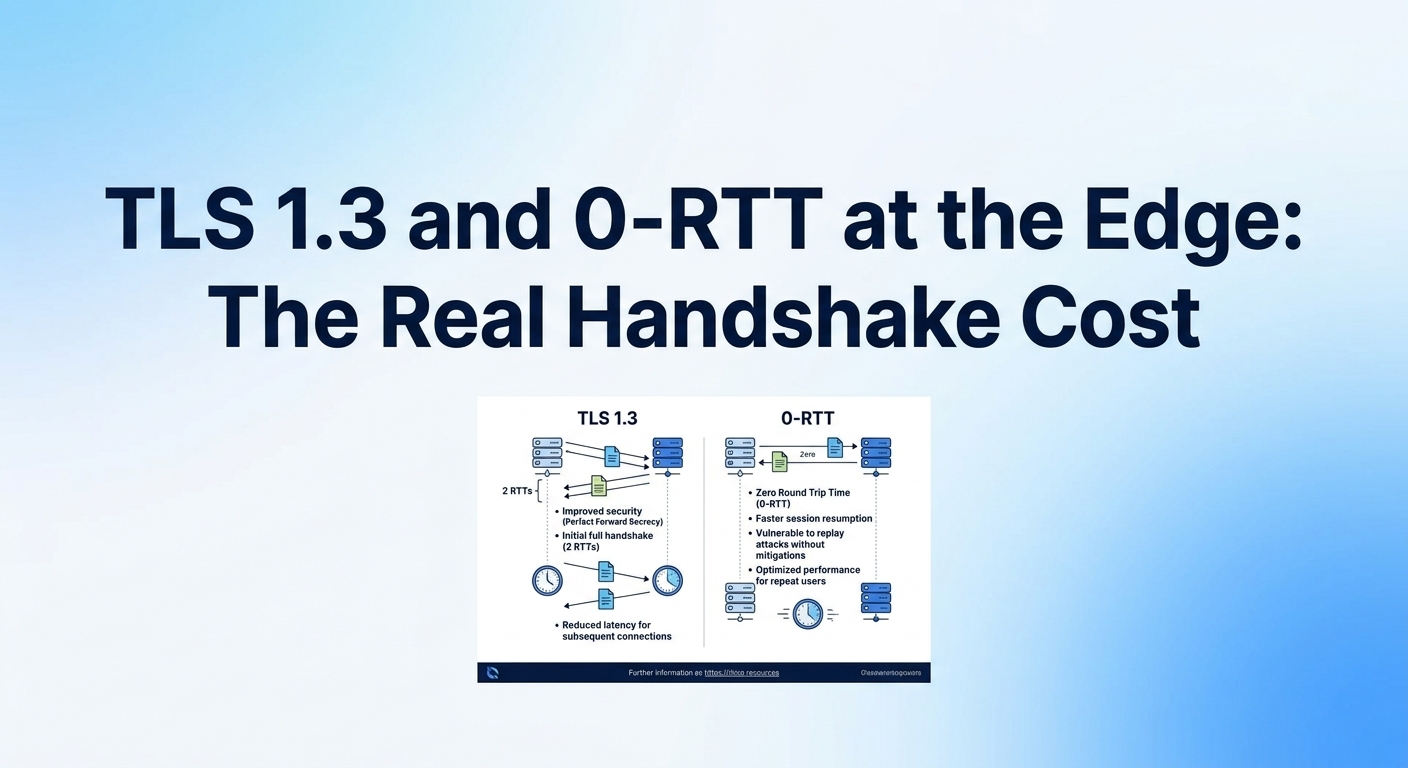
TLS 1.3 removes exactly one round trip from a full handshake compared with TLS 1.2, and 0-RTT removes one more on ...
A mid-market streaming company we spoke with earlier this year was paying $0.052/GB on Akamai for roughly 30 TB/month of video delivery across three continents. After a contract renegotiation in Q1 2026, their effective rate dropped to $0.044/GB, but only after they committed to a 36-month term with a 20% overage penalty. That single detail, buried in a renewal addendum, would cost them an extra $18,000 the first month they exceeded their commit. Akamai CDN pricing is not just a per-GB number. It is a matrix of commit tiers, regional multipliers, feature bundles, and contract mechanics that determines your actual spend. This article gives you the full breakdown as of April 2026: estimated per-GB rates by tier, the hidden costs most comparison articles ignore, a workload-profile decision matrix for picking the right provider, and a direct cost comparison across six CDN options including pricing at scale.
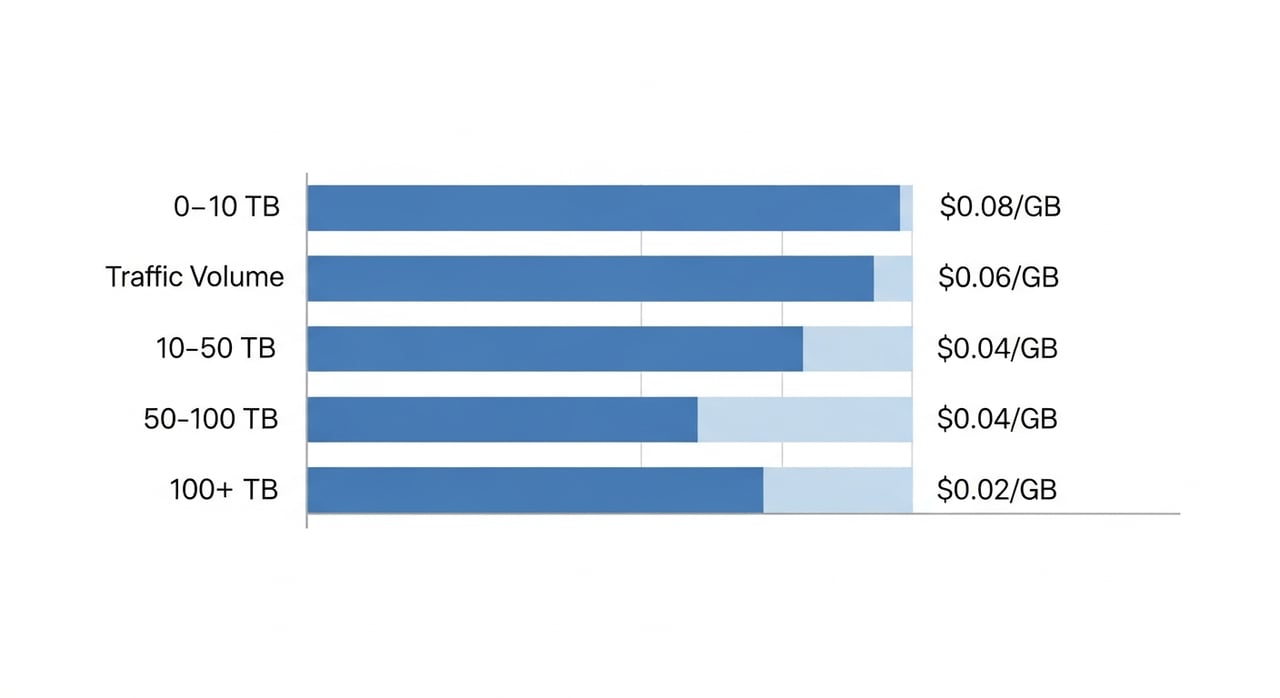
Akamai does not publish a public rate card. Every deal is negotiated, and final pricing depends on commit volume, contract length, geographic mix, and which product SKU you land on (Ion, DSA, AMD, or the newer Akamai Connected Cloud delivery products). That said, based on publicly available data and contract benchmarks circulating as of Q1 2026, the approximate per-GB ranges look like this:
| Monthly Volume | Estimated $/GB (North America/Europe) | Notes |
|---|---|---|
| 0 – 10 TB | $0.048 – $0.055 | Typically requires annual commit; no month-to-month |
| 10 – 50 TB | $0.038 – $0.046 | Mid-market sweet spot; security bundle often mandatory |
| 50 – 200 TB | $0.025 – $0.038 | Volume discounts steepen; 24-36 month terms common |
| 200 TB+ | $0.015 – $0.025 | Fully custom; includes dedicated account engineering |
These figures apply to North American and Western European delivery. Asia-Pacific rates run 1.3–1.8x higher. South America and Africa can reach 2x or more. If your traffic profile is 40% APAC, your blended rate is meaningfully higher than the headline number your Akamai rep quotes.
The per-GB rate is the number everyone fixates on. It is often the smallest problem. Here is where the real cost surprises live:
Most Akamai contracts include a monthly or annual commit with overage rates that are 15–30% above your contracted per-GB price. If your traffic is spiky (game launches, live events, flash sales), overage charges can dominate your bill during peak months. Some contracts include burst provisions, but they are not default. You have to negotiate them in.
As of 2026, Akamai increasingly bundles App & API Protector (formerly Kona Site Defender) into delivery contracts. For new customers in the 10–50 TB range, security add-ons can add $3,000–$8,000/month on top of delivery costs. Declining the bundle is possible but may result in a higher per-GB delivery rate as compensation.
Property Manager configuration, certificate management, and origin shield tuning often require Akamai professional services engagement, billed at $250–$400/hour. Self-service is improving with the Akamai Control Center, but complex multi-origin setups or EdgeWorkers deployments still frequently require PS hours.
Akamai quotes headline rates based on favorable regions. If you serve meaningful traffic in Latin America, the Middle East, or Sub-Saharan Africa, the blended rate can shift substantially. Contracts often lack per-region rate transparency until you request a detailed billing breakdown.
If your origin sits in AWS, GCP, or Azure, you pay cloud egress on cache misses. This is not an Akamai fee, but it is a cost that scales with your cache-miss ratio. High TTL variance or personalized content paths can push origin egress to 10–15% of your total CDN spend.
| Provider | Approximate $/GB (10–50 TB range, 2026) | Contract Model |
|---|---|---|
| Akamai | $0.038 – $0.046 | Annual/multi-year commit, negotiated |
| Cloudflare (Enterprise) | $0.04 – $0.05 | Annual commit; free tier for low-volume sites |
| Amazon CloudFront | $0.020 – $0.085 (region-dependent) | Pay-as-you-go; savings plans available |
| Google Cloud CDN | $0.02 – $0.08 (tier + region) | Pay-as-you-go; cache egress + fill charged separately |
| Azure CDN (Microsoft) | $0.065 – $0.087 | Pay-as-you-go; Front Door integration priced separately |
| BlazingCDN | $0.004 (up to 25 TB at $100/mo) | Monthly; volume tiers down to $0.002/GB at 2 PB |
The spread is significant. At 40 TB/month, your Akamai bill lands somewhere around $1,520–$1,840. The same volume on CloudFront with US/EU-heavy traffic might cost $800–$1,200 depending on region mix and savings plan enrollment. On BlazingCDN, that 40 TB falls in the $350/month tier (up to 100 TB), with overages at $0.0035/GB. The cost delta is not marginal; it is an order of magnitude.
Flat comparisons miss the point. The right CDN depends on what you are actually delivering. Here is a workload-driven decision framework:
| Workload | Best Fit | Why |
|---|---|---|
| Large-scale VOD / live streaming (50+ TB) | BlazingCDN or multi-CDN with BlazingCDN primary | Per-TB cost at scale ($2–$3/TB) makes video economics viable; 100% uptime SLA handles live event spikes |
| Global e-commerce with bot/fraud concerns | Akamai or Cloudflare | Integrated bot management and edge compute for personalization; cost secondary to security posture |
| AWS-native SaaS with CloudFront already in stack | CloudFront | Zero egress from S3/ALB origins within the same region; Lambda@Edge for request manipulation |
| Software distribution / game patching (high-volume, cacheable) | BlazingCDN | Bulk static file delivery with predictable cache patterns; cost per GB is the dominant variable |
| Regulated enterprise with compliance mandates | Akamai | FedRAMP authorization, PCI DSS Level 1 on delivery infrastructure; compliance documentation depth unmatched |
| Multi-CDN failover architecture | Primary: cost-leader (BlazingCDN); Secondary: hyperscaler | Route 80%+ of traffic through the lowest-cost provider; fail over via DNS or steering layer to a hyperscaler CDN |
This matrix reflects a pattern we see across teams running delivery at scale in 2026: Akamai earns its premium when compliance, bot management, or edge compute is the primary requirement. When the workload is bandwidth-dominant and cache-friendly, the cost differential to a provider like BlazingCDN is too large to ignore. BlazingCDN delivers stability and fault tolerance on par with CloudFront while pricing aggressively enough that enterprises including Sony have adopted it for high-volume delivery. At the 500 TB tier, you are looking at $1,500/month flat, with overages at $0.003/GB. That changes the economics of video, software distribution, and large-object delivery fundamentally.
Yes. As of 2026, Akamai does not offer a self-serve pay-as-you-go CDN product. All delivery contracts require a minimum annual commit with negotiated terms. Shorter terms exist but carry a premium. The Akamai Connected Cloud compute products (formerly Linode) have separate, more flexible billing, but the CDN delivery SKUs remain contract-gated. This is the single largest structural difference between Akamai and hyperscaler CDNs, where you can spin up a distribution in minutes with a credit card.
For most mid-market contracts in the 10–50 TB/month range, expect $0.038–$0.046 per GB for North American and European delivery as of Q1 2026. APAC and LATAM regions cost more. Your blended rate depends on geographic traffic distribution, commit volume, and contract length.
Akamai uses a commit-based model. You negotiate a monthly or annual bandwidth floor and pay a per-GB rate against it. Overages above the commit are billed at a higher rate. This contrasts with CloudFront or Google Cloud CDN, where you pay per GB consumed with no floor. The commit model favors predictable workloads but punishes traffic variability.
At enterprise volumes, Akamai and Cloudflare land in a similar per-GB range ($0.04–$0.05). Cloudflare offers a free tier and lower entry cost for smaller properties. Akamai differentiates on network depth, compliance certifications, and advanced edge compute. For pure delivery cost, neither is the lowest option available.
Akamai charges different per-GB rates depending on the delivery region. North America and Europe are cheapest. Asia-Pacific typically runs 30–80% higher. South America and Africa can be double. If your audience skews global, the geo-weighted blended rate can be significantly higher than the headline number, and this is where careful contract negotiation matters most.
Three levers work: increase your commit volume to unlock a lower tier, extend your contract term (36 months gets better rates than 12), and optimize your cache-hit ratio to reduce origin pulls and overage risk. Implementing stale-while-revalidate and tuning TTLs can shift your effective cost by 10–20% without renegotiating.
Pull your last 90 days of CDN billing. Break it down by region, by overage vs. commit, and by month-over-month variance. Calculate your actual blended $/GB, not the rate on your contract, but what you paid divided by what you delivered. Then run that same volume through two alternative pricing models. The gap between what you are paying and what you could be paying is probably larger than you expect. If the number surprises you, that is the signal to start a proof-of-concept migration on a non-critical property this quarter.

Heavy traffic.
Light bill.
The CDN for video and large traffic
Learn
TLS 1.3 removes exactly one round trip from a full handshake compared with TLS 1.2, and 0-RTT removes one more on ...
Learn
Evaluated February 2026. Two mechanisms decide which edge serves a request, and they fail on completely different ...

Security
Cloudflare Rate Limiting Pricing 2026: Plans, Rules, Real Costs Cloudflare rate limiting pricing has one detail that ...