
Learn
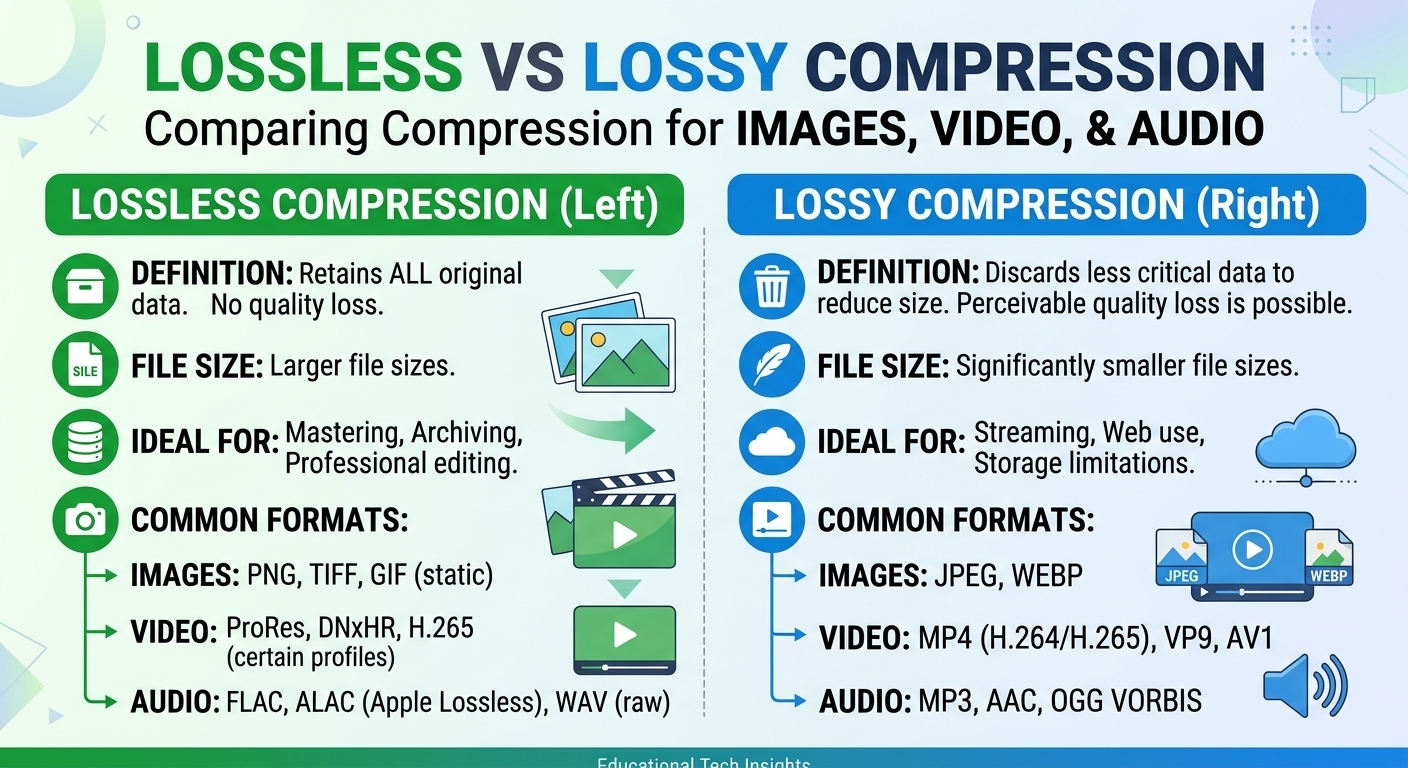
Lossy vs Lossless Compression: Images, Video and Audio
Lossy vs lossless compression comes down to one trade: lossless compression rebuilds every original bit and typically ...
A 50 TB month on CloudFront rarely costs 50,000 GB times $0.085. When we model a typical mixed-geography workload against Q3 2026 list rates, the blended figure comes out near $0.10/GB. That is about 17% above the headline US rate, because APAC and India traffic start at a higher price and request fees sit on top of transfer. CloudFront pricing is a function of four inputs: pricing region, per-region volume tier, request count, and the add-ons your architecture pulls in.
This guide gives you the 2026 regional rate table in both per-GB and per-TB terms, the request, origin, and invalidation fees, three worked examples with full math, and a decision matrix for when the flat-rate plans, a Savings Bundle, or a different CDN make more sense.
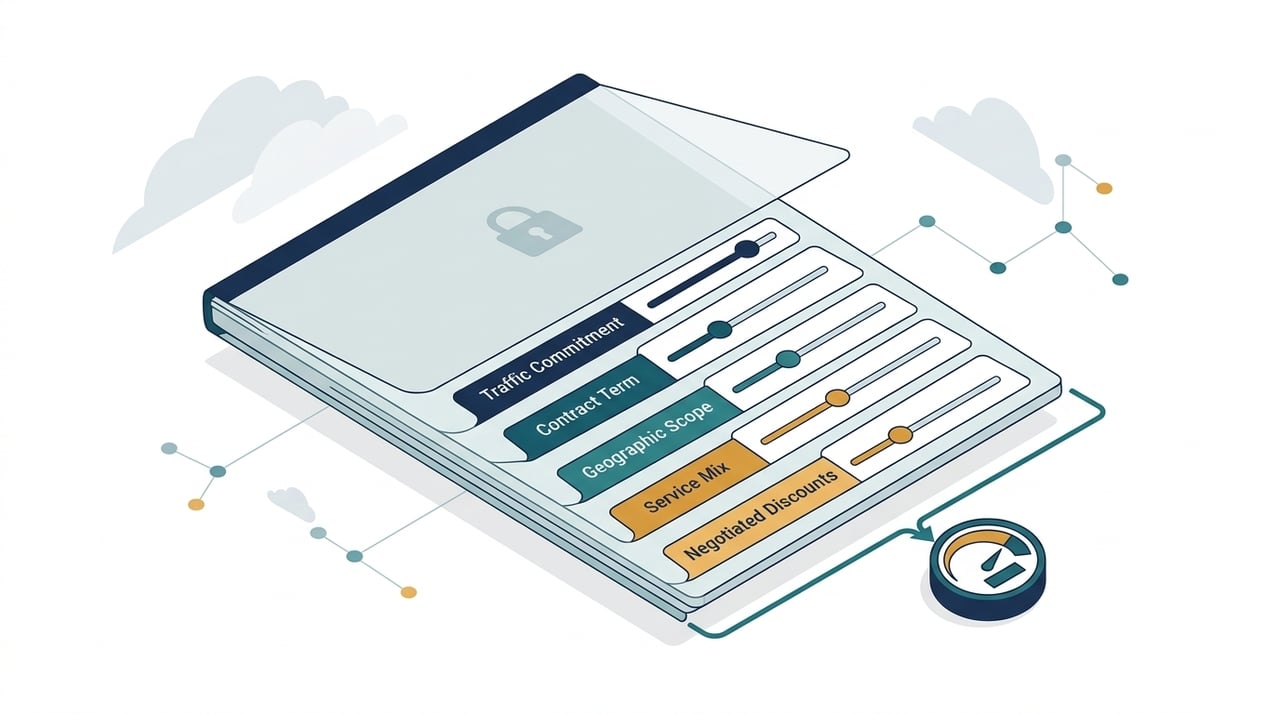
Pay-as-you-go CloudFront pricing is still metered on data transfer out to viewers, HTTP and HTTPS requests, and optional features. Volume tiers accumulate across every distribution on the account, and they are tracked separately for each pricing region. US and Europe share the same rate schedule, but each region climbs its own ladder. A workload split 25 TB US and 10 TB EU therefore pays the first-tier $0.085/GB twice.
The big 2026 change for returning readers is packaging, not list rates. AWS launched flat-rate plans in late 2025. At launch these were Free, Pro ($15/month), Business ($200/month), and Premium ($1,000/month), and they bundle CloudFront delivery with WAF, DDoS protection, Route 53, and some S3 credits. Pay-as-you-go rates have not moved meaningfully. The always-free allowance of 1 TB transfer and 10 million requests per month still applies to pay-as-you-go accounts.
These are list rates for data transfer out to the internet, as of Q3 2026. Check the AWS pricing page before you sign anything, because AWS adjusts regional columns without much notice.
| Monthly tier (per region) | US / Canada / Europe | Japan | APAC (SG, HK, KR, TW) | India | South America | Australia |
|---|---|---|---|---|---|---|
| First 10 TB | $0.085/GB ($85/TB) | $0.114 ($114/TB) | $0.120 ($120/TB) | $0.109 ($109/TB) | $0.110 ($110/TB) | $0.114 ($114/TB) |
| Next 40 TB | $0.080 ($80/TB) | $0.089 | $0.100 | $0.085 | $0.105 | $0.098 |
| Next 100 TB | $0.060 ($60/TB) | $0.086 | $0.080 | $0.082 | $0.090 | $0.094 |
| Next 350 TB | $0.040 ($40/TB) | $0.084 | $0.070 | $0.080 | $0.080 | $0.092 |
| Next 524 TB | $0.030 ($30/TB) | $0.080 | $0.060 | $0.078 | $0.070 | $0.090 |
| Over 5 PB | $0.020 ($20/TB) | $0.060 | $0.040 | $0.072 | $0.060 | $0.080 |
Look at the shape of the curve. US/EU falls 76% from the first tier to the 5 PB tier. India falls only 34%. If you are APAC-heavy, volume barely rescues you on list pricing, so a private rate agreement or traffic steering matters far more there.
| Line item (as of 2026) | Approximate list price |
|---|---|
| HTTPS requests, US | $0.0100 per 10,000 (HTTP about $0.0075) |
| HTTPS requests, EU / Japan / APAC / India | About $0.0120 per 10,000; Australia about $0.0125 |
| HTTPS requests, South America | About $0.0220 per 10,000 |
| Origin fetch from AWS origins (S3, ALB, EC2) | $0.00 origin-to-CloudFront transfer |
| Transfer out to origin (POST/PUT, uploads) | About $0.020/GB US/EU, higher elsewhere |
| Origin Shield | About $0.0075–$0.0090 per 10,000 requests reaching the shield |
| Invalidations | First 1,000 paths/month free, then $0.005 per path (a wildcard counts as one path) |
| CloudFront Functions | $0.10 per million invocations |
| Lambda@Edge | $0.60 per million requests plus about $0.00005 per GB-second |
| Real-time logs | $0.01 per million log lines, plus Kinesis costs |
How BlazingCDN compares: At 100 TB a month, Amazon CloudFront pay-as-you-go comes to about $6,965 on its published price list (checked August 2026), while BlazingCDN costs $415 (as of October 2026) at one rate for the US, Europe and Asia. The full comparison is on the BlazingCDN vs Amazon CloudFront page.
All three examples use Q3 2026 list rates and exclude the free tier unless we say otherwise.
Transfer is 5,000 GB at $0.085, which is $425. Requests are 20 million HTTPS at $0.01 per 10,000, which is $20. The total is $445. After the 1 TB and 10 million request free allowance, it drops to about $350, a blended rate of $0.07/GB. At this size, CloudFront is hard to beat if your origin already lives in AWS.
The traffic splits as 25 TB US, 10 TB EU, 10 TB APAC, and 5 TB India, with 300 million HTTPS requests in the same proportions.
The total is roughly $4,975, a blended $0.0995/GB. APAC and India are 30% of the bytes but 36% of the transfer bill.
The split is 150 TB US and 50 TB EU, with 100 million requests because the objects are large. US costs $850 + $3,200 + $6,000 = $10,050. EU costs $850 + $3,200 = $4,050. Requests add about $106. The total is around $14,200, or $0.071/GB. Large-object workloads like this are where per-GB pricing hurts most.
The expensive surprises almost never come from the rate card. They come from architecture decisions that multiply a metered dimension without anyone noticing.
| Workload profile | Best fit | Why |
|---|---|---|
| Under 10 TB, AWS origin, needs WAF | CloudFront flat-rate plan | Bundled security, free origin fetch |
| 10–50 TB, Lambda@Edge logic | CloudFront pay-as-you-go plus Savings Bundle | Edge compute integration; bundle saves up to 30% on a 1-year commit |
| 100 TB+ VOD, downloads, game patches | BlazingCDN, Bunny.net, CDN77, Gcore | Per-TB economics dominate, request count is low |
| Live streaming, programmable edge | Fastly or CloudFront | Mature instant purge and edge logic |
| High-RPS small-object API | Model the request line first | Request fees can exceed transfer |
For the 100 TB+ row, compare Example 3 directly. On BlazingCDN, 200 TB comes to $765 a month (as of October 2026) against roughly $14,200 on CloudFront list pricing. BlazingCDN offers flexible configuration and fast scaling under demand spikes. Pricing starts at $5 per TB and falls to $2.50 per TB at volume, which is why enterprises move large-object traffic there.
Bunny.net and CDN77 are strong in the same league, and Gcore brings broad regional reach. Benchmark all of them against your own object-size distribution. For the rate math across volumes, see BlazingCDN's volume-based pricing. A common 2026 pattern is to keep CloudFront for HTML and APIs and route bulk bytes through a second CDN.
As of Q3 2026, the first 10 TB in US and Europe costs $85/TB, dropping to $60/TB between 50 and 150 TB and $20/TB above 5 PB. APAC starts at $114–$120/TB and India at $109/TB. Request fees are billed on top.
Tiers aggregate across all distributions on the account, but each pricing region has its own tier ladder. Consolidating distributions does not change your tier. Consolidating accounts under AWS Organizations consolidated billing can, because usage is pooled.
Yes. Transfer from AWS origins such as S3, ALB, and EC2 to CloudFront is not charged. With non-AWS origins, you pay your provider's egress instead. Uploads from viewers through CloudFront to the origin are billed at about $0.02/GB in US/EU.
The first 1,000 paths per month are free, and each additional path costs $0.005. A wildcard path counts as one path regardless of how many objects it matches. Versioned filenames avoid the cost entirely.
It caps delivery to US, Canada, and Europe edges, so every byte bills at the cheapest regional rate. Viewers in Asia or South America are then served from farther edges with higher latency. Measure p95 TTFB by country before and after the switch.
This week, export 90 days of Cost Explorer data grouped by usage type. Separate DataTransfer-Out-Bytes by region from Requests-Tier1 and Requests-Tier2-HTTPS, then divide total CloudFront spend by total GB to get your real blended rate. If that number is above $0.07 and your request share is under 10% of the bill, price the bulk-byte path elsewhere.
If request fees are more than 40% of the bill, start with your cache policy before you touch vendors. Then tell us what your blended rate turned out to be. We are collecting 2026 figures and suspect most teams are paying more than they think.

Heavy traffic.
Light bill.
The CDN for video and large traffic
Learn
Lossy vs lossless compression comes down to one trade: lossless compression rebuilds every original bit and typically ...
Pricing - Pricing & Costs
The CloudFront vs S3 decision depends more on object size than on traffic volume. At a 500 KB average response, 100 TB ...

Learn
For most on-demand video, capped variable bitrate (VBR) wins the cbr vs vbr decision: it spends bits where the picture ...