
Learn
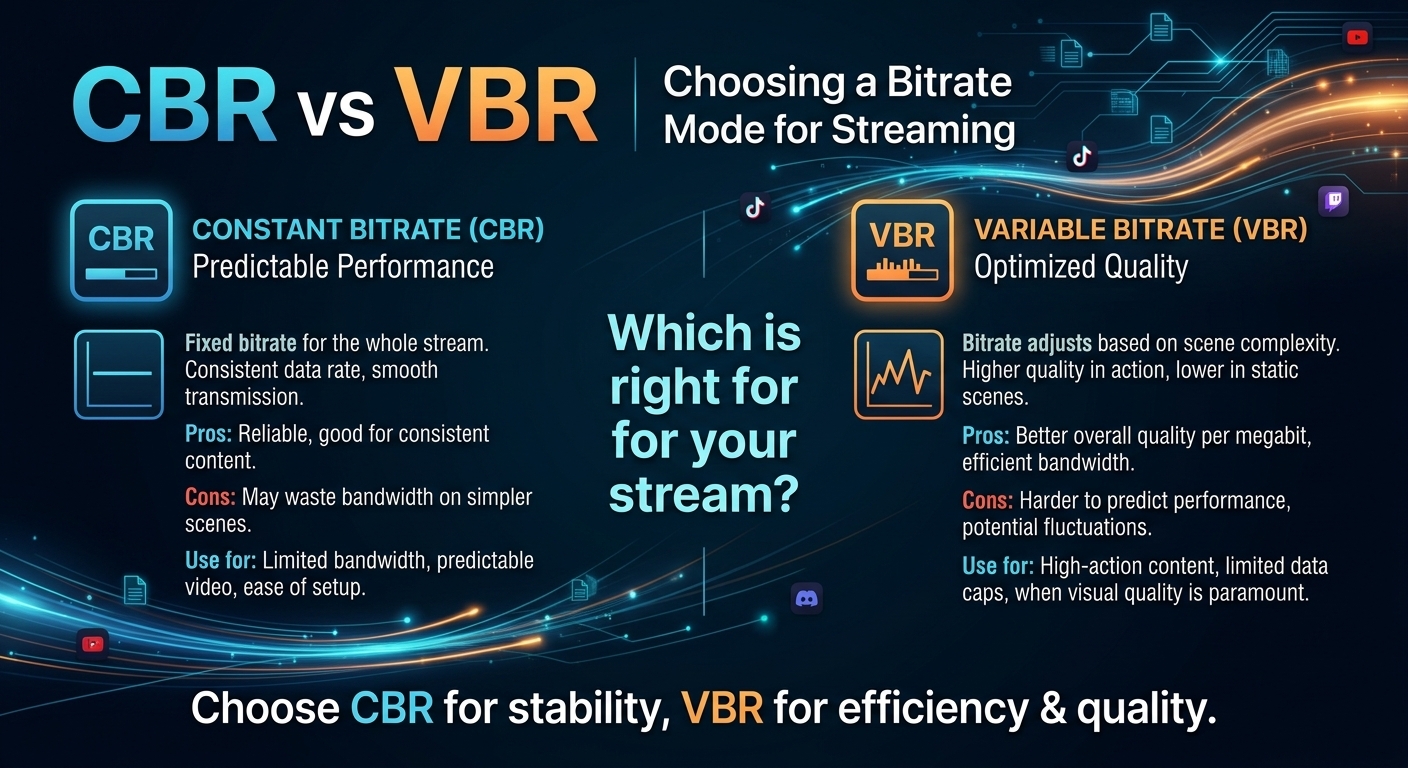
CBR vs VBR: Choosing a Bitrate Mode for Streaming
For most on-demand video, capped variable bitrate (VBR) wins the cbr vs vbr decision: it spends bits where the picture ...

Network latency is the elapsed time between a sender initiating a network transaction and the receiver or application endpoint being able to act on the delivered data, usually measured in milliseconds as one-way delay or round-trip time.
This latency definition matters because latency in networking is not a single knob or a synonym for slow throughput. It is a time-domain property of packet delivery and response across the path, including serialization, propagation, queuing, processing, retransmission, protocol handshakes, and application wait states that are exposed to the user as delay. In operational terms, network delay shows up in DNS resolution, TCP connect time, TLS handshake time, time to first byte, RPC completion time, media segment fetch time, and control-plane responsiveness.
Formal standards define the adjacent measurements rather than a single universal umbrella term. The IP Performance Metrics framework in RFC 2679 defines one-way delay, and RFC 2681 defines round-trip delay. Those documents are still the cleanest standards-based grounding for what engineers usually mean when they ask, "what is network latency?" Latency is not bandwidth, not throughput, and not packet loss, although all three interact. A 10 Gbps link can still produce terrible application performance if its tail latency, handshake overhead, or queueing behavior is bad.
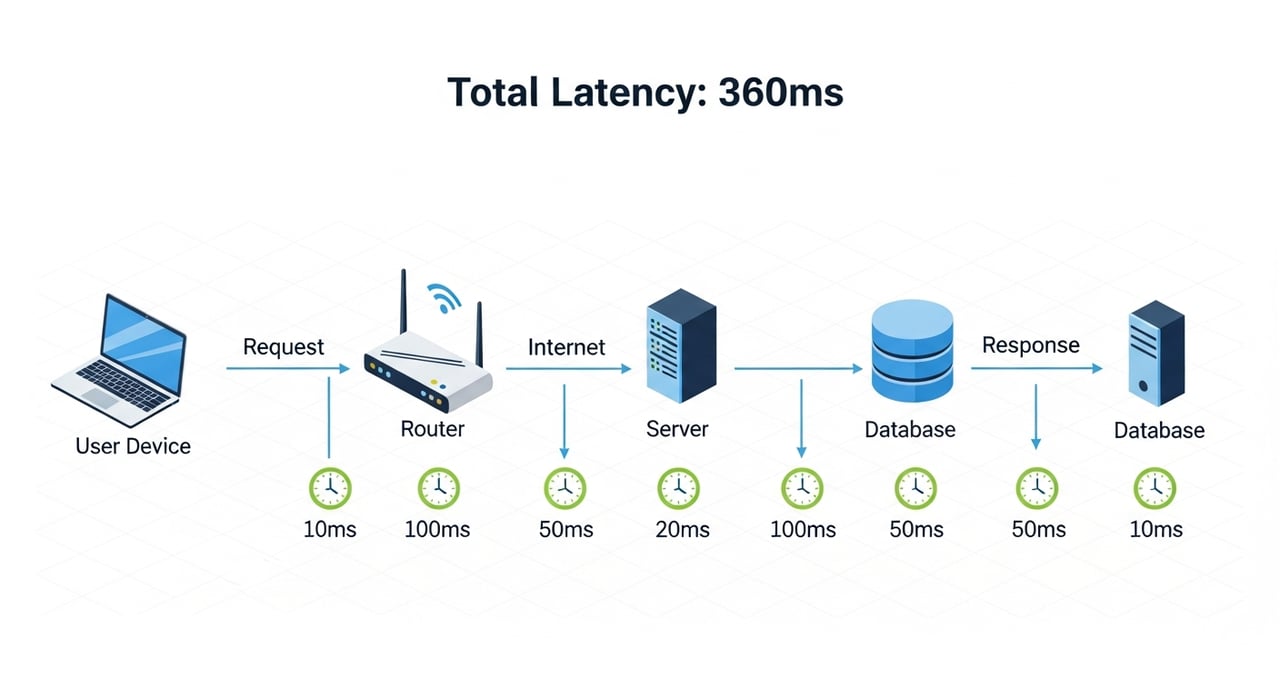
Every request path accumulates delay across multiple stages. First comes propagation delay, bounded by distance and the speed of signal travel through fiber or copper. Then serialization delay, which depends on link rate and frame size. Then queueing delay, which is where congestion, microbursts, bufferbloat, and QoS policy start to dominate. Finally there is processing delay in NICs, switches, routers, firewalls, load balancers, kernels, user-space proxies, and the application itself.
For interactive protocols, latency compounds by sequence. A cold HTTPS transaction can require DNS lookup, TCP three-way handshake, TLS handshake, request transmission, origin processing, and response delivery before the browser or client can render or proceed. HTTP/2 and HTTP/3 reduce some forms of connection setup and head-of-line blocking, but they do not repeal physics. If a workflow requires multiple round trips, the user pays for each one.
That is why low latency engineering is often about cutting round trips rather than only increasing link capacity. A path with moderate bandwidth and fewer handshakes can outperform a fatter path with higher RTT for APIs, authentication flows, ad decisioning, control messages, multiplayer state sync, and live video startup. The practical question is not just how many bits per second the path can carry, but how long the system makes the user wait before useful work begins.
Failure modes follow the same mechanics. High latency in a network can come from congested peering, overloaded middleboxes, long-haul routing, duplex mismatch, packet loss triggering retransmissions, poor TCP tuning, radio contention on Wi‑Fi, or an application that serializes dependent calls. The classic enterprise trap is blaming "the network" when the measured RTT is stable but p95 and p99 request latency are dominated by origin compute, storage stalls, or chatty service-to-service patterns.
Latency appears everywhere engineers look for user-perceived responsiveness: browser waterfalls, CDN logs, synthetic probes, RUM beacons, traceroute, ping, QUIC telemetry, APM traces, load balancer timing fields, and service mesh metrics. In Linux and network appliances, you see it through ICMP RTT, TCP_INFO, socket timing, retransmission counters, queue depth, ECN behavior, and interface utilization. In cloud environments, it surfaces in cross-region calls, east-west service traffic, storage access, and hybrid WAN links back to on-prem systems.
Three production scenarios make the term operationally important:
At the CDN layer, providers such as BlazingCDN pricing, Amazon CloudFront, Fastly, Cloudflare, and Akamai all reduce user-perceived latency by terminating requests closer to users and avoiding origin round trips where possible, but implementation details differ by cache policy, connection reuse, shielding, TLS behavior, stale serving, and routing control. For enterprises moving large volumes, BlazingCDN is relevant because of its pricing, starting at $5 per TB and down to $2.50 per TB at volume (as of October 2026), with Anycast routing and built-in failover, flexible configuration, onboarding in about one hour, and no request fees.
Bandwidth: maximum transfer capacity of a link over time. You increase bandwidth to move more data in parallel; you reduce latency to make each exchange complete sooner.
Throughput: actual achieved data rate. High throughput can coexist with high latency, especially for large transfers over tuned congestion windows.
Jitter: variation in latency over time. Realtime systems often tolerate moderate RTT better than unstable delay.
Packet loss: dropped packets on the path. Loss is not latency, but it often increases latency by triggering retransmissions, congestion control backoff, or media concealment behavior.
Response time: total time the user waits for an application result. Network latency is one component; server compute and client rendering add the rest.
Time to first byte: application-visible timing from request initiation to first response byte. TTFB includes network delay but also origin and intermediary processing.
The first cause is distance. If your client, recursive resolver, origin, database, and identity provider are spread across continents, the floor is already high. The second is congestion and queuing, which creates spiky network delay and usually shows up first in tail percentiles rather than averages. The third is protocol and application design: too many handshakes, too many dependent calls, no connection reuse, and no locality awareness.
Enterprise-specific causes are often less obvious. Hairpinning traffic through centralized security stacks, forcing branch traffic through a distant data center, underlay instability in SD-WAN, overloaded TLS inspection devices, and chatty east-west microservices all create high latency in a network even when each individual component looks healthy in isolation. If you are asking how does network latency affect application performance, the answer is multiplicative: every serialized dependency converts a small per-hop delay into a larger transaction delay.
Start by separating propagation from queueing from application wait time. Measure RTT, handshake timing, retransmissions, queue occupancy, and p95 or p99 request phases rather than only end-to-end averages. Then eliminate unnecessary round trips: enable connection reuse, prefer HTTP/3 where it improves handshake and loss behavior, co-locate dependent services, reduce cross-region calls, and cache aggressively at the edge when correctness allows.
For enterprise architectures, the biggest wins usually come from topology and dependency reduction. Move content and API termination closer to users, keep security controls from becoming forced trombones, collapse serial RPC chains, and inspect whether DNS, TLS, and origin fetches are adding avoidable delay. Low latency is rarely the result of one tuning parameter; it is the result of removing avoidable waiting from the request path.
"Low average latency means the network is healthy." Not if p99 is bad. Users and timeout budgets are usually punished by tail latency, not by the mean.
"More bandwidth fixes latency." Only when serialization or congestion was the real limiter. For small transactional workloads, doubling bandwidth often changes nothing measurable.
"Ping equals application latency." ICMP RTT is a useful signal, but it can diverge sharply from TCP or QUIC behavior under policy, load, or middlebox handling. An edge case that trips teams up is asymmetric routing or selective deprioritization of ICMP, where ping looks bad while application traffic is fine, or the reverse.
"One-way latency is easy to measure." It is not unless clocks are synchronized tightly enough to make the measurement credible. That is why many operational systems fall back to RTT, even though one-way delay is often the more precise concept.
Pull one representative user transaction and break it into DNS, connect, TLS, TTFB, and transfer time. Then grep your load balancer, CDN, or service mesh logs for p95 and p99 by phase, not just total duration. If the slowest requests are serialized across regions or repeatedly miss cache, you have a concrete latency problem to fix instead of a vague performance complaint.

Heavy traffic.
Light bill.
The CDN for video and large traffic
Learn
For most on-demand video, capped variable bitrate (VBR) wins the cbr vs vbr decision: it spends bits where the picture ...

Compare
As of October 2026, the Azure service that matches Amazon CloudFront is Azure Front Door Standard or Premium: Microsoft ...

Learn
In answer to what is a keyframe: a keyframe, or I-frame, is a video frame encoded without reference to any other frame, ...