Pricing - Pricing & Costs
CloudFront Request Fees and Data Transfer Costs Explained
On small-object workloads, Amazon CloudFront request pricing can outweigh bandwidth by nearly 6 to 1. At US and Europe ...
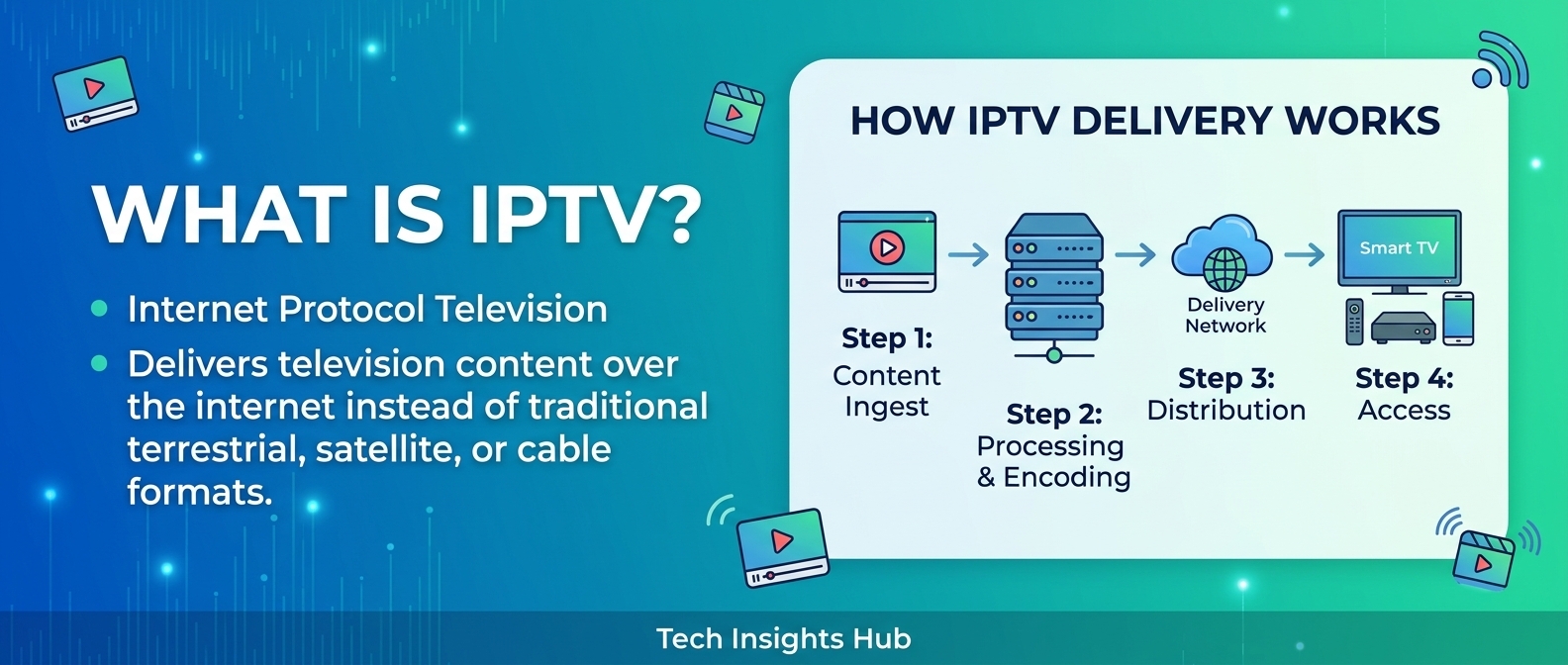
IPTV (Internet Protocol Television) is the delivery of live TV channels and video on demand as IP packets, usually over a network the operator controls end to end. In managed IPTV, channels travel as multicast MPEG transport streams to set-top boxes, while a middleware layer handles the program guide, entitlements and the user interface.
Anyone asking what is IPTV in 2026 should start with one scaling property: a managed IPTV operator carrying 300 HD channels at about 8 Mbps each needs roughly 2.4 Gbps of multicast capacity in its core, whether 1,000 or 1 million subscribers are watching. Unicast internet streaming scales the other way, at about 2.25 GB of egress per viewer-hour at 5 Mbps, so cost follows the audience instead of the channel lineup.
IPTV delivery is a pipeline with five stages: acquisition, encoding, protection, transport and presentation. Each stage has its own timing budget, and the end-to-end target that subscribers actually notice is channel change time, which operators typically try to keep under 1 to 2 seconds.
The keyframe wait is where channel change latency hides. With a 1 to 2 second group of pictures (GOP), a cold IGMP join can sit idle for most of that interval, so many operators deploy fast channel change servers that send a short unicast burst starting at a keyframe, then hand the STB over to the multicast stream.
Multicast sends one copy of a channel per network link no matter how many viewers are behind it; unicast sends one copy per viewer. Managed IPTV uses multicast for linear channels and unicast for video on demand, catch-up and time-shift, because those sessions are individual by nature.
In the core, operators typically run PIM sparse mode or, more commonly now, source-specific multicast (SSM) in the 232.0.0.0/8 range with IGMPv3, which removes the need for rendezvous points. At the access layer, IGMP snooping on OLTs and DSLAMs ensures a channel only reaches the GPON port or DSL line that asked for it.
A worked comparison shows why the model matters. A 300-channel lineup at 8 Mbps is a fixed 2.4 Gbps per multicast-enabled link. Serving the same channels as unicast HLS to 100,000 concurrent viewers at 5 Mbps needs 500 Gbps of egress, and every million viewer-hours adds about 2,250 TB of transfer.
| Factor | Managed multicast IPTV | Unicast HLS or DASH over a CDN |
|---|---|---|
| Cost driver | Channel count times bitrate | Concurrent viewers times bitrate |
| Reach | Only the operator's own access network | Any internet-connected device |
| Quality control | Fixed bitrate with QoS-reserved bandwidth | Adaptive bitrate absorbs congestion |
| Live latency | Typically 1 to 3 seconds behind source | Typically 6 to 30 seconds; 2 to 5 with LL-HLS |
| Best fit | Large linear lineups on owned fiber or DSL | Mobile, smart TV apps, off-net subscribers, VOD |
Multicast wins on cost only inside a network you own; the moment a subscriber leaves that network, every stream becomes unicast and egress becomes the dominant variable.
IPTV middleware is the control plane between the subscriber management system and the STB. It renders the electronic program guide (EPG), checks entitlements against billing, issues DRM or CAS key requests, maps channel numbers to multicast groups and launches VOD sessions. It carries almost no video itself, which is why its scaling problem is request concurrency at prime-time channel surfing, not bandwidth.
A channel map entry illustrates the handoff. A typical row tells the STB that logical channel 101 is an HD news service on SSM source 10.20.0.15, group 232.10.1.5, UDP port 5000, RTP-encapsulated, encrypted under a named CAS product, with a fallback unicast HLS URL for off-net devices. That last field is what turns a classic IPTV deployment into a hybrid one.
IPTV vs. OTT: IPTV runs over an operator-managed network with reserved capacity, multicast and a provisioned STB. OTT (over-the-top) streaming runs over the public internet as unicast HLS or DASH to apps, with no control over the last mile. Both use IP; the difference is who owns the path and the quality guarantee.
IPTV vs. internet TV: internet TV is a loose consumer term for any channel watched through a browser or app. Technically it is OTT, and it inherits OTT's best-effort delivery and adaptive bitrate behavior.
IPTV vs. multicast ABR: multicast adaptive bitrate (DVB-mABR) carries HLS or DASH segments over multicast to a home gateway, which republishes them as local unicast. It lets operators keep multicast economics while feeding ordinary streaming apps.
Licensed IPTV services scale along two independent axes: the managed multicast footprint, sized by channels, and the unicast footprint for VOD, catch-up and off-net apps, sized by viewers. Most growth since the late 2010s has come on the second axis, as subscribers expect the same lineup on phones and smart TVs outside the operator's network.
That unicast side is standard streaming delivery: pre-packaged HLS, LL-HLS or DASH segments served from cache, with origin shielding so a popular live channel does not stampede the packager. For that layer, the BlazingCDN HLS Streaming CDN for IPTV delivery serves pre-encoded HLS, LL-HLS and DASH with origin shield and request coalescing; it does not handle multicast, RTMP ingest or transcoding, which stay in the operator's headend.
IPTV means piracy. The term describes a transport method used by licensed telecom operators worldwide. Unlicensed resellers use the same protocols, but legality depends on rights, not technology.
IPTV is always multicast. Only linear channels on managed networks are. VOD, catch-up and every off-net session are unicast, and many operators now package all channels as HLS or DASH as well.
Multicast removes bandwidth planning. It removes per-viewer growth, not per-channel growth. Adding 50 UHD channels at about 20 Mbps each adds 1 Gbps to every multicast-enabled link.
IPTV itself is legal: it is a delivery method used by licensed telecom and cable operators worldwide. Legality depends on whether the provider holds distribution rights for the channels it carries. Unlicensed IPTV resellers use identical protocols, so a service's technology says nothing about its licensing; check the operator's rights agreements and local regulation instead.
IPTV runs on a network the operator controls, usually with multicast and reserved bandwidth to a provisioned set-top box. OTT streaming runs over the public internet as unicast HLS or DASH, using adaptive bitrate to cope with congestion. Both carry video as IP packets; the real difference is ownership of the last mile and the quality guarantee.
IPTV delivery uses both. Linear channels on managed networks travel as multicast, typically source-specific multicast with IGMPv3 joins from the set-top box. Video on demand, catch-up, time-shift and any viewing outside the operator's network use unicast, which means bandwidth for those services grows with concurrent viewers rather than with channel count.
An HD IPTV channel typically needs about 6 to 10 Mbps with H.264 or 3 to 5 Mbps with HEVC, and UHD channels run around 15 to 25 Mbps. On a multicast network that cost is paid once per link per channel; on unicast streaming it is paid once per concurrent viewer, about 2.25 GB per viewer-hour at 5 Mbps.
This week, pull two numbers from your own platform: peak concurrent off-net and VOD sessions, and their average bitrate. Multiply them for peak egress in Gbps, then convert monthly viewer-hours to terabytes at 0.45 GB per hour per Mbps. Compare that against your multicast core load (channels times bitrate). If the unicast figure is growing faster, your scaling plan belongs to the delivery layer, not the multicast network, and that is where caching ratios and origin shielding deserve your attention.
For operators and broadcasters moving linear and VOD to HLS or DASH, the BlazingCDN delivery for TV and online broadcasters page describes the packaged-segment delivery setup, including a 14-day testing period on real production traffic.

Heavy traffic.
Light bill.
The CDN for video and large traffic
Pricing - Pricing & Costs
On small-object workloads, Amazon CloudFront request pricing can outweigh bandwidth by nearly 6 to 1. At US and Europe ...
Video - Video & Streaming
OTT (over-the-top) is the delivery of video and audio directly to viewers over the public internet, bypassing the ...