Pricing - Pricing & Costs
DigitalOcean Spaces CDN Review: Speed, Pricing and Limits
DigitalOcean CDN (Spaces CDN) is included in the $5 per month Spaces subscription. According to DigitalOcean list ...
The precise answer to what is HDR video: high dynamic range video is video encoded with 10-bit or higher samples, ITU-R BT.2020 color primaries, and a PQ or HLG transfer function. Together these let a signal describe highlights up to 10,000 nits and a far wider color gamut than SDR, which is graded to a reference white of roughly 100 nits in BT.709 color.
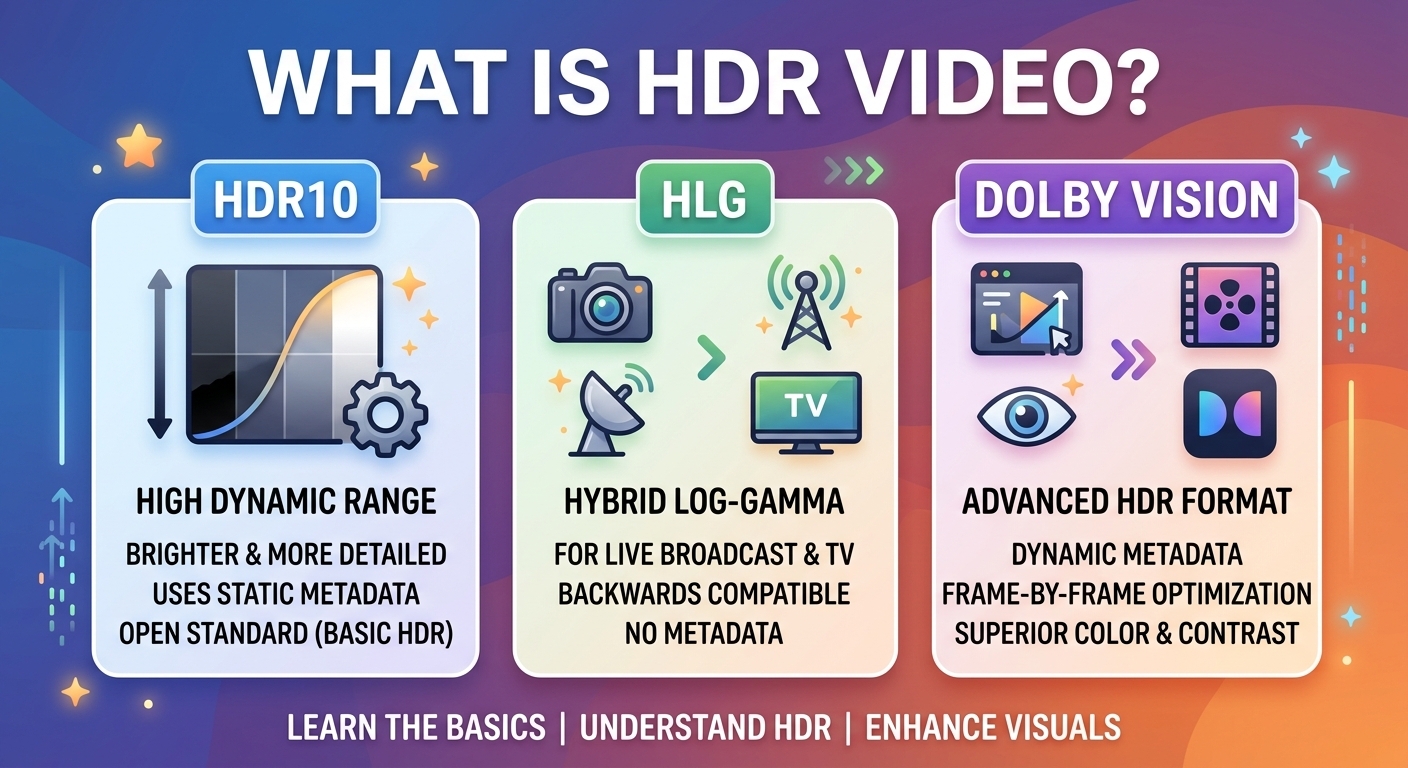
As of 2026, four HDR formats dominate streaming: HDR10 (static metadata), HDR10+ and Dolby Vision (dynamic metadata), and HLG (no metadata, built for live broadcast). All four need a 10-bit codec such as HEVC Main 10, VP9 Profile 2 or AV1. At the same resolution, an HDR ladder typically needs an estimated 10 to 25% more bitrate than its SDR equivalent.
HDR video is defined by three properties. The first is the transfer function, which maps code values to light. The second is the color container, which defines how saturated a color can be. The third is metadata, which tells the display how to fit the content into its own capabilities. ITU-R BT.2100 standardizes the first two for both PQ and HLG.
PQ (Perceptual Quantizer, SMPTE ST 2084) is display-referred. Each code value means an absolute luminance, from 0.0001 to 10,000 nits, and the curve is shaped so that 10 bits produce no visible banding. HLG (Hybrid Log-Gamma, ARIB STD-B67) is scene-referred. It uses a conventional gamma curve for the lower half of the signal and a logarithmic curve for highlights, so the display decides the absolute brightness.
Metadata is what separates the PQ formats. HDR10 carries static values for the whole title: mastering display color volume (SMPTE ST 2086), plus MaxCLL and MaxFALL (maximum content light level and maximum frame-average light level). HDR10+ (SMPTE ST 2094-40) and Dolby Vision (SMPTE ST 2094-10, carried as RPU data) update tone-mapping instructions per scene or per frame. A 4,000-nit grade therefore lands well on a 600-nit TV without crushing every bright shot to the same curve.
| Format | Transfer | Metadata | Licensing | Typical use |
|---|---|---|---|---|
| HDR10 | PQ | Static (ST 2086, MaxCLL, MaxFALL) | Open, royalty-free | Baseline for VOD, universal device support |
| HDR10+ | PQ | Dynamic (ST 2094-40) | Royalty-free, certification program | VOD on supporting TVs, falls back to HDR10 |
| Dolby Vision | PQ (profile 8.4: HLG base) | Dynamic (ST 2094-10 RPU) | Proprietary, licensed | Premium VOD; profiles 5, 8.1 and 10 in streaming |
| HLG | HLG | None required | Royalty-free | Live sports and broadcast, SDR-compatible |
HDR10 is the mandatory fallback layer: every other PQ format is either built on it or degrades to it on non-supporting devices.
HDR is decided at grading and encoding, signaled at packaging, and enforced at playback. The CDN only sees more renditions. Most HDR failures come from a broken hand-off between these stages, not from the format itself.
HDR encoding and packaging happen upstream of delivery. BlazingCDN's HLS Streaming CDN for pre-encoded HDR ladders delivers HLS, LL-HLS and DASH segments as packaged; it does not transcode, so the 10-bit encode and metadata injection stay in your pipeline.
HDR10 vs. HLG: HDR10 is absolute and metadata-driven, which suits graded VOD where a colorist targets a known mastering display. HLG has no metadata and is relative to the display. It survives live production chains, unknown downstream devices and SDR BT.2020 receivers, which is why broadcasters use it for live sports.
HDR10 vs. Dolby Vision: both use PQ, but Dolby Vision adds per-frame dynamic metadata and supports mastering up to 12 bits. Profile 8.1 is a single HEVC stream whose base layer is valid HDR10, so one rendition serves both device populations. Profile 5 uses the IPTPQc2 color space and has no HDR10 fallback.
HDR video vs. HDR photography: HDR photography merges several exposures and then tone-maps them into an SDR image. HDR video keeps the extended range in the delivered signal and leaves tone mapping to the display. A smartphone "HDR" photo mode says nothing about HDR video capability.
In an HLS multivariant playlist, each HDR10 variant's EXT-X-STREAM-INF line needs three things. CODECS should be set to an HEVC Main 10 string such as hvc1.2.4.L153.B0 (Main 10, level 5.1). VIDEO-RANGE should be set to PQ. RESOLUTION and BANDWIDTH should reflect the HDR encode, not the SDR one. An HLG variant sets VIDEO-RANGE to HLG. A Dolby Vision profile 8.1 variant keeps the hvc1 base codec and adds a SUPPLEMENTAL-CODECS attribute naming the dvh1.08 profile with the db1p compatibility brand, so non-Dolby players still pick it as HDR10.
In DASH, the AdaptationSet carries a SupplementalProperty using the scheme urn:mpeg:mpegB:cicp:TransferCharacteristics, with value 16 for PQ or 18 for HLG. Matching properties for ColourPrimaries and MatrixCoefficients both carry value 9. On the encoder side with x265, the equivalent settings are color primaries bt2020, transfer smpte2084, matrix bt2020nc, a master-display string from the grading monitor, max-cll such as 1000,400, the hdr10 option enabled, and headers repeated on every keyframe so mid-stream joins see the metadata.
HDR itself adds an estimated 10 to 25% bitrate over SDR at equal resolution and perceived quality. The extra cost comes from 10-bit precision, wider gamut and more visible highlight detail. The bigger egress driver is that HDR rarely ships without 4K, and resolution multiplies bitrate far more than dynamic range does.
A worked estimate (our arithmetic, illustrative bitrates): an SDR HEVC 1080p top rung at 6 Mbps moves 2.7 GB per viewing hour. An SDR 2160p rung at 12 Mbps moves 5.4 GB, and an HDR10 2160p rung at 15 Mbps (+25%) moves 6.75 GB. At 100,000 premium viewing hours a month, the HDR delta over SDR 4K is 1.35 GB per hour, or about 135 TB. The jump from 1080p SDR to 4K HDR is 4.05 GB per hour, or about 405 TB. Most of an "HDR" egress increase is really a 4K increase.
Storage scales differently. Parallel SDR and HDR ladders roughly double rendition count. Dolby Vision profile 8.1 avoids a separate HDR10 ladder, while HDR10+ adds metadata to an existing HDR10 encode at negligible size.
HDR video uses 10-bit or higher samples, BT.2020 color primaries and a PQ or HLG transfer function, while SDR uses BT.709 color graded to roughly 100 nits. The result is brighter highlights, deeper shadow detail and more saturated color. HDR only shows its benefit on a display that can reproduce it; on SDR screens the player selects an SDR rendition or tone-maps the stream.
HLG is usually the better choice for live streaming because it needs no metadata and degrades gracefully on SDR BT.2020 displays. Live production chains rarely carry ST 2086 values reliably end to end. HDR10 remains stronger for graded VOD, where a colorist targets a known mastering display and static metadata accurately describes the finished title.
HDR streaming typically needs an estimated 10 to 25% more bitrate than SDR at the same resolution and perceived quality. The total increase is often much larger because HDR usually ships with 4K. Moving from 1080p SDR to 2160p HDR can raise per-hour egress by roughly 2.5 times, depending on the encoder, codec and content complexity.
Not necessarily. Dolby Vision profile 8.1 is a single HEVC stream whose base layer is valid HDR10, with Dolby Vision RPU metadata added. Players without Dolby Vision decode it as HDR10. Profile 5 has no HDR10-compatible base layer, so services using profile 5 must also encode and store a separate HDR10 ladder.
HDR video in practice requires a 10-bit codec: HEVC Main 10, VP9 Profile 2 or AV1 Main. AVC High 10 is defined in the standard but almost no consumer hardware decodes it, so it is not viable for distribution. Dolby Vision streaming profiles build on HEVC (profiles 5 and 8) or AV1 (profile 10).
This week, pull your multivariant playlists or MPDs and confirm that every HDR rendition's VIDEO-RANGE or CICP transfer value matches the transfer characteristics in the bitstream itself. Mislabels are the most common silent HDR bug. Then split last month's playback logs by video range and resolution, compute bytes per viewing hour for HDR 4K, SDR 4K and SDR 1080p, and size how much of your egress growth comes from HDR versus resolution.
If those ladders are pre-encoded and growing, BlazingCDN's Video CDN for HDR and SDR libraries replicates the library inside the CDN so your origin stays out of the delivery path.

Heavy traffic.
Light bill.
The CDN for video and large traffic
Pricing - Pricing & Costs
DigitalOcean CDN (Spaces CDN) is included in the $5 per month Spaces subscription. According to DigitalOcean list ...
Learn
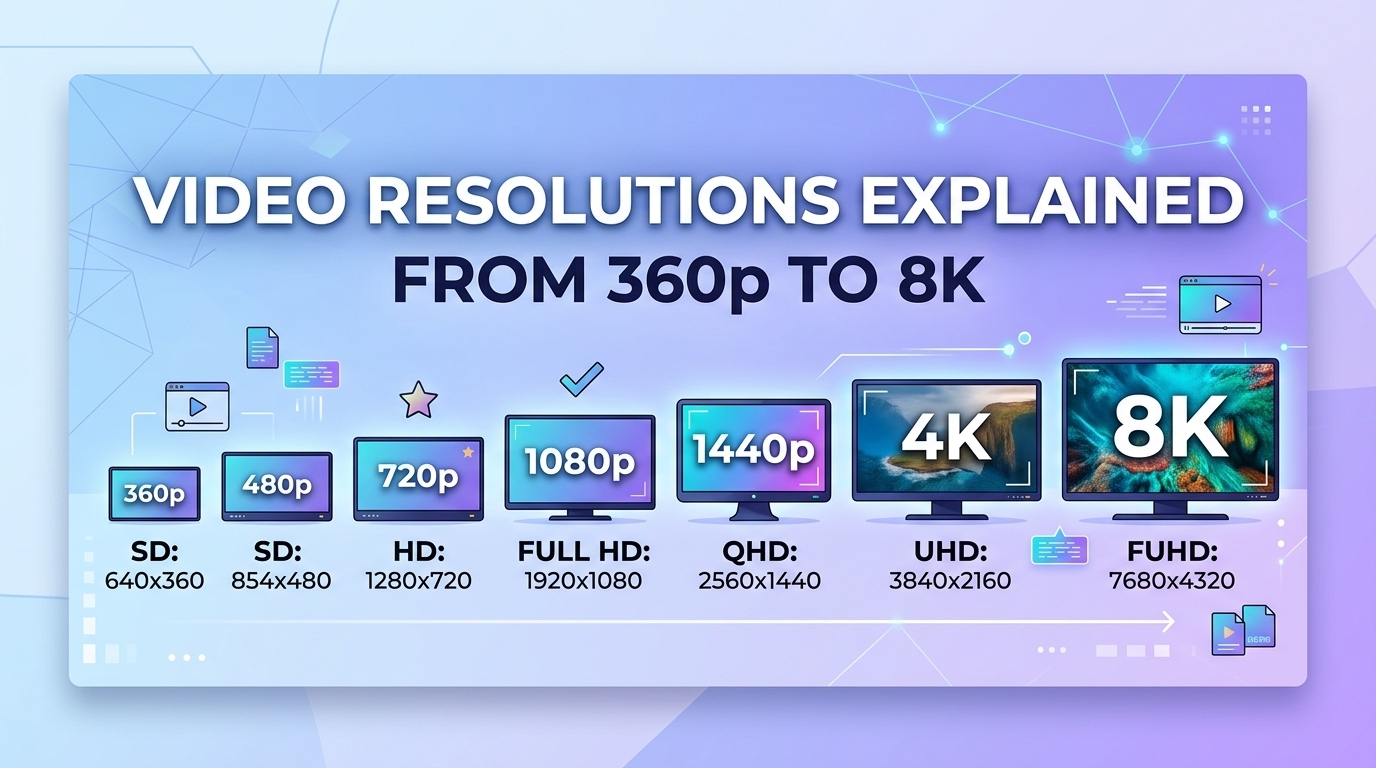
Video resolutions run from 360p (640 x 360, about 230,000 pixels) to 8K (7680 x 4320, about 33.2 million pixels), a ...