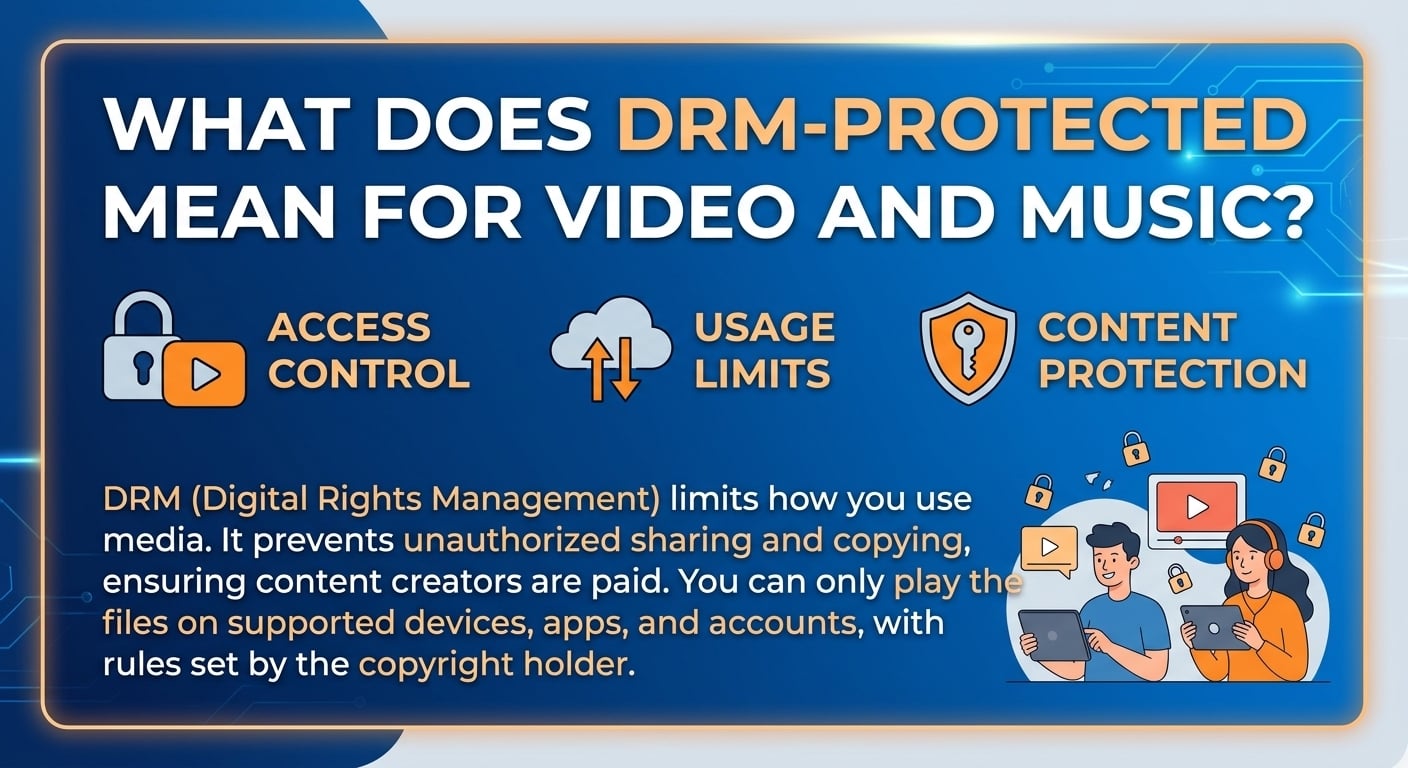
DRM protected means a file or stream is encrypted, typically with 128-bit AES, and only an approved player that has obtained a license from the rights holder's license server can decrypt it. The license sets the rules: which device, for how long, at what resolution, and whether external-screen output or offline playback is allowed.
As of 2026, three DRM systems cover almost every consumer device: Google Widevine (Chrome, Android, most smart TVs), Apple FairPlay (Safari, iOS, tvOS) and Microsoft PlayReady (Edge, Windows, many TVs). Streaming services typically encrypt each title once using Common Encryption (CENC) and issue licenses for all three systems, so one set of encrypted segments plays on every major platform.
How DRM protected content actually plays
Playback of DRM protected content is a key exchange wrapped around ordinary adaptive streaming. The media segments are normal files. Everything that makes them "protected" happens in the packager, the license server and a sealed component on the device called the Content Decryption Module (CDM).
- Packaging. The packager encrypts each rendition with a content key, usually in CMAF fragments. CENC defines two schemes: cenc (AES-CTR) and cbcs (AES-CBC with a 1:9 pattern, encrypting one block in ten). FairPlay requires cbcs, and current Widevine and PlayReady clients accept it, which is why cbcs-only CMAF has become the default for one-package-everywhere delivery.
- Signaling. The manifest and the init segment carry a key ID and a PSSH (Protection System Specific Header) box per DRM system, telling the player which systems can unlock the content.
- License request. The player hands the PSSH data to the CDM, which produces a signed, device-bound license request. The application forwards it to the license server with a session or entitlement token.
- Policy decision. The license server checks entitlement and device security level, then returns the content key wrapped for that CDM, plus a policy: expiry, persistence for offline use, maximum resolution, required HDCP version.
- Decrypt and decode. The CDM decrypts samples and, on hardware-backed devices, passes them straight to a secure decode path, so the clear frames never reach application memory.
The license round trip adds startup latency on top of the first segment fetch, typically tens to a few hundred milliseconds depending on license server placement (estimate). Players that prefetch or reuse licenses across titles sharing a key hide most of it.
What is DRM in the delivery stack?
DRM is an access-control layer spanning four components: a key management service, the packager, the license server and the client CDM. The CDN sits between packager and player and only ever handles ciphertext. Encrypted segments cache like any other object, while license requests are per-user and must bypass the cache entirely.
Keys usually move between the key service and packager over CPIX (Content Protection Information Exchange), a DASH Industry Forum format. Two operational rules follow from this split. License endpoints should answer with no-store caching semantics, because a cached license response served to the wrong user is either a failure or a leak. Encrypted segments, by contrast, are identical for every subscriber, so the edge cache hit ratio for a DRM catalogue should match an unencrypted one. Per-session forensic watermarking is the exception that breaks this, since it makes segments user-specific.
Why some devices block DRM protected streams
Devices block or downgrade DRM protected streams when they cannot satisfy the license policy: the CDM is missing or revoked, the device only offers software-level security, or the display chain fails an HDCP check. The stream itself is usually fine. The license server, or the CDM enforcing its policy, said no.
| Symptom |
Likely cause |
Where to look |
| Plays, but capped near 480p or 720p |
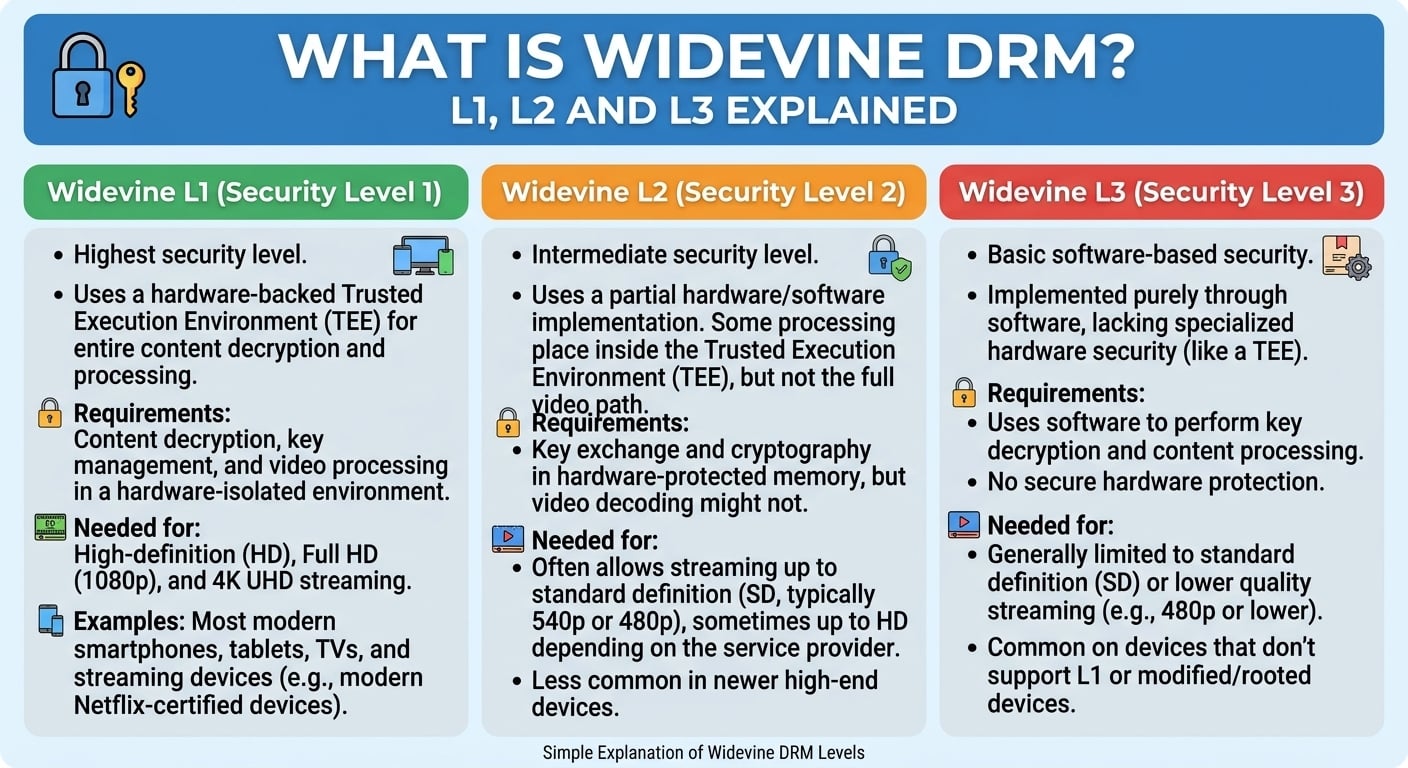
Software-only security (Widevine L3, PlayReady SL2000); 1080p and 4K policies typically require hardware L1 or SL3000 |
License server logs by reported security level |
| Black screen with audio on an external monitor |
HDCP missing or below the version the policy demands (4K usually requires HDCP 2.2) |
Output protection fields in the license policy |
| Error on rooted or modified Android devices |
Failed device integrity check drops the device to L3 or causes a refusal |
Client error codes, integrity attestation results |
| Fails in one browser, works in another |
Browser ships a different CDM (Safari has FairPlay only) or DRM is disabled in settings |
Which PSSH entries the manifest offers |
| Screenshots and screen recordings come out black |
Secure decode path renders to a protected surface by design |
Expected behavior, not a bug |
Most "DRM broke playback" tickets are policy mismatches between device security level and the resolution the license allows, not delivery failures.
DRM vs. encryption, signed URLs and clear-key HLS
DRM vs. TLS encryption: TLS protects bytes in transit and ends at the client, which then holds plaintext. DRM keeps content encrypted at rest on the device and controls the key, so a user who saves the segments to disk still cannot play them without a valid license.
DRM vs. signed URLs and tokens: Signed URLs decide who can fetch a segment; DRM decides who can decrypt it. Production services run both: tokens stop hotlinking and bandwidth theft at the edge, while DRM governs playback. BlazingCDN, for example, includes signed URLs, tokens and geo lists on every plan, which covers the fetch-control half; the license half stays with your DRM provider.
DRM vs. clear-key HLS (AES-128): HLS with METHOD=AES-128 encrypts whole segments, but the key is fetched by the player over HTTPS and sits in application memory. There is no CDM, no device binding and no output policy, so it raises the bar against casual copying without meeting studio DRM requirements.
Example: how manifests signal DRM protected content
A player decides which DRM to use by reading identifiers in the manifest. These are the values to check when a stream refuses to start on one platform.
| Format and field |
Typical value |
Meaning |
| DASH ContentProtection, generic |
urn:mpeg:dash:mp4protection:2011, value cenc or cbcs |
Content is CENC-encrypted with this scheme and default key ID |
| DASH ContentProtection, Widevine |
System ID edef8ba9-79d6-4ace-a3c8-27dcd51d21ed |
Widevine PSSH available |
| DASH ContentProtection, PlayReady |
System ID 9a04f079-9840-4286-ab92-e65be0885f95 |
PlayReady PSSH available |
| HLS EXT-X-KEY |
METHOD=SAMPLE-AES, KEYFORMAT com.apple.streamingkeydelivery |
FairPlay protected, cbcs sample encryption |
If a manifest lacks the system ID a device's CDM understands, that device cannot request a license, no matter how healthy the CDN path is.
Common misconceptions about DRM for video and music
- "DRM stops piracy." It raises the cost. Software-level CDMs have had keys extracted, and camera capture of a screen bypasses everything, which is why premium services restrict high resolutions to hardware security and add forensic watermarking.
- "DRM breaks CDN caching." Encrypted segments are shared by all users and cache normally. Only licenses, and per-user watermarked segments, are uncacheable.
- "Encryption inflates bitrate." CENC subsample encryption leaves NAL unit headers clear and adds only small metadata boxes per fragment; payload size is essentially unchanged.
- "Purchased music is always DRM protected." Apple's iTunes Store dropped DRM from music sales in 2009. Subscription downloads on Apple Music and Spotify remain encrypted and stop playing once the subscription or license check lapses.
FAQ: DRM protected video and music
What does DRM protected mean on a downloaded song or movie?
It means the downloaded file is encrypted and plays only inside the app that holds a valid license for it. Spotify and Apple Music offline tracks, or Netflix downloads, are tied to your account and device, and they expire or stop working when the subscription ends or the app cannot renew its license within the allowed offline window.
Can you remove DRM from protected content legally?
In most jurisdictions, circumventing DRM is illegal even for content you paid for, under laws such as the US Digital Millennium Copyright Act and the EU Copyright Directive. Narrow exemptions exist for accessibility, security research and some archival uses. The practical alternative is buying DRM-free versions where sellers offer them, which is standard for purchased music.
Why does DRM protected video show a black screen in screenshots?
A DRM protected video often renders to a protected hardware surface that screenshot and screen recording tools cannot read. This happens on devices using hardware-backed decryption such as Widevine L1 or PlayReady SL3000. The audio keeps playing because the policy typically restricts video output only. It is intended behavior, not a playback fault.
Does DRM protected streaming need a special CDN?
No, DRM protected streaming works on any CDN that delivers HLS or DASH segments, because the edge only stores and serves ciphertext. The special components are the packager, the key service and the license server. The CDN requirement is operational: never cache license responses, and keep segments user-agnostic so cache hit ratio stays high.
Audit your DRM pipeline and test delivery of encrypted segments
This week, pull a day of license server logs and break failures down by DRM system, device security level and requested resolution. Compare that against edge cache hit ratio for your encrypted segments versus unencrypted assets; a gap usually means something user-specific (tokens in the cache key, per-session watermarking) is fragmenting the cache. Confirm your license endpoint returns no-store and is excluded from caching at every tier.
If your packager already produces encrypted HLS or DASH, the BlazingCDN HLS Streaming CDN delivers pre-encoded HLS, LL-HLS and DASH output, and its 14-day testing period runs on real production traffic at $5 per TB with the monthly minimum waived.