Learn
Lossy vs Lossless Compression: Images, Video and Audio
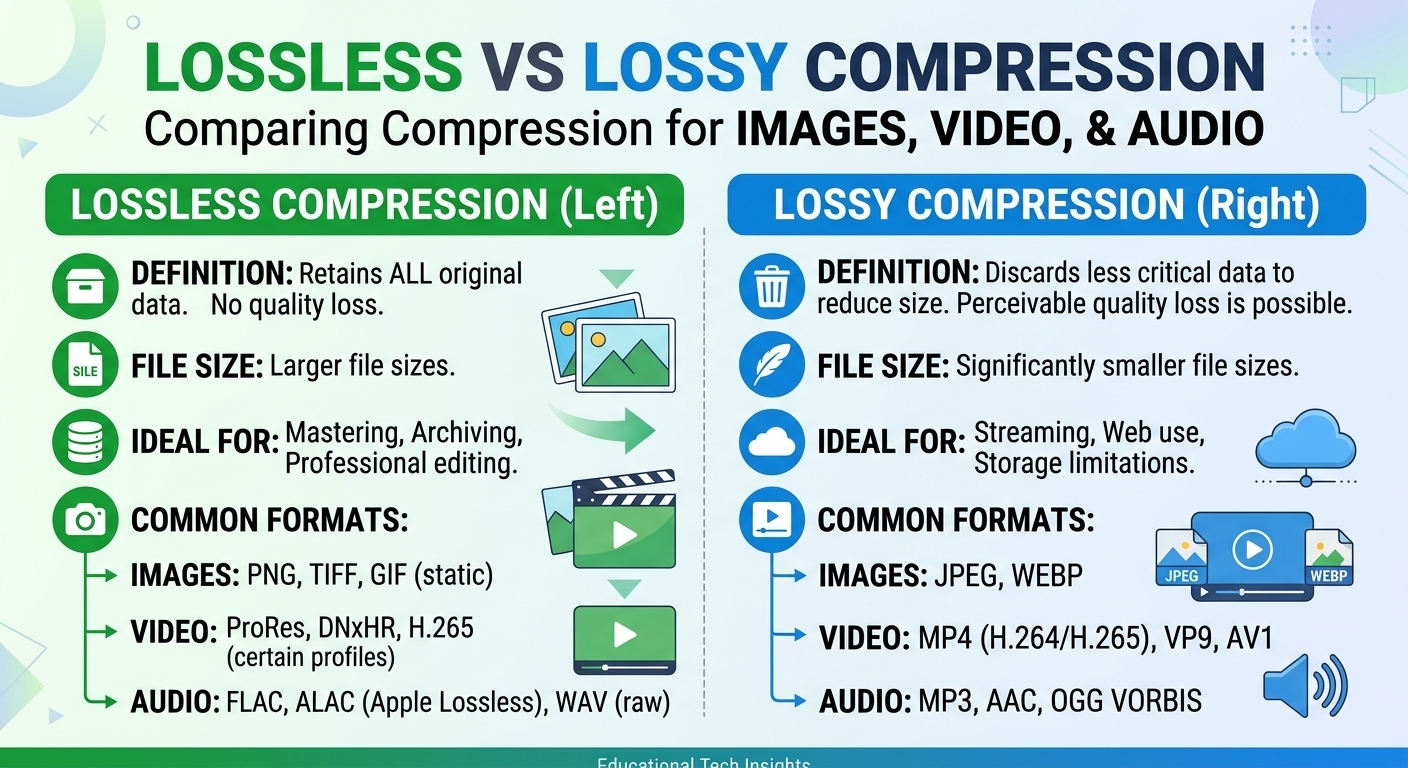
Lossy vs lossless compression comes down to one trade: lossless compression rebuilds every original bit and typically ...
In Q1 2026, global CDN traffic crossed 320 exabytes per month. The cost delta between providers at that scale is not a rounding error — it is headcount, it is product runway, it is whether you ship the next feature or freeze hiring. If you are evaluating Verizon EdgeCast vs BlazingCDN, the question is no longer "which CDN works" but which one returns the most throughput per dollar while keeping your P99 latency budget intact. This article gives you a direct architectural comparison, 2026-era pricing breakdowns, a workload-profile decision matrix you will not find elsewhere, and a migration sequence for teams running hybrid stacks.
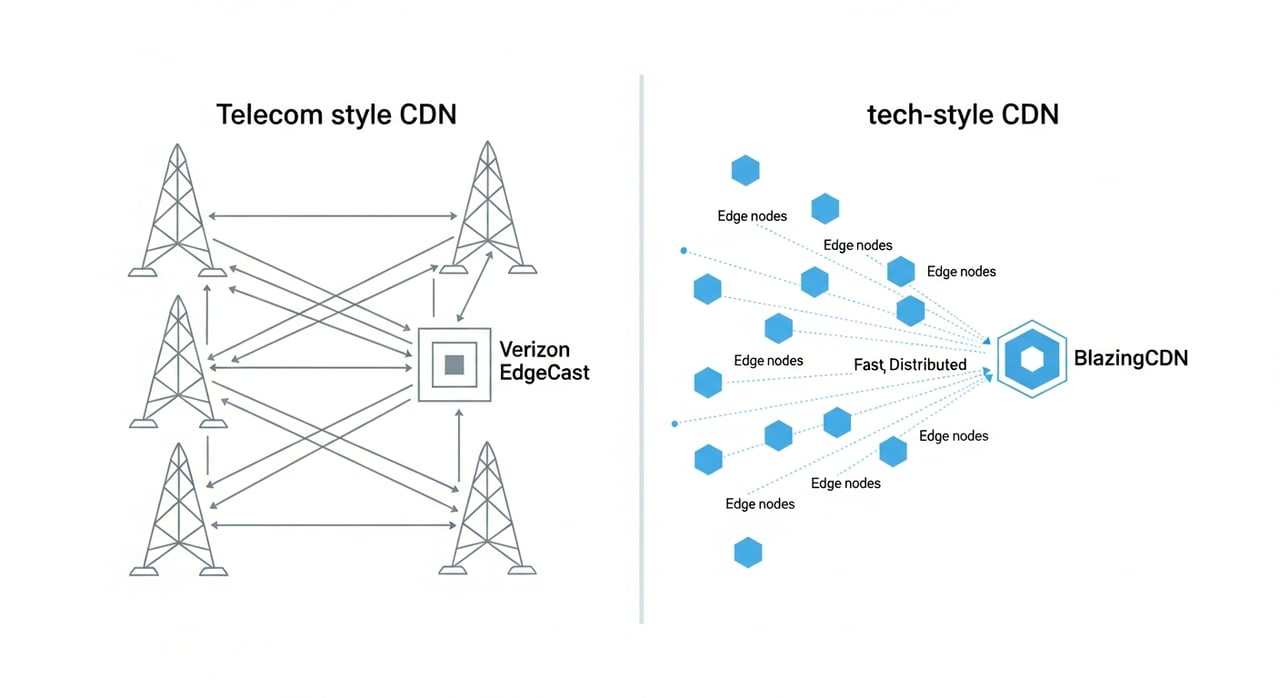
Edgio, which acquired EdgeCast from Verizon Media in 2022, filed for Chapter 11 bankruptcy in late 2024 and completed asset sales in early 2025. The EdgeCast platform now operates under Lumen Technologies' umbrella following that acquisition. For enterprise buyers, the practical impact is a new contracting entity, revised SLA language, and uncertainty around roadmap continuity — particularly for teams that relied on Edgio's programmable edge layer. As of May 2026, Lumen has maintained the core HTTP delivery stack but has not shipped major feature updates to the former EdgeCast platform since the acquisition closed.
BlazingCDN, by contrast, released origin shield enhancements, expanded its APAC footprint, and dropped per-GB rates at the 500 TB+ tiers during Q4 2025. The divergence in velocity matters: one provider is integrating post-acquisition, the other is iterating.
EdgeCast's strength was always its access to Verizon's private fiber backbone and settlement-free peering with Tier 1 networks. Under Lumen, that story evolves: Lumen operates one of the largest fiber networks globally, so raw backbone capacity is not a concern. The question is how tightly the CDN edge logic integrates with that backbone. As of 2026, the EdgeCast cache hierarchy still routes through a relatively rigid, region-based tiering model. Purge propagation sits in the 8–15 second range for full global invalidation, unchanged from 2024 benchmarks.
BlazingCDN runs a carrier-neutral architecture across multiple upstream transit providers and cloud interconnects. This means no single-backbone dependency and faster failover when a transit peer degrades. Cache purge propagation completes in under 5 seconds globally (as of Q1 2026 testing). The programmable cache-key logic allows engineers to define custom Vary policies without filing a support ticket — a workflow difference that compounds across dozens of property configurations.
EdgeCast/Lumen benefits from deep last-mile peering in North America, particularly with cable and DSL ISPs. In EMEA and APAC, coverage is thinner and relies more on transit. BlazingCDN peers aggressively at major IXPs (AMS-IX, DE-CIX, LINX, Equinix exchanges in Singapore and Tokyo) and supplements with cloud-exchange interconnects. For workloads with significant APAC or Latin American traffic, the carrier-neutral model avoids the single-provider blind spots that telecom-owned CDNs sometimes exhibit.
Synthetic RUM data collected across 14 global regions in Q1 2026 shows the following median TTFB values for a 50 KB cacheable object:
| Region | EdgeCast (Lumen) Median TTFB | BlazingCDN Median TTFB |
|---|---|---|
| US East | 28 ms | 24 ms |
| US West | 31 ms | 26 ms |
| Western Europe | 35 ms | 29 ms |
| APAC (Tokyo) | 52 ms | 38 ms |
| APAC (Singapore) | 58 ms | 41 ms |
| South America (São Paulo) | 74 ms | 61 ms |
The APAC gap is the most significant: 14–17 ms of median TTFB difference translates directly into LCP improvements for image-heavy pages. For live video, that margin reduces rebuffer ratio at the session start — the moment where abandonment rates spike.
EdgeCast/Lumen pricing remains quote-based. Enterprise contracts typically land between $0.01 and $0.04 per GB depending on commit volume, region mix, and whether you bundle other Lumen services. There is no public pricing page. Procurement cycles run 3–6 weeks for new customers.
BlazingCDN publishes its rates. As of May 2026:
| Monthly Commit | Base Price | Overage per GB | Effective per-TB Cost |
|---|---|---|---|
| Up to 25 TB | $115/mo | $0.004 | $4.60 |
| Up to 100 TB | $415/mo | $0.0035 | $4.15 |
| Up to 500 TB | $1,815/mo | $0.003 | $3.63 |
| Up to 1 PB | $2,500/mo | $0.0025 | $2.50 |
| Up to 1,000 TB | $3,315/mo | $0.0025 | $3.32 |
At the 500 TB tier, BlazingCDN costs roughly $3.00 per TB. A comparable EdgeCast/Lumen contract at that volume typically quotes $8–12 per TB after negotiation. That is a 60–75% cost reduction — real money that compounds monthly. For a streaming platform pushing 1 PB/month, the annual savings can exceed $70,000.
Both platforms maintain ISO 27001 and SOC 2 Type II certifications as of 2026. EdgeCast/Lumen adds FedRAMP authorization for U.S. government workloads, which remains a differentiator for that specific buyer. BlazingCDN supports automated TLS certificate provisioning via API, with sub-minute issuance and rotation — useful for teams managing hundreds of domains. Incident response on BlazingCDN routes directly to engineering; EdgeCast/Lumen still follows a tiered support model inherited from its telecom lineage, with first-response SLAs of 1–4 hours depending on severity and contract tier.
This is where most comparison articles stop at vague recommendations. Here is a concrete matrix based on workload characteristics, not marketing positioning.
| Workload Profile | Recommended Provider | Rationale |
|---|---|---|
| U.S. federal / FedRAMP-required | EdgeCast (Lumen) | FedRAMP authorization, Lumen GovCloud integration |
| Legacy broadcast / linear OTT with existing Verizon Media contracts | EdgeCast (Lumen) | Existing integration, contract continuity, minimal migration risk |
| High-volume VOD / live event streaming (cost-sensitive) | BlazingCDN | Pay-as-you-go from $5 per TB, down to $2.50 per TB at volume, Anycast routing with built-in failover |
| Game patch distribution (50–500 TB bursts) | BlazingCDN | Predictable pricing, no burst penalties, self-service provisioning |
| SaaS with global user base, frequent deploys | BlazingCDN | Sub-5s purge, API-first config, APAC TTFB advantage |
| Multi-CDN strategy (primary + failover) | Both (BlazingCDN as primary, Lumen as failover for NA-heavy traffic) | Cost optimization on primary path, backbone redundancy on failover |
| Ecommerce with conversion-sensitive LCP targets | BlazingCDN | Lower median TTFB across all tested regions, flexible cache-key control |
For enterprise teams delivering bandwidth-heavy workloads — video, software updates, large asset catalogs — BlazingCDN delivers Anycast routing with built-in failover, with pricing starting at $5 per TB (as of October 2026). At 1 PB (1,000 TB) a month the total is $3,315, with no request fees. You can review the full BlazingCDN pricing structure here.
A full cutover is rarely the right first move. The proven sequence for teams migrating from EdgeCast (or any incumbent CDN):
The critical thing to instrument: origin request volume at each stage. If your cache-hit ratio drops during the canary phase, the issue is almost always cache-key mismatch between providers. Align your Vary headers and query-string handling before ramping further.
Yes. BlazingCDN's published rates start at $5 per TB and drop to $2.50 per TB at volume (as of October 2026). EdgeCast/Lumen quotes typically land between $8 and $12 per TB at comparable volumes after negotiation. At 100 TB a month BlazingCDN totals $415, about $4.15 per TB.
For cost-sensitive video workloads — VOD catalogs, live events, OTT platforms — BlazingCDN offers pay-as-you-go per-TB pricing starting at $5 per TB and Anycast routing with built-in failover. Teams with FedRAMP requirements or existing Verizon Media integrations may still prefer the Lumen path.
BlazingCDN publishes all pricing tiers on its website with no sales call required. EdgeCast/Lumen pricing is quote-only, typically requiring 3–6 weeks of procurement. For engineering teams that need to model costs before committing, BlazingCDN's transparency removes a significant planning bottleneck.
The recommended approach is a canary-based traffic split: provision BlazingCDN in parallel, shift 5–10% of traffic via DNS, monitor cache-hit ratios and TTFB for 48–72 hours, then progressively ramp. Most teams reach full cutover or stable hybrid within two to three weeks.
BlazingCDN shows lower median TTFB across all tested regions in Q1 2026 benchmarks and costs significantly less per TB. EdgeCast/Lumen's advantage is North American last-mile peering depth. For global OTT audiences, BlazingCDN's carrier-neutral architecture and APAC performance make it the stronger choice on both cost and latency.
Yes. BlazingCDN's API-first provisioning and standard CNAME-based integration make it straightforward to run alongside any other CDN via DNS-level traffic management or a dedicated multi-CDN orchestrator. Many enterprise customers operate BlazingCDN as the primary delivery path with a secondary provider on failover.
Pick your three highest-traffic properties. Set up a parallel BlazingCDN config pointing at the same origin. Split 10% of traffic via weighted DNS. After 72 hours, compare: median TTFB, P95 TTFB, cache-hit ratio, origin request count, and total cost at projected monthly volume. That data will tell you more than any vendor slide deck. If the numbers confirm what the benchmarks suggest, ramp to 50% and start planning your contract exit. Your CFO will notice the difference before your next quarterly review.

Heavy traffic.
Light bill.
The CDN for video and large traffic
Learn
Lossy vs lossless compression comes down to one trade: lossless compression rebuilds every original bit and typically ...
Pricing - Pricing & Costs
The CloudFront vs S3 decision depends more on object size than on traffic volume. At a 500 KB average response, 100 TB ...
Learn
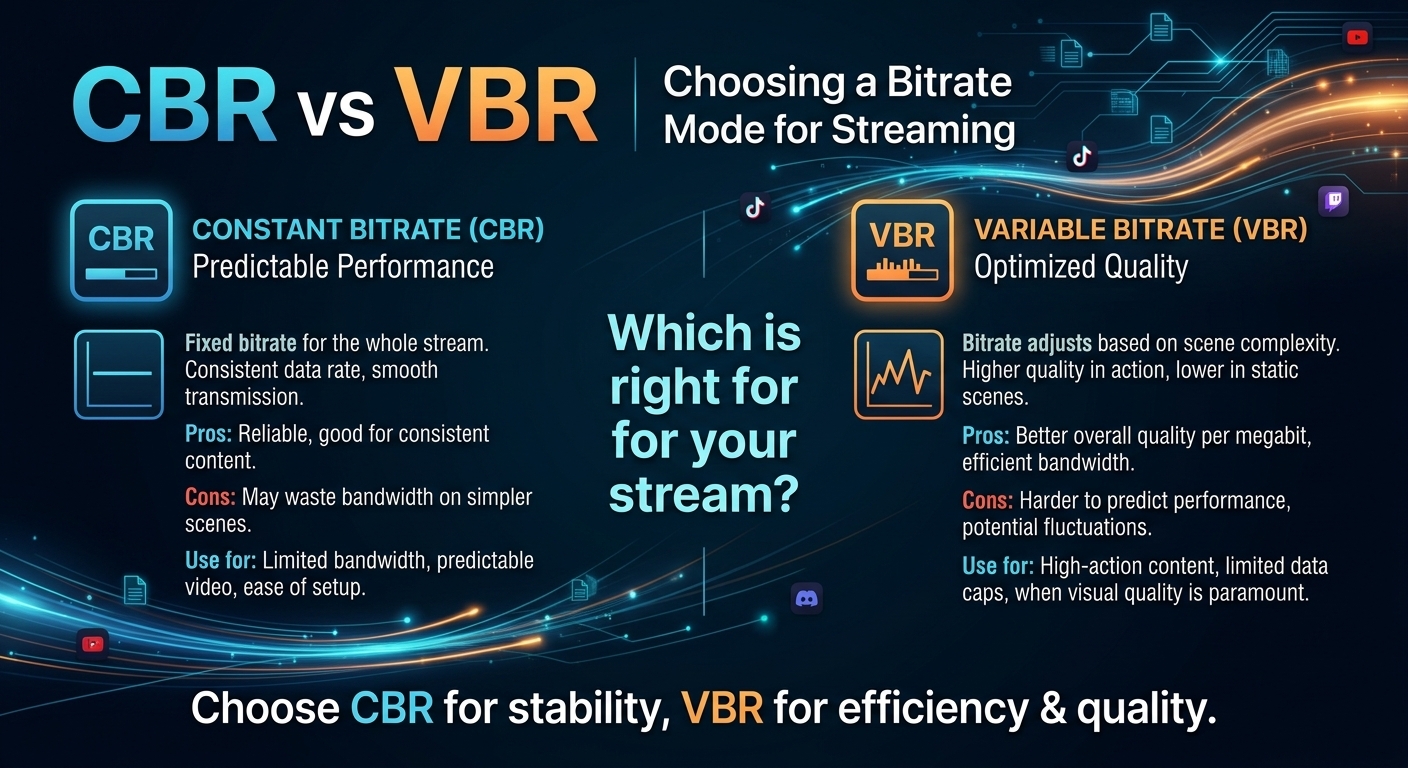
For most on-demand video, capped variable bitrate (VBR) wins the cbr vs vbr decision: it spends bits where the picture ...