
Learn
CBR vs VBR: Choosing a Bitrate Mode for Streaming
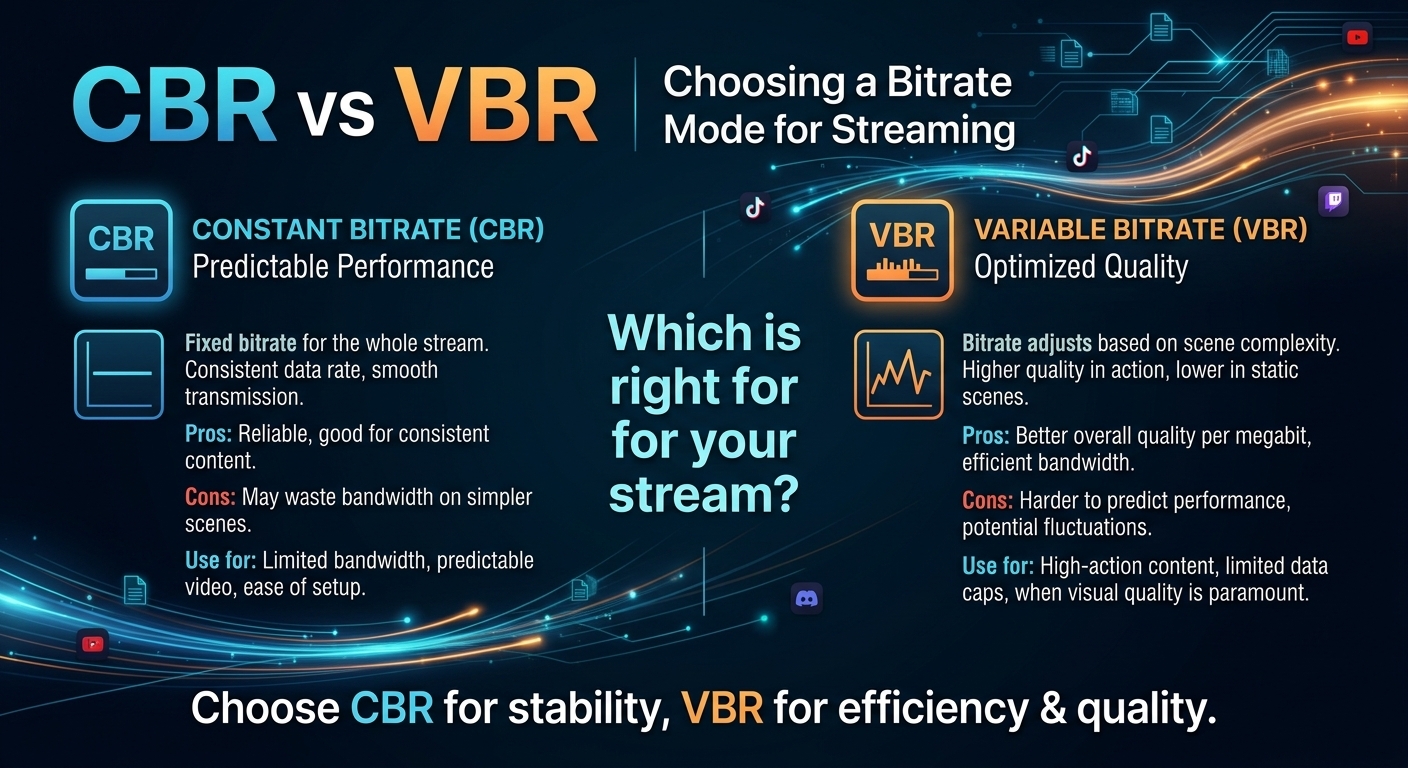
For most on-demand video, capped variable bitrate (VBR) wins the cbr vs vbr decision: it spends bits where the picture ...
A mid-sized streaming platform we spoke with in Q1 2026 discovered that 38% of their Fastly invoice came from a single cost component they had never explicitly optimized: inter-shield bandwidth between origin-shield POPs and edge nodes in Asia-Pacific. Their total Fastly bandwidth pricing bill was $14,200/month — and $5,400 of it was technically avoidable. This article gives you the regional rate breakdown, the nine specific engineering levers that reduce Fastly bandwidth cost in production, and a workload-profile decision matrix for evaluating whether your traffic pattern even belongs on Fastly's billing model.
Fastly bills bandwidth on delivered bytes measured at the edge, not at the origin. As of May 2026, their published pricing page lists a pay-as-you-go rate starting at $0.12/GB for North America and Europe, with significant regional multipliers. The critical details most teams miss:
Regional pricing is where Fastly bills diverge most from flat-rate CDNs. The following table reflects Fastly's published pay-as-you-go rates as of May 2026. Committed-spend contracts typically discount these by 20–40% depending on volume and term length.
| Region | Pay-As-You-Go $/GB | Approx. $/TB |
|---|---|---|
| North America | $0.12 | $120 |
| Europe | $0.12 | $120 |
| Asia-Pacific | $0.19 | $190 |
| South America | $0.28 | $280 |
| Australia / New Zealand | $0.19 | $190 |
For comparison: a flat-rate CDN charging $0.0025–$0.005/GB delivers the same byte to São Paulo for less than Fastly's PAYG rate. The performance tradeoff is real but often smaller than the price gap suggests, especially for cacheable static and video workloads.
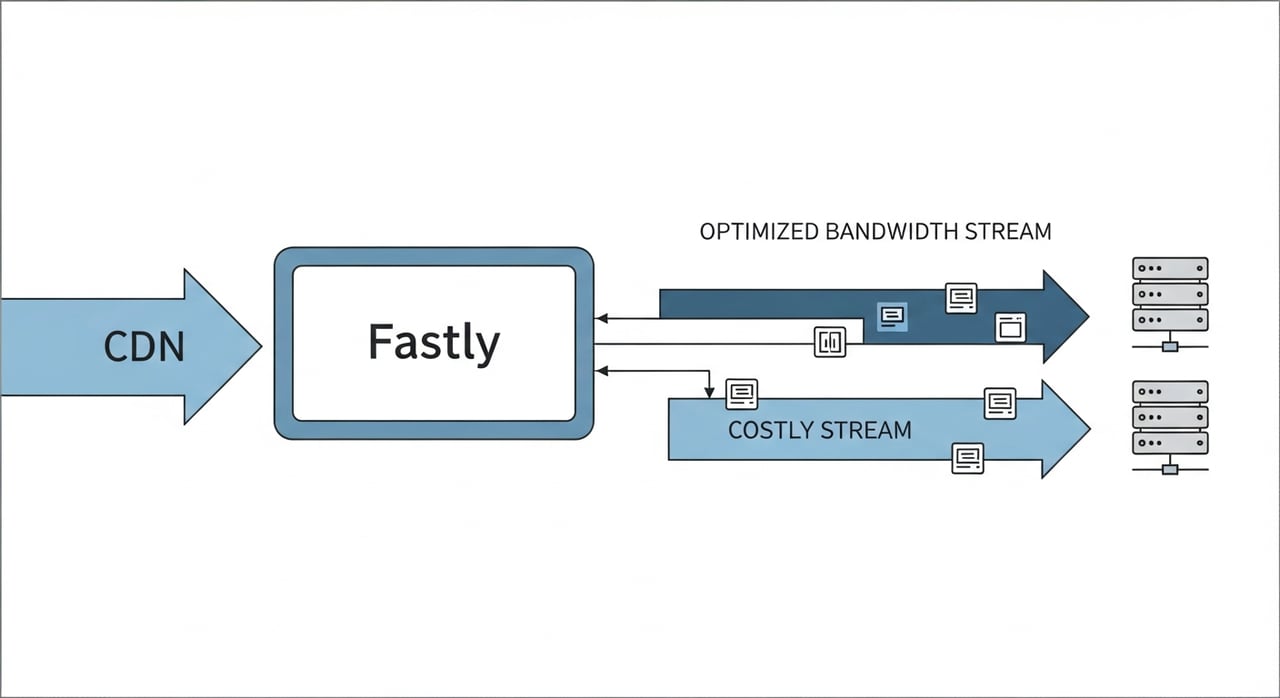
Shielding collapses origin fetches but routes all edge-miss traffic through a single POP. If your shield POP is in Ashburn but 40% of your users are in Tokyo, every cache miss traverses the Pacific twice (origin → shield → edge). Measure shield-hit ratio via Fastly's real-time analytics API. If it is below 85%, consider whether a second shield in a closer region or removing shielding entirely reduces total delivered bytes.
Every cache miss is bandwidth you pay for twice: once on origin egress, once on Fastly delivery. Run a TTL audit across your top 100 URLs by traffic volume. Objects with TTLs under 60 seconds that are not personalized are almost always under-cached. Surrogate-Control headers let you set Fastly-specific TTLs independent of browser Cache-Control.
Fastly supports Brotli compression on text-based responses. Brotli typically compresses 15–25% smaller than gzip at equivalent CPU cost. Since Fastly bills on compressed delivered size, switching from gzip to Brotli on HTML, CSS, JS, and JSON responses directly reduces your invoice. Verify via response headers that Brotli is actually being served — misconfigured VCL can silently fall back to gzip.
The stale-while-revalidate directive serves a stale cached copy while asynchronously refreshing in the background. This eliminates thundering-herd cache misses on popular objects whose TTL just expired. Fewer simultaneous origin fetches means less bandwidth billed during traffic spikes.
If your APAC or LATAM traffic is a small percentage of total requests but a disproportionate percentage of cost (due to regional rate multipliers), evaluate whether that traffic can be routed through a different CDN with flat-rate or lower regional pricing. Multi-CDN architectures are operationally more complex, but the savings at 50+ TB/month can justify the engineering investment.
Fastly's Image Optimizer (IO) is an add-on billed separately, but it can reduce image payload by 40–60% through format negotiation (WebP/AVIF) and quality tuning. If you are delivering images at fixed quality without content negotiation, you are over-delivering bytes to every client that supports modern formats. The IO cost is often recovered within the first 10–15 TB of monthly image traffic.
A Vary header that includes User-Agent effectively makes every cache key unique per browser version. This tanks hit ratios and multiplies origin-to-edge bandwidth. Normalize your Vary values to the minimum set your application actually needs — typically Accept-Encoding and at most one custom header for A/B testing or locale.
Fastly's Billing Overview in the dashboard shows aggregate monthly usage, but the real-time analytics API (rt.fastly.com) lets you build granular dashboards by service, POP, and status code. Instrument a daily bandwidth-by-region alert. Catching a misconfigured deployment that bypasses cache within 2 hours instead of 48 hours can save thousands in a single incident.
Fastly offers committed-spend agreements starting at roughly $5,000/month. The discount typically ranges from 20–40% off PAYG rates depending on term and volume. If your monthly Fastly bill exceeds $3,000 on PAYG, request a custom quote — the ROI on a 12-month commit is almost always positive if your traffic is stable or growing.
Not every traffic pattern maps well to Fastly's billing model. The following matrix helps you evaluate fit based on your actual workload characteristics as of 2026.
| Workload Profile | Fastly Fit | Why |
|---|---|---|
| Low-volume API with edge logic (Compute@Edge) | Strong | Bandwidth cost is low; value is in compute and instant purge |
| High-volume static site (>100 TB/mo, NA/EU only) | Moderate | Committed discount helps, but flat-rate CDNs are 10–30x cheaper per GB |
| Global video/streaming (>200 TB/mo, multi-region) | Weak | Regional multipliers on APAC/LATAM make cost prohibitive at scale |
| Software distribution (large binaries, global) | Weak | Cacheable but high-volume; bandwidth cost dominates the bill |
| Personalized content at edge (low cache-hit ratio) | Moderate | Instant purge and VCL flexibility justify premium; optimize Vary carefully |
For workloads in the "Weak" fit category — particularly high-volume video, game distribution, or software updates — a volume-oriented CDN changes the economics entirely. BlazingCDN is a pay-as-you-go CDN with pricing from $5 per TB down to $2.50 per TB at volume (as of October 2026), one rate for US, Europe and Asia. At 100 TB per month that is $415. It offers flexible configuration and fast scaling under demand spikes without the regional surcharges.
Fastly applies per-GB rates that vary by geographic region. As of Q2 2026, North America and Europe are $0.12/GB on PAYG, while Asia-Pacific runs $0.19/GB and South America $0.28/GB. Committed contracts discount these rates but preserve the regional multiplier structure.
It can. Shielding reduces origin egress by consolidating fetches through a single POP, but the shield-to-edge transfer still counts toward your Fastly bandwidth bill. If the shield-hit ratio is low, you may pay more in Fastly data transfer than you save in origin egress. Monitor shield-hit ratio and evaluate the net cost impact.
Compressed size. When Fastly applies gzip or Brotli at the edge, the metered bytes reflect the post-compression payload delivered to the client. This makes enabling Brotli a direct cost reduction for text-heavy responses — typically 15–25% smaller than gzip equivalents.
The Billing Overview in Fastly's dashboard shows aggregate monthly bandwidth and request counts by service. For granular, real-time monitoring, use the real-time analytics API at rt.fastly.com, which exposes per-POP, per-status-code bandwidth metrics at 1-second resolution. Pipe this into your observability stack to alert on anomalies before they compound into invoice surprises.
Teams that systematically apply TTL audits, Brotli compression, Vary normalization, and shield topology optimization typically reduce Fastly bandwidth cost by 25–45% without changing providers. The largest single lever is usually fixing under-cached objects — a TTL audit alone often recovers 15–20% of wasted bandwidth.
Pull your last three Fastly invoices. Divide total bandwidth charges by total delivered TB. Break it out by region if you can. Compare that effective $/GB against both Fastly's published PAYG rate and at least one volume-oriented alternative. If your effective rate is within 20% of PAYG, you are leaving committed-discount money on the table. If it exceeds $0.08/GB on a workload that is 90%+ cacheable static content, the architecture discussion is not about optimization — it is about provider fit. Run the numbers. The spreadsheet will tell you what to do next.

Heavy traffic.
Light bill.
The CDN for video and large traffic
Learn
For most on-demand video, capped variable bitrate (VBR) wins the cbr vs vbr decision: it spends bits where the picture ...
Compare
As of October 2026, the Azure service that matches Amazon CloudFront is Azure Front Door Standard or Premium: Microsoft ...

Learn
In answer to what is a keyframe: a keyframe, or I-frame, is a video frame encoded without reference to any other frame, ...