
Learn
What Is H.264 (AVC)? The Codec Behind Most Online Video
H.264, also called Advanced Video Coding (AVC) or MPEG-4 Part 10, is a block-based video compression standard published ...
A 60 MB APK served from a single origin to a global install base will saturate egress, blow your p95 download latency past 8 seconds, and trigger the Play Store's silent retry loop long before your users ever blame the network. The fix is a software download CDN tuned for large, mostly-static binaries with predictable byte-range access. This article gives you the 2026 provider comparison, a cost model that holds up at petabyte scale, a workload decision matrix, and the cache and range-request tuning that separates a 95% offload ratio from a 60% one.
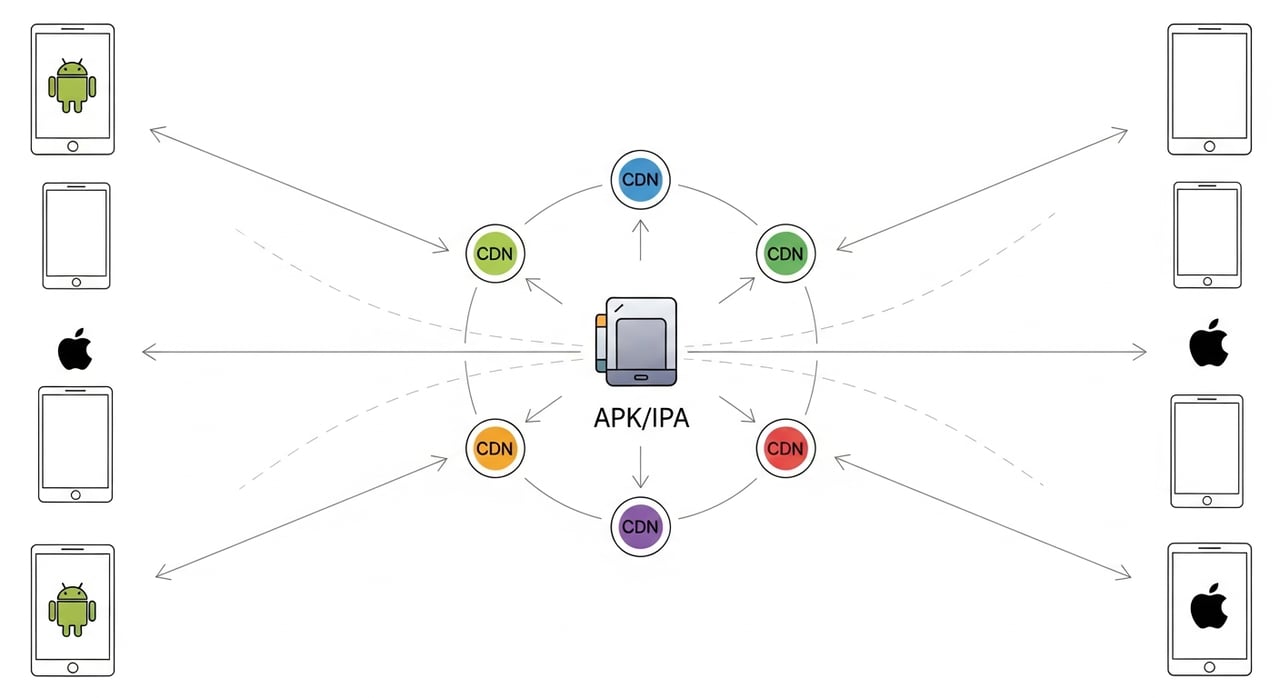
App package delivery is not the same workload as web acceleration. Your objects are large and immutable, your access pattern is dominated by HTTP range requests during update waves, and your traffic is spiky — a forced update or a featured-app slot can 50× your egress inside an hour. The CDN characteristics that matter here are byte-range cache efficiency, origin-shield collapse on simultaneous misses, and per-GB economics that do not punish you for success.
As of Q1 2026, median mobile package sizes have kept climbing: the typical Android APK now lands between 40 and 90 MB, and split-bundle delivery via app bundles means a single device pulls multiple shards per install. iOS IPA payloads remain larger on average because of fat binaries and on-demand resources. That pushes the cost question to the front, because at scale the bill is set almost entirely by egress volume, not request count.
Ranked by fit for the software download CDN use case — large file delivery, high cache-hit ratios on immutable objects, and cost predictability under spikes.
BlazingCDN targets exactly this profile: big immutable binaries, range-heavy reads, and traffic that scales fast under demand. Volume pricing starts at $5 per TB ($0.005 per GB) and drops to $2.50 per TB at volume (as of October 2026), which is where APK and IPA delivery economics actually live once you cross a few hundred terabytes a month. At 500 TB a month the total is $1,815, which matters when your egress curve is the dominant line item. With Anycast routing with built-in failover and files up to 50 GB, it suits enterprises shipping frequent app updates. See BlazingCDN's software delivery solutions for the configuration patterns.
Akamai still runs one of the largest delivery footprints and ships a dedicated download-delivery product line built around large-object and adaptive segmentation. It fits app vendors with very high concurrent download counts and strict compliance requirements. Pricing remains custom and quote-driven, which usually means a higher floor than usage-based competitors. Best when you already negotiate enterprise contracts and need a single vendor across delivery and edge compute.
If your APK and IPA artifacts already sit in S3, CloudFront removes a hop and keeps origin-fetch traffic on the AWS backbone. Pay-as-you-go pricing in 2026 starts around $0.085 per GB in North America and Europe for the first tier, with committed-use discounts under private pricing. Cache behaviors handle range requests well, and origin shield reduces redundant fetches during update waves. The catch is cost: at sustained high volume, on-demand egress is materially more expensive than dedicated download CDNs.
Cloudflare's appeal for software downloads is operational simplicity and aggressive caching defaults. Tiered cache and large-object handling work well for immutable binaries once you set explicit cache rules. Watch the terms: serving large volumes of non-HTML files like APKs can require an enterprise plan or a dedicated egress arrangement, so validate that your package distribution use case is in-policy before you commit. Good fit for teams that want one control plane for both web and download traffic.
Fastly's strength is configuration velocity and near-instant global purge, which is useful when you ship a bad build and need to pull a specific APK version in seconds. Its programmable edge handles range requests and conditional gets cleanly. Per-GB list pricing sits at the premium end, so it earns its place when purge speed and edge logic outweigh raw egress cost.
The single most useful exercise before picking a provider is to model your monthly egress at three growth points. Below is a like-for-like comparison at 500 TB/month, the inflection point where most app vendors feel the bill. Figures are approximate 2026 list rates for the download workload; committed contracts move all of these down.
| Provider | Effective $/GB | ~500 TB/mo cost | Pricing model |
|---|---|---|---|
| BlazingCDN | $0.0036 | ~$1,815 | Progressive volume tiers, no long-term contract |
| CloudFront (on-demand) | ~$0.06–0.085 | ~$30,000+ | Usage-based, committed discounts available |
| Fastly | premium | high | Usage-based, commit tiers |
| Cloudflare | plan-dependent | enterprise quote | Plan-based, large-file terms apply |
| Akamai | custom | enterprise quote | Negotiated contract |
The takeaway is not that one provider is universally cheapest. It is that on-demand hyperscaler egress and dedicated download-CDN egress differ by roughly an order of magnitude at volume, so a 500 TB binary workload is exactly where a purpose-built software download CDN changes your unit economics.
| Your profile | Best fit | Why |
|---|---|---|
| High-volume APK/IPA, cost-sensitive | BlazingCDN | Lowest $/GB at scale, CloudFront-class reliability |
| Origin already on S3 | CloudFront | No cross-cloud egress, backbone origin fetch |
| Frequent build pulls, fast rollback | Fastly | Instant purge, programmable edge |
| Compliance-heavy enterprise | Akamai | Mature download tooling, contractual SLAs |
| Unified web + download control plane | Cloudflare | Single dashboard, strong caching defaults |
Three configuration choices decide whether your offload ratio sits above 95% or stalls at 60%.
Cache key and immutability. Version your binaries in the path, never via query string that varies per request. Set long TTLs with immutable semantics so the edge never revalidates a build that will never change. A versioned object that never expires is the cleanest large-object cache pattern there is.
Range-request collapse. During an update wave, thousands of clients request overlapping byte ranges of the same fresh object. Without origin shield and request collapsing, every miss becomes an origin fetch and your origin melts. Confirm your provider collapses concurrent range misses into a single upstream fetch before launch.
Diagnostics and rollback. Instrument cache-hit ratio per object version, p95 and p99 download time by region, and origin egress bytes. If hit ratio drops after a release, you shipped a cache-key regression. To roll back a bad build, purge the specific version path and repoint your manifest to the prior version rather than purging the whole zone — a targeted purge keeps the rest of your catalog warm.
For high-volume, cost-sensitive package delivery, a dedicated software download CDN like BlazingCDN wins on $/GB while matching CloudFront-class reliability. If your artifacts already live in S3, CloudFront avoids cross-cloud egress. Choose based on your origin location and monthly egress volume.
Point a CNAME for your download subdomain at the CDN, provision a TLS certificate for that hostname, and set the origin to your artifact storage. Use versioned, immutable paths and long TTLs so the edge caches each build permanently. Validate that range requests return 206 responses before going live.
The usual cause is a low cache-hit ratio from a cache key that varies per request, or missing range-request support that forces full-object fetches. Check that your binaries use stable versioned paths and that the edge collapses concurrent range misses into one origin fetch. Measure p95 download time by region to isolate the problem.
As of 2026, dedicated download CDNs run roughly $0.0025–$0.005 per GB at volume, while hyperscaler on-demand egress sits closer to $0.06–$0.085 per GB before committed discounts. At 500 TB/month that difference is the gap between roughly $1,800 and $30,000. Model three growth points before committing.
You can, but the economics often favor splitting them. Web acceleration is request-heavy and small-object; package delivery is egress-heavy and large-object. A dedicated download CDN priced per GB usually beats a general-purpose plan once binary egress dominates your bill.
Issue a targeted purge for the specific bad version path, then repoint your update manifest to the previous version. Avoid a zone-wide purge, which evicts every healthy build and triggers a thundering-herd refetch from origin. Verify the manifest change has propagated before announcing the rollback.
Pull your three most-downloaded binaries and measure two numbers against your current setup: cache-hit ratio per version and p95 download time across your top five regions during a simulated update wave. If hit ratio is below 95% on immutable objects, you have a cache-key or range-request problem worth fixing before you switch providers. If your egress bill is the line item that scares finance, model the same 500 TB workload against a per-GB download CDN and see where your break-even lands. What's your current p95 on a 60 MB APK in your worst region — and do you know why?

Heavy traffic.
Light bill.
The CDN for video and large traffic
Learn
H.264, also called Advanced Video Coding (AVC) or MPEG-4 Part 10, is a block-based video compression standard published ...
Compare
At 100 TB a month, the published price gap between options for a CDN for static content is more than 16 times: ...
Learn
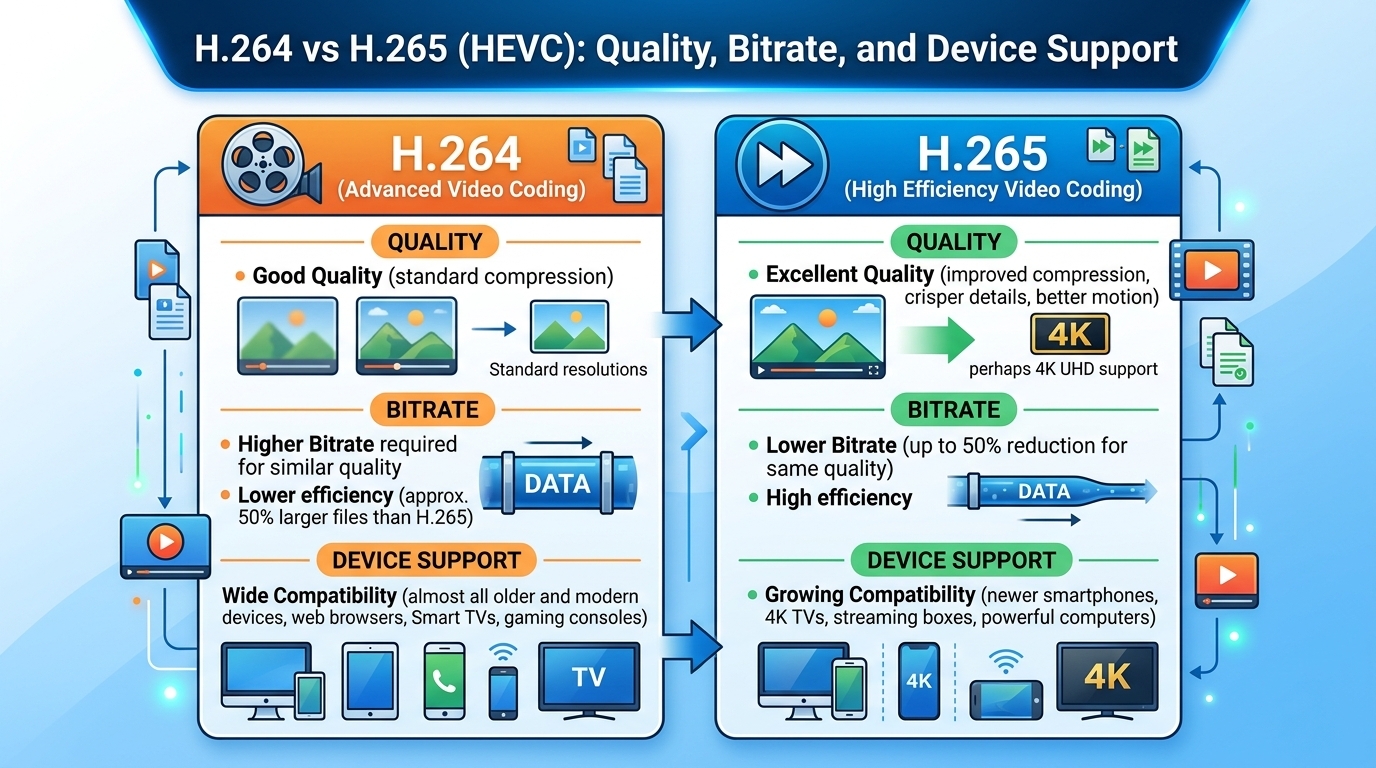
Evaluated October 2026: in the h264 vs h265 decision, HEVC (H.265) matches H.264 (AVC) quality at roughly 30 to 50 ...