

Learn
What Is H.264 (AVC)? The Codec Behind Most Online Video
H.264, also called Advanced Video Coding (AVC) or MPEG-4 Part 10, is a block-based video compression standard published ...
Conviva reported that video startup failures rise sharply once buffering crosses low single-digit percentages, and large object delivery still collapses under exactly the workloads teams claim are cache-friendly: release-day binaries, live sports concurrency, fragmented HLS ladders, and API-adjacent dynamic traffic. The common failure mode is not average latency. It is tail behavior under burst, cache dilution from key explosion, and origin recovery time after a miss storm. That is where the real cdn use cases stop being generic architecture diagrams and start becoming traffic engineering.
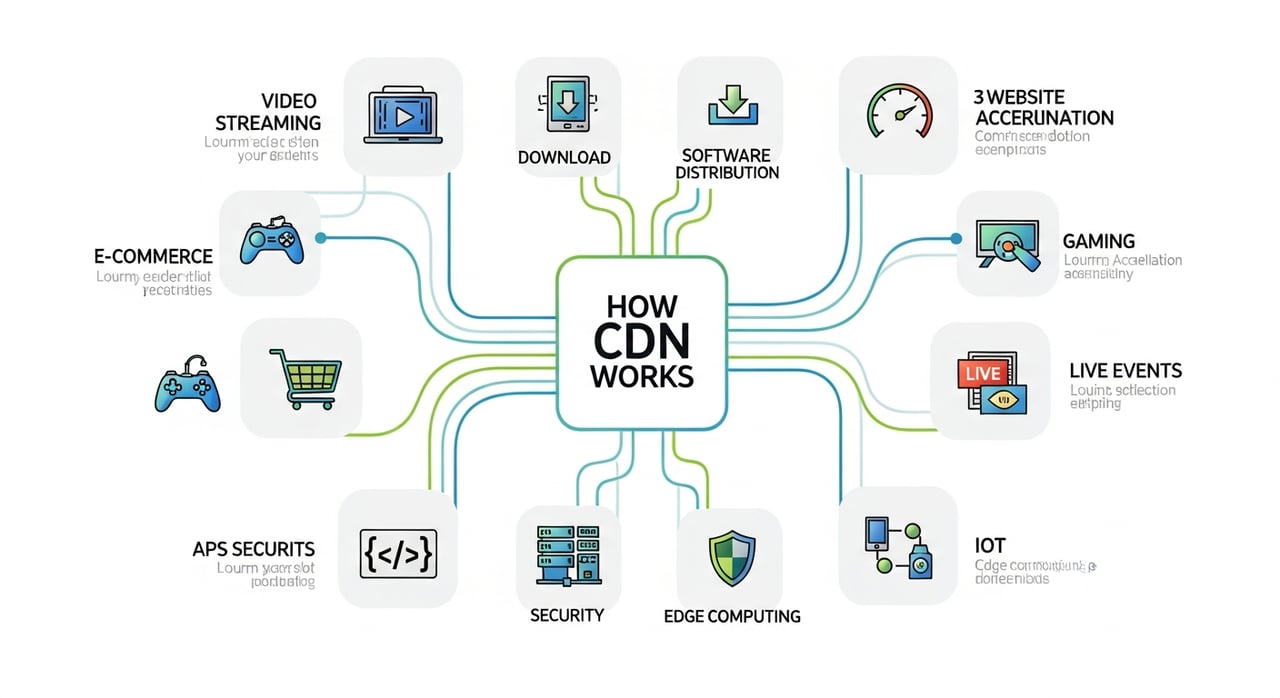
Most discussions of content delivery network use cases flatten very different traffic shapes into one story. A 20 KB cacheable CSS file, a 6 MB video segment, a 4 GB installer, and a signed API bootstrap response all stress different layers: connection reuse, cache admission, shield saturation, TCP congestion control, request coalescing, and object eviction policy. Architects deciding when should you use a content delivery network need to reason from those workload shapes, not from vendor feature checklists.
As of 2026, public measurements remain consistent on one point: user experience tracks the tail. APNIC and RIPE Atlas measurements repeatedly show that path quality varies materially by network and geography, while browser performance data and streaming QoE reports show that a few hundred milliseconds at p95 can dominate abandonment and startup delay. For software distribution, the failure symptom is often not higher median download time but retransmit-heavy last-mile collapse and origin 5xx spikes as clients retry in parallel.
The top cdn use cases cluster into ten patterns: video on demand, live streaming, software and OS distribution, game patch delivery, website performance acceleration, dynamic content delivery, API-adjacent edge caching, media and image transformation pipelines, e-commerce burst handling, and large-scale documentation or package repository delivery. Some are throughput problems. Some are cache-key problems. Some are control-plane problems disguised as delivery problems.
Two public datasets are especially useful here. First, Sandvine has consistently shown video as the dominant share of downstream internet traffic in many markets, which is why cdn for video streaming remains the canonical case. Second, Cloudflare Radar and other public network observability sources show how quickly regional congestion and route instability can shift, which explains why single-region origin architectures fail unpredictably under otherwise ordinary traffic spikes.
For practical engineering decisions, the useful numbers are these:
One caveat: p50 improvements tend to be overstated in vendor marketing because many workloads are already browser-cache or connection-reuse friendly. The durable gains appear in p95 and p99, especially during cache cold starts, regional congestion, and deployment spikes. That is also why asking how cdn improves video streaming performance should start with tails, not averages.
Sources worth checking directly are Sandvine’s annual internet phenomena reporting and Cloudflare Radar for traffic and network shifts. They are useful not because they give you your exact answer, but because they anchor traffic mix and volatility assumptions in public data.
| Use case | Primary bottleneck | What to optimize | Common failure mode |
|---|---|---|---|
| 1. Video on demand | Segment fetch tail latency | Manifest TTL, segment cache policy, range handling | Cache fragmentation by tokens or query params |
| 2. Live streaming | Burst concurrency and shield pressure | Short TTLs, request collapsing, playlist freshness | Origin overload on segment rollover |
| 3. Software distribution | Large object fan-out | Pre-warm, byte-range policy, checksum caching | Release-day thundering herd |
| 4. Game patch delivery | Mass simultaneous downloads | Object versioning, resume support, cache admission | Evicting hot web assets with giant patch files |
| 5. Website performance | Critical path latency | HTML microcaching, compression, immutable static assets | Low hit ratio from poor cache key design |
| 6. Dynamic content delivery | Origin round-trip and handshake cost | Shielding, stale-if-error, connection reuse | Assuming non-cacheable means non-accelerable |
| 7. API-adjacent delivery | Tokenized bootstrap and config fetches | Selective edge caching, signed URL normalization | Cache poisoning concerns block safe caching |
| 8. Media delivery | Image variant explosion | Variant normalization, format negotiation controls | Cache blowup from unbounded transforms |
| 9. E-commerce bursts | Campaign-driven concurrency spikes | HTML microcache, origin shielding, stale serving | Cart/session paths bypass all protection |
| 10. Package repos and docs | Hot metadata plus warm binaries | Small-file tuning, conditional requests, immutable versioned paths | Index freshness fights hit ratio |
For VOD, the hot path is usually manifest plus initial segments, not the full session. That means cache policy should treat manifests, audio renditions, subtitles, and top bitrate segments differently. Engineers often under-optimize range requests and over-focus on headline throughput, even though seek behavior and ABR ladder transitions can dominate backend request multiplicity.
The practical tuning target is stable p95 manifest fetch and predictable cache residency for the first few segments of popular titles. If your library has a heavy long tail, cache admission matters. Blindly admitting every segment can lower effective hit ratio for the actually hot set.
Live is the case that exposes weak request collapsing immediately. Every segment boundary creates a mini stampede, and playlist TTLs are short enough that shield behavior matters more than edge storage capacity. This is the most operationally punishing of the best cdn use cases for media delivery because the load shape is synchronized by the content itself.
Low-latency live tightens the screws further. Smaller chunks reduce startup and glass-to-glass delay, but increase request rate, metadata churn, and header overhead. If your origin and shield are not coalescing effectively, low-latency modes can trade end-user latency gains for backend instability.
This is a distinct workload from video. Objects are much larger, clients aggressively resume, and release timing creates coordinated surges. The question why use a cdn for software distribution has a simple engineering answer: without one, your origin becomes a retry amplifier during rollout windows.
Three details matter more than many teams expect: byte-range support, checksum file caching, and immutable versioned URLs. Versioned binaries with strong cacheability let the CDN behave like a durable fan-out layer. Non-versioned download endpoints with auth tokens in the query string do the opposite and create avoidable misses.
Game patch delivery combines large binary distribution with synchronized client behavior. Unlike general software downloads, launcher traffic often includes manifest polling, region-aware patch selection, and resume-heavy transfers. Storage class and cache admission policy become important because patch files can evict the smaller assets that keep the launcher UI fast.
For websites, the obvious wins are static assets, but the interesting wins are often HTML microcaching, edge compression policy, and cache-key normalization around cookies. Many stacks leave performance on the table because they classify HTML as globally uncacheable when only a subset of paths are truly session-dependent.
This is one of the most misunderstood cdn use cases because teams stop at JS and CSS. In practice, a 1 to 5 second microcache on anonymous HTML during bursts can cut origin request volume dramatically without changing application semantics.
Dynamic content delivery is where simplistic cache hit ratio dashboards become misleading. You can get value from a CDN even with low object hit ratio if transport reuse, origin shielding, stale-if-error, and TLS termination are reducing backend pressure. For personalized traffic, partial caching and surrogate key invalidation often outperform TTL-only strategies.
When people search for cdn for dynamic content delivery, they usually mean one of two things: API bootstrap responses with some shared fields, or server-rendered HTML with narrow personalization. Both are cacheable enough to matter if you partition properly.
Not every API should be fronted with aggressive edge caching, but many bootstrapping paths should. Mobile app config, JS bundle manifests, feature flags with short TTLs, JWKS documents, and package metadata all fit well. The key is proving cache safety and keeping the key cardinality bounded.
Image resizing and format negotiation look cache-friendly until variant explosion appears. Width, DPR, quality, format, and crop mode can create unbounded object multiplication. The fix is to whitelist variant dimensions, normalize query parameters, and pin transformation outputs to a finite set.
Promotional bursts are rarely bottlenecked by catalog images alone. The real pain is anonymous HTML, search suggestions, and semi-static personalization that falls back to origin at the worst possible moment. Microcache plus stale serving during backend saturation is often the difference between graceful degradation and queue collapse.
Package indexes are small and hot; artifacts are large and versioned; documentation mixes both. That makes repository delivery a hybrid of website performance and software distribution. Conditional requests, ETags, and immutable paths matter more here than raw throughput, because clients poll frequently and metadata freshness affects correctness.
The architecture that works across these content delivery network use cases is not one giant cache policy. It is a layered design with explicit classes for object size, mutability, authorization mode, and request synchronization behavior.
This design beats a simpler all-paths policy because it aligns eviction and admission behavior with actual object economics. A 4 GB patch file should not compete directly with 40 KB CSS in the same way. Nor should a live HLS playlist share freshness rules with a nightly installer image.
For teams comparing providers, the important point is operational control. BlazingCDN fits well when you need flexible configuration across these workload classes without enterprise egress pricing becoming the dominant architecture constraint. In contexts like media delivery and software distribution, that balance matters: materially lower delivery cost and pricing starting at $5 per TB (as of October 2026) can change which caching strategies are economically viable at enterprise scale. See BlazingCDN's delivery and configuration features.
The example below shows a practical split for website performance, video manifests, and software distribution. Syntax is nginx-style and intentionally explicit about cache keys and bypasses.
proxy_cache_path /var/cache/nginx levels=1:2 keys_zone=hot:512m max_size=200g inactive=24h use_temp_path=off;
proxy_cache_lock on;
proxy_cache_lock_timeout 10s;
proxy_cache_background_update on;
proxy_cache_revalidate on;

map $request_uri $cache_bucket
{
    default                                 dynamic;
    ~*\.(css|js|woff2|svg|ico)$             static_immutable;
    ~*\.(m3u8|mpd)$                         media_manifest;
    ~*\.(ts|m4s|mp4|aac|vtt)$               media_segment;
    ~*\.(exe|msi|pkg|dmg|zip|tar|tar.gz)$   large_binary;
}

map $http_cookie $anon_bypass
{
    default 1;
    ""      0;
}

server
{
    listen 443 ssl http2;
    server_name cdn.example.com;

    location /
    {
        proxy_pass https://origin_pool;
        proxy_cache hot;
        proxy_cache_key "$scheme|$host|$uri|$arg_v|$http_accept_encoding";
        proxy_ignore_headers Set-Cookie;
        add_header X-Cache-Bucket $cache_bucket always;
        add_header X-Cache-Status $upstream_cache_status always;
    }

    location ~* \.(css|js|woff2|svg|ico)$
    {
        proxy_pass https://origin_pool;
        proxy_cache hot;
        proxy_cache_valid 200 301 302 30d;
        expires 30d;
    }

    location ~* \.(m3u8|mpd)$
    {
        proxy_pass https://origin_pool;
        proxy_cache hot;
        proxy_cache_valid 200 2s;
        proxy_cache_use_stale error timeout updating http_500 http_502 http_503 http_504;
    }

    location ~* \.(ts|m4s|mp4|aac|vtt)$
    {
        proxy_pass https://origin_pool;
        proxy_cache hot;
        proxy_cache_valid 200 10m;
        proxy_force_ranges on;
    }

    location /download/
    {
        proxy_pass https://origin_pool;
        proxy_cache hot;
        proxy_cache_valid 200 7d;
        proxy_force_ranges on;
        proxy_cache_use_stale error timeout updating http_500 http_502 http_503 http_504;
    }

    location /html/
    {
        proxy_pass https://origin_pool;
        proxy_cache hot;
        proxy_no_cache $anon_bypass;
        proxy_cache_bypass $anon_bypass;
        proxy_cache_valid 200 3s;
    }
}
If you are tuning cdn for software distribution, add one more operational procedure: pre-warm at shield before release promotion. Fetch the top N binaries and checksums from shield using the exact production URLs, then verify range support and cache residency before publishing manifests or update channels.
Large-object caching is not free. If your cache hierarchy admits every patch file, you can reduce website performance by evicting smaller, hotter assets. Admission control and tier-specific storage matter. Some systems should cache binaries at shield only and keep edge admission conservative.
Live streaming has a freshness trap. Tight playlist TTLs reduce staleness but can explode origin query rate. Looser TTLs improve offload but can hurt latency and segment availability around rollover. You need instrumentation on manifest age, origin fetch fan-out, and per-title rebuffering, not just aggregate hit ratio.
Dynamic content delivery has correctness risks. Cookie normalization that is too aggressive can leak personalized content. Header-based cache keys can grow cardinality unexpectedly, especially with localization and experiments. Every cacheable dynamic path needs explicit proof of safety.
Range requests create observability blind spots. A binary may appear well cached while origin still serves many partial misses due to resume behavior or sparse reads. Track 200 versus 206 ratio, origin bytes versus edge bytes, and object-level collapsed-forwarding effectiveness.
Invalidation can become the hidden bottleneck. High-cardinality surrogate keys, frequent purge patterns, or broad wildcard invalidations can consume more control-plane budget than serving the content. Immutable versioning is still the cleanest answer for most software and static media workflows.
Cost can push architecture in both directions. Premium delivery can justify very aggressive caching if origin egress is even more expensive, but low-cost delivery can also justify broader edge coverage for binaries and media that teams previously kept centralized. BlazingCDN is relevant in that calculation because pricing starts at $5 per TB, down to $2.50 per TB at volume (as of October 2026), with Anycast routing and built-in failover. That becomes especially meaningful under release-day spikes or sustained streaming volume.
Use this model when: your traffic has a recognizable hot set, synchronized bursts, globally distributed users, or a meaningful difference between p50 and p95 user experience. It fits media platforms, download services, package repositories, SaaS frontends with anonymous HTML, and organizations that care about both origin offload and delivered $/GB.
Use a lighter approach when: your audience is regional and close to origin, objects are tiny and mostly browser-cached, or your team cannot safely classify dynamic paths yet. A badly keyed CDN can add complexity faster than it adds value.
Be careful if: your workload is mostly personalized API traffic, your auth model depends on query-string entropy everywhere, or your release process cannot support immutable artifact versioning. In those cases, start with shielding, transport optimization, and narrow cacheable subsets instead of broad edge caching.
For media-heavy organizations, software vendors, and streaming teams, these are not academic distinctions. They are what separate a clean launch from a retry storm. That is also why providers with flexible policy controls and low delivery cost tend to win adoption in practice; they let teams tune by workload class instead of imposing one expensive default.
Pick one path from each of three buckets: a manifest or HTML document, a 1 to 10 MB media object, and a 1 GB or larger binary. Measure p50, p95, p99, origin fetch count, 200 versus 206 ratio, and edge-to-origin byte amplification before and after cache-key normalization and request collapsing. If your dashboard only shows hit ratio, add those metrics first. They will tell you far more about whether your cdn use cases are actually engineered well.
If you want a sharper internal review question, use this one: which of your top ten externally requested objects would still overload origin if they all expired at once? The answer usually exposes the next real tuning task faster than another synthetic homepage test.

Heavy traffic.
Light bill.
The CDN for video and large traffic
Learn
H.264, also called Advanced Video Coding (AVC) or MPEG-4 Part 10, is a block-based video compression standard published ...

Compare
At 100 TB a month, the published price gap between options for a CDN for static content is more than 16 times: ...
Learn
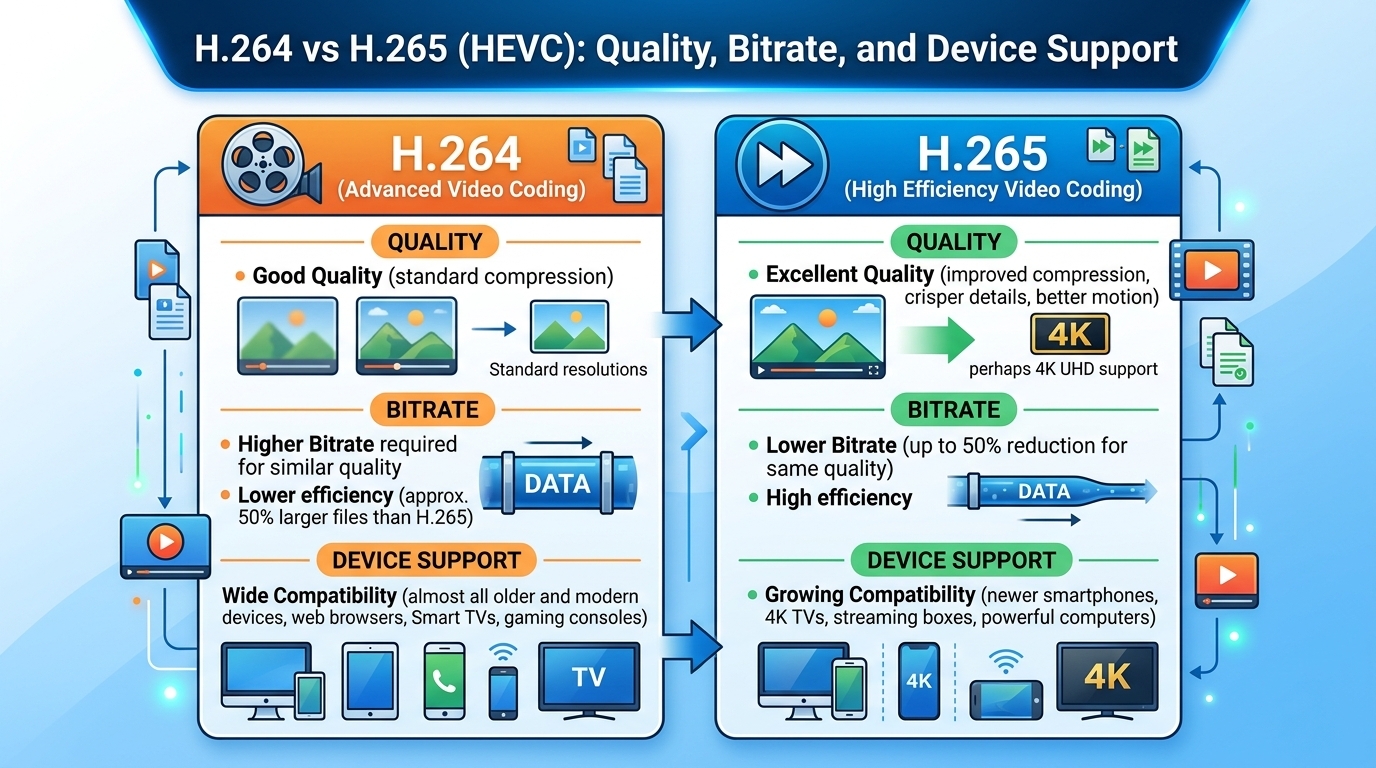
Evaluated October 2026: in the h264 vs h265 decision, HEVC (H.265) matches H.264 (AVC) quality at roughly 30 to 50 ...