"Cloud gaming" and "game streaming" are often used as one term, but they put very different loads on a network. One is an interactive video feed rendered for a single player; the other is a broadcast watched by thousands. A CDN is central to the second and plays only a supporting role in the first.
Short answer: a CDN does not deliver the interactive video of a cloud gaming session. Those frames are rendered and encoded on GPU servers for one player, at roughly 20-25 Mb/s for 1080p at 60 fps, and cannot be cached. A CDN does deliver spectator streams over HLS or DASH, replays, trailers, client updates and storefront files.
What is the difference between cloud gaming and game streaming?
In cloud gaming, the game runs on a GPU server in a data center. The server renders each frame, encodes it as video and sends it to the player, while the player's controller inputs travel back the other way. The player's device only decodes video and sends inputs, which is why cloud gaming works on TVs, phones and low-end laptops.
In game streaming, a player or tournament broadcasts gameplay to an audience. Viewers watch; they do not control anything. The video is encoded once, cut into segments of a few seconds and delivered to every viewer as identical files over HTTP.
That difference decides the architecture. Cloud gaming is one unique stream per player with a tight input loop. Game streaming is one stream copied to many viewers with a delay budget measured in seconds. The first is a real-time compute problem; the second is a distribution problem, which is exactly what a CDN is built for.
Why can't a CDN cache a cloud gaming session?
Caching works when many people request the same bytes. In a cloud gaming session every frame is unique to one player and depends on inputs from a few milliseconds earlier, so there is nothing to reuse. At 60 fps the server has 16.7 ms per frame, and the full loop (input travels to the server, the game simulates, the frame is encoded, sent, decoded and displayed) has to stay short enough that controls feel direct.
Distance is a hard part of that budget. Light in fiber needs about 1 ms of round trip per 100 km, so a player 1,500 km from the GPU region pays at least 15 ms before any encoding or decoding. That is why cloud gaming services build GPU capacity in many regions and route each player to the nearest one. The interactive stream comes from those servers, not from a cache. A CDN placed in front would only add a hop, so no serious cloud gaming platform routes its gameplay video that way.
Where does a CDN fit in a cloud gaming platform?
Around the interactive loop sits a large amount of ordinary, cacheable traffic, and that is where a CDN earns its place:
- Client apps and updates: the desktop, TV and mobile apps players install, plus every update to them.
- Storefront and catalog: box art, screenshots, store pages, scripts and images, often several megabytes per page view.
- Trailers and replays: on-demand video that many users watch, delivered as HLS or DASH segments.
- Spectator and creator streams: live broadcasts of sessions to viewers who are not playing.
- Game builds for GPU regions: some platforms pull new builds into each GPU region over HTTP, where an origin shield stops every region from reading the same files from the origin.
None of this is latency-critical at the millisecond level, but all of it shapes how fast the service feels and what bandwidth costs. A slow storefront or a 400 MB client update that crawls is a worse first impression than a few extra milliseconds of input delay.
How does a CDN deliver game streams to viewers?
Live game streams are packaged as HLS or DASH: a playlist file plus video segments of 2-6 seconds each. Every viewer requests the same segments, so the CDN fetches each one from the origin once and serves it from cache to thousands of viewers. BlazingCDN handles live HLS and DASH delivery and video on demand, with an average cache hit ratio of 96%+; in one live streaming deployment, segment cache hit reached 97%+, which keeps origin load nearly flat as audiences grow.
Latency for viewers is a different scale from cloud gaming. Standard HLS with 6-second segments usually runs 15-30 seconds behind live, and low-latency HLS or DASH brings that down to a few seconds. Both are fine for spectators, and both depend more on segment length and player buffer settings than on the CDN. Encoding happens in your pipeline before the CDN; the CDN distributes the result. For esports specifics, see esports streaming without delay.
How do you reduce lag in cloud gaming?
Since the CDN is not on the gameplay path, lag is reduced elsewhere:
- GPU regions close to players. Every 100 km of fiber adds about 1 ms of round trip, so region placement is the largest single factor.
- Peering with consumer ISPs. Direct interconnects avoid congested transit hops that add jitter in the evening peak.
- Encoder and decoder tuning. Low-latency encoder presets, hardware decoding on the client and short frame queues remove whole frames of delay.
- Adaptive bitrate for the interactive stream. Dropping resolution when bandwidth falls avoids stalls, which players notice more than softer images.
- Player network checks. A connection test before the session, and advice to use wired Ethernet or 5 GHz Wi-Fi, prevents many complaints that are really home-network problems.
The same split applies to classic online games, where match ping depends on server placement, not caching. That case is covered in CDN in online gaming and latency.
How much does streaming and update delivery cost?
A 6 Mb/s spectator stream uses 2.7 GB per viewer-hour (6 Mb/s times 3,600 seconds, divided by 8). BlazingCDN pricing starts at $5 per TB and goes down to $2.50 per TB at volume, one rate for the US, Europe and Asia, with a $25 monthly minimum and no request fees (as of October 2026).
- Smaller platform: 50,000 viewer-hours (135 TB) plus a 250 MB client update for 80,000 users (20 TB): 155 TB, $607.50 per month.
- Larger platform: 200,000 viewer-hours (540 TB) plus the same updates: 560 TB, $1,995 per month.
- Replay library: permanent cache costs $0.02 per GB per month after the first 500 GB included, so 2 TB costs $30 per month.
The interactive feed is separate: an hour of cloud gaming at 25 Mb/s is about 11.25 GB per player, billed by the GPU host. For 100 TB of CDN traffic, published price lists checked August 2026 show about $6,965 on Amazon CloudFront, $990 on CDN77 and $500 (Volume) or $1,000 (Standard) on bunny.net, versus $415 on BlazingCDN. This is the BlazingCDN blog, so test any provider, including us, on your own traffic.
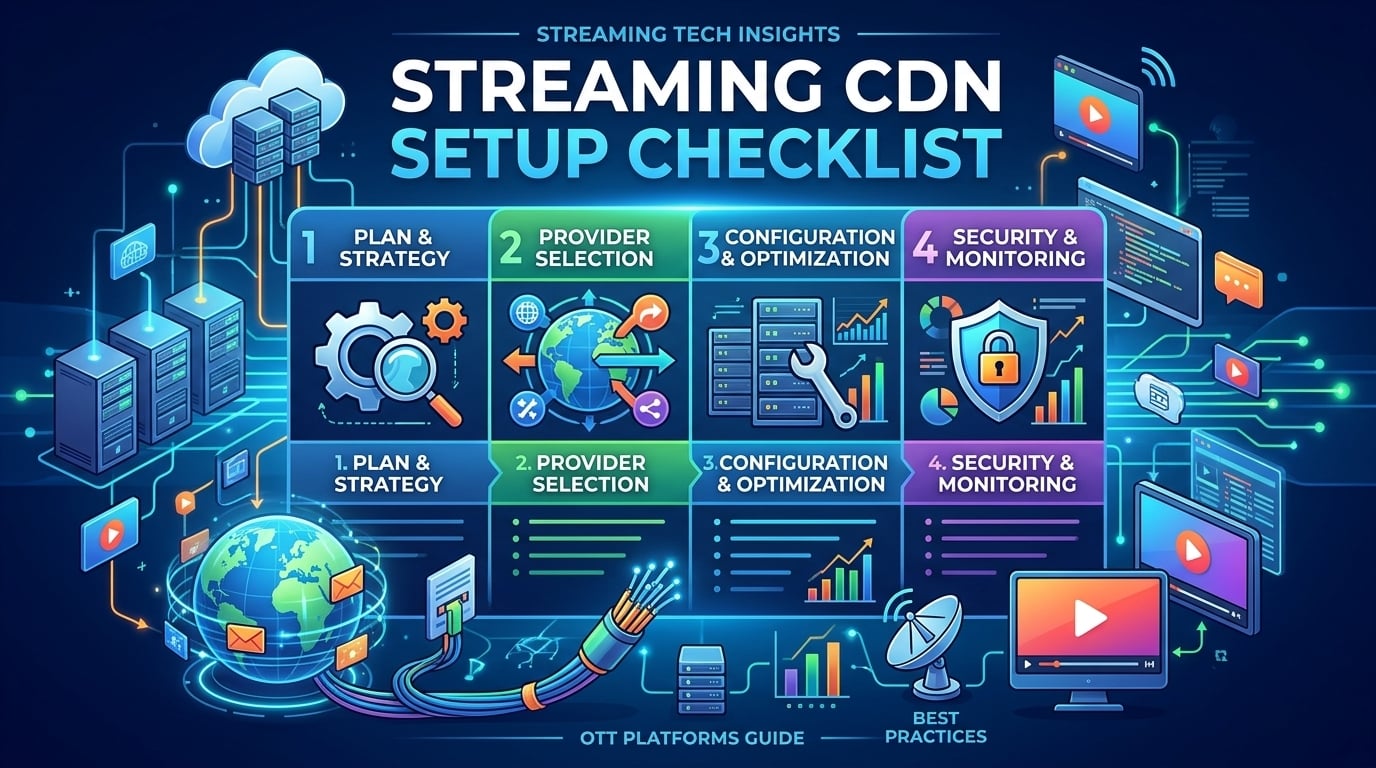
How should a cloud gaming or streaming platform set up its CDN?
- Use separate hostnames for live segments, on-demand video, client downloads and storefront files.
- Give live playlists a TTL of 1-2 seconds and segments a long TTL, since a segment never changes once written.
- Version client builds in the URL path and cache them for a year; publish a new path instead of overwriting files.
- Protect paid or pre-release content with signed URLs that expire.
- Turn on origin shield so a popular stream or build hits the origin once.
- Export CDN metrics to the same dashboards as your GPU fleet, so viewer and player problems are never confused.
BlazingCDN includes origin shield, signed URLs, purge, real-time statistics, Prometheus metrics and a REST API. It can run as a second CDN behind DNS with a weighted split, and offers a 14-day testing period on real production traffic. Studio-oriented details are on the game company solutions page, and download delivery on the files CDN page. For patch and launcher delivery at scale, read the guide to choosing a CDN for gaming.
FAQ
Does a CDN reduce lag in cloud gaming?
Not for the gameplay itself. The interactive video is rendered and encoded per player on GPU servers and sent in real time, so it cannot be cached. Lag in cloud gaming depends on the distance to the GPU region, ISP peering, encoder settings and the player's home network. A CDN speeds up everything around the session: apps, updates, storefront and video.
Is cloud gaming the same as game streaming?
No. Cloud gaming means the game runs remotely and the player controls it through a live video feed. Game streaming means broadcasting gameplay to viewers who only watch. Cloud gaming needs a short input loop and one stream per player; game streaming sends one stream to many viewers and tolerates seconds of delay, which suits a CDN.
How much bandwidth does a game stream use?
A spectator stream at 6 Mb/s uses 2.7 GB per viewer-hour, so 50,000 viewer-hours is 135 TB a month. An interactive cloud gaming session at 25 Mb/s uses about 11.25 GB per player-hour. The first is CDN traffic; the second comes from the GPU servers running the game.
What latency should spectators expect?
With standard HLS and 6-second segments, viewers usually sit 15-30 seconds behind live. Low-latency HLS or DASH with shorter parts brings that to a few seconds. For esports, a few seconds of delay also helps against stream sniping. The CDN serves either format; segment length and player buffer settings decide most of the delay.
Can a CDN deliver game builds to cloud gaming servers?
Yes, when builds are pulled over HTTP. With an origin shield, each GPU region reads a new build through the cache instead of hitting the origin separately. BlazingCDN serves single files up to 50 GB, which covers most game packages, and signed URLs keep unreleased builds private.