

Learn
What Is H.264 (AVC)? The Codec Behind Most Online Video
H.264, also called Advanced Video Coding (AVC) or MPEG-4 Part 10, is a block-based video compression standard published ...
At 300 TB per month, CDN77 pricing costs you $1,188 more than you planned. That is not a billing error. It is 50 TB of overage at $3.96 per terabyte, stacked on top of the $990 Growth Plan base, pushing your real effective rate to $7.26/TB. For a CDN that positions itself as a mid-market performance play, that overage penalty reshapes the economics fast. This article gives you the full cost model for CDN77 in 2026, a breakpoint analysis across traffic tiers, a workload-profile decision matrix you will not find elsewhere, and a direct comparison against volume-priced alternatives that cut your per-TB spend by 50–75%.
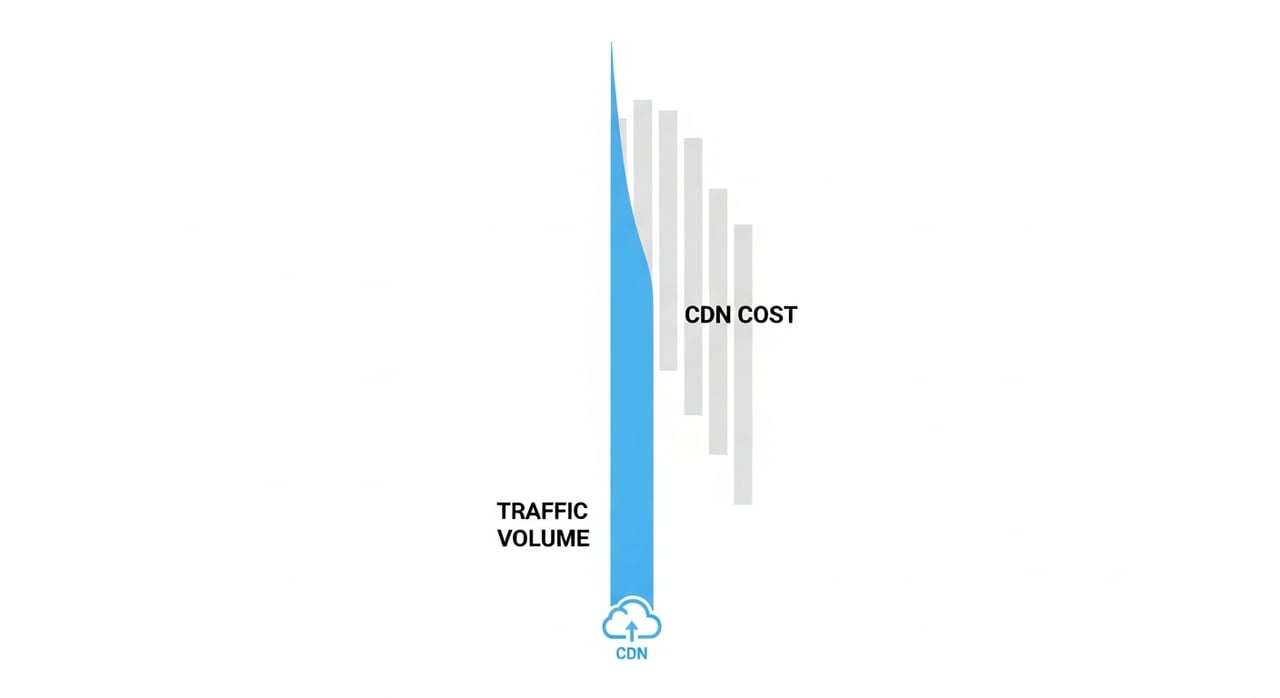
As of May 2026, CDN77 publishes two tiers on its pricing page. The structure has not changed meaningfully since late 2024, but the economics deserve a closer read than the marketing page offers.
The Growth Plan is $990/month and includes 250 TB of transfer. Every terabyte above 250 TB incurs an overage charge of $3.96/TB. There is no auto-scaling tier discount. If you push 400 TB in a month, your bill is $990 + (150 × $3.96) = $1,584. Your blended rate: $3.96/TB. Acceptable at 250 TB exactly, increasingly painful above it.
CDN77 enterprise pricing is custom-quoted. The company does not publish rates, commit thresholds, or discount curves. Anecdotal reports from infrastructure teams suggest that negotiated enterprise rates land between $2.50 and $3.50/TB depending on commit volume and contract length, but these are not guaranteed and typically require a 12-month minimum. If you are evaluating CDN77 enterprise pricing, expect a two-to-four-week sales cycle before you see a number.
CDN77's origin storage starts at $200/month for 10 TB. That is $20/TB/month for storage alone, before any transfer costs. For comparison, S3 Standard in us-east-1 runs approximately $23/TB/month as of Q2 2026, and most teams already have origin infrastructure provisioned. The storage add-on rarely changes the CDN selection calculus, but it adds friction during migration if you have adopted it.
CDN77 bandwidth pricing is straightforward below 250 TB and punishing above it. Here is what the cost curve looks like at specific traffic thresholds:
| Monthly Traffic | CDN77 Growth Plan Cost | Effective $/TB | CDN77 Overage Portion |
|---|---|---|---|
| 100 TB | $990 | $9.90 | $0 |
| 250 TB | $990 | $3.96 | $0 |
| 500 TB | $1,980 | $3.96 | $990 |
| 1 PB (1,000 TB) | $3,960 | $3.96 | $2,970 |
The key insight: CDN77 overage pricing does not tier down. Whether you exceed by 10 TB or 750 TB, every additional terabyte costs $3.96. There is no volume discount on the overage side of the Growth Plan. This makes the Growth Plan economically irrational for any workload that consistently exceeds 250 TB, because you are paying the same marginal rate without the benefit of a declining cost curve.
For workloads below 150 TB per month, the effective rate ($6.60+/TB) makes CDN77 one of the more expensive mid-tier options in 2026. The plan only reaches its best economics at exactly 250 TB.
This is where most CDN comparison articles stop at feature lists. The real question is which cost structure matches your traffic profile. Below is a decision matrix based on workload characteristics, not marketing tiers.
| Workload Profile | Monthly Volume | Traffic Pattern | CDN77 Fit | Better Alternative Structure |
|---|---|---|---|---|
| SaaS with steady-state delivery | 200–250 TB | Flat, predictable | Good | — |
| Video/streaming platform | 500 TB–2 PB | Spiky, event-driven | Poor | Volume-based with declining $/TB |
| Game distribution / patch delivery | 300 TB–1 PB | Burst on release day | Poor | Volume-based with no overage penalty |
| E-commerce with seasonal peaks | 100–400 TB | 2–3 month spikes | Mediocre | Pay-as-you-go with low per-GB floor |
| Software update distribution | 50–150 TB | Periodic large bursts | Overpriced (high eff. $/TB) | Lower base with granular billing |
The pattern is clear: CDN77 growth plan pricing works for a narrow band of steady-state workloads sitting near 250 TB. Any workload that is bursty, growing, or already above that threshold is overpaying on a flat overage curve.
CDN77 has not adjusted its published Growth Plan pricing since 2024. The $990/250 TB structure and $3.96/TB overage remain identical. What has changed is the competitive landscape around it. Transit and peering costs continued declining through 2025 and into Q1 2026, with Tier 1 transit in major metros dropping below $0.20/Mbps in several European and North American markets. CDN providers with their own backbone capacity have passed those savings through. CDN77, which relies on third-party infrastructure in many regions, has not.
The practical effect: the gap between CDN77 bandwidth pricing and volume-priced alternatives has widened since 2024. Two years ago, CDN77's rates were roughly competitive at scale. In 2026, they are not.
For teams running 500 TB or more per month, the calculus favors CDN providers with tiered volume pricing that drops the marginal rate as volume increases. As a concrete benchmark, BlazingCDN's volume pricing scales from $5/TB down to $2.50/TB at volume (as of October 2026), with no overage penalty structure—additional GBs simply bill at the tier rate. At 500 TB/month, BlazingCDN costs $1,815 versus CDN77's $1,980 (Growth Plan with overage). At 1 PB, the spread is $3,315 versus $3,960. The savings compound when traffic is unpredictable: a spike month that pushes you from 500 TB to 800 TB costs an additional $900 on BlazingCDN ($3 per TB) versus $1,188 on CDN77 ($3.96/TB flat overage). BlazingCDN offers Anycast routing with built-in failover, fast scaling under demand spikes, and flexible configuration.
The Growth Plan includes 250 TB for $990/month. Every terabyte above 250 TB costs $3.96 with no volume discount on overages. Your effective per-TB rate improves as you approach 250 TB but never improves beyond it on the Growth Plan. Enterprise pricing is custom-quoted and may include declining rates, but CDN77 does not publish those thresholds.
Exactly $990/month on the Growth Plan as of May 2026. This is the plan's sweet spot: your effective rate is $3.96/TB. At any volume below 250 TB, you are paying more per terabyte because the base cost is fixed.
Yes. Every terabyte above 250 TB on the Growth Plan incurs a $3.96/TB overage. There is no tiered discount, no burst allowance, and no automatic upgrade to a higher plan. The overage rate is the same whether you exceed by 1 TB or 500 TB.
CDN77 enterprise pricing is custom-quoted and typically factors in committed monthly volume, contract duration, and geographic distribution of traffic. The company does not publish enterprise rate cards. Expect negotiation to center on a minimum monthly commit in exchange for a lower per-TB rate than the Growth Plan's $3.96.
The Growth Plan is self-serve with fixed pricing: $990/month, 250 TB included, $3.96/TB overage. Enterprise plans are negotiated, typically offer lower per-TB rates in exchange for annual commits, and may include SLA guarantees, dedicated support, and custom configuration. The Enterprise plan makes sense only if your committed volume is high enough that the negotiated rate beats $3.96/TB after accounting for the commit floor.
Three things: whether the marginal rate declines with volume (CDN77 Growth does not), whether overages carry a penalty premium versus the base rate, and whether the provider's commit tiers align with your P95 monthly traffic rather than your average. A provider whose pricing tiers match your actual traffic distribution will almost always be cheaper than one whose single tier forces you into either overage or over-provisioning.
Pull your last six months of CDN transfer logs. Calculate your P50, P90, and P99 monthly volumes. Then run CDN77's Growth Plan pricing model against those numbers: $990 base, $3.96/TB for everything above 250 TB, no discount curve. Compare that total against at least two volume-priced alternatives at their published rates. If your P90 month exceeds 300 TB, you are likely leaving 30–50% of your CDN budget on the table. That is not an optimization exercise. It is a line-item you can recover this quarter.

Heavy traffic.
Light bill.
The CDN for video and large traffic
Learn
H.264, also called Advanced Video Coding (AVC) or MPEG-4 Part 10, is a block-based video compression standard published ...

Compare
At 100 TB a month, the published price gap between options for a CDN for static content is more than 16 times: ...
Learn
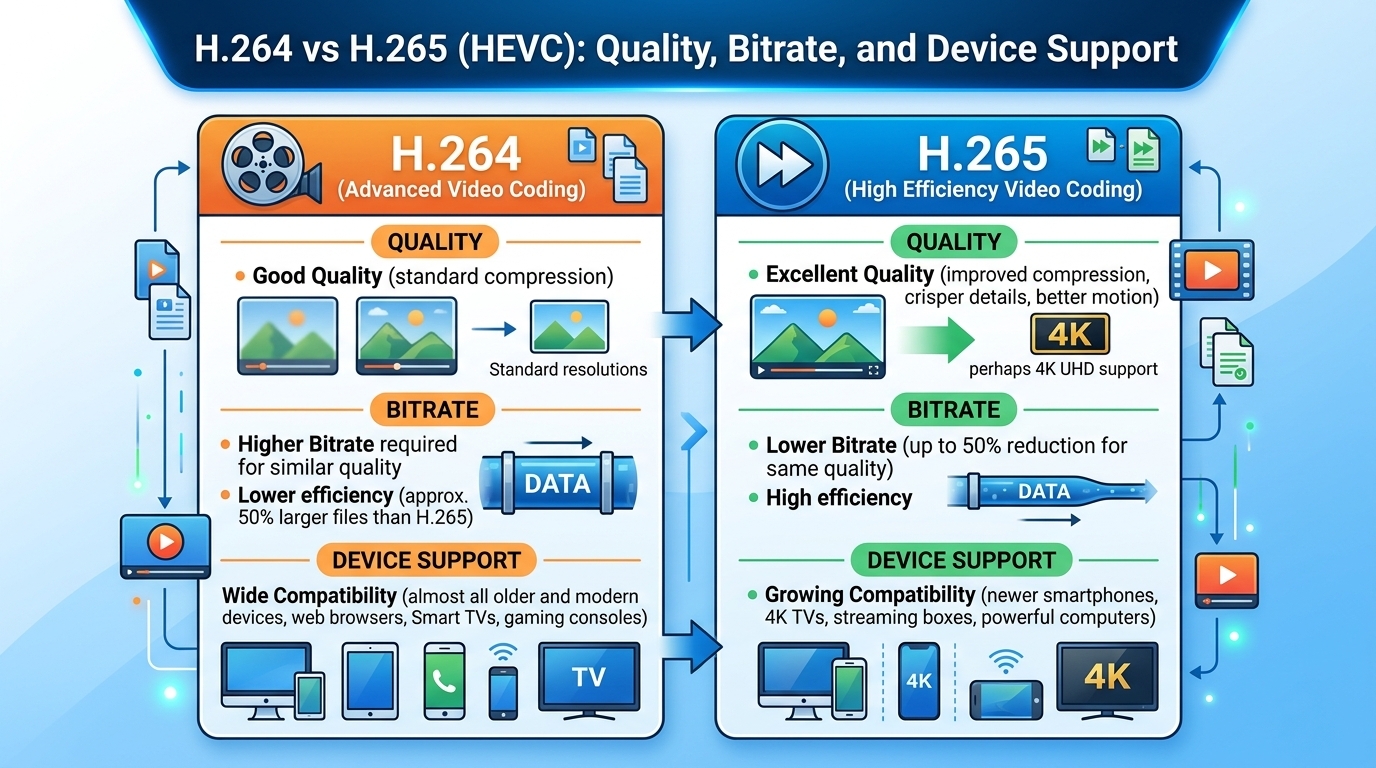
Evaluated October 2026: in the h264 vs h265 decision, HEVC (H.265) matches H.264 (AVC) quality at roughly 30 to 50 ...