

Learn
How a Multi-CDN Strategy Saved Us from Costly Downtime
In a recent survey, 60% of enterprises reported that a single hour of critical-application downtime costs them at least ...
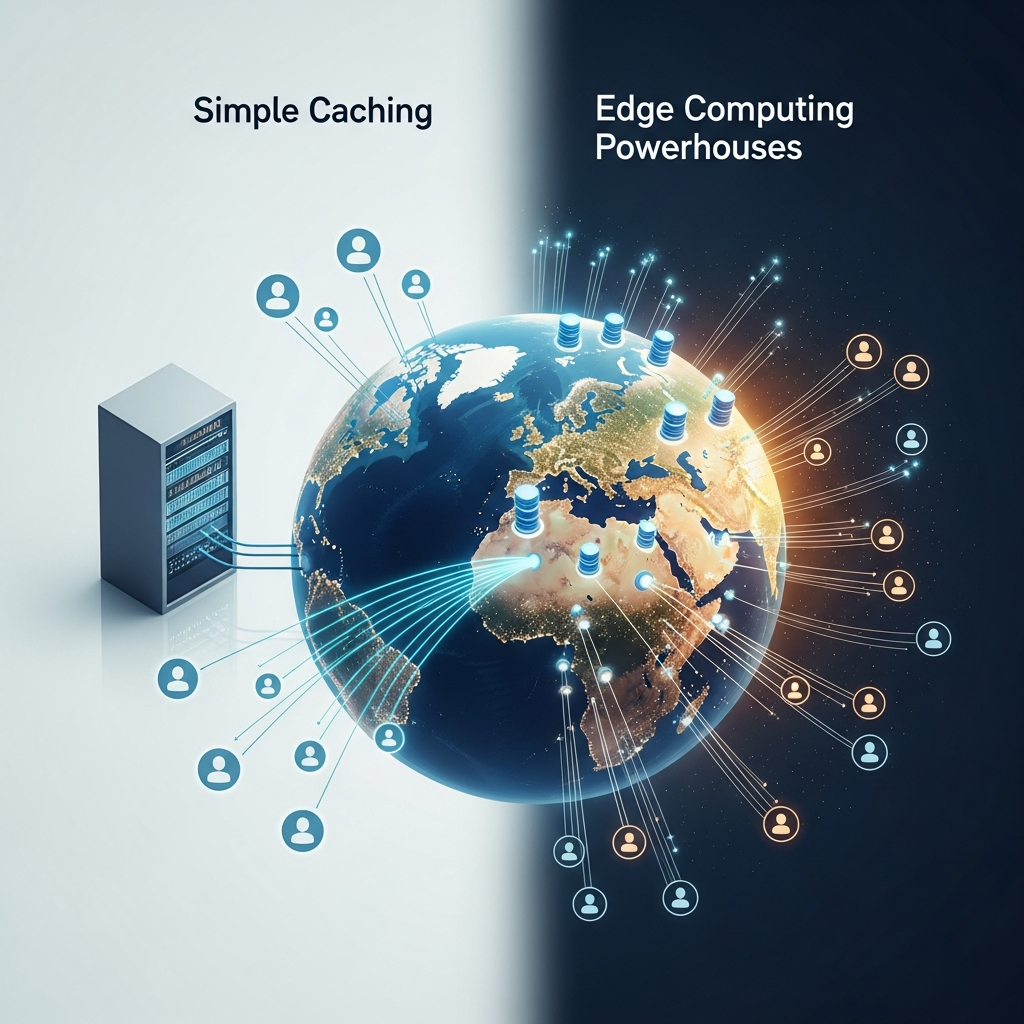
In 1993, the entire global internet carried roughly 100 GB of traffic per day. Today, a single popular streaming platform can push multiple terabits per second during a big release window. The original web protocols and single data centers that powered simple HTML pages were never designed for 4K video, global multiplayer games, or real-time SaaS dashboards—and that mismatch is why Content Delivery Networks (CDNs) emerged and have since transformed into full-blown edge computing powerhouses.
This article traces that evolution: from basic static caching to programmable edge logic, serverless at the edge, and data-aware edge architectures. Along the way, you’ll see how business drivers (latency, cost, reliability, compliance) shaped CDN technology—and what that means for your own infrastructure roadmap.
As you read, ask yourself: if your current CDN strategy is still stuck in the "static caching" era, how much performance, control, and cost efficiency are you leaving on the table?

To understand modern edge platforms, it helps to rewind to the late 1990s.
Websites were hosted in a single data center—often a single rack or even a single server room. When a user in Europe requested a page from a server sitting in the U.S., every byte had to cross the Atlantic. With dial-up connections and overloaded origin servers, page loads frequently took 10+ seconds. Banner images would load line by line; timeouts were common during traffic spikes.
As major portals, news sites, and early e-commerce platforms started experiencing "slashdot effects" and holiday bursts, they faced two hard realities:
This pain created the first generation of CDNs, initially focused on caching static files closer to users. It was a simple idea: replicate content around the world so each user talks to a nearby cache instead of a distant origin.
Think about your own stack: how much of your current traffic is still making a full trip back to origin when it could be served locally?
The earliest CDNs were essentially globally distributed caching layers. They tackled one core problem: serve frequently requested, unchanging content (images, CSS, JavaScript, downloads) from as close to the end user as possible.
At a high level, the model looked like this:
When a user requested /images/logo.png, the CDN would:
For websites heavy on static assets (news sites, portals, software downloads), this reduced origin load and improved latency dramatically. It also turned bandwidth into a utility: instead of every company building global network capacity, they could buy it as a service from a CDN provider.
First-generation CDNs excelled at:
But they struggled with:
For businesses, that raised a question: if only static assets could be accelerated, what about the rest of the experience that actually drives conversions and engagement?
The 2000s and early 2010s brought a new wave of demands:
By the mid-2010s, streaming video alone accounted for more than half of consumer internet traffic worldwide, according to Sandvine’s Global Internet Phenomena reports (source). This went far beyond caching static images. CDNs had to adapt or become irrelevant.
Streaming changed everything. Instead of downloading a full file before playback, video was segmented into small chunks (a few seconds each) using protocols like HLS and MPEG-DASH. CDNs became responsible for:
Large streaming platforms adopted multi-CDN strategies, using several providers and proprietary infrastructure to improve resilience and performance. CDNs evolved from "static file hosts" into critical layers of the video delivery pipeline, integrating tightly with origin storage, transcoding farms, and player logic.
At the same time, dynamic applications—e-commerce, banking, SaaS dashboards—needed help. CDNs responded with Dynamic Site Acceleration (DSA):
In effect, CDNs started to "think" about more than static objects—they began to treat applications holistically, optimizing both content and the paths it traveled on.
As your own traffic mix shifts toward APIs, streaming, and real-time user interfaces, are you still relying on legacy, static-only caching rules?
As the web matured, users and regulators demanded stronger security and privacy. HTTPS (TLS) went from "nice to have" to default. Google started using page speed and HTTPS as ranking signals, and browsers began warning users away from non-secure sites.
Encrypting traffic at scale introduced overhead—handshakes, key negotiation, and more CPU usage. CDNs stepped in with:
The rollout of HTTP/2 and later HTTP/3 (based on QUIC) shifted even more responsibility to CDNs. These protocols added features like multiplexing, header compression, and improved congestion control—but they required careful tuning and global deployment.
CDNs became the most practical place to deploy such protocols at scale, because:
The role of the CDN was now much broader: not just copies of files on remote servers, but a sophisticated, globally distributed networking stack that shaped how and where your traffic moved.
Given how deeply modern CDNs touch encryption and protocols, are you using that edge footprint to its full potential—or only as a glorified cache?
Once CDNs sat in the critical path for most traffic, customers started asking for more control. They didn’t just want faster delivery; they wanted to program the edge.
Traditional CDN configuration lived in control panels and static config files: URL patterns, TTLs, basic header rules. Over time, this evolved into:
This programmability unlocked use cases such as:
The real turning point came when CDNs began offering serverless functions at the edge—small, event-driven pieces of code that can inspect, modify, and respond to requests without touching origin. Instead of configuring behavior with static rules, you could now write actual code (JavaScript, Rust, etc.) to run on every request.
Typical use cases include:
Edge functions blurred the line between CDN and application platform. You no longer had just "delivery" at the edge—you had logic at the edge.
If your team is still shipping all traffic back to origin for basic logic like redirects, geo-targeting, or header transformation, how much latency and origin load could you reclaim by moving that to programmable edge functions?
With serverless functions, protocol optimization, and visibility into global traffic patterns, CDNs effectively became distributed compute platforms. Modern "edge CDNs" no longer just move bytes; they execute business logic, integrate with data systems, and participate in application workflows.
Today’s edge computing platforms typically provide:
This shift enables entirely new architectures: real-time personalization without central bottlenecks, low-latency APIs for global users, and hybrid models where some logic lives in cloud regions and some at the edge.
| Capability | Traditional CDN | Modern Edge Platform |
|---|---|---|
| Primary role | Static content caching and delivery | Distributed compute, data access, and delivery |
| Logic at edge | Basic rules (TTL, headers, URL rewrites) | Full serverless runtimes and programmable workflows |
| Data handling | Opaque content blobs | Stateful patterns via KV stores, caches, and integrations |
| Observability | Batch logs and coarse metrics | Real-time, fine-grained metrics and streaming logs |
| Use cases | Website acceleration, downloads | Low-latency APIs, real-time personalization, IoT, and more |
The "CDN" of today looks far more like a distributed application platform than the simple cache networks of the past.
Looking at your roadmap for the next 12–24 months, are you planning for a world where meaningful chunks of your application logic run at the edge?
Different industries have pushed CDNs in different directions, often becoming catalysts for new capabilities. Understanding these patterns helps you see where the technology is heading—and where you can borrow proven approaches.
Video platforms are among the heaviest CDN users. SVOD and AVOD services rely on CDNs for:
To minimize rebuffering and startup delay, they often maintain complex policies: per-region cache rules, codec- or device-specific optimization, and near-real-time log ingestion to react to QoE issues.
For modern media companies, a provider like BlazingCDN can be especially attractive: a high-performance, globally distributed CDN with 100% uptime and flexible configuration, but with pricing optimized for heavy egress workloads. When your business involves pushing petabytes of video monthly, the difference between a premium-priced CDN and a cost-efficient one with comparable stability can easily reach six to seven figures annually.
E-commerce sites live and die by speed. A widely cited analysis from Google has shown that as page load time goes from 1 to 3 seconds, the probability of a mobile user bouncing increases by 32% (source). CDNs help online retailers by:
Because retail is highly seasonal, scalable CDNs with fair, transparent pricing are crucial. Instead of overprovisioning origin infrastructure for Black Friday peaks, retailers can offload spikes to the edge, reducing the risk of slowdowns while controlling infrastructure spend.
SaaS providers often serve globally distributed user bases from a handful of core cloud regions. Without an edge layer, users far from those regions may experience higher latency and inconsistent performance during network congestion. Modern CDNs help by:
As SaaS moves to microservices and event-driven models, an edge platform becomes a strategic control plane for routing, rollout, and resilience.
Games and real-time apps are particularly sensitive to latency. While actual gameplay traffic often travels over specialized UDP-based protocols, CDNs play a major role in:
Here, edge computing is less about raw bandwidth and more about responsiveness and control—ensuring that the first launch and every subsequent update feels quick, reliable, and localized.
In your own sector, which of these patterns resonate most—and where could adopting a more modern, edge-capable CDN immediately improve user experience or reduce costs?
The transition from simple caching to edge compute didn’t happen in a vacuum. Several architectural trends converged to make it possible.
As virtualization and later containerization took over the data center, CDNs adopted similar techniques to:
Cloud-native patterns—immutable infrastructure, container orchestration, declarative configuration—gave CDN operators the tools to manage highly distributed networks.
SDN allowed CDNs to treat the network as software: dynamically routing traffic, shaping flows, and optimizing paths. Combined with advanced telemetry, this enabled:
The result: more reliable and predictable performance for end users, even under volatile internet conditions.
Modern CDNs ingest enormous streams of data: request logs, latency metrics, error codes, cache hits, and more. Using this telemetry, they can:
These observability capabilities are also what make edge computing viable: if you’re going to run user-facing logic across thousands of edge nodes, you need deep, actionable visibility into what’s happening.
Does your current CDN strategy treat observability as a core feature, or is it still operating as an opaque black box?
As CDNs evolved into edge platforms, the metrics that matter most to enterprises also changed.
Traditional performance focus started with:
Today, performance also includes:
In the early days, CDN billing was mostly about bandwidth and requests. Now, enterprises look more holistically at:
This is where newer entrants like BlazingCDN stand out. By focusing on efficient delivery and lean operations, BlazingCDN offers enterprise-grade performance and reliability with a starting cost of just $4 per TB ($0.004 per Gb), delivering stability and fault tolerance on par with Amazon CloudFront while remaining significantly more cost-effective for large-scale workloads.
Control has expanded from simple caching directives to:
The more your CDN behaves like an extension of your application platform, the more critical this control plane becomes.
When you evaluate CDN vendors now, are you comparing them only on raw price per GB—or on the complete picture of performance, operational savings, and the application control they provide at the edge?
Enterprises that have lived through multiple CDN generations increasingly look for a provider that blends modern edge capabilities with predictable economics. BlazingCDN is built for exactly that balance.
Designed as a high-performance, globally available CDN with a 100% uptime track record, BlazingCDN focuses on efficient delivery and robust fault tolerance comparable to mature hyperscale offerings like Amazon CloudFront—yet at a fraction of the cost. Large enterprises and corporate clients use it to offload massive volumes of traffic without the premium pricing typical of legacy vendors, often freeing budget to invest in product features instead of infrastructure overhead.
BlazingCDN fits particularly well in bandwidth-heavy verticals such as streaming media, software distribution, gaming, and SaaS platforms where egress dominates the cost structure. Its flexible configuration model and edge-focused features allow teams to tune caching, routing, and acceleration to their specific workflows, while keeping invoices simple and transparent. To benchmark total delivery costs against legacy vendors, you can explore BlazingCDN’s transparent pricing model at BlazingCDN pricing.
Because it’s already trusted by global enterprise brands that demand both reliability and efficiency, BlazingCDN is increasingly seen as a forward-thinking choice for organizations that want modern edge performance without overpaying for commodity bandwidth.
Knowing the history of CDNs is useful—but what should you do with it? Here’s a pragmatic roadmap for evolving from basic caching to a true edge strategy.
Start by understanding what you’re actually delivering:
Real-user monitoring and CDN logs are invaluable here. Look especially at tail latencies and how performance varies by geography and time of day.
Before jumping to complex edge compute use cases, ensure you’ve fully exploited classic CDN capabilities:
filename.[hash].js) to enable long-lived caching.Many enterprises find that a disciplined pass over caching and compression alone can reduce origin load and bandwidth by 30–50%.
Once the fundamentals are in place, start moving simple logic to the edge:
Use edge functions or programmable configuration to run these decisions as close to users as possible, reducing round trips and simplifying origin services.
Next, shift appropriate layers of access control and request validation to the edge:
This reduces the blast radius of malicious traffic and protects precious origin compute capacity.
As your comfort level grows, explore patterns that combine edge compute with data-aware workflows:
The goal is not to reimplement your entire database at the edge, but to identify specific, high-impact flows where moving read access closer to users will materially improve responsiveness.
Finally, reevaluate whether your current CDN provider’s features and pricing match your evolving architecture:
For many enterprises, migrating to a modern, cost-optimized provider like BlazingCDN can simultaneously upgrade edge capabilities and reduce total delivery costs—especially in bandwidth-intensive industries where every terabyte matters.
The story of CDNs is a story of relentless adaptation: from caching static images for early web pages, to streaming the world’s video, to running application logic and data access at the edge. The question now is not whether CDNs will keep evolving—they will—but whether your own architecture and vendor choices are evolving with them.
If your current setup still treats the CDN as a simple cache in front of a monolithic origin, you’re likely overpaying in both latency and infrastructure costs. A modern edge-aware strategy—backed by a provider like BlazingCDN that offers 100% uptime, enterprise-grade stability comparable to Amazon CloudFront, and a starting cost of $4 per TB ($0.004 per Gb)—can turn this layer from a commodity expense into a competitive advantage.
Take a hard look at your performance metrics, your origin bills, and the complexity of your current delivery stack. Then map out one concrete next step: pilot edge logic on a high-traffic route, optimize caching for a key media workflow, or run a cost comparison between providers. When you’re ready, share your findings with your team—or with the broader community. What surprised you the most about the evolution from simple caching to edge computing powerhouses, and where do you see the biggest opportunity for your organization to gain an edge?
Learn
In a recent survey, 60% of enterprises reported that a single hour of critical-application downtime costs them at least ...

Learn
When Deloitte analyzed billions of user sessions for major retailers, they found that shaving just 0.1 seconds off ...
Learn
Every extra second your site takes to load can drop mobile conversions by up to 20%—that’s the stark finding from a ...