
Learn
What Is a Codec? Video and Audio Codecs Explained
A codec (short for coder-decoder) is an algorithm, plus the software or hardware that implements it, that compresses ...
A single 15-second vertical clip on a top-five social platform now averages 2.3 MB after per-device transcoding, and the median platform serves north of 800 million clip plays per day. Multiply those numbers and you land squarely in the multi-petabyte-per-month range where your choice of video CDN providers determines whether your P99 start time stays under 300 ms or quietly bleeds into a 1.2-second tail that tanks swipe-through rate. In Q1 2026, measured rebuffer ratios on short-form platforms still vary by 4× depending on which delivery stack sits behind the player. This article gives you the comparison, the architectural context, and a workload-profile decision matrix you can bring into your next vendor review.
Three shifts define the 2026 landscape versus even twelve months ago:
Below is a concise, technically grounded look at each provider. Pricing is listed where publicly available or reliably estimable as of Q2 2026.
Still the largest private CDN by PoP count. AMD's per-title encoding integration and EdgeWorkers let you run lightweight viewer-side logic at the edge. The trade-off is price: committed rates for video-heavy workloads typically land between $0.008 and $0.015/GB depending on geography and contract length. Best fit for platforms already in the Akamai ecosystem with complex geo-rights requirements.
Stream bundles encoding, storage, and delivery at $1/1,000 minutes of stored video and $5/1,000 minutes of delivered video (2026 pricing). Raw CDN egress on the Enterprise plan is negotiable but generally competitive below 500 TB/month. Cloudflare's strength is integration speed and Workers-based customization; the gap remains in advanced ABR ladder tuning and origin shield flexibility for multi-origin UGC architectures.
The gravitational pull of AWS keeps CloudFront dominant for platforms whose origin lives in S3 or MediaLive. The 2026 on-demand rate starts at $0.085/GB for the first 10 TB (North America) but drops to roughly $0.020/GB at 5 PB+ via committed-use discounts. Tight integration with MediaConvert and IVS makes it a turnkey stack for live social streaming, though multi-cloud egress costs remain punitive.
Google's video-specific CDN layer (distinct from standard Cloud CDN) added CMAF-ingest support in late 2025 and now routes through the same infrastructure that serves YouTube. Pricing at committed tiers approaches $0.02/GB. A strong option when your ML inference pipeline already runs on Vertex AI and you want single-pane observability through Cloud Operations.
Fastly's VCL and Compute@Edge remain the most programmable edge in the market. For social platforms that need per-request content personalization, watermarking, or real-time A/B manifest manipulation, Fastly is hard to beat. Egress pricing starts around $0.08/GB on-demand and is negotiable into the $0.01–0.02 range at volume. The smaller PoP footprint versus Akamai can show up in tail latency in parts of Africa and LATAM.
A budget-conscious option at $0.04/GB (pay-as-you-go, 2026). Limited video-specific features — no built-in transcoding, no ABR optimization layer — but solid for platforms that handle encoding in their own pipeline and just need fast, cheap byte delivery. HTTP/3 support is now GA.
Edgio's 2024 restructuring consolidated the old Limelight network under a unified edge platform. Video delivery performance on the network remains strong in North America and Europe. The question mark as of mid-2026 is long-term product roadmap stability post-restructuring. Pricing is contract-only.
Focused on edge compute plus delivery. StackPath's EdgeCompute VMs can run lightweight transcoding, but the network is smaller than the hyperscalers. Best suited for platforms with a North America–centric audience. Pricing starts at $0.04/GB (on-demand).
A mid-market provider with strong European and Asian presence. Offers HLS and DASH delivery with built-in token authentication. Pricing is competitive at approximately $0.029/GB at the 100 TB tier (2026). Notably good latency metrics in Central and Eastern Europe.
Operates one of the largest private backbone networks. The video CDN offering targets OTT and social broadcasting with integrated DRM workflow support. Pricing is enterprise-contract only; expect rates comparable to Akamai's mid-tier. The advantage is backbone-level peering in the Indian subcontinent, where Tata's own fiber reaches places other CDNs rely on third-party transit.
Built specifically for high-throughput video delivery, BlazingCDN's media delivery stack provides Anycast routing with built-in failover at much lower list rates than CloudFront — a material difference for social platforms pushing hundreds of terabytes monthly. Volume pricing scales down progressively: starting at $5 per TB and down to $2.50 per TB at volume (as of October 2026), for example 100 TB = $415. For enterprise social platforms that need predictable spend without locking into hyperscaler ecosystems, BlazingCDN offers fast scaling under traffic spikes.
No single video CDN provider wins every workload. The matrix below maps five common social-media video workload profiles to the providers best positioned for each as of 2026.
| Workload Profile | Key Requirements | Best-Fit Providers |
|---|---|---|
| Short-form UGC (TikTok-style) | Sub-200 ms TTFB, massive fan-out, low cost/GB | BlazingCDN, CloudFront, Cloudflare |
| Social live streaming (sub-2s glass-to-glass) | WebRTC or LL-HLS ingest, edge transcoding | CloudFront + IVS, Akamai, Google Media CDN |
| Long-form VOD (Instagram Reels extended, Stories archives) | Multi-bitrate ABR, DRM, high cache-hit ratio | Akamai, Fastly, CDN77 |
| Emerging-market mobile-first | HTTP/3, aggressive bitrate floor, regional PoPs | Tata, BlazingCDN, Google Media CDN |
| Multi-CDN with real-time switching | Standardized logging, origin shield interop, fast DNS failover | Fastly + BlazingCDN, Cloudflare + CloudFront |
The multi-CDN row deserves emphasis. As of 2026, platforms above 500 TB/month that run a single video CDN provider are leaving both reliability and cost on the table. A two-provider strategy — pairing a programmable edge (Fastly, Cloudflare) with a cost-optimized high-throughput layer (BlazingCDN, CloudFront committed-use) — typically reduces blended cost by 20–35% while improving P99 availability from 99.95% to 99.99%+.
Skip the vendor slide decks. Instead, instrument these five metrics during your proof-of-concept:
UGC apps need high fan-out, fast purge/invalidation, and cost efficiency at scale because content popularity is unpredictable. BlazingCDN and CloudFront both perform well here: BlazingCDN for cost efficiency at high volume, CloudFront for tight S3 origin integration. Fastly wins if you need per-request logic at the edge.
Prioritize TTFB under 200 ms in your top traffic regions and verify cache-hit ratios against a realistic long-tail content distribution. Run a 2-week proof-of-concept with real user traffic, not synthetic tests, and compare rebuffer ratios at P95 concurrency. Cost per GB matters more here than for VOD because content is consumed in high volume but each clip is small.
Pair a programmable CDN (Fastly or Cloudflare) with a high-throughput, cost-optimized CDN (BlazingCDN or CloudFront committed-use). Use real-time DNS or client-side switching based on TTFB measurements, not static geographic splits. Standardize your logging format across providers so your observability pipeline can compare apples to apples.
At 100 TB/month with committed-use contracts, expect blended rates between $0.003 and $0.020/GB depending on provider and geography. BlazingCDN sits at the low end at $0.0035/GB for 100 TB. Hyperscalers are competitive at PB scale with committed spend agreements but carry higher on-demand rates if your traffic is spiky and hard to predict.
Indirectly, yes. Google's Core Web Vitals include Largest Contentful Paint, and a slow video CDN can push LCP past the 2.5-second "good" threshold on video-heavy pages. On social platforms, faster start times correlate with higher completion rates, which feed the recommendation algorithm. The CDN itself is invisible to the algorithm, but its performance is not.
If you are evaluating video CDN providers for a social media workload, here is the single highest-value action you can take in the next five days: deploy a 10,000-object test library that mirrors your real content-length distribution across two candidate CDNs. Measure TTFB and rebuffer ratio from at least five geographic regions using real devices on cellular networks, not just wired synthetic probes. Compare the results at 1× and 3× your current peak QPS. The delta between providers at 3× peak is where the actual decision lives — everything else is marketing. Share your findings with your team, and if you want a second data point, drop your numbers in the engineering community and see who else is running similar tests.

Heavy traffic.
Light bill.
The CDN for video and large traffic
Learn
A codec (short for coder-decoder) is an algorithm, plus the software or hardware that implements it, that compresses ...
Learn
The Apple CDN is a layered stack rather than one network. It combines Apple's own edge caches, many embedded inside ISP ...
Learn
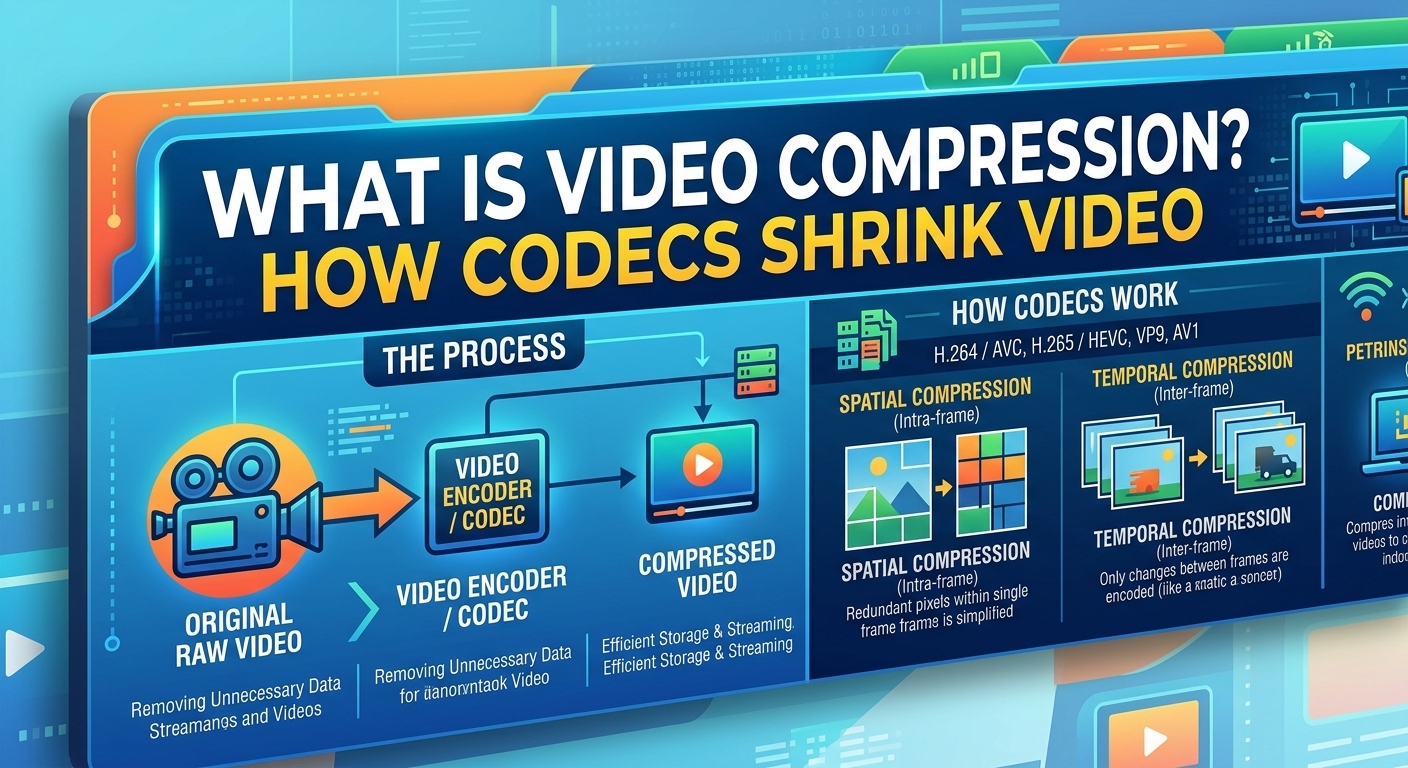
Video compression is the process of encoding moving images into far fewer bits by removing spatial redundancy inside ...