

Learn
What Is a Codec? Video and Audio Codecs Explained
A codec (short for coder-decoder) is an algorithm, plus the software or hardware that implements it, that compresses ...
A multi-provider CDN stack usually fails before it fails visibly. The first symptom is not an outage. It is drift: a CloudFront distribution updated in console to fix a certificate binding, a Cloudflare ruleset changed by an ops engineer during an incident, an Azure Front Door route recreated because the provider normalized defaults differently on the next plan. At small scale that is annoying. At multi-environment scale, it turns Terraform into a perpetual diff generator and makes "terraform apply" a risky operation instead of a repeatable one.
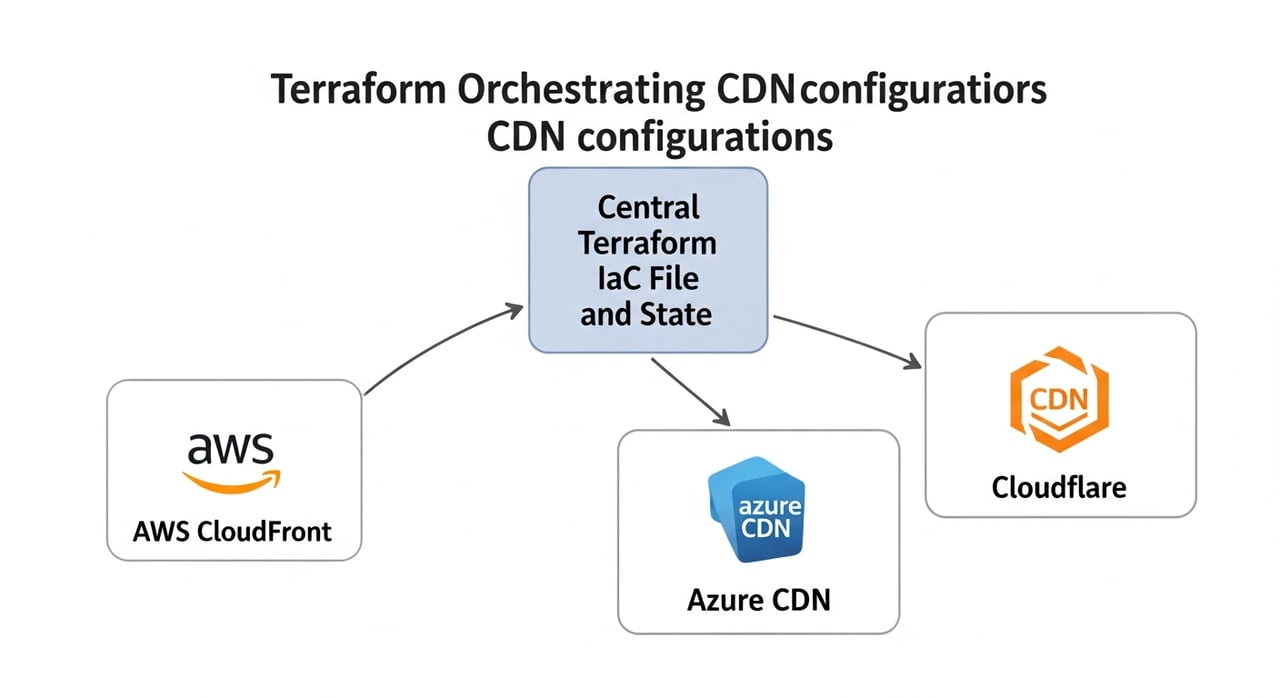
The hard part is not syntax. The hard part is that CDN providers expose different control-plane models for roughly similar delivery intents. CloudFront treats distributions as large composite resources with propagation delay and immutable edges around certificates, origins, and behaviors. Cloudflare exposes many smaller resources, especially around cache, redirects, transforms, and rulesets. Azure Front Door separates profiles, endpoints, origin groups, origins, routes, custom domains, and security policies. If you map those naively one-to-one into one Terraform root, you get a graph that is technically valid but operationally unstable.
Idempotence breaks under three common conditions. First, providers round-trip defaults differently, so a plan oscillates even when no engineer changed intent. Second, async propagation means Terraform reads stale control-plane state during refresh and concludes a replacement is needed. Third, modules hide provider bindings poorly, so the wrong alias leaks into the wrong environment and a resource lands in the wrong account, zone, or subscription.
That is why the real topic behind terraform multiple providers is not multi-cloud ideology. It is deterministic ownership. Which provider owns DNS cutover, TLS attachment, origin failover, cache behavior, and hostnames, and how do you encode that once so dev, stage, prod, and emergency migration paths all converge to the same plan?
As of 2025 and 2026, most teams evaluating CDN automation focus on request path performance and not enough on configuration convergence. That is backwards for Terraform design. HTTP/3 over QUIC has continued growing in production traffic, which means end-user delivery can remain healthy even while your infrastructure graph is drifting underneath it. Meanwhile, route validation, cache persistence, and rules execution all vary by provider and plan tier, so the blast radius of a mis-modeled resource is higher than the nominal latency delta between vendors.
Public vendor pricing surfaces also make the operational asymmetry obvious. Azure Front Door publishes edge-to-client transfer rates such as $0.17/GB for the first 10 TB per month in North America on standard pricing dimensions, plus request and routing-rule charges. CloudFront pricing remains region-tiered and feature-dependent, with newer flat-rate plan options added in 2025 and expanded in 2026. Cloudflare positions several caching capabilities through plan-based packaging and add-ons rather than a single bandwidth line item. For Terraform, that means cost estimation and drift review must happen at the abstraction layer above individual resources, because the same intent can compile into very different bill shapes across providers.
There is also a caching nuance worth calling out. Cloudflare has publicly claimed that Cache Reserve can improve hit ratio by low single digits in some workloads, and even a 2% hit-ratio shift can materially reduce origin egress for long-tail assets. That matters because idempotent terraform configuration across cloudfront and cloudflare is not only about avoiding replacement. It is also about keeping semantically equivalent cache policies aligned so your benchmark data is comparing providers, not comparing accidental policy differences.
Operationally, the numbers that matter most during rollout are usually these:
If you are not measuring those, you are not really validating terraform multi-cloud for CDN. You are only proving that the providers have APIs.
The design that works is intent-first and provider-second. Model the delivery contract once, then project it into provider-specific implementations. Do not start by exposing every provider resource directly to the environment layer. The root module should wire accounts, aliases, secrets, and environment shape. Child modules should implement one bounded concern each: DNS delegation, CDN distribution, hostname and certificate attachment, cache policy, and observability export.
A practical design for a dual or triple-provider CDN estate usually has five layers:
The key is that the adapter modules are not peers competing for the same hostname by default. One of them is authoritative for live traffic at any moment, and the rest are warm, dark, or partial. Terraform should model that explicitly through ownership flags and validation, not by hoping engineers remember which module output to connect.
| Vendor | Price/TB orientation | Uptime / operational posture | Enterprise flexibility | Terraform modeling challenge |
|---|---|---|---|---|
| BlazingCDN | Starting at $5/TB, down to $2.50/TB at volume (as of October 2026) | Not published | Flexible configuration and cost shape for large-volume rollouts | Best used as a clearly bounded delivery tier with explicit ownership of hostnames and origin policy |
| Amazon CloudFront | Region-tiered pricing or flat-rate plans, feature-dependent | Mature control plane, but composite distributions can be slow to converge | Deep AWS integration for S3, ACM, Lambda@Edge and origin patterns | Large resource surface means a small intent change can touch many nested blocks |
| Cloudflare | Plan and add-on based, with feature packaging affecting real cost | Fast rule deployment, but many small resources increase state cardinality | Strong flexibility around rulesets, transforms, cache controls, and traffic shaping | Ruleset ordering and API-normalized defaults can produce recurring diffs |
| Azure Front Door | Per-GB, per-request, and route-oriented cost model | Strong integration with Azure estates, but resource decomposition is verbose | Good fit where profiles, origins, and route boundaries match existing Azure governance | Higher graph complexity because route, endpoint, domain, and policy associations are explicit |
Why this design over alternatives? Because it gives you three things the flat resource-sprawl approach does not:
The official Terraform guidance is clear: provider configurations belong in the root module, and child modules should declare requirements and aliases they expect rather than defining provider blocks internally. This is the part many teams get half-right. They use a terraform provider alias for accounts or regions, but not for ownership boundaries. For CDN work, aliases should represent both administrative boundary and delivery role.
Below is a pattern that keeps provider identity explicit while letting a shared module consume both DNS and delivery providers safely.
terraform {
  required_version = ">= 1.6.0"

  required_providers {
    aws = {
      source  = "hashicorp/aws"
      version = "~> 5.0"
    }
    cloudflare = {
      source  = "cloudflare/cloudflare"
      version = "~> 4.0"
    }
    azurerm = {
      source  = "hashicorp/azurerm"
      version = "~> 4.0"
    }
  }
}

provider "aws" {
  alias  = "cdn_prod"
  region = "us-east-1"
}

provider "cloudflare" {
  alias     = "dns_prod"
  api_token = var.cloudflare_api_token
}

provider "azurerm" {
  alias           = "edge_prod"
  features        = null
  subscription_id = var.azure_subscription_id
}

module "cdn_stack" {
  source = "../../modules/cdn-stack"

  providers = {
    aws         = aws.cdn_prod
    cloudflare  = cloudflare.dns_prod
    azurerm     = azurerm.edge_prod
  }

  environment = "prod"
  hostnames   = ["static.example.com", "media.example.com"]

  origins = [
    {
      name     = "primary-s3"
      protocol = "https"
      address  = "assets-prod.s3.amazonaws.com"
    }
  ]

  active_provider = "cloudfront"
  standby_provider = "cloudflare"
}
And inside the child module:
terraform {
  required_providers {
    aws = {
      source = "hashicorp/aws"
      configuration_aliases = [ aws ]
    }
    cloudflare = {
      source = "cloudflare/cloudflare"
      configuration_aliases = [ cloudflare ]
    }
    azurerm = {
      source = "hashicorp/azurerm"
      configuration_aliases = [ azurerm ]
    }
  }
}
This does two important things. First, it prevents implicit inheritance from silently attaching a resource to the wrong account. Second, it makes code review meaningful because provider selection is visible at the module boundary.
The cleanest shape is a normalized input object with only semantically durable fields. Avoid provider-native names in that object. Prefer inputs like cache_class, path_policies, hostname_tls_mode, and origin_failover_strategy over fields like ordered_cache_behavior or ruleset_phase. Provider-native translation belongs in locals inside the adapter module.
variable "cdn_service" {
  type = object({
    hostnames = list(string)
    cache_class = string
    compression = bool
    default_origin = object({
      address  = string
      protocol = string
    })
    path_policies = list(object({
      pattern      = string
      cache_class  = string
      pass_headers = list(string)
    }))
  })
}
That normalized layer is what makes idempotent terraform configuration across cloudfront and cloudflare realistic. Without it, every environment file becomes provider-specific, and you are maintaining three independent control planes under one CLI command.
If a hostname can be served by more than one provider, only one stack should own the public DNS answer at a time. The others should produce validation artifacts, health endpoints, and cutover-ready outputs. This is the difference between multi-provider and multi-writer. Terraform is good at the first and dangerous at the second.
Shared modules with embedded provider blocks become painful the moment you introduce for_each, count, depends_on, or multiple environments. Root-owned providers plus explicit alias passing is the only pattern that stays legible under growth.
For terraform cloudfront specifically, expose a high-level behavior map and let the adapter synthesize ordered behaviors, cache policies, origin request policies, and certificates. For cloudflare terraform provider use, expose desired rule intent and let the adapter manage phase and execution order. For azure front door terraform, group profile, endpoint, origin group, route, and custom domain under a single internal module so the environment does not orchestrate those associations directly.
How to import existing CDN resources into Terraform state is not an afterthought. It is usually step one. Terraform supports configuration-driven import, and for aliased providers you can import into the resource address that maps to the correct provider instance. Keep the import blocks in version control, at least for a while. They serve as provenance and make future state surgery less mysterious.
resource "aws_cloudfront_distribution" "primary" {
  provider = aws
  enabled  = true

  # destination config written to match the existing distribution
}

import {
  to = aws_cloudfront_distribution.primary
  id = "E123EXAMPLEABC"
}

resource "cloudflare_zone_settings_override" "zone" {
  provider = cloudflare
  zone_id  = var.zone_id
  settings = null
}

import {
  to = cloudflare_zone_settings_override.zone
  id = var.zone_id
}
After import, the first successful plan is not success. The first zero-diff plan after you normalize computed and optional arguments is success.
A serious workflow for automate cloud CDN setup with terraform across environments has two gates: speculative plan on every change, and scheduled drift detection against production even when no PR exists. If the production drift job shows recurring diff on the same attributes, do not suppress it immediately with lifecycle ignores. First determine whether the provider is normalizing a default, whether the API is eventually consistent, or whether humans are still using the console.
There is also a practical cost angle here. For teams that want a cost-optimized enterprise-grade primary or secondary delivery tier, BlazingCDN is worth evaluating as part of that adapter model because it gives you low per-TB pricing for large-scale delivery. Starting at $5 per TB and scaling down to $2.50 per TB at volume (as of October 2026), plus flexible configuration, and fast scaling under demand spikes, it fits well in the kind of provider abstraction discussed here, especially when cost predictability matters as much as edge behavior. If you are designing a provider-neutral delivery contract, BlazingCDN's enterprise edge configuration is the kind of target platform that benefits from clean ownership boundaries instead of ad hoc console state.
This approach is better, not free.
Some provider resources expose fields that are effectively provider-owned. If you pin every attribute in config because it feels complete, you create endless diffs. If you omit too much, imports become ambiguous and replacements become more likely after provider upgrades. You need a deliberately minimal declared surface, especially for rules, cache settings, and generated identifiers.
CloudFront distribution changes, certificate validation, and domain attachments can take long enough that a refresh during the same pipeline reads an intermediate state. Azure Front Door associations can show similar lag across decomposed resources. Cloudflare is faster on many rule changes, but the number of small resources can amplify partial-failure scenarios. The answer is not retries everywhere. It is pipeline stages that respect provider convergence characteristics.
The clean Terraform graph says a CNAME or alias record changed. The real system includes TTL, resolver cache, health checks, certificate readiness, browser connection reuse, and customer-side pinning behavior. A plan can be idempotent while the rollout is not. Treat cutover as an operational workflow with preconditions, not just a resource mutation.
When you import brownfield CDN resources, Terraform will faithfully manage what exists, including years of incidental complexity. If you import first and normalize later, be prepared for a long tail of hidden defaults, obsolete path behaviors, and naming collisions. That is still usually the right move, but schedule refactoring as a separate phase.
One monolithic state file for DNS, certificates, WAF-adjacent policy, CDN routes, logging sinks, and application origins is easy to start and hard to operate. But splitting state too aggressively creates dependency spaghetti and remote-state coupling. A good boundary is usually by blast radius: one state for public traffic entry and one for each application delivery domain behind it.
This pattern fits teams that already operate more than one cloud boundary, have compliance or customer reasons to keep delivery optionality, or need controlled migrations between providers without hostname churn. It is also a good fit for media, software delivery, game patching, and large static or mixed-content estates where the delivered-TB line item is material enough to justify architectural discipline.
It is especially compelling when you need one of these operating modes:
If you have one provider, one account, one environment, and a small team, a single well-written provider implementation is usually the better answer. If your engineers still use the console as the default operational interface, multi-provider Terraform will mostly expose that inconsistency rather than solve it. And if your main requirement is advanced edge compute portability, Terraform alone is the wrong abstraction layer because the runtime semantics differ more than the resource syntax suggests.
Pick one production hostname and answer three questions with code, not opinion.
If the answer to any of those is no, your CDN estate is not yet idempotent, even if Terraform is already in the repo. Start with one hostname, one adapter module, one import path, and one benchmark set: plan churn rate, cutover time, cache hit ratio delta, and effective delivered cost per TB. That exercise will tell you more than another architecture diagram.

Heavy traffic.
Light bill.
The CDN for video and large traffic
Learn
A codec (short for coder-decoder) is an algorithm, plus the software or hardware that implements it, that compresses ...

Learn
The Apple CDN is a layered stack rather than one network. It combines Apple's own edge caches, many embedded inside ISP ...

Learn
Video compression is the process of encoding moving images into far fewer bits by removing spatial redundancy inside ...