
Learn
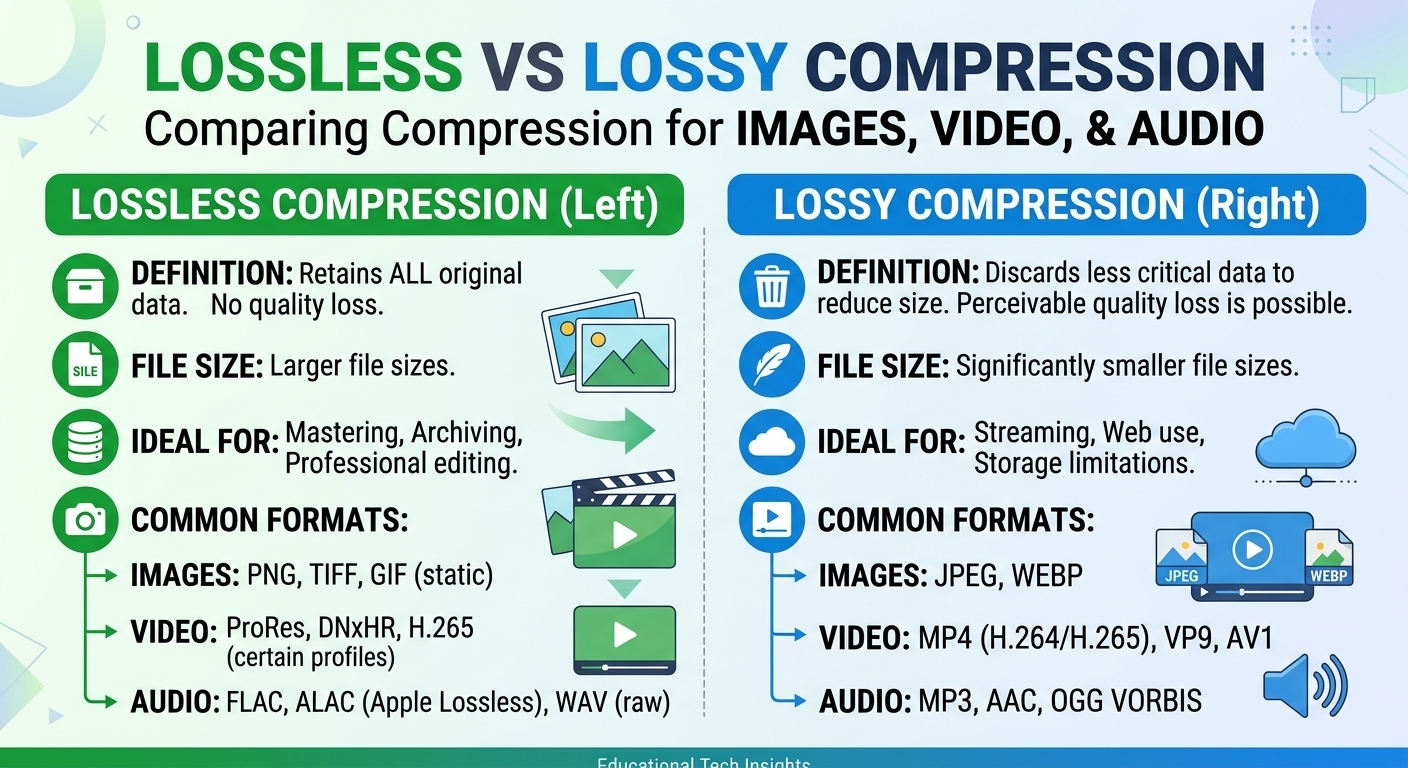
Lossy vs Lossless Compression: Images, Video and Audio
Lossy vs lossless compression comes down to one trade: lossless compression rebuilds every original bit and typically ...
A live stream can be only 3 to 6 seconds behind real time and still feel broken if segment publish jitter, cache miss amplification, and ABR oscillation line up in the same minute. That is the operational problem a video streaming CDN has to solve. At scale, buffering is rarely caused by one slow edge. It is usually the compound effect of manifest churn, long-tail object misses, retransmission delay under light packet loss, and origin fan-out during bitrate ladder shifts.
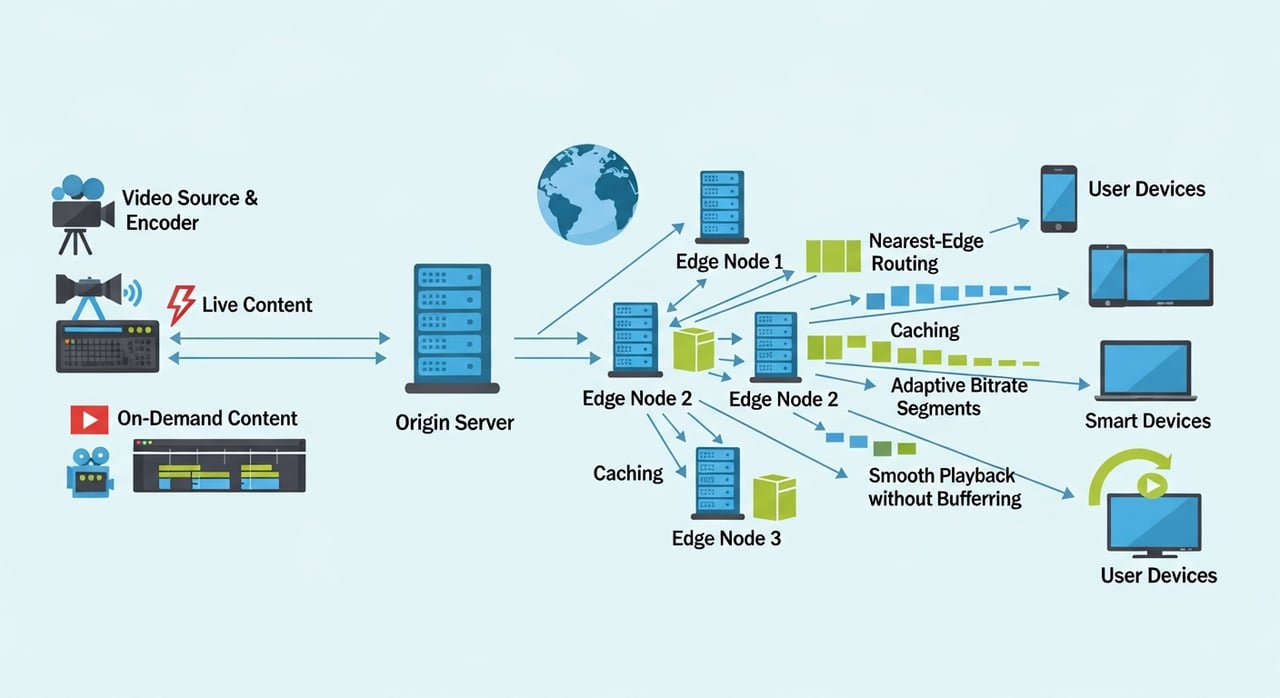
The naive fix is to increase player buffer depth, lengthen segments, and overprovision origin. That works until the first real spike. Longer segments raise latency and make bitrate adaptation coarser. Bigger buffers hide transient issues but worsen channel-change time and live drift. More origin capacity does nothing for a miss storm caused by five renditions, three audio groups, and millions of clients reloading a manifest on the same cadence.
A video streaming CDN fails in predictable ways when the control plane and the data plane are tuned independently. The packager emits 2 second segments because the player team wants lower live delay. The CDN team uses conservative cache keys and generic TTLs. The network team enables HTTP/3 but does not revisit loss behavior, congestion windows, or first-byte timing for partial objects. Each decision is locally reasonable. In combination, they create a delivery path that looks healthy in averages and fails in p95 and p99.
For live, every segment interval creates a micro-flash crowd. A six-rendition ladder with stereo plus alternate audio can turn one viewer population into a large request surface area. Manifest TTL that is too long causes stale playlists and missed parts. TTL that is too short drives avoidable revalidation. If the first viewers in a region miss cache for the newest segment, the shield and packager absorb the penalty for every rendition at once.
For VOD, the pathology is different. Head objects and first segments are hot; the middle of the title is warm; the tail is cold and fragmented across byte ranges. If the CDN treats every range request as effectively unique, cache efficiency collapses exactly where long-session watch time should have been easy margin.
QUIC improves head-of-line behavior at the transport layer, but it does not repeal loss recovery. RFC 9002 still uses probe timeout logic for loss detection, and under poor path conditions recovery delay is enough to blow through tight live playback buffers. Recent APNIC measurements of QUIC backscatter also showed meaningful differences in how large operators react to packet loss, with first retransmission often occurring around 100 ms for one deployment class and much later for others. That matters when your low latency streaming CDN is trying to deliver CMAF parts every few hundred milliseconds. ([datatracker.ietf.org](https://datatracker.ietf.org/doc/html/rfc9002?utm_source=openai))
Where BlazingCDN fits: BlazingCDN serves HLS segments and media files from NVMe SSD servers at one rate for the US, Europe and Asia, from $5 per TB down to $2.50 per TB; 100 TB costs $415 a month (as of October 2026). Setup details are on the HLS streaming CDN page.
There is no single canonical benchmark for video CDN performance because operators optimize for different points on the cost, latency, and compatibility frontier. Still, a few public sources are useful for grounding the discussion.
Conviva’s published streaming reports and metric documentation remain useful because they frame the KPIs operators actually alert on: startup time, video start failures, and rebuffering ratio. Their historical state-of-streaming data showed global startup time around 4.24 seconds in Q1 2021, while Q2 2022 reporting showed global average bitrate around 5.45 Mbps and highlighted startup-time regression even as buffering improved in some regions. The exact numbers are old enough that you should not treat them as current internet-wide baselines, but the KPI hierarchy still holds: startup time and rebuffer ratio are the first two metrics that move churn and abandonment. ([pages.conviva.com](https://pages.conviva.com/rs/138-XJA-134/images/RPT_Conviva_State_of_Streaming_Q1_2021.pdf?utm_source=openai))
A practical operating target in 2026 for premium OTT and event streaming is still roughly this: startup under 2 seconds for cached VOD first play, under 3 seconds for live channel join, rebuffer ratio below 0.5 percent for managed-device cohorts, and below 1 percent for the open internet. Those thresholds are an engineering heuristic derived from vendor KPI frameworks and field practice, not a formal standard.
RFC 9317 is explicit that low-latency live media over HTTP is feasible with HLS and DASH extensions built around CMAF. In other words, low latency hls and dash streaming cdn design is no longer about protocol legitimacy. It is about operational discipline around chunk production, manifest freshness, cacheability, and player control loops. Apple’s Low-Latency HLS guidance adds blocking playlist reload and partial segments for exactly this reason: reduce segment discovery delay without turning the CDN into a stale-manifest factory. ([datatracker.ietf.org](https://datatracker.ietf.org/doc/html/rfc9317?utm_source=openai))
CloudFront’s documentation for video on demand and live streaming emphasizes segmented delivery through HLS and DASH with CDN distribution in front of media services. Akamai documents short manifest TTLs and delivery modes tuned for live behavior. Fastly pushes on-the-fly packaging and cache prefetch to reduce first-byte penalties for large expected audiences. These are different product surfaces, but they point to the same core truth: the best cdn for video streaming without buffering is the one that handles manifests, small objects, and cache warmup as first-class problems rather than treating video as generic static delivery. ([docs.aws.amazon.com](https://docs.aws.amazon.com/AmazonCloudFront/latest/DeveloperGuide/on-demand-streaming-video.html?utm_source=openai))
AWS’s published Video on Demand solution documentation has used CloudFront pricing examples around $0.085 per GB in the associated cost material. Even if your negotiated rates differ, that order of magnitude matters when you choose between aggressive prewarm, dual-CDN overflow, and origin egress-heavy packaging strategies. Delivery architecture that saves 10 to 20 percent in rebuffering but doubles egress can be the right answer for a tentpole event and the wrong one for a large VOD library. ([docs.aws.amazon.com](https://docs.aws.amazon.com/solutions/latest/video-on-demand-on-aws/cost.html?utm_source=openai))
The winning pattern is not exotic. Separate the hot-path objects by behavior, minimize origin fan-out, and make the player’s fetch cadence predictable enough that the CDN can help rather than just absorb damage.
For live streaming cdn delivery:
For vod cdn delivery:
Most buffering incidents come from treating all streaming objects the same. They are not.
| Object type | Primary goal | Cache policy | Common failure mode |
|---|---|---|---|
| Master manifest | Fast startup and stable ladder discovery | Short TTL, stale-while-revalidate only if player tolerates it | Wrong variants exposed after ladder update |
| Media playlist | Fresh segment discovery | Very short TTL or blocking reload aware behavior | Stale playlist causes live edge drift and missed parts |
| Init segment | Immediate decode start | Long TTL, immutable | Cache miss on join spikes startup time |
| Partial segment or chunk | Low live latency | Cache only when request collapsing is effective | Edge connection explosion and tiny-object inefficiency |
| Full media segment | Efficient bulk delivery | Cache aggressively, long TTL when immutable | Origin fan-out after rendition switch storm |
Operationally, single-encode fragmented MP4 for both HLS and DASH reduces storage duplication, packaging complexity, and cache fragmentation. It also makes it easier to line up ABR switching points across protocols. The important nuance is that CMAF is not automatically low latency. You still need short parts, aligned GOPs, chunked transfer, manifest behavior that does not sabotage freshness, and a player tuned to avoid sitting too far behind the live edge. RFC 9317 says as much in less operational language. ([datatracker.ietf.org](https://datatracker.ietf.org/doc/html/rfc9317?utm_source=openai))
| Vendor | Price per TB / scale economics | Uptime SLA / reliability posture | Enterprise flexibility | Best fit |
|---|---|---|---|---|
| BlazingCDN | Starting at $5 per TB, down to $2.50 per TB at volume (as of October 2026) | Not published; Anycast routing with built-in failover | Flexible configuration for media workflows and fast scaling under demand spikes | Cost-optimized enterprise video delivery, especially for large libraries and event traffic |
| Amazon CloudFront | Public examples often materially higher per GB depending on region and commit | Strong integration with AWS media stack | Deep ecosystem fit, broad control surface | Teams already standardized on AWS media services |
| Fastly | Typically optimized via custom contracts rather than entry-level economics | Strong edge programmability story | Good for teams that want cache and packaging logic close to delivery | Advanced VOD workflows and programmable delivery paths |
| Akamai | Usually contract-heavy, tuned for very large deployments | Mature media delivery feature set, documented 100% uptime SLA in product brief | Extensive media-specific knobs and operational modes | Large broadcast and premium live estates |
For teams evaluating a video cdn primarily on engineering economics, this is where BlazingCDN is worth a serious look. Its pricing matters when your platform carries both live peaks and a long-tail VOD catalog. The pricing curve is straightforward: starting at $5 per TB and down to $2.50 per TB at volume, for example 100 TB = $415, 500 TB = $1,815, and 1,000 TB = $3,315 per month (as of October 2026).
If you need flexible media delivery controls rather than a one-size-fits-all preset, review BlazingCDN's enterprise edge configuration. For enterprises and large corporate clients, that mix of fast scaling under demand spikes and predictable volume pricing is often more relevant than headline brand recognition alone.
The shortest path to less buffering is usually to reduce avoidable object churn and make every new segment discoverable without making it globally uncacheable.
This ffmpeg example is intentionally opinionated. It assumes aligned GOPs, short fragments, no scene-cut keyframe drift, and output suitable for HLS and DASH packaging downstream.
ffmpeg -re -i input.srt \
  -filter_complex "[0:v]split=4[v1][v2][v3][v4]" \
  -map "[v1]" -c:v:0 libx264 -b:v:0 6000k -maxrate:v:0 6420k -bufsize:v:0 12000k \
  -g 48 -keyint_min 48 -sc_threshold 0 -r 24 \
  -map "[v2]" -c:v:1 libx264 -b:v:1 3000k -maxrate:v:1 3210k -bufsize:v:1 6000k \
  -g 48 -keyint_min 48 -sc_threshold 0 -r 24 \
  -map "[v3]" -c:v:2 libx264 -b:v:2 1500k -maxrate:v:2 1605k -bufsize:v:2 3000k \
  -g 48 -keyint_min 48 -sc_threshold 0 -r 24 \
  -map "[v4]" -c:v:3 libx264 -b:v:3 800k -maxrate:v:3 856k -bufsize:v:3 1600k \
  -g 48 -keyint_min 48 -sc_threshold 0 -r 24 \
  -map 0:a -c:a aac -b:a 128k -ar 48000 \
  -f tee "[select='v:0,v:1,v:2,v:3,a:0']packager-input.mp4"
The non-obvious knobs are the GOP alignment and scene-cut suppression. If your encoder inserts opportunistic IDRs, your ABR switch points and chunk boundaries drift, which increases player correction behavior and weakens cross-rendition cache usefulness.
map $uri $video_cache_ttl {
  default                         10m;
  ~*\.m3u8$                       2s;
  ~*\.mpd$                        2s;
  ~*init\.(mp4|m4s)$              24h;
  ~*\.m4s$                        1h;
  ~*\.ts$                         1h;
}

proxy_cache_path /var/cache/nginx/video levels=1:2 keys_zone=video:500m
                 max_size=200g inactive=2h use_temp_path=off;

server {
  listen 443 ssl http2;
  server_name video.example.com;

  location / {
    proxy_cache video;
    proxy_cache_lock on;
    proxy_cache_lock_timeout 10s;
    proxy_cache_valid 200 206 $video_cache_ttl;
    proxy_ignore_headers Set-Cookie;
    add_header X-Cache-Status $upstream_cache_status always;
    proxy_pass http://shield_backend;
  }
}
The critical directive there is request collapsing via cache lock. Without it, a fresh segment miss during a live event becomes a thundering herd against shield or origin. Also note the explicit caching of 206 responses. For VOD workflows that use range requests, failure to cache partial content is self-inflicted pain.
If you have to choose only three interventions this quarter, do these first.
This is the most common high-impact fix in a live streaming cdn stack. Segment publish events are synchronized. Clients are numerous. Without collapsing, every synchronized miss becomes origin fan-out. With collapsing, the first miss pays the origin cost and the rest wait a few milliseconds. That is a good trade.
Signed URLs, token parameters, CMCD, device hints, and player query flags all have legitimate uses. They also destroy cache efficiency when included indiscriminately in the key. Normalize what can be normalized. Whitelist only the parameters that truly affect representation selection or authorization outcome.
Many teams try to serve catch-up TV, DVR windows, and true live edge with one cache policy. That is usually wrong. Live edge wants aggressive freshness behavior. Recent archive wants high hit ratio with selective revalidation. Older archive wants immutable treatment and cheap bulk delivery.
A serious cdn for video streaming design is a bundle of trade-offs, not a checklist.
When you shrink playback buffer and part duration, you reduce the time available for recovery from transient loss, shield miss, packager jitter, and GC pauses in player runtimes. The system becomes more honest. That is useful and painful.
On clean paths, HTTP/3 can improve tail behavior and reduce transport-level blocking. On some mobile and enterprise networks, UDP treatment is still inconsistent enough that HTTP/2 remains better behaved. You need dual-stack observability by ASN, geography, device OS, and app version. Turning on QUIC globally and calling it done is not engineering.
Low latency streaming cdn designs that rely heavily on partial segments trade media delay for request amplification. More requests mean more headers, more TLS record churn, more connection state, and more log volume. If your observability pipeline bills by event count, your finance team will notice before your viewers do.
Teams often optimize segment delivery and forget license latency. First-frame delay can be dominated by token minting, entitlement lookup, or key exchange. A video streaming CDN cannot compensate for a slow authorization path unless you explicitly design around it.
Dual-CDN or overflow-CDN strategies improve resilience, but only if your switching signal is better than random and your manifests or DNS decisions do not create cache cold starts at the moment of failover. Without warm capacity and stable routing logic, failover can look like self-induced DDoS against your backup path.
Run one experiment, not ten. Take a representative live channel and instrument three timestamps for every session: manifest fetch start, first segment first byte, and first frame rendered. Then break p50, p95, and p99 out by ASN, protocol version, and cache status of the first media object after join. If you do that well, you will know whether your buffering problem is transport, cache, packaging, or player control logic.
For VOD, pick one title with meaningful traffic and compare current behavior against a policy that caches 206 responses, normalizes query parameters, and prewarms manifest plus init plus first two segments before release. Measure origin offload, startup time, and rebuffers per play hour. If the numbers do not move, your bottleneck is somewhere else. If they do, you have the beginning of a real video streaming CDN optimization program rather than another dashboard.

Heavy traffic.
Light bill.
The CDN for video and large traffic
Learn
Lossy vs lossless compression comes down to one trade: lossless compression rebuilds every original bit and typically ...
Pricing - Pricing & Costs
The CloudFront vs S3 decision depends more on object size than on traffic volume. At a 500 KB average response, 100 TB ...
Learn
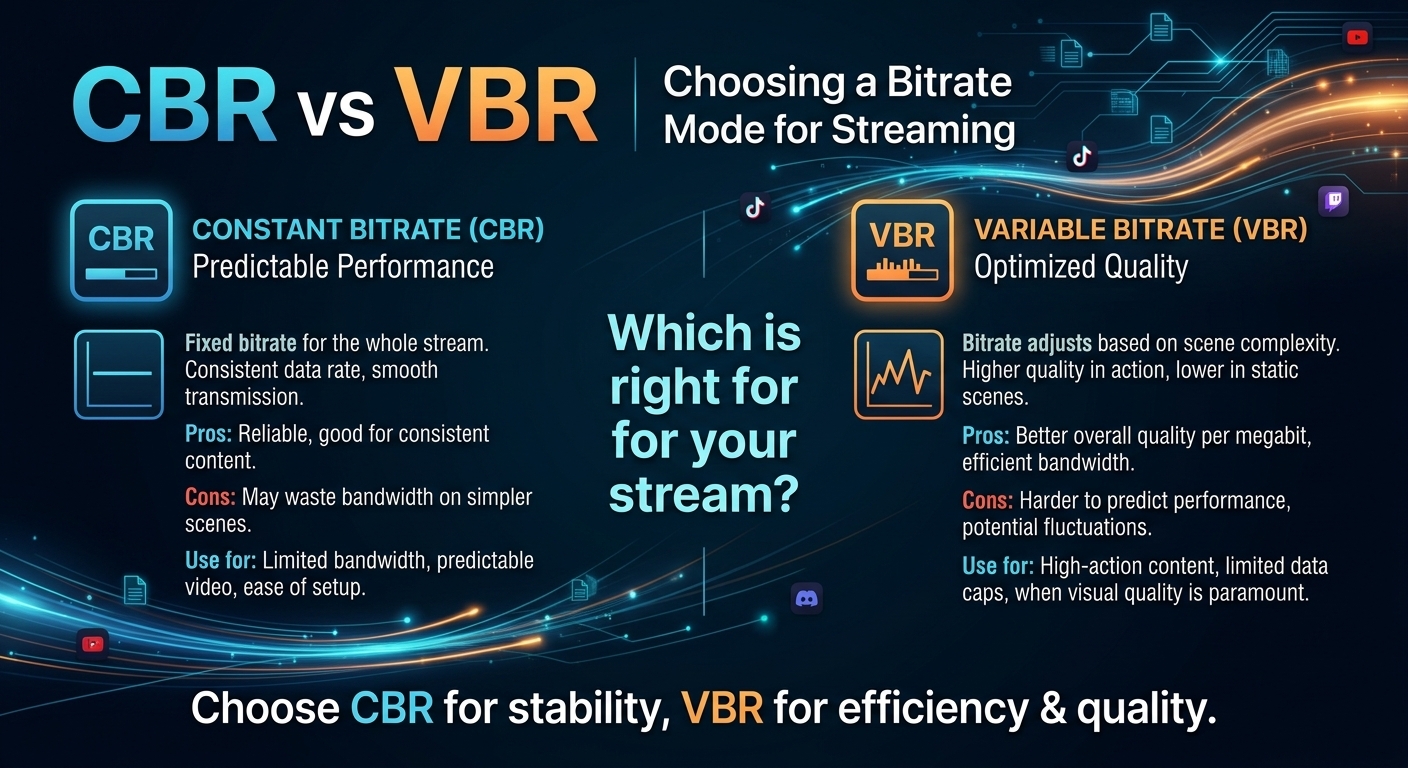
For most on-demand video, capped variable bitrate (VBR) wins the cbr vs vbr decision: it spends bits where the picture ...