
Compare
BunnyCDN Pricing in 2026: What You Actually Pay per TB
Imagine a bustling global marketplace where digital content flows as smoothly as traffic in a well-orchestrated city. ...
Forty-seven percent of ML models that pass validation never survive their first 90 days in production. The failure mode is almost always operational, not statistical: misconfigured replicas, silent drift, missing rollback paths, alert fatigue from unprioritized metrics. Seldon Core deployment has matured substantially since v1, and the 2026-era stack (Seldon Core 2, v2.9.x as of Q2 2026) addresses most of these gaps if you configure it correctly. This article gives you the production architecture, the observability wiring, the drift-detection pipeline, and a diagnostics-and-rollback playbook you will not find in the upstream docs or the current page-1 results for this topic.
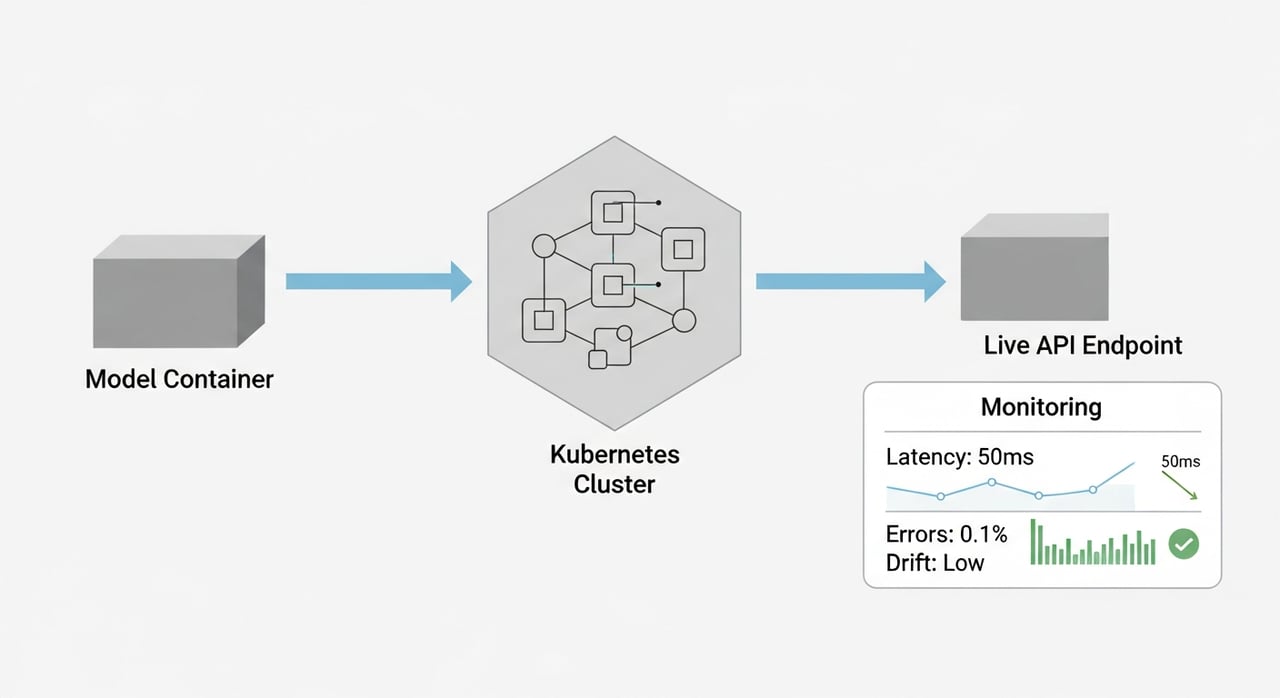
Seldon Core 2 (SCv2) is not an incremental patch over the v1 line. The control plane shifted from a monolithic Operator to a set of composable Kubernetes controllers that manage individual inference pipelines as first-class CRDs. As of v2.9, released in Q1 2026, the scheduler supports multi-model serving on a single replica with memory-aware bin-packing, which cuts GPU idle cost by 30–40% in clusters running more than 20 models concurrently.
Key changes practitioners need to internalize for 2026:
A minimal production topology in 2026 looks different from what most guides still describe. Here is the reference architecture we recommend for teams running 10–100 models:
| Component | Role | 2026 Recommendation |
|---|---|---|
| Seldon Core 2 Controllers | CRD management, scheduling | v2.9.x, deployed via Helm with separate namespace isolation |
| Kafka (data plane) | Inter-step communication in pipelines | Strimzi operator, 3-broker minimum, topic-per-pipeline |
| Triton / MLServer | Inference runtime | MLServer 1.6+ for sklearn/xgboost; Triton for TensorRT-optimized GPU models |
| Prometheus + Grafana | Metrics and dashboards | ServiceMonitor CRDs, 15s scrape interval for inference latency histograms |
| Alibi Detect | Drift detection, outlier detection | v0.13+, deployed as a pipeline step consuming from the model output topic |
The critical decision is whether Kafka is worth the operational overhead. If you are serving fewer than five models with no pipeline composition, a simpler setup using direct gRPC calls between steps is viable. Beyond that threshold, Kafka's replay capability and backpressure handling justify themselves quickly—especially when a downstream drift-detection consumer falls behind during a traffic spike.
Seldon Core 2 exposes metrics at three levels: the scheduler, the data plane (Kafka consumer lag, message throughput), and the inference server (latency histograms, prediction counts, error rates). Most teams instrument only the third level and miss the first two, which is where scheduling failures and pipeline stalls surface earliest.
Ignore vanity throughput counters. The metrics that predict incidents before they page you at 3 AM are:
Set these as starting points and tune from actual distributions after two weeks of production traffic. p99 inference latency above 500ms for synchronous serving paths. Error rate above 0.5% over a 5-minute window. Scheduler queue depth above 50 pending model load requests. These are aggressive; adjust upward only with evidence.
Drift detection is where most Seldon deployments are underbuilt. Alibi Detect, bundled within the Seldon ecosystem, supports Kolmogorov-Smirnov, Maximum Mean Discrepancy, and Classifier-based drift detectors. As of v0.13 (Q1 2026), the online drift detectors support windowed statistical tests that run incrementally, avoiding the need to buffer full reference datasets in memory.
The pattern that works at scale: deploy the drift detector as a Seldon Pipeline step that reads from the model output Kafka topic. Configure it with a reference window of 5,000–10,000 samples from your validation set. Use a significance threshold of 0.01 for the KS test, not the default 0.05, which generates too many false positives on high-cardinality feature spaces. When drift is detected, the detector writes an event to a dedicated Kafka topic that triggers both an alert and a metadata tag on the model version in your model registry.
Do not automate retraining on drift signals alone. Drift in input features does not always mean degraded predictions. Pair drift alerts with a business-metric monitor (conversion rate, fraud catch rate, recommendation click-through) and require both to trigger a retrain pipeline.
This section does not exist in any current page-1 result for Seldon Core deployment. It should, because rollback is where most production ML setups fail.
Symptoms: p99 latency doubles within 10 minutes of a new model version going live. Root cause is almost always a model artifact that is larger than the previous version, exceeding the memory allocated to the inference server container. Diagnosis: check the model memory footprint reported by MLServer logs against the container memory limit. Rollback: Seldon Pipelines are versioned. Repoint the Pipeline CRD to the previous model artifact URI and apply. The scheduler will drain in-flight requests on the current version and swap. Expect 15–30 seconds of increased latency during the transition, not a hard outage.
Symptoms: No latency change, no errors, but the business metric is declining. This is the hardest failure mode because nothing pages you. Prevention: instrument a shadow scoring pipeline that runs the previous model version in parallel and compares output distributions. If the Jensen-Shannon divergence between old and new model outputs exceeds 0.1 over a 1-hour window, flag for manual review. This is more expensive than running a single model, but for high-value prediction endpoints (fraud scoring, dynamic pricing), the cost is trivially justified.
Symptoms: pipeline steps stop receiving inputs, but inference servers report healthy. Check Strimzi operator logs for under-replicated partitions. If a broker is down, Kafka will reassign partitions, but Seldon pipeline consumers may need to be restarted to pick up the new partition assignment. As of v2.9, the consumers do not auto-reconnect on partition rebalance in all configurations. A targeted rollout restart of the pipeline pods resolves this within 60 seconds.
One operational detail that gets overlooked: model artifact delivery. When the Seldon scheduler loads a new model, it pulls the artifact from object storage (S3, GCS, MinIO). For large models (multi-GB transformer checkpoints), this pull can take minutes and is bottlenecked by network throughput to the storage backend. Teams running multi-region Kubernetes clusters often see model load times vary by 3–5x depending on region proximity to the storage bucket.
A CDN layer in front of your model artifact store eliminates this variance. BlazingCDN is worth evaluating here: it delivers fault tolerance comparable to CloudFront at significantly lower cost, starting at $4/TB for lower volumes and scaling down to $2/TB at 2 PB+ monthly commitment. For teams pulling hundreds of model artifacts daily across regions, the cost difference adds up fast, and the 100% uptime SLA means model loads do not stall on CDN-side errors.
Install Seldon Core 2 v2.9 via Helm into a dedicated namespace. Define your model as a Seldon Model CRD pointing to an artifact URI in object storage, then define a Pipeline CRD that wires the model to input/output topics on Kafka. Apply both CRDs, and the scheduler handles replica creation and traffic routing automatically.
Deploy the Prometheus Operator with ServiceMonitor CRDs that target the Seldon controller and inference server pods. Seldon Core 2 exposes metrics on a /metrics endpoint by default. Configure a 15-second scrape interval for inference latency histograms and a 60-second interval for scheduler-level metrics. Import the community Grafana dashboards from the Seldon GitHub repository as a starting point.
Deploy Alibi Detect v0.13+ as a pipeline step consuming model output via Kafka. Use the Kolmogorov-Smirnov online detector with a significance threshold of 0.01 and a reference window of 5,000–10,000 samples. Pair drift alerts with business-metric monitors to avoid retraining on false positives.
Yes. As of v2.9, the scheduler supports multi-model serving with memory-aware bin-packing. Models are loaded and evicted from GPU memory based on request frequency. Configure overcommit ratios carefully: a 2x overcommit works well for models with complementary traffic patterns, but above 3x you risk eviction thrashing under sustained load.
Update the Pipeline CRD to reference the previous model artifact URI and apply it. The scheduler drains in-flight requests from the current version and loads the previous artifact. Expect 15–30 seconds of elevated latency, not downtime. Keep at least two previous model artifact versions available in object storage at all times.
Kafka is required for pipeline-based deployments where multiple inference steps are composed together. For single-model serving without pipelines, Seldon Core 2 can serve models directly over gRPC or REST without Kafka. However, you lose pipeline composition, replay capability, and asynchronous drift-detection wiring.
If you are running Seldon Core in production right now, here is the concrete action: add the three metrics above (p99 infer duration per model, scheduler load duration, Kafka consumer lag) to your monitoring stack by Friday. Set the alerting thresholds described in this article as starting points. Run them for two weeks in observation mode. Then tighten. If you have already migrated to SCv2 and have a rollback playbook that handles a scenario we did not cover, drop it in the comments—this is the kind of operational knowledge that does not belong locked inside a single team's runbook.
Compare
Imagine a bustling global marketplace where digital content flows as smoothly as traffic in a well-orchestrated city. ...

Learn
AWS CloudFront Pricing in 2026: Cost per TB Breakdown At 50 TB/month of egress from US edge locations, your AWS ...
Learn
CDN Failover in 2026: The Five-Nines Architect's Playbook In January 2026, a major European streaming platform lost CDN ...