

Learn
What Is H.264 (AVC)? The Codec Behind Most Online Video
H.264, also called Advanced Video Coding (AVC) or MPEG-4 Part 10, is a block-based video compression standard published ...
A global CDN can put a request on the wrong continent in under 20 ms. That is fast enough to look healthy in a dashboard and still fail a residency review. The hard part in SaaS data residency is not static asset delivery. It is making sure identity, API writes, logs, cache keys, failover paths, and vendor-managed control planes do not quietly move tenant data out of region while your edge layer keeps returning 200s.
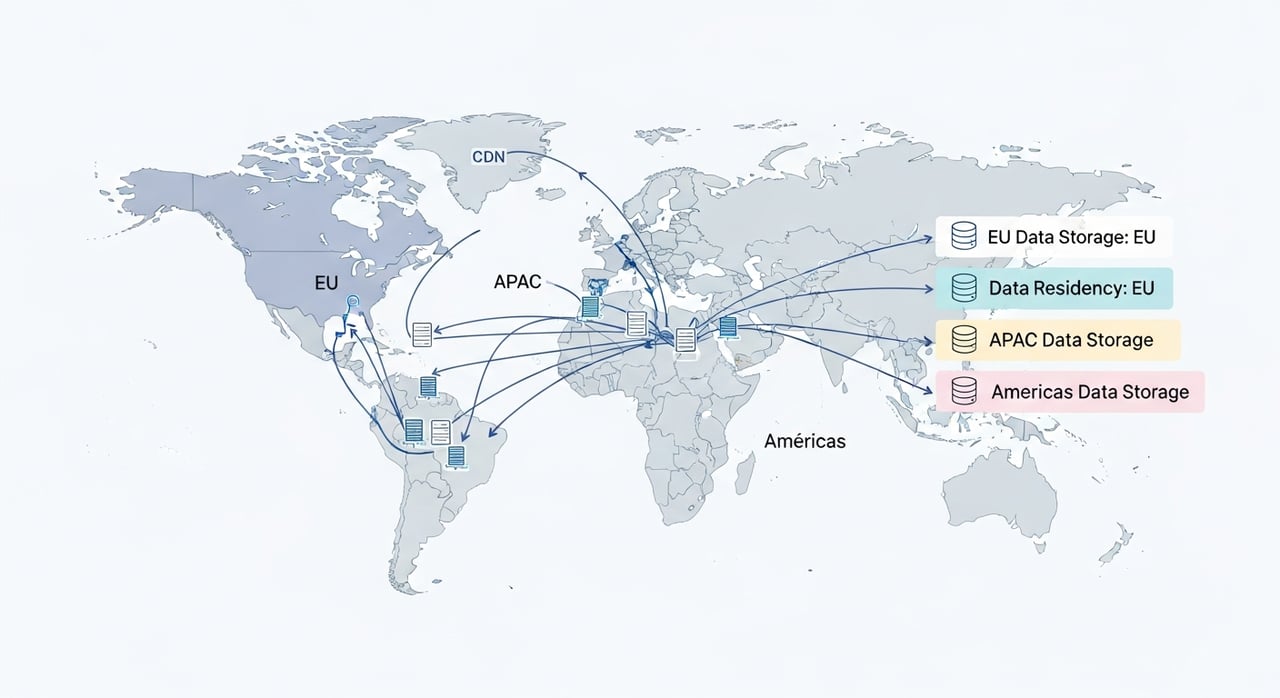
The common failure mode is architectural mismatch. Teams build a single global hostname, a single global auth tier, and a single CDN property, then try to bolt on regional origin routing later. Reads look fine. Cache hit ratio looks fine. But the first uncached API request, token refresh, signed upload, webhook callback, or image transformation job escapes the intended region.
Most cloud front doors and CDNs were designed to optimize reachability, latency, origin protection, and cache efficiency. Residency adds a different constraint: the request path itself becomes part of compliance scope. That means your routing decision, cache topology, metadata propagation, log sinks, and failover policy need explicit regional boundaries.
Naive fixes usually fail for one of three reasons. First, GeoIP alone is not a tenant residency control because user location and tenant home region are different variables. Second, active-active multi-region APIs without write fencing often replicate data before policy can stop it. Third, global identity and observability products can exfiltrate the metadata you forgot to classify.
Public internet quality measurements as of 2026 continue to show strong continental variance in estimated round-trip time under average utilization, with intra-continent paths materially lower than inter-continent ones. That pushes teams toward aggressive edge steering and regional origin selection for good reason. The problem is that optimizing for nearest healthy origin is not the same as optimizing for legal processing boundaries.
On current front-door architectures, shifting a user from Frankfurt to a US East origin may still keep median request latency within a range that does not trigger synthetic alarms, especially for cacheable content or TLS-resumed sessions. Residency failure is therefore often silent until audit, customer security review, or incident retro.
For SaaS data residency, engineers tend to focus on primary database placement and miss the higher-frequency cross-region paths:
HTTP semantics matter here. If routing policy depends on request metadata, cache behavior has to vary on the same dimensions or be explicitly bypassed for sensitive paths. Otherwise you get correct routing for misses and wrong reuse for hits.
In practice, the difference between a residency-safe edge design and a convenience-first one usually appears in p95 and p99 more than p50. The safe design adds a region lookup hop, a stricter cache key, and sometimes a regional auth redirect. Expect low-single-digit millisecond overhead at the edge plus the cost of keeping warm capacity in each geography. The unsafe design looks faster until you add legal controls, read-your-write guarantees, and region-specific failover tests.
A useful planning assumption for an enterprise SaaS control plane in 2026 is this: keeping tenant writes in-region costs less than repairing a global control-plane dependency after onboarding regulated customers. That is especially true once audit logs, BI exports, and support tooling enter scope.
The clean mental model is a two-step decision. First, resolve the tenant's residency region from an authoritative policy map. Second, enforce that decision consistently across edge routing, auth, origin selection, object storage, job execution, and telemetry. User geography is then an optimization input, not the compliance source of truth.
That yields four control layers:
The pattern that holds up best under real audits is a global edge with shared static delivery and per-region dynamic origins. Each tenant is pinned to a home region such as eu, apac, or amer. The CDN or front door injects a canonical header derived from hostname, token claims, or a signed routing cookie. The origin only accepts writes if the asserted region matches the tenant's configured residency region.
That means your edge is not the policy engine of record. It is an enforcement point backed by an authoritative mapping service and verified again at origin. If either layer disagrees, fail closed for dynamic traffic.
This is where teams lose months. Geo routing is a traffic steering feature. Multi-region SaaS architecture is a deployment and state-management model. One cannot substitute for the other.
| Pattern | Residency strength | Latency profile | Operational cost | What breaks first |
|---|---|---|---|---|
| GeoIP routing to nearest region | Low | Good for anonymous traffic | Low | Traveling users, remote workforces, enterprise VPNs, tenant mismatch |
| Global edge plus tenant-pinned regional stamps | High | Good p50, predictable p95 | Medium | Cross-region auth, logging, and async pipelines if not isolated |
| Full active-active global writes | Variable | Best user-local latency | High | Conflict resolution, replica leakage, compliance review complexity |
| Separate product stacks per geography | Very high | Predictable | Very high | Feature drift, release coordination, platform duplication |
If you need a short answer to “best CDN pattern for EU data residency in SaaS,” it is almost never pure GeoIP steering. It is a global edge in front of region-pinned application stamps, with write fencing, region-aware auth, and regional observability pipelines.
Use one hostname for globally cacheable assets and another for residency-scoped application traffic. Example: static.examplecdn.com for public assets and app.example.com for authenticated traffic. This is the least elegant branding model and often the cleanest compliance model.
The benefit is mechanical separation. Different cache keys, different logging policy, different origin pools, different response header policy, different purge semantics. It sharply reduces the chance that an optimization for static delivery bleeds into residency-scoped API traffic.
When product constraints force one hostname, classify paths aggressively. Only allow global cache and global failover on known-safe routes such as versioned assets. For anything carrying session state, tenant identifiers, or write intent, bind the cache key and origin selection to tenant residency.
This pattern works, but it is easier to get wrong. A single omitted path, rewritten URL, or edge function default can move traffic across borders.
Issue a short-lived signed token after authentication that includes tenant_id, allowed_region, and policy_version. The edge trusts only tokens signed by the regional auth plane or a global control plane that does not process resident payloads. The edge uses that token to select origin and stamp a header the origin must verify.
This avoids a blocking lookup on every request and gives you deterministic routing even when users roam globally. It also makes incident forensics cleaner because the request carried an explicit region assertion.
For SaaS products with file previews, exports, and media, classify object stores into public-global and tenant-private-regional. Public-global objects can sit behind a standard global cache. Private objects should use regional bucket namespaces, region-bound signing services, and explicit no-store or tenant-region-varied cache behavior.
This is usually where media-heavy SaaS gets expensive. Private object egress explodes if your cache policy treats signed URLs as unique per user and per request.
The following NGINX-style example shows the shape of a safe policy. The important part is not the syntax. It is the sequence: classify, derive tenant region, route, then enforce again at origin.
map $host $tenant_hint
  default "";
  ~^(?<tenant>[a-z0-9-]+)\.app\.example\.com$ $tenant;
;

map $http_x_residency_region $region_upstream
  default regional_default;
  EU eu_app_pool;
  APAC apac_app_pool;
  AMER amer_app_pool;
;

map $request_method $is_write
  default 0;
  POST 1;
  PUT 1;
  PATCH 1;
  DELETE 1;
;

server
  listen 443 ssl http2;
  server_name .app.example.com;

  location /assets/
    proxy_cache static_global;
    proxy_pass https://global_assets_pool;
    add_header Cache-Control "public, max-age=31536000, immutable";
  ;

  location /api/
    auth_request /_authz;
    proxy_set_header X-Tenant-Hint $tenant_hint;
    proxy_set_header X-Residency-Region $upstream_http_x_residency_region;
    proxy_set_header X-Write-Intent $is_write;
    proxy_no_cache $is_write;
    proxy_cache_bypass $is_write;
    proxy_pass https://$region_upstream;
  ;

  location = /_authz
    internal;
    proxy_pass https://policy_lookup_service;
    proxy_set_header X-Tenant-Hint $tenant_hint;
    proxy_pass_request_body off;
    proxy_set_header Content-Length "";
  ;
;
At the application tier, reject requests if any of these are true:
That last one matters. A surprising number of residency incidents come from emergency failover playbooks that never got reclassified for regulated tenants.
If your cache key varies by every signed query parameter, private object caching collapses. If it varies by too little, tenant leakage becomes possible. The right compromise is to normalize signatures out of the cache key only for objects whose authorization was checked upstream and whose object namespace is region-bound and tenant-bound.
For example, cache key components for private object delivery might include tenant_id, object_id, residency_region, and object_version, but exclude one-time URL signature entropy after authorization is validated at the edge.
Avoid using client geolocation cookies as the region authority. A tenant-scoped signed residency cookie is acceptable if it is derived from authenticated tenant metadata and has a short lifetime. It should not be writable by frontend code and should be ignored on write paths if it conflicts with token claims.
Conditional GETs are easy to overlook. If your edge revalidates a resident object against a nonresident origin, you have still created a cross-region metadata path. Keep validation endpoints regional for resident objects, even when the payload is unchanged.
The CDN choice here is less about raw cache performance and more about whether the platform lets you build residency policy without fighting the product. The questions that matter are pricing predictability at high egress volumes, fine-grained routing controls, header manipulation, cache segmentation, and how much configuration sprawl you inherit as tenant count grows.
| Vendor | Price at scale | Enterprise flexibility | Operational fit for residency patterns | Notes |
|---|---|---|---|---|
| BlazingCDN | From $5 per TB at lower volume, down to $2.50 per TB at volume (as of October 2026) | Flexible configuration, volume pricing, onboarding in about one hour, no request fees | Strong fit when you need cost-controlled regional delivery and custom routing behavior without hyperscaler economics | Relevant for SaaS platforms where regional private asset delivery is a large line item |
| Amazon CloudFront | Typically higher at enterprise egress scale | Deep integration in AWS-centric stacks | Good when your control plane, origin, and observability already live in the same cloud envelope | Can be operationally clean if your residency design is already region-native inside AWS |
| Cloudflare | Contract dependent | Strong programmable edge model | Works well if your team is prepared to encode residency in edge logic and govern it tightly | Powerful, but programmability increases blast radius for policy mistakes |
| Fastly | Contract dependent | Precise cache and delivery controls | Good for teams that already treat cache policy as code and can sustain that discipline | Strong engineering ergonomics for advanced delivery patterns |
For enterprises pushing large resident object volumes, cost becomes architectural, not just financial. This is where BlazingCDN is worth evaluating in the middle of a residency design rather than at procurement time. It is a cost-effective delivery layer, which matters when EU, APAC, and Americas each need their own private object paths and cache policies. If you are modeling private asset delivery, start with BlazingCDN for SaaS delivery. The platform also exposes the practical things infrastructure teams care about in this pattern: Anycast routing with built-in failover, flexible configuration, and a REST API.
At current pricing, the economics are straightforward: starting at $5 per TB and down to $2.50 per TB at volume, with 100 TB at $415, 500 TB at $1,815, and 1,000 TB at $3,315 (progressive tiers, as of October 2026). For residency-heavy SaaS where duplicate regional footprints are unavoidable, that price curve changes what designs remain viable.
The most obvious trade-off is disaster recovery. Global failover is no longer a default safety net. If an EU write primary is down, your DR target cannot automatically be US unless your policy, contracts, and product tier explicitly allow it. That means lower operational freedom during incidents and more precomputed failure states.
If your login flow depends on a global session store, central token introspection endpoint, or user-profile enrichment service, your CDN routing can be perfect and you still lose the residency argument. Identity metadata often contains the same regulated fields you were trying to constrain in the application plane.
Regional traces, logs, and metrics are manageable. Cross-region debugging is not. Correlating an EU edge request with an APAC support event without centralizing sensitive metadata takes planning. Most teams end up with regional raw telemetry plus a redacted global control stream containing only event IDs, policy versions, route decisions, and coarse performance counters.
New tenants are easy. Existing tenants that need to move from Americas to EU are hard. You need dual-write suppression, replay-safe queues, cache invalidation across regions, token version rollover, object copy with checksum verification, and a hard cut line for auditability. The CDN part is small. The asynchronous backlog is where surprises live.
A wrong route decision at origin hurts one request. A wrong cacheability flag at the edge hurts every similar request until TTL expiry or purge. Treat cache configuration changes for residency-sensitive paths like schema migrations, not like UI tweaks.
This architecture fits B2B SaaS with named enterprise tenants, contractual region commitments, private file delivery, moderate to high authenticated traffic, and a platform team that can own routing policy as code. It also fits products where most static assets are globally safe but writes and tenant objects must remain in-region.
If your product has heavy cross-tenant collaboration, shared analytics across geographies, or low-margin workloads with huge private object churn, the regional isolation overhead may dominate. You can still do it, but your data model and cost model both need work.
If your team is small, your product is still changing core data models weekly, and no customer contract yet requires residency, full regional stamping may be premature. In that case, implement residency-ready seams now: tenant-to-region metadata, path classification, region-aware object naming, and redaction boundaries in logs. Those choices are cheap early and brutal later.
Run one experiment, not a strategy deck. Pick a real tenant. Instrument every hop for three routes: login, authenticated read, authenticated write. Add region labels at edge, auth, app, queue, object store, and log sink. Then force one failure in each region and verify what actually happens, not what your runbook says happens.
If you only keep one metric from this article, make it this one: percentage of authenticated requests whose effective processing region differs from the tenant home region. Break it down by path, method, and failover state. If that number is not already on a dashboard, your SaaS data residency architecture is still aspirational.

Heavy traffic.
Light bill.
The CDN for video and large traffic
Learn
H.264, also called Advanced Video Coding (AVC) or MPEG-4 Part 10, is a block-based video compression standard published ...

Compare
At 100 TB a month, the published price gap between options for a CDN for static content is more than 16 times: ...
Learn
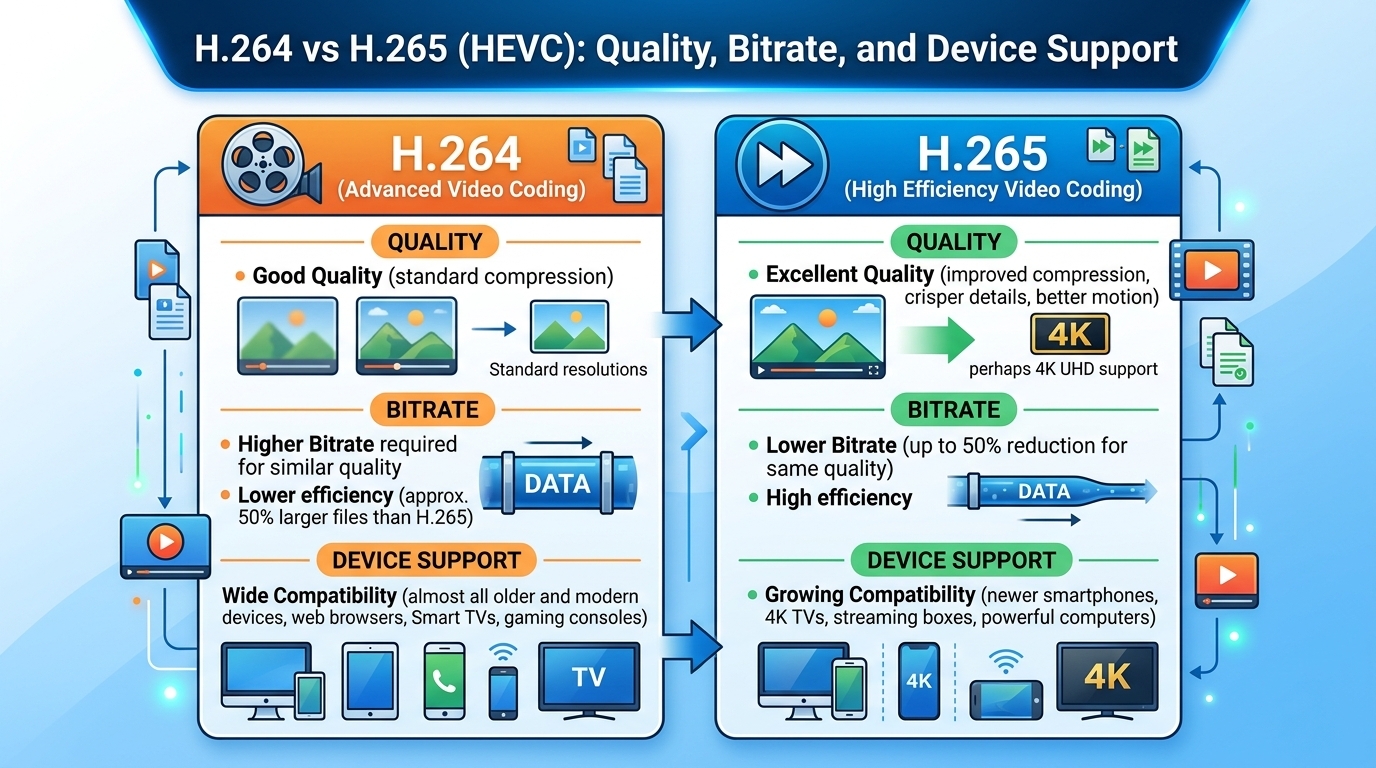
Evaluated October 2026: in the h264 vs h265 decision, HEVC (H.265) matches H.264 (AVC) quality at roughly 30 to 50 ...