Infrastructure
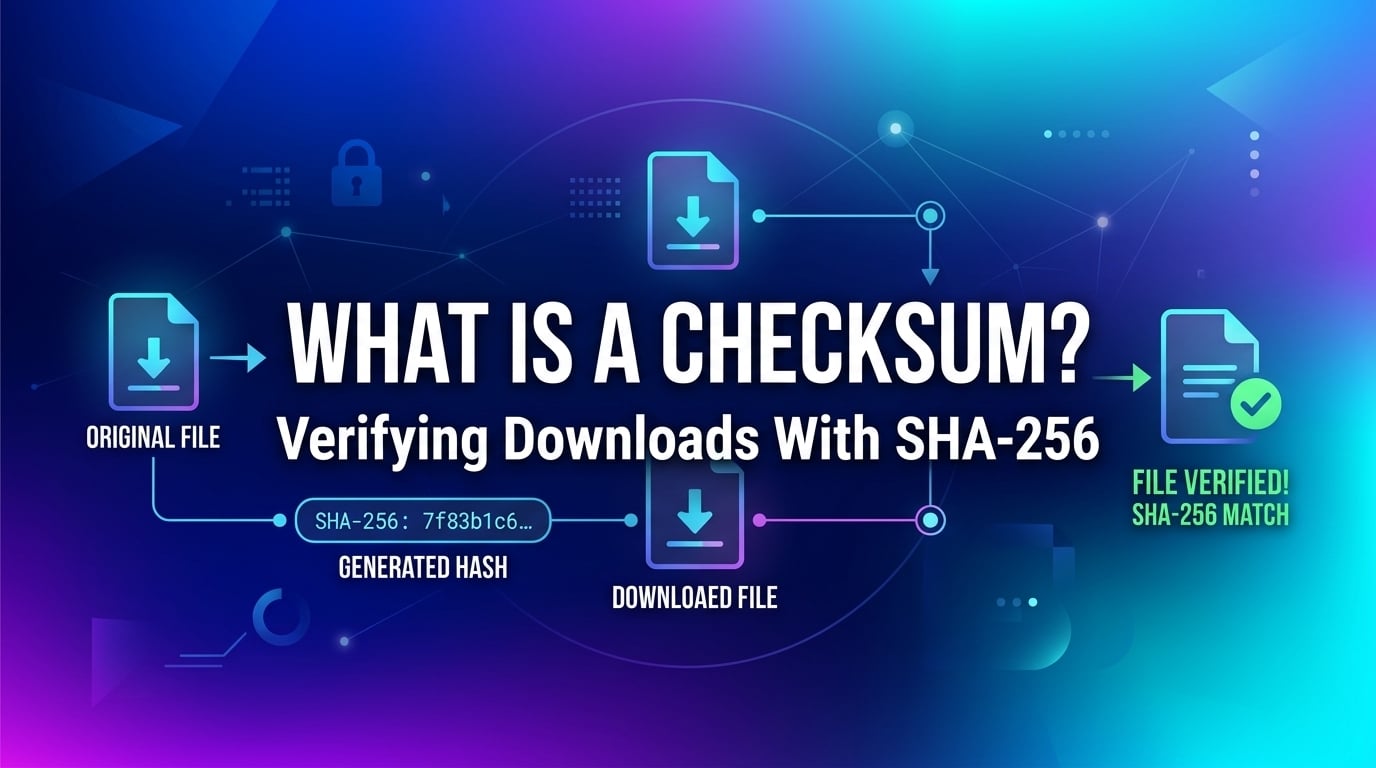
What Is a Checksum? Verifying Downloads With SHA-256
A checksum is a short, fixed-length value computed from a file's bytes so that any change to those bytes produces a ...
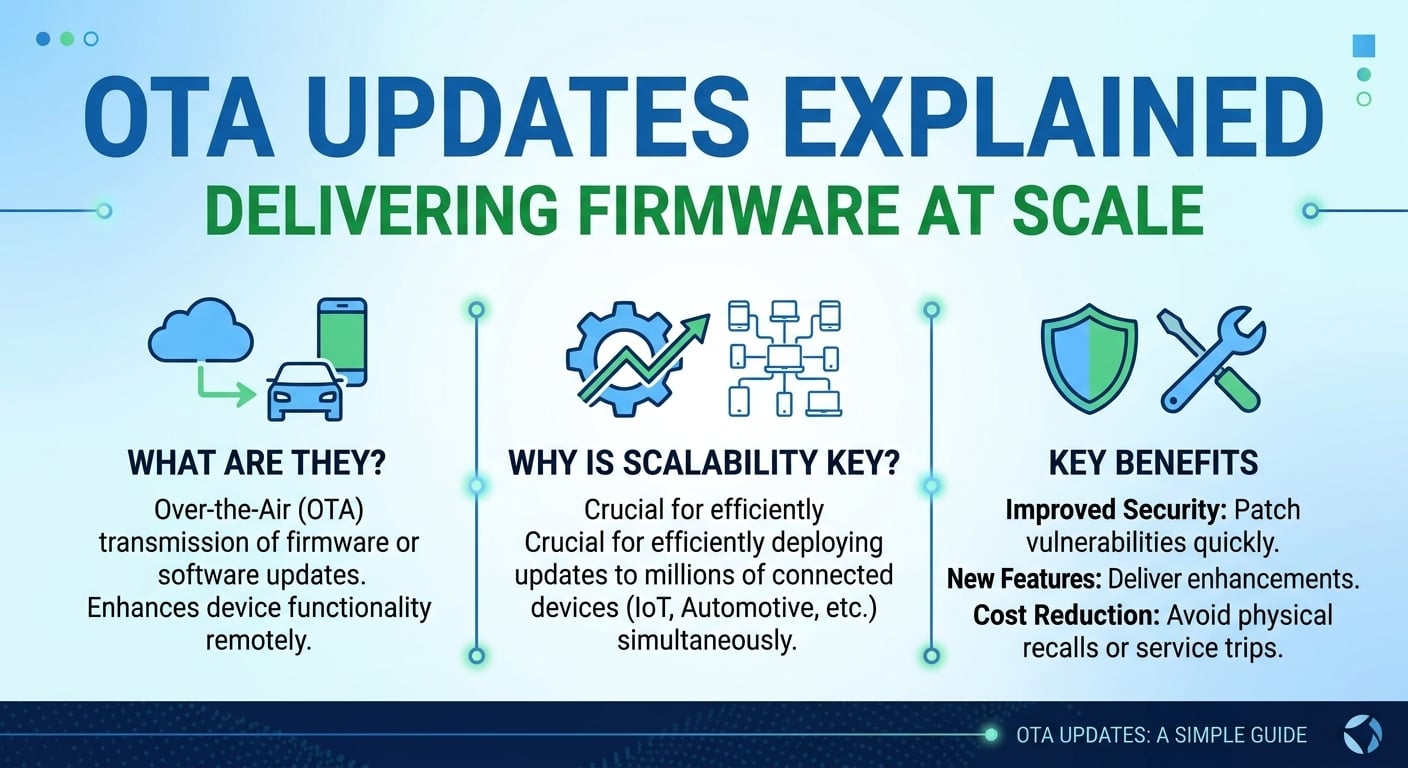
OTA updates move a signed software package from a vendor's firmware update server to a device in the field, verify it cryptographically, install it into an inactive partition, and commit only after the new image boots cleanly. In a well-run pipeline, a delta package is typically 5 to 25 percent of the full image (an estimate that depends on how much of the binary changed). The rollout expands in stages starting at about 1 percent of the fleet. A CDN serves the heavy bytes, and the origin only decides which device gets which release.
In cars, regulation has made this formal. Under UNECE Regulation No. 156, every new vehicle registered in the European Union since July 2024 must be covered by a certified software update management system, so automotive OTA pipelines are now audited release engineering, not a download link.
The pipeline has eight stages, and each one fails in its own way. Fleets that ship weekly run each stage as a separate service with its own metrics.
An update has two parts that should never be confused. The payload is large, immutable and identical for every device. The metadata is small, signed, short-lived and specific to the device asking for it.
Android's update_engine consumes a payload.bin made of install operations plus a signed payload properties file. Vehicle stacks that follow Uptane split metadata across two repositories. A Director repository issues per-vehicle instructions, and an Image repository signs the set of images that exist, so compromising one server is not enough to push malicious firmware.
Delta generators trade server-side CPU and storage for fewer bytes on the wire. Common examples are bsdiff, Google's Zucchini (used by Chromium), and puffin, which lets Android diff inside deflate streams. The catch is combinatorial: a delta is valid only against one exact source build. Supporting the last five versions therefore means five deltas per release, plus a full image as the fallback for everything older.
Chunk-based schemes avoid per-version deltas. RAUC's adaptive updates and casync-style chunking let the device fetch only the blocks whose hashes it lacks. These chunks also cache better on a CDN, because consecutive releases share most of them.
A hash proves the bytes match the manifest, and a signature proves who wrote the manifest. Neither one covers the attacks The Update Framework (TUF) was designed for:
The defenses for these attacks are:
The detail that bites in production is time. Expiring metadata assumes the device knows the date, but many IoT boards without a battery-backed real-time clock boot believing it is 1970 until NTP answers. Either order the boot sequence so time sync completes before metadata checks, or define an explicit, bounded skew window.
A staged rollout releases to a deterministic cohort and expands only when health gates pass. The cohort is usually a hash of the device ID modulo 100 or 10,000. Typical ladders run 1, 5, 25, 50 and 100 percent. Each stage soaks long enough to cover a full daily usage cycle: 24 to 72 hours for phones and IoT devices, and longer for vehicles that may sit parked for days.
Gate on what devices report after commit:
Halting a rollout is a control-plane flag that takes effect on each device's next check-in. Your check-in interval is therefore your worst-case reaction time to a bad release.
The scenario below uses this blog's assumptions, not measurements:
The "no jitter" rows assume every device checks in at the same nightly maintenance time, so 60 percent of the stage downloads in the first 2 hours.
| Scenario | Bytes delivered | Window | Average egress |
|---|---|---|---|
| Delta, check-ins jittered across 48 h | 62.5 TB | 48 h | 2.9 Gb/s |
| Full image, check-ins jittered across 48 h | 300 TB | 48 h | 13.9 Gb/s |
| Delta, no jitter, 60 percent in first 2 h | 37.5 TB | 2 h | 41.7 Gb/s |
| Full image, no jitter, 60 percent in first 2 h | 180 TB | 2 h | 200 Gb/s |
Deltas cut peak egress by a factor of 4.8 (13.9 to 2.9 Gb/s), while jittering check-ins cuts it by about 14 (41.7 to 2.9 Gb/s), so the polling schedule moves the peak more than the package format does.
The fix is almost free. Add several hours of random jitter to the check-in schedule. When a stage is saturated, have the server answer with a Retry-After header carrying a randomized delay.
The firmware update server should never stream payloads. Its job is to answer small, authenticated, uncacheable check-ins. The blobs live behind a CDN on immutable, content-addressed URLs, with the file's SHA-256 in the path. Serve them with Cache-Control set to public, a max-age of one year and the immutable directive. Every release gets a new URL, so there is never anything to purge.
If you run the cache tier yourself on nginx, four directives do most of the work:
Two more rules prevent cache fragmentation:
Software update delivery is one of the workloads BlazingCDN is built for. Its Files on Demand delivery for firmware and installers serves objects up to 50 GB, with origin shield, request coalescing, signed URLs and cache warm-up through the API on every plan. On its published tiers as of November 2026, with no request fees, the 1,200 TB full-image release to the 1 million devices above prices at $3,815, and the 250 TB delta release at $940.
The split between a control plane and a CDN data plane pays off for fleets above roughly 10,000 devices, or for payloads above 100 MB. At that scale, a single release reaches tens of terabytes, and origin egress plus stage-expansion peaks dominate the cost.
It fits poorly in two cases:
They write the new image to an inactive partition and switch only after it boots successfully. A/B layouts on Android, RAUC and Mender keep the old slot intact, so a power loss mid-write leaves the device on its current version. After reboot, the new image must mark itself healthy, or the bootloader reverts to the previous slot automatically.
A delta is typically 5 to 25 percent of the full image, an estimate that depends on how much of the binary changed between builds. Compressed images diff poorly unless the tool works inside the compression, which is why Android uses puffin for deflate streams. Every delta is valid against only one exact source version.
No. The firmware update server should answer check-ins and hand out signed manifests, while a CDN serves the payloads. Check-ins are small, per-device and uncacheable, whereas firmware blobs are large and identical across the fleet. Content-addressed URLs with long cache lifetimes, origin shield and request coalescing keep origin load near one fetch per object per release.
Expand only after each stage survives a full usage cycle with healthy metrics, typically 24 to 72 hours per stage for phones and IoT devices. Common ladders run 1, 5, 25, 50 and 100 percent of the fleet. Vehicles need longer soaks because many sit parked for days, and how fast you can halt depends on how often devices check in.
This week, pull three numbers from your last release:
Rebuild the egress table above with your figures, and compare the jittered peak with the unjittered one. If the gap exceeds 5 times, fix the polling schedule before touching delta tooling. Then run the mid-object range test against your current CDN to confirm that slicing and coalescing actually protect the origin.
If your fleet pulls firmware or installers at tens of terabytes per release, the BlazingCDN software delivery page describes how its 14-day testing period on real production traffic works, at $5 per TB with the monthly minimum waived.

Heavy traffic.
Light bill.
The CDN for video and large traffic
Infrastructure
A checksum is a short, fixed-length value computed from a file's bytes so that any change to those bytes produces a ...
Industries
Public crowdsourced speed tests from 2024 and 2025 put median 5G download speeds in mature markets at roughly 100 to ...
Industries
Choosing an enterprise CDN for software delivery comes down to four numbers that matter more than any feature list: ...

Industries
Game delivery is mostly a bulk download problem. A modern patch moves tens of gigabytes to every player within hours, ...