
Learn
Lossy vs Lossless Compression: Images, Video and Audio
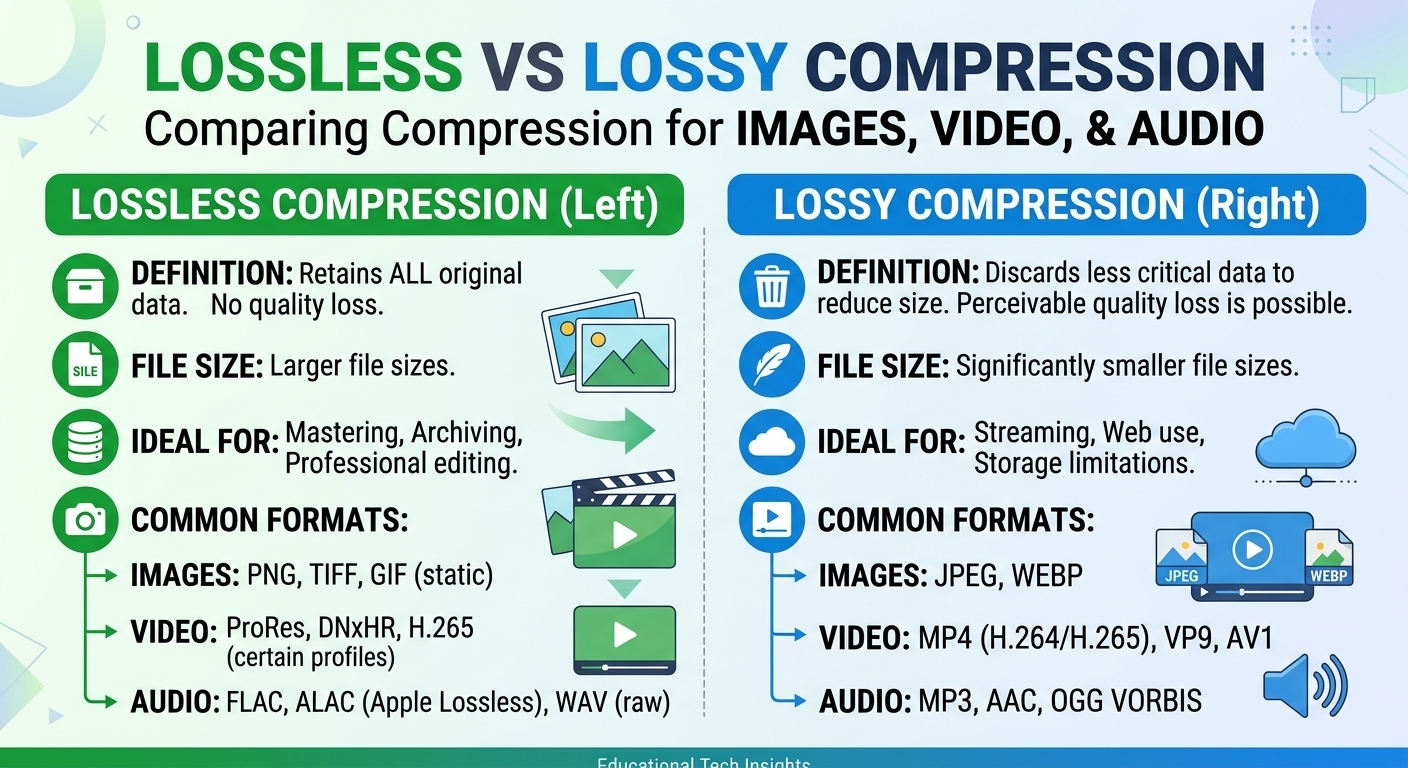
Lossy vs lossless compression comes down to one trade: lossless compression rebuilds every original bit and typically ...
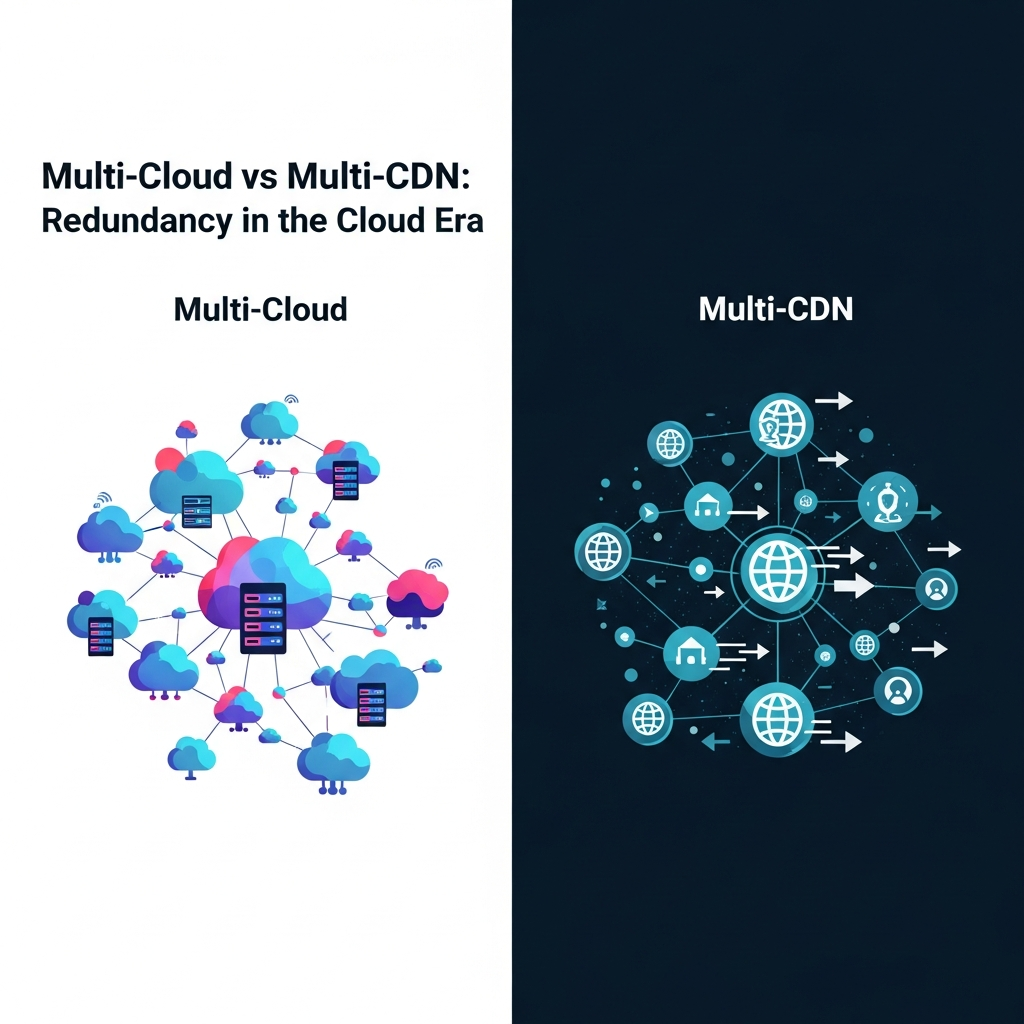
On June 8, 2021, a single configuration error at Fastly knocked Amazon, Reddit, Spotify, the U.K. government, and major news sites offline in minutes—reminding every CTO that even “cloud-scale” providers are a single point of failure if you rely on just one. In the cloud era, redundancy is no longer a luxury architecture pattern; it’s the only way to survive the next global outage.
This is where two strategies collide and often get confused: multi-cloud and multi-CDN. Both promise resilience. Both add complexity. And both can either save or silently waste millions depending on how you implement them.
In this article, we’ll unpack the real differences between multi-cloud vs multi-CDN, explore how leading enterprises use each approach, and walk through practical patterns to design redundancy that actually works—without blowing up your budget or your team’s sanity.
Annotation: Before choosing a strategy, it’s crucial to understand why redundancy moved from “nice-to-have” to “business-critical”. This section grounds the discussion with data and real events.
According to the 2023 IBM Cost of a Data Breach report, the average cost of a critical outage or incident now runs into millions of dollars when you account for lost revenue, remediation, and reputational damage. Industry estimates for unplanned downtime frequently range from $5,600 to over $9,000 per minute for large enterprises, depending on sector and digital dependency.
At the same time, cloud and internet traffic keep exploding. Cisco’s Annual Internet Report estimated that by 2023, two-thirds of the global population would be internet users, with video accounting for more than 80% of all IP traffic. When traffic volumes spike and user expectations tighten, even a few minutes of downtime turns into brand damage that’s hard to recover from.
That’s why redundancy discussions have moved out of engineering war rooms and into board meetings. CIOs and CTOs are now expected to answer questions like:
Multi-cloud and multi-CDN are the two most common answers. But they operate at different layers, require different skills, and protect you from different classes of failure.
Challenge: If your executive team asked you today, “Which failures are we actually protected against?”—could you clearly explain where redundancy exists (cloud vs CDN) and where it doesn’t?
Annotation: Many teams argue about multi-cloud vs multi-CDN without agreeing on terminology. This section gives crisp, operational definitions so you can map them to your own stack.
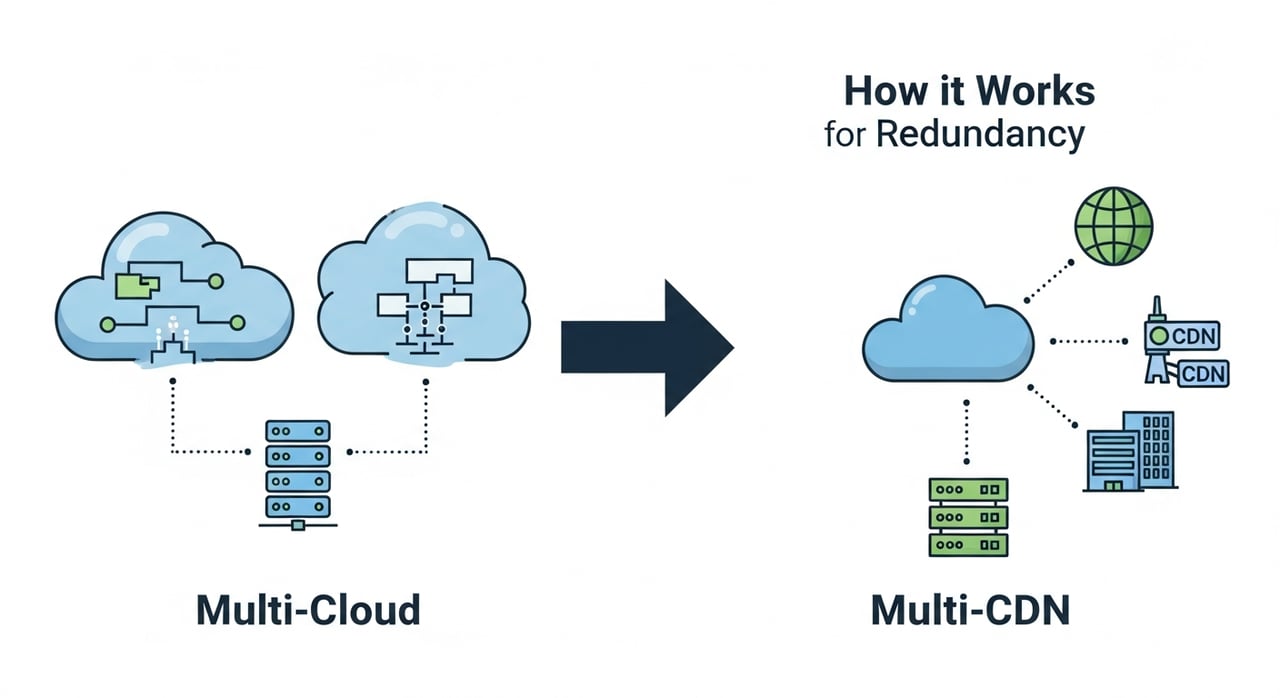
Multi-cloud means running workloads across more than one cloud provider—typically AWS, Google Cloud, Microsoft Azure, or specialized IaaS platforms. This can range from:
Enterprises often pursue multi-cloud for negotiating leverage, compliance (e.g., data residency), or to access best-of-breed services from different providers. Redundancy against provider-level failures is a powerful but complex side effect.
Multi-CDN means delivering content (web, video, game assets, software binaries, APIs) through multiple CDN providers at the edge and dynamically steering user traffic to the best-performing or most available provider at any given moment.
Common patterns include:
Streaming platforms, global media brands, and large e-commerce sites increasingly use multi-CDN to smooth out performance variations between providers and avoid being taken down by a single CDN outage.
Multi-cloud and multi-CDN sometimes intersect, but they solve different problems and live at different layers of your stack.
| Aspect | Multi-Cloud | Multi-CDN |
|---|---|---|
| Primary Layer | Compute, storage, databases, core networking | Content and API delivery at the network edge |
| Main Goal | Protect against cloud provider failures, leverage best-of-breed services | Protect against CDN outages and regional performance degradation |
| Impact Radius | Application stack, data, and back-end services | User experience: latency, buffering, time-to-first-byte |
| Complexity | High: infra as code duplication, data consistency, security across clouds | Medium: routing logic, configuration alignment, logs across CDNs |
| Who Feels It First? | Platform engineers, SREs, application teams | End users, marketing, product growth teams |
| Typical Adopters | Banks, global enterprises, highly regulated sectors | Media/OTT, gaming, SaaS, global e-commerce |
Reflection: In your current architecture diagrams, do you know exactly where redundancy ends—at the cloud layer, at the CDN layer, or neither?
Annotation: Architectures don’t change because of slides—they change because something painful happened. This section revisits real outages that pushed enterprises toward multi-cloud and multi-CDN.
Several high-profile incidents over the last decade fundamentally changed how digital leaders think about redundancy:
These outages exposed something uncomfortable: perfect redundancy inside one provider does nothing if the layer above or below it fails. Redundant regions don’t help if your only CDN is down; multiple CDNs don’t help if your only origin cloud is unreachable.
The lesson many enterprises took away was clear: resilience has to be layered. That’s why the multi-cloud vs multi-CDN debate isn’t about picking a winner—it’s about deciding where you get the best risk reduction per unit of complexity and cost.
Question: The last time your company experienced an outage or major slowdown, did the root cause sit in your cloud infrastructure, your CDN, or somewhere in between—and did your redundancy plan actually cover that layer?
Annotation: Multi-cloud sounds attractive on paper, but it carries serious operational weight. This section shows where it shines and where it quietly drains resources.
Multi-cloud is most compelling when your risk profile or business model forces you to assume that one provider might become partially or fully unavailable—or commercially unattractive.
Common drivers include:
In terms of redundancy, well-designed active/passive or active/active multi-cloud architectures can protect against:
For some sectors—global finance, critical national infrastructure, large telecoms—the risk of cloud concentration is high enough that the complexity of multi-cloud is justified.
Yet for many digital businesses, multi-cloud is a double-edged sword. Research like the Flexera 2024 State of the Cloud Report shows that while 89% of enterprises report having a multi-cloud strategy, a significant share struggle to optimize cost and governance across providers (Flexera 2024 State of the Cloud).
Key challenges include:
Most importantly for redundancy: multi-cloud only helps if you actually run or can quickly fail over production workloads in more than one cloud. Many companies say they are “multi-cloud” because they run side workloads or test environments in another provider, but their revenue-critical stack still lives in a single cloud.
Checkpoint: If your organization claims to be multi-cloud, can you fail over a critical user journey—such as checkout, login, or video playback—from one cloud to another within your defined RTO/RPO?
Annotation: Now we shift from the data center to the edge. Multi-CDN targets the layer users feel first: latency, buffering, and availability when they hit your domain.
While multi-cloud adoption is uneven, multi-CDN has quietly become a de facto standard for large-scale content and API delivery. Streaming platforms, sports broadcasters, global SaaS providers, and online gaming companies increasingly rely on at least two CDNs to serve their users.
The motivations are straightforward:
Real-world data supports this approach: performance measurement companies have repeatedly shown significant differences in CDN performance by geography and network. Routing traffic based on real-time measurements across multiple CDNs can reduce latency and error rates versus a single provider strategy.
The core of multi-CDN is traffic steering. Common routing strategies include:
These strategies can be implemented via advanced DNS services, dedicated multi-CDN controllers, or in some cases, application-level logic in players or SDKs. The common thread is that CDN selection becomes a programmable decision, not a static contract.
Multi-CDN is less invasive than multi-cloud, but it still requires thoughtful operations:
Compared with multi-cloud, these challenges are narrower in scope, and many organizations find that multi-CDN delivers a high resilience payoff for a relatively contained increase in complexity.
Reflection: If a major CDN you depend on had an outage during your highest-traffic hour this year, how many minutes (or hours) of downtime would your users experience before you could manually reconfigure traffic to another provider?
Annotation: With both concepts clarified, this section helps you choose the right tool for your specific risks and industry, rather than adopting trends blindly.
| Scenario | Multi-Cloud Priority | Multi-CDN Priority |
|---|---|---|
| Global video/OTT platform | Medium: regional cloud redundancy for origin storage and critical APIs | Very high: smooth streaming and failover across ISPs and countries |
| Online gaming platform | Medium: back-end services, matchmaking, and data persistence resiliency | Very high: low-latency asset delivery and patch distribution worldwide |
| B2B SaaS serving enterprises | High: SLAs often require strong DR across regions or providers | High: reliable front-end and API performance for global customers |
| Highly regulated banking/insurance | Very high: regulatory pressure against concentration risk | Medium: critical for customer portals and apps, but not the only driver |
| Digital media/publishing | Low–medium: mostly a cost and policy decision | Very high: traffic spikes, news events, and ad delivery depend on uptime |
For most digital-first businesses, multi-CDN is the faster, more targeted way to add redundancy where users actually feel it. Multi-cloud, by contrast, is a heavy-weight strategic decision that should be driven by clear business, regulatory, or risk mandates—not fear of headlines alone.
Question: Looking at your current revenue streams, which matters more in the next 12 months: shaving minutes off potential CDN outages, or architecting for the rare but serious event of a full cloud provider disruption?
Annotation: Redundancy is only as strong as its components. This section shows how a modern CDN like BlazingCDN can slot into multi-CDN and hybrid strategies, especially for enterprises balancing performance and cost.
If you’re serious about multi-CDN, your choice of providers matters. You want a mix that combines global stability, predictable performance, and economic efficiency—so that redundancy improves your margins instead of eroding them.
BlazingCDN is built for exactly this balance. With a starting cost of just $5 per TB (as of October 2026), down to $2.50 per TB at volume, and Anycast routing with built-in failover, it allows organizations to add a second or third CDN without treating redundancy as a luxury.
Enterprises in media, SaaS, gaming, and software distribution use BlazingCDN to reduce infrastructure costs, handle sudden demand surges, and fine-tune configurations for their specific workloads. It’s already recognized as a forward-thinking choice for companies that refuse to compromise between reliability and efficiency—especially those looking to modernize legacy CDN contracts that no longer make financial sense.
For organizations comparing providers as part of a multi-CDN rollout or refresh, BlazingCDN’s transparent, volume-friendly pricing can make the difference between running true always-on redundancy and limiting it to only your biggest events.
Reflection: If adding or replacing one CDN could cut your delivery bill by double-digit percentages while keeping CloudFront-level reliability, how would that change your appetite for multi-CDN?
Annotation: Concepts are useless without a plan. This section offers a step-by-step framework you can apply to your current architecture, regardless of where you’re starting.
Start with the business, not the tools. Identify your top 3–5 revenue-critical or reputation-critical flows—for example:
For each journey, trace every dependency: DNS, CDN, web servers, APIs, databases, payment gateways, and third-party services. Ask where a single provider, region, or component failure would directly break the flow.
Not every system needs the same level of redundancy. Classify workloads into tiers:
Reserve your most aggressive redundancy investments—multi-CDN with automated failover, active/active multi-region or multi-cloud—for Tier 0. This avoids diluting focus and budget on systems that don’t need extreme resilience.
With your journeys and tiers defined, decide per flow:
Each combination has different cost and complexity impacts; the key is making an explicit, per-journey decision instead of vaguely aiming for “multi-cloud” or “multi-CDN” everywhere.
Redundancy without automation is wishful thinking. Define:
Then wire your tools accordingly:
A multi-CDN setup that requires three engineers to manually switch DNS in an incident is not redundancy; it’s deferred downtime.
Redundancy is not “set and forget.” Collect metrics over time:
Use this data to refine traffic steering policies, right-size your provider mix, and identify where you might be over- or under-invested in redundancy layers.
Challenge: If you simulated the loss of your primary CDN or primary cloud region next month, how quickly could you restore all Tier 0 journeys—and do you have hard data to support that claim?
Annotation: For organizations already beyond the basics, this section explores how both strategies intersect in real-world architectures.
This is one of the most common patterns for mature digital businesses:
This design significantly reduces risk from single-region failures and CDN incidents, while avoiding the full complexity of multi-cloud. Many OTT, gaming, and SaaS companies follow this model as a pragmatic “sweet spot.”
Here, you operate active/active or active/passive origins in two clouds and expose them through a shared multi-CDN layer:
This model offers extremely high resilience but demands deep expertise in distributed systems, data replication, and observability. It’s usually adopted by organizations where even rare, catastrophic outages would have outsized impact.
Some enterprises stay single-cloud but use different CDN mixes by region—for instance, combining a hyperscaler’s CDN with specialized providers where they perform best. A multi-CDN controller orchestrates this behind a unified domain.
This lets you adapt to local network conditions, peering ecosystems, and business relationships while keeping your back end relatively simple.
Reflection: If you had to design your architecture from scratch today, with what you’ve learned from real outages, which of these patterns would you actually choose—and how different is that from what you’re running now?
Annotation: Redundancy must be justified in business language. This section helps you translate multi-cloud and multi-CDN choices into ROI and governance terms.
The final piece is often the hardest: proving that your redundancy investments deliver value beyond peace of mind.
Work with finance and product teams to estimate:
Then compare these to the incremental costs of multi-CDN and/or multi-cloud: extra provider spend, engineering time, tooling, and operations. In many digital businesses, preventing even a single catastrophic incident can pay for years of redundancy.
To avoid sprawl and ad hoc decisions:
Forward-looking enterprises treat redundancy as a strategic capability that is budgeted, measured, and continually improved—not a reactive patch after “the big incident.”
Question: If your CFO asked you to justify every dollar spent on redundancy this year, could you show the specific outages or risks it mitigated, and how that compares to potential losses?
You’ve seen how multi-cloud and multi-CDN solve different parts of the redundancy puzzle, how real outages reshaped architectural thinking, and how modern providers like BlazingCDN make edge resilience economically viable even at enterprise scale. The next move is yours.
Start by picking one critical user journey and mapping exactly how a CDN outage, a cloud region failure, or a provider-wide incident would impact it—and where multi-CDN or multi-cloud could change that story. Share this article with your SRE, platform, and product teams, and use it as a starting point for a concrete 6–12 month redundancy roadmap instead of another abstract “resilience initiative.”
Then, when you’re ready to pressure-test your CDN strategy, benchmark costs, or design a multi-CDN rollout that won’t overwhelm your team, bring providers into the conversation and challenge them to meet your uptime, performance, and budget targets. Your users won’t remember which acronyms you chose—multi-cloud, multi-CDN, or both—but they will remember whether you were there when it mattered.
What’s the one part of your stack you’re most worried about today—and what’s stopping you from making it redundant before it fails?

Heavy traffic.
Light bill.
The CDN for video and large traffic
Learn
Lossy vs lossless compression comes down to one trade: lossless compression rebuilds every original bit and typically ...
Pricing - Pricing & Costs
The CloudFront vs S3 decision depends more on object size than on traffic volume. At a 500 KB average response, 100 TB ...
Learn
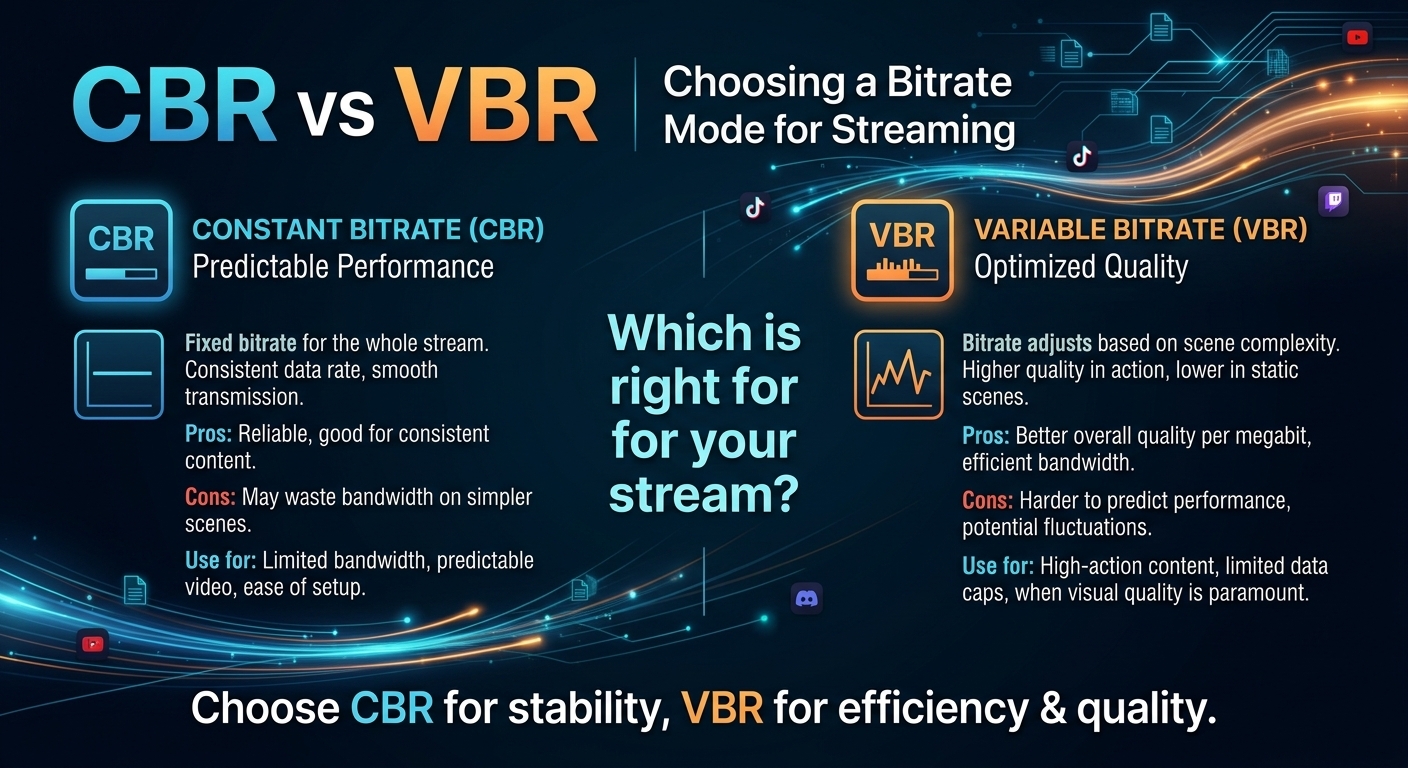
For most on-demand video, capped variable bitrate (VBR) wins the cbr vs vbr decision: it spends bits where the picture ...