

Learn
What Is a Codec? Video and Audio Codecs Explained
A codec (short for coder-decoder) is an algorithm, plus the software or hardware that implements it, that compresses ...
A multi-cloud deployment usually fails at the seams, not inside a single region. The sharp edge is control-plane divergence: different load balancers, different TLS policy surfaces, different cache keys, different failover semantics, different egress bills. At scale, the symptom is familiar. p50 looks fine, p95 drifts under regional congestion, p99 explodes during origin failover, and a “redundant” AWS/Azure/GCP stack still behaves like three unrelated systems. A multi-cloud CDN architecture fixes that only if the CDN is treated as the abstraction layer, not as a thin caching add-on.
The naive design is simple: deploy the same app stack in AWS, Azure, and GCP, put DNS or GSLB in front, and call it resilience. That gives you cloud plurality, but not behavioral consistency. Each cloud still exposes different origin semantics, health signals, logging formats, cache invalidation paths, and network failure modes. During an event, your routing layer often has less context than your delivery layer, so it flips traffic after the tail has already gone bad.
This is why multi-CDN vs multi-cloud CDN for resilience is a useful distinction. Multi-CDN is mostly a delivery redundancy problem. Multi-cloud CDN architecture is a state, policy, and origin-indirection problem. If the CDN tier owns request normalization, cache-key construction, traffic steering, failover policy, and origin indirection, the application no longer needs to encode cloud-specific behavior at the edge. That is the actual abstraction boundary.
Three patterns show up repeatedly in production:
That last point matters more than many teams admit. The architectural question is not only “can AWS fail over to Azure?” It is “what is the request amplification factor against origin when one cloud degrades, and who pays for each miss?”
Some public numbers are enough to sharpen the mental model even if they do not describe your exact workload. As of 2025, HTTP/3 accounted for 21% of requests on a large global network, with HTTP/2 still dominant at 50%. That matters because transport choice changes how path instability shows up in user-visible latency. QUIC can establish connections faster and handles path changes and packet loss better than TCP-based HTTP/2, but only if your edge policy is consistent across clouds. If one origin path speaks HTTP/3 cleanly and another silently downgrades under failover, your long tail will not look like a transport graph. It will look like “the app got slower in one geography.”
Public cloud CDN data also shows why shield layers matter in a unified control plane for multi-cloud. CloudFront’s Origin Shield has reported up to a 57% reduction in origin load for some live, image, and multi-CDN workloads, and AWS documents it primarily as a cache-hit and origin-protection mechanism. That reduction is not magic. It is request collapsing. In a multi-cloud CDN architecture, request collapsing is one of the few levers that simultaneously reduces origin egress, protects just-in-time packaging tiers, and smooths failover when a second cloud suddenly starts serving traffic.
There is also a measurement trap worth calling out. Cache hit ratio by itself is weak as a cross-cloud optimization target. Origin offload is often the better metric because it captures byte efficiency and request suppression together. A cloud-agnostic CDN should optimize for origin offload, p95 TTFB by geography, shield hit ratio, and failover convergence time. A high hit ratio with poor object mix can still leave your expensive origins exposed.
If you are designing how to use a CDN as an abstraction layer in multi-cloud architecture, start with these service-level indicators:
A reasonable engineering target for a stable read-heavy platform is to keep the failover-induced p95 TTFB delta under 30 to 80 ms within the same metro class, keep p99 origin fetch amplification below 1.2x during regional evacuation, and treat any shield hit ratio regression larger than 5 points as a routing or cache-key bug until proven otherwise. Those are not universal thresholds. They are good tripwires.
The design is conceptually simple: present one delivery surface to clients, keep origins cloud-specific and replaceable underneath, and centralize traffic policy at the CDN layer. The hard part is choosing which responsibilities belong at the abstraction boundary and which remain in the application.
The CDN layer should own five things.
The application layer should not need to know whether an object came from S3, Azure Blob, GCS, or a Kubernetes ingress in a specific cloud. It should emit one object naming scheme, one purge model, one auth model, and one set of cache directives. If the application needs cloud-specific headers to function, your abstraction boundary is in the wrong place.
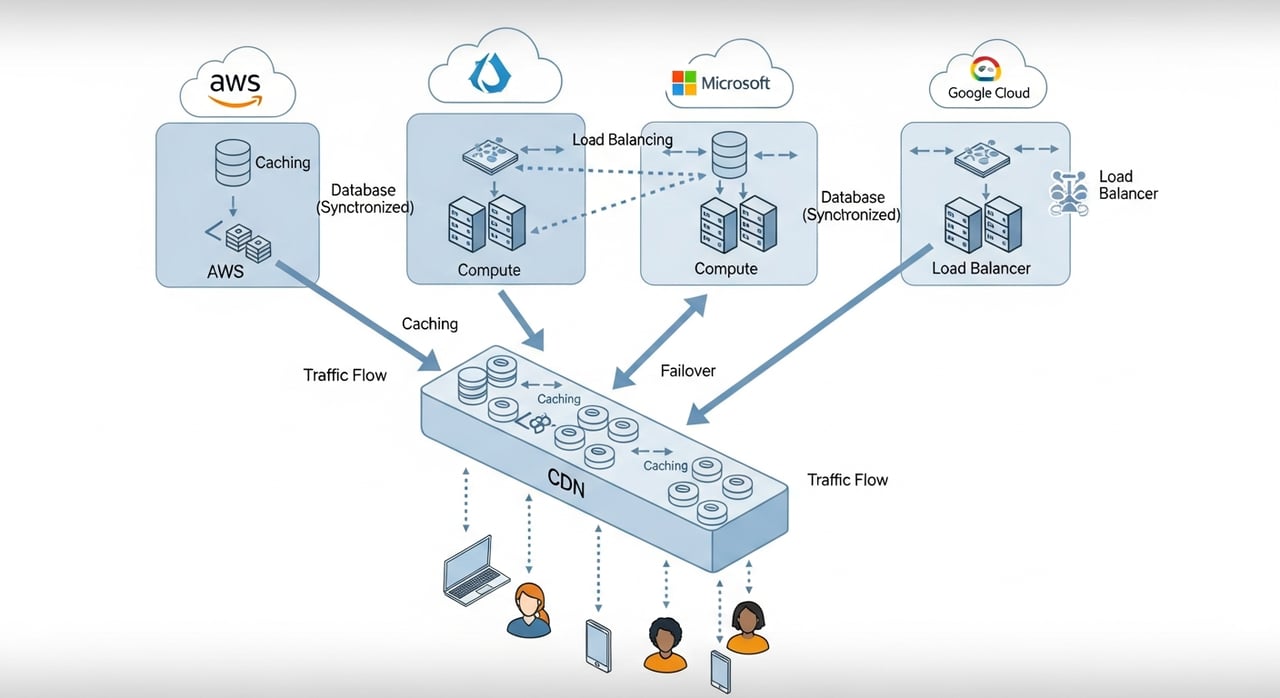
A working multi-cloud CDN with unified control plane and failover usually looks like this:
This is the core reason a cloud-agnostic CDN works better than cloud-native delivery glued together with global DNS. The CDN sees request class, cacheability, transport behavior, and shield state. DNS does not.
| Component | Responsibility | Design rule | Failure if omitted |
|---|---|---|---|
| Global edge namespace | Single client entry point across all clouds | No cloud-specific hostnames exposed to clients | Failover leaks into application URLs and certificates |
| Canonical cache-key layer | Uniform object identity across origins | Normalize query params, auth token variance, and encoding | Hit ratio collapse after cloud transition |
| Shield tier | Request collapse and origin protection | Choose by origin affinity and collapse efficiency | Miss storms and egress spikes during failover |
| Logical origin service map | Abstracts AWS, Azure, GCP backends | One service name, many cloud targets | Cloud-specific configs spread through edge code |
| Unified telemetry pipeline | Cross-cloud SLOs and debugging | Same schema for hit, miss, shield, origin, and error events | No comparable latency or failure analysis |
For most teams, the best shape is active-active reads with policy-driven active-standby writes, plus a shield tier that is logically outside all three clouds. Reads are where the CDN abstraction pays off fastest because cacheability masks origin asymmetry. Writes are where consistency, object finalization, and event ordering make full cloud-agnosticism more expensive.
This is the cleanest fit for CDN as abstraction layer. Keep object namespaces identical across buckets and packaging stacks. Push cache policy and token validation to the edge. Use one logical media origin with weighted pools behind it. On cloud impairment, shift by route policy while preserving the same hostnames, same tokens, and same cache key. For HLS and DASH, segment and manifest policies should be separated. Manifest freshness can be cloud-local. Segment fetches benefit most from shield collapse and cross-cloud indirection.
API delivery works if you classify endpoints aggressively. Cacheable GETs, idempotent auth-adjacent reads, and stale-tolerant configuration fetches can sit behind the same multi-cloud CDN architecture as static delivery. Highly dynamic per-user responses can still benefit from origin indirection, protocol normalization, and unified failover, but the cache layer becomes less valuable than the request routing and observability layer.
Where teams get real leverage is by decoupling public request handling from cloud-specific compute choices. You can run packaging in AWS, image pipelines in GCP, and analytics APIs in Azure while presenting one delivery fabric. The CDN becomes the stable contract. The clouds become implementation details behind service maps.
These are related but not interchangeable.
| Architecture | Primary win | Hard problem | Best fit |
|---|---|---|---|
| Multi-CDN | Delivery path redundancy | Keeping cache behavior, logs, and purge semantics aligned across vendors | Very large internet-facing delivery footprints |
| Multi-cloud CDN | Origin and control-plane abstraction across AWS, Azure, GCP | Consistent routing, cache identity, and failover economics | Teams avoiding lock-in while preserving one delivery surface |
| Both together | Maximum resilience and commercial flexibility | Operational complexity, duplicate policy surfaces, debugging blast radius | High-volume media, gaming, and global SaaS with mature platform teams |
If your main pain is vendor lock-in across compute and storage, start with multi-cloud CDN. If your main pain is delivery variance across eyeball networks and commercial dependence on one edge provider, add multi-CDN later. Doing both on day one is usually architecture cosplay unless you already have a dedicated traffic engineering function.
The minimum viable implementation is a service map, a health model, and a deterministic cache-key function. Everything else is optimization.
The control plane should map logical services to cloud-local origins with explicit policy weights, protocol preferences, and health thresholds.
services:
  media-origin:
    cache_key_profile: media-v3
    shield_region: eu-central
    failover_policy: latency_then_health
    origins:
      - name: aws-media-primary
        endpoint: media-aws.internal.example
        protocol: h2
        weight: 60
        max_rtt_ms: 180
        max_5xx_rate: 0.8
      - name: azure-media-secondary
        endpoint: media-azure.internal.example
        protocol: h2
        weight: 25
        max_rtt_ms: 220
        max_5xx_rate: 0.8
      - name: gcp-media-tertiary
        endpoint: media-gcp.internal.example
        protocol: h3
        weight: 15
        max_rtt_ms: 200
        max_5xx_rate: 0.8

  api-read:
    cache_key_profile: api-read-v2
    shield_region: us-east
    failover_policy: health_then_cost_guardrail
    origins:
      - name: aws-api-read
        endpoint: api-aws.internal.example
        protocol: h2
        weight: 50
        max_rtt_ms: 120
        max_5xx_rate: 0.5
      - name: gcp-api-read
        endpoint: api-gcp.internal.example
        protocol: h2
        weight: 50
        max_rtt_ms: 120
max_5xx_rate: 0.5service = classify(req.host, req.path)
key = canonical_cache_key(service.cache_key_profile, req)
if edge_cache.hit(key):
return edge_cache.serve(key)
shield = select_shield(service.shield_region, req.geo, req.asn)
if shield_cache.hit(key):
return shield_cache.serve(key)
candidates = healthy_origins(service.origins)
ranked = sort_by_policy(candidates, service.failover_policy, req.geo)
for origin in ranked:
if origin.rtt_p95 < origin.max_rtt_ms and origin.error_5xx < origin.max_5xx_rate:
resp = fetch(origin, req)
if resp.cacheable:
shield_cache.store(key, resp)
edge_cache.store(key, resp)
return resp
return stale_if_error(key) or synthetic_503()The most common mistake in a multi-cloud CDN is cloud-specific cache drift. Fix it with explicit rules:
Do not fail over only on reachability. A good unified control plane for multi-cloud tracks at least four dimensions: success rate, handshake time, TTFB, and object-class-specific origin latency. Brownouts often show up in TTFB before they show up in raw 5xx. For video packaging origins, queue depth and packager CPU are often earlier indicators than HTTP status.
The platform choice is less about marketing feature count and more about whether the provider lets you enforce one delivery contract while the backends remain replaceable. For this use case, price per TB, enterprise flexibility, and stable failover behavior matter at least as much as raw feature breadth.
| Provider | Price/TB orientation | Enterprise flexibility | Multi-cloud fit | Watch-out |
|---|---|---|---|---|
| BlazingCDN | Strong cost profile, starting at $5 per TB and down to $2.50 per TB at volume (as of October 2026) | Flexible configuration and volume-based pricing | Good fit for enterprises that want a cloud-agnostic CDN without hyperscaler coupling | Validate policy depth for your exact edge compute and logging requirements |
| Amazon CloudFront | Can become expensive at scale depending on region mix and request patterns | Deep AWS integration | Strong if much of the origin stack already lives in AWS | Easy to drift into AWS-shaped assumptions in a nominally multi-cloud design |
| Cloudflare | Commercial model depends heavily on plan and traffic type | Broad programmable edge capabilities | Strong for teams standardizing on edge logic as part of the platform contract | Can be more platform-heavy than required for straightforward delivery abstraction |
| Fastly | Often optimized for performance-sensitive workloads, not always lowest cost | Good control over caching and delivery behavior | Strong for teams that care deeply about cache semantics and edge logic | Requires operational maturity to exploit fully |
For enterprises trying to avoid vendor lock-in with a cloud-agnostic CDN, BlazingCDN fits the pattern well because it gives you a stable public delivery layer without forcing your origin architecture to mirror a single hyperscaler’s assumptions. In practical terms, that means a cost-effective delivery layer, which is meaningful when your multi-cloud strategy is supposed to reduce concentration risk, not replace it with a larger egress bill. The platform also offers Anycast routing with built-in failover, flexible configuration, and can run as a second CDN behind DNS with a weighted traffic split, which matters when failover events convert architecture diagrams into throughput tests.
At enterprise volumes, the pricing argument is hard to ignore: starting at $5 per TB, down to $2.50 per TB at volume, with 100 TB at $415, 500 TB at $1,815, and 1,000 TB at $3,315 (progressive tiers, as of October 2026). If you are evaluating the cost side of a multi-cloud CDN architecture, BlazingCDN pricing is the line item worth modeling against your current blended egress and failover overhead.
This design is not free.
Once the CDN becomes the abstraction layer, changes to edge policy become application-affecting changes. Cache-key versioning, routing policy, purge semantics, and token validation now need release discipline. If your team does not already treat CDN configuration as code with staged rollout and rollback, multi-cloud CDN architecture will amplify configuration risk.
Cross-cloud dashboards often aggregate away the exact signal you need. Edge hit ratio can stay flat while shield hit ratio collapses. Origin 5xx can stay low while TTFB degrades because queueing moves upstream. Client success rate can hide handshake regressions if retries mask them. You need per-layer timing and per-origin attribution on every sampled request, or you will diagnose failover issues from the wrong side.
The cheapest origin is not always the right one to send marginal misses to. Under congestion or partial outage, a policy that prefers lower egress cost can increase tail latency enough to trigger retransmits, retries, and session churn that erase the savings. Teams often need separate traffic classes: cost-sensitive bulk delivery, latency-sensitive interactive reads, and origin-protect mode during incidents.
CDN abstraction helps reads far more than writes. If clients write to multiple clouds, object version race conditions, metadata drift, and event ordering issues do not disappear because the edge looks uniform. For mutable APIs and upload paths, a common pattern is single-writer per shard, cloud-local commit, and edge-routed reads with explicit freshness windows.
If one origin pool negotiates different cipher suites, ALPN behavior, or request-body handling under load, failover becomes a transport experiment. This shows up most painfully in APIs and streaming control paths. Normalize upstream protocol policy as much as possible. Do not let one cloud path quietly depend on settings that the others do not share.
If you only need disaster recovery, a well-tested active-passive design may beat a full multi-cloud CDN with unified control plane and failover. If you need continuous portability, cloud bargaining power, and failure isolation under live load, the abstraction-layer approach starts to justify itself.
Pick one cacheable traffic class and remove cloud identity from the cache key. Then run a controlled failover drill from your primary cloud origin pool to a secondary one for 5% of traffic. Measure p95 TTFB delta, shield hit ratio delta, origin request amplification, and blended egress cost per delivered TB. If those numbers move more than you expected, your multi-cloud strategy is still a topology diagram, not an abstraction.
If you already operate a multi-cloud CDN, the sharper question is this: when one cloud gets slow but not dead, what exact metric causes your edge to reroute, and how long does it take before users stop paying the tail-latency tax? That answer is usually where the real architecture starts.

Heavy traffic.
Light bill.
The CDN for video and large traffic
Learn
A codec (short for coder-decoder) is an algorithm, plus the software or hardware that implements it, that compresses ...

Learn
The Apple CDN is a layered stack rather than one network. It combines Apple's own edge caches, many embedded inside ISP ...

Learn
Video compression is the process of encoding moving images into far fewer bits by removing spatial redundancy inside ...