

Learn
How a Multi-CDN Strategy Saved Us from Costly Downtime
In a recent survey, 60% of enterprises reported that a single hour of critical-application downtime costs them at least ...

In November 2022, Ticketmaster’s site buckled under the weight of Taylor Swift ticket demand, leaving millions locked out and furious — despite the company’s massive infrastructure and budget. If an enterprise at that scale can struggle with traffic spikes, what happens when your next product launch, flash sale, viral tweet, or live stream hits harder than expected?
In an always-online world, traffic spikes aren’t a “nice problem to have” — they’re a make-or-break moment. The difference between record revenue and public embarrassment often comes down to one key capability: how effectively you use a Content Delivery Network (CDN) to absorb the load and prevent website crashes.
This guide walks step by step through how to handle traffic spikes using a CDN, from understanding why websites topple under pressure to designing a resilient architecture that rides out demand surges without a hiccup.
Before you can fix traffic spikes with a CDN, you need to understand what actually fails when demand explodes.
Your backend infrastructure — origin servers, databases, application layer — is sized for “normal” or slightly elevated demand. A spike can multiply that traffic by 10x, 50x, or more. Here’s what typically happens:
Any one of these is enough to bring a site to its knees. Under a major spike, they can all happen at once.
Ask yourself: if your concurrent users jumped by 20x in the next 10 minutes, which of these weak points would fail first?
These are not theoretical risks. Across industries, traffic spikes regularly break production systems:
These failures are painful not just technically, but reputationally. Users remember “site down” moments for years.
So the core question becomes: how much of that load can you safely offload to a CDN before your origin even feels it?
A CDN is far more than “just caching images.” When correctly integrated and tuned, your CDN becomes a pressure shield between end users and your origin.
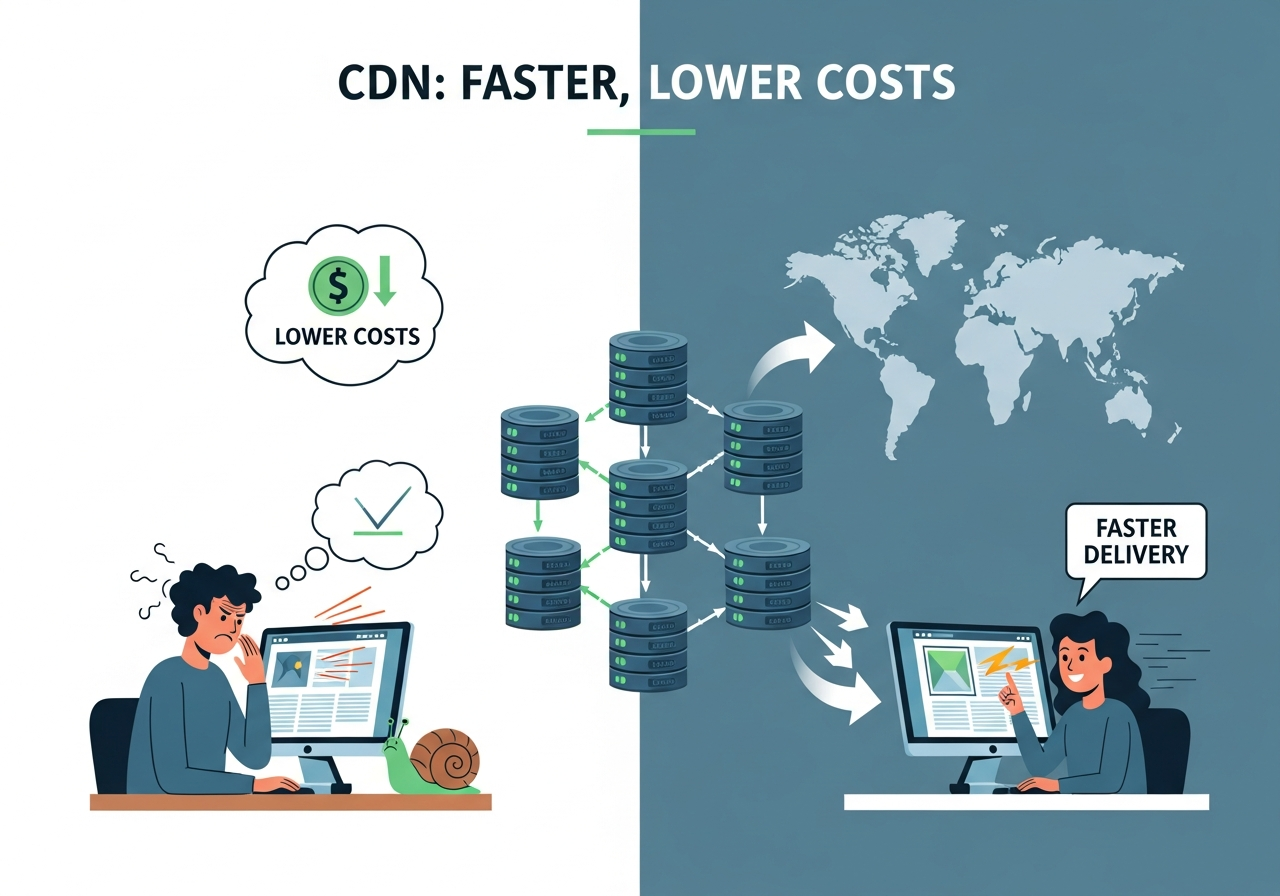
A Content Delivery Network distributes your content across a globally distributed infrastructure. Instead of every user pulling from your primary origin data center, the CDN serves content from its edge infrastructure as close as possible to the user.
Under spikes, that distribution has three key effects:
Well-tuned caching can offload 70–95% of requests from your origin, depending on your stack and caching strategy. That directly translates to fewer origin crashes and slower resource exhaustion.
According to Google’s research on mobile page speed, as page load time goes from 1 to 5 seconds, the probability of bounce increases by 90% (Think With Google, 2017). under load, latency often spikes long before outright downtime appears — meaning performance degradation alone can devastate conversions and engagement.
A study by Akamai found that a 100-millisecond delay in website load time can hurt conversion rates by 7% (Akamai, “The State of Online Retail Performance”). When traffic spikes push your infrastructure to its limits, CDNs help keep latency and errors under control, preventing those conversion-killing slowdowns from turning success into failure.
As you read the next sections, keep this in mind: it’s not just about “surviving traffic spikes,” but also about continuing to perform competitively under extreme demand.
To handle traffic spikes reliably, you can’t bolt on a CDN at the last minute. It needs to be part of your architecture from the start — or as early as possible in your scaling journey.
Begin by classifying your traffic and responses:
The goal is to push as much of the first three categories as possible to the CDN, using smart caching strategies and cache keys.
Ask yourself: what percentage of yesterday’s requests could have been served from cache without harming user experience or data freshness?
With that classification, define concrete caching policies at the CDN level:
stale-while-revalidate for APIs: Cache for seconds to minutes while keeping the user experience snappy, then refresh in the background.A CDN with flexible cache key configuration (headers, cookies, query parameters) and granular rules per path or hostname is essential to reaching high cache hit ratios without breaking functionality.
During major spikes, your origin should be treated as a scarce, protected resource. Use CDN capabilities to shield it:
Consider this scenario: if your origin becomes unstable for 60 seconds during a spike, would users see a wall of 5xx errors — or would your CDN quietly keep serving cached content while your team recovers?
Traffic spikes aren’t generic. The shape, intensity, and tolerances vary dramatically by industry. Let’s look at how CDNs help in real-world sectors — and how to tune your strategy for each.
Black Friday and Cyber Monday set annual traffic records year after year. Adobe reported that U.S. online shoppers spent $9.8 billion on Black Friday alone in 2023, up 7.5% year over year (Adobe Digital Insights). Behind those numbers are extreme, hour-by-hour spikes driven by email drops, ad campaigns, and social media.
CDN strategies that matter most:
Reflection point: if your email campaign sends 500,000 users to a landing page in 10 minutes, how many of those requests need to reach your origin at all?
Video streaming traffic is dominated by large objects (segments, manifests) and huge concurrency. When a major show premieres or a live event kicks off, the curve is steep. Services that rely too heavily on origin streaming regularly see buffer events, bitrate drops, or outright interruptions.
CDN strategies that matter most:
Think about your biggest upcoming live event or premiere: is your origin streaming architecture designed for “peak of peak” concurrency, or are you relying on the CDN to handle the lion’s share?
Major game launches and seasonal updates routinely generate multi-gigabyte downloads for millions of players within hours. Without a CDN, patch servers and ISP links can be overwhelmed, causing slow downloads and frustrated communities.
CDN strategies that matter most:
Question to consider: when your next content update goes live, how many gigabytes per minute will users be pulling — and is that traffic going anywhere near your application servers?
SaaS products see spikes during conferences, launches, and third-party integrations that suddenly scale. API endpoints can be hammered by partner systems, and dashboards can see usage go from hundreds to tens of thousands of sessions almost instantly.
CDN strategies that matter most:
Ask yourself: when you pitch enterprise customers on reliability, can you credibly say your architecture has been tested and tuned to withstand an order-of-magnitude spike in usage overnight?
Not all CDNs are created equal when it comes to handling spikes. Some are optimized purely for simple static sites; others provide a deep feature set tuned for complex enterprise architectures.
To maximize origin offload without breaking functionality, you need:
stale-while-revalidate and stale-if-error behaviors to keep users served even when origins are unstable.During spikes, these controls determine whether your origin sees a small fraction of traffic or gets flooded by avoidable cache misses.
Modern CDN platforms let you run custom logic at the edge — such as rewriting URLs, applying security headers, doing A/B assignment, or routing traffic based on geo or device type.
Under spike conditions, edge logic can:
The question: if a spike started right now, could you adapt behavior at the edge within minutes, or would you be waiting on a full application deployment cycle?
When traffic surges, every additional connection to your origin counts. Enterprise-grade CDNs protect you by:
The net effect is that your origin infrastructure behaves as though the spike is far smaller than it looks from the outside.
In a spike, you need visibility in seconds, not hours. CDN analytics are critical for answering questions like:
Combined with your APM and infrastructure metrics, this data lets you respond before issues cascade into a full outage.
For enterprises that need to ride out extreme demand without paying extreme prices, BlazingCDN is engineered as a modern, high-performance CDN that delivers stability and fault tolerance on par with Amazon CloudFront — while being significantly more cost-effective for large-scale usage.
BlazingCDN is already used by global, brand-conscious companies that demand consistent performance under heavy load. For media, gaming, SaaS, e‑commerce, and software vendors, it offers 100% uptime, flexible configuration, and the ability to scale quickly when traffic surges — whether that’s a marketing-driven spike or a global launch day.
With transparent, enterprise-friendly pricing that starts at just $4 per TB ($0.004 per GB), BlazingCDN helps organizations reduce infrastructure costs while strengthening resilience. That cost structure is particularly compelling for teams moving large volumes of streaming media, large binaries, or high-traffic web properties where every additional terabyte with a hyperscale CDN can become painfully expensive.
If you’re evaluating options, you can explore how BlazingCDN stacks up on performance, flexibility, and pricing via the **CDN comparison overview** and map it directly to your current and projected traffic patterns.
Preparation is everything. Here’s a pragmatic checklist to prepare your CDN setup before the next big spike hits.
Question: Could you quickly list your top 20 pages by traffic and confirm they are aggressively cached at the CDN?
stale-while-revalidate for semi-static content to avoid origin floods.Run a synthetic test or controlled campaign to validate that your cache hit ratios reach acceptable levels (often 80%+ for many workloads).
Ask: if 90% of traffic is cached, can your origin comfortably handle the remaining 10% with headroom?
During the next spike, will your on-call engineers see clear signals early enough to act, or will the first sign be angry tweets and support tickets?
Even with strong preparation, reality is messy. Traffic patterns can exceed forecasts, marketing teams can extend campaigns, or an unexpected mention from a major influencer can send demand soaring.
In those moments, your CDN becomes your fastest lever for mitigation.
Under stress, your first line of defense is to reduce origin work:
Done right, these changes can dramatically reduce origin QPS within minutes, buying valuable time for your team.
Sometimes you need to make hard choices about what to protect. CDN rules can help you prioritize:
Ask yourself: if forced to, which 10–20% of your experience must remain pristine, and which can gracefully degrade for a few hours?
During an active spike, your response loop should be tight:
The organizations that consistently survive huge spikes are not those with perfect forecasts, but those with fast, coordinated response capabilities centered around flexible CDN policies.
Every spike is an opportunity to stress-test your architecture in the real world. The worst outcome isn’t a slowdown — it’s failing to learn from it.
After the event, ask:
Use this data to update your baseline rules before the next spike.
Complex rulesets can become brittle. As you iterate:
Then, instead of improvising under pressure, you can apply a proven configuration for each event type.
Marketing, product, and engineering should treat major campaigns and launches as joint operations:
The more your teams treat the CDN as a strategic tool rather than a background utility, the more resilient your overall business becomes.
Large enterprises that once defaulted to hyperscale CDNs are increasingly re-evaluating their options. The reason is simple: sustained high traffic, massive media libraries, and global user bases make every marginal cost and performance improvement matter.
BlazingCDN is positioned precisely for these organizations: it combines the robustness and uptime expectations enterprises associate with providers like Amazon CloudFront with a more accessible pricing model — 100% uptime, capacity to handle extreme spikes, and starting costs of $4 per TB that are friendly to both finance and engineering teams.
For media companies running recurring live events, game publishers orchestrating global launches, SaaS platforms onboarding large enterprise customers, and software vendors shipping frequent multi‑gigabyte updates, this combination of reliability and cost efficiency unlocks room to innovate without constantly worrying about cloud bills spiraling during successful campaigns.
To explore how such a setup can look in detail — from configuration models to integration patterns — review the **custom enterprise CDN infrastructure options** and map them to your own architecture and growth roadmap.
At some point, your brand will have a moment — a launch, a partnership, a piece of content, or an event that drives traffic far beyond your day-to-day norms. Whether that moment turns into a crisis or into a showcase of your reliability depends largely on how intelligently you’ve put your CDN to work.
You’ve seen how crashes happen, how a CDN can intercept and absorb the load, and how industries from e‑commerce to streaming and gaming rely on edge delivery to survive their busiest days. You’ve walked through the pre‑spike checklist, in‑spike tactics, and post‑spike learning loops that separate fragile systems from resilient platforms.
The next move is yours:
Don’t wait for a viral moment to expose architectural weaknesses in front of your entire user base. Use this as your prompt to turn traffic spikes from a source of anxiety into a competitive advantage — and ensure that the next time demand surges, your systems stay fast, stable, and confidently online.
Learn
In a recent survey, 60% of enterprises reported that a single hour of critical-application downtime costs them at least ...

Learn
When Deloitte analyzed billions of user sessions for major retailers, they found that shaving just 0.1 seconds off ...
Learn
Every extra second your site takes to load can drop mobile conversions by up to 20%—that’s the stark finding from a ...