
Learn
Lossy vs Lossless Compression: Images, Video and Audio
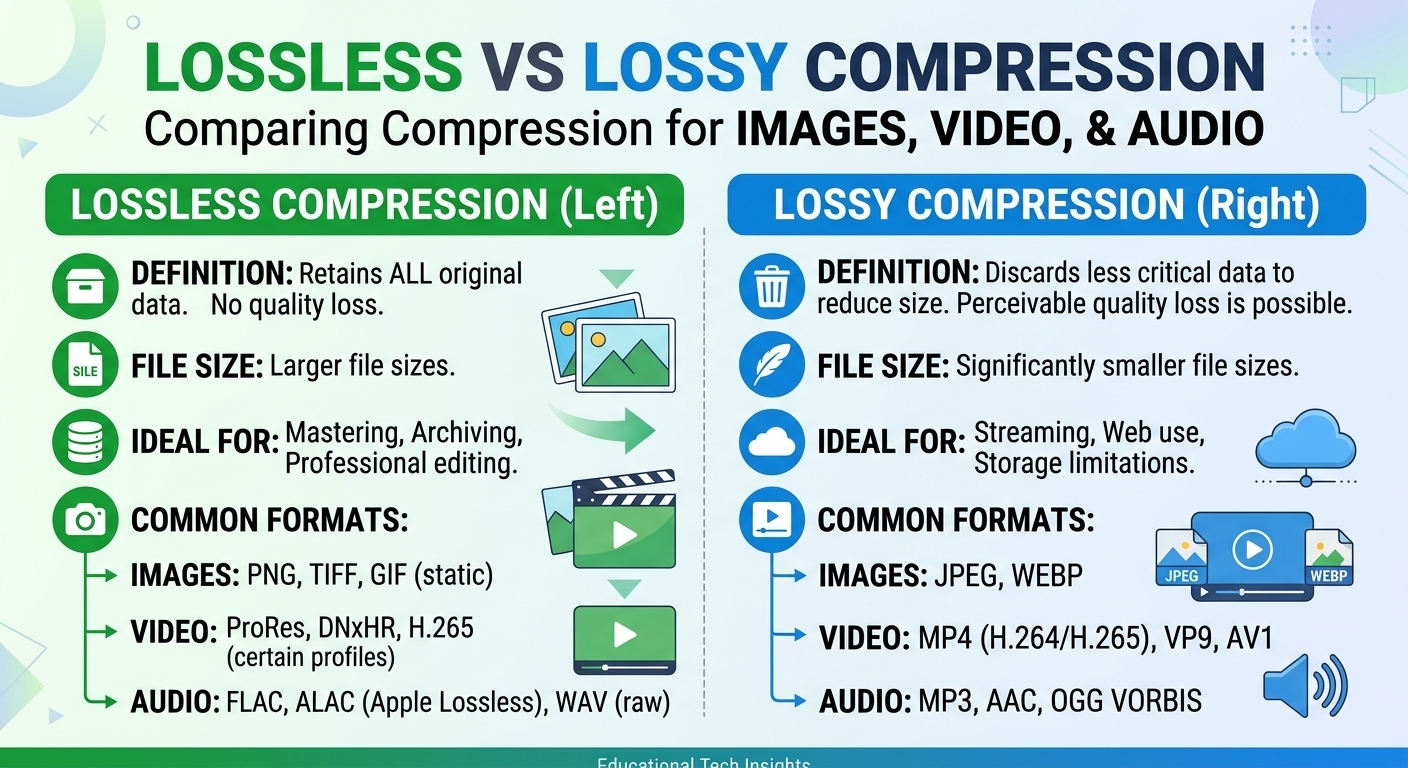
Lossy vs lossless compression comes down to one trade: lossless compression rebuilds every original bit and typically ...
A mid-market SaaS team I spoke with in Q1 2026 discovered their Fastly invoice had quietly grown 34% over six months—not because traffic surged, but because their Asia-Pacific delivery mix shifted from 15% to 30% of total egress. Nobody recalculated the regional weighting. That single oversight cost them roughly $1,800 per month in unbudgeted spend. Understanding Fastly CDN pricing at the line-item level is not optional if you operate at any meaningful scale. This article gives you the exact formulas, a regional cost matrix, a worked enterprise estimate, and a side-by-side cost comparison so you can model your own bill in under ten minutes.
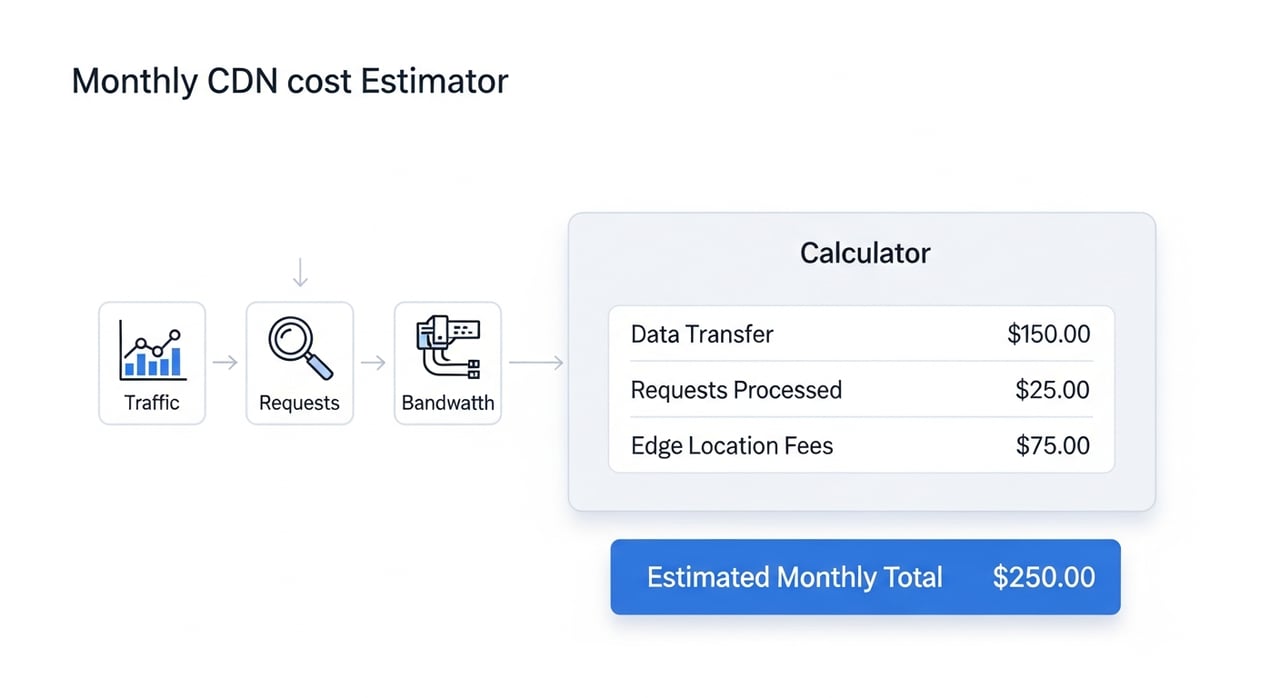
Fastly bills on three axes: data transfer (bandwidth), HTTP/HTTPS requests, and optional platform services. There is no flat monthly fee for the core delivery product—you pay for what you use. As of May 2026, the published rates on fastly.com remain usage-based with region-differentiated bandwidth tiers, meaning your geographic traffic distribution directly shapes the bill.
The pricing model rewards predictable, committed volume through custom enterprise agreements, but the self-serve rates are what most teams start with and what this playbook focuses on.
Bandwidth is almost always the dominant cost component. Fastly prices data transfer per GB, and the rate varies significantly by geography. As of Q2 2026, the published per-GB rates are:
| Region | Per-GB Rate (USD) |
|---|---|
| North America | $0.12 |
| Europe | $0.12 |
| Asia-Pacific | $0.19 |
| South America | $0.28 |
| Australia / New Zealand | $0.19 |
South America and APAC carry the steepest premium. If your user base is expanding into those regions—common for video platforms and global SaaS—this is where your forecast diverges from reality fastest. Always model bandwidth by region, never as a blended average.
Suppose you push 10 TB/month with 70% North America, 10% Europe, and 20% Asia-Pacific:
Total bandwidth cost: $1,340/month. Shift 10% from NA to APAC and the bill jumps to $1,410—a 5.2% increase with zero additional traffic.
Fastly charges approximately $0.0075 per 10,000 HTTPS requests (as of Q2 2026). For high-request-volume workloads—API gateways, single-page apps with aggressive fetch patterns, IoT telemetry endpoints—this line item can quietly compete with bandwidth.
At 200 million requests per month: (200,000,000 / 10,000) × $0.0075 = $150. At 1 billion requests, that climbs to $750. If your origin returns small payloads (JSON API responses under 5 KB), request costs may actually exceed bandwidth costs. Model both.
Fastly's optional services carry their own metered pricing and can dominate the invoice for certain workloads:
Consider a B2B SaaS platform serving 5 TB from North America, 3 TB from Europe, handling 200 million requests, running 500,000 IO transformations, and inspecting 50 million requests through WAF:
| Line Item | Calculation | Monthly Cost |
|---|---|---|
| NA Bandwidth | 5,000 GB × $0.12 | $600 |
| EU Bandwidth | 3,000 GB × $0.12 | $360 |
| HTTPS Requests | 200M / 10K × $0.0075 | $150 |
| Image Optimization | 500K transformations | ~$18,000 |
| WAF Inspection | 50M inspected requests | ~$75 |
| Total | ~$19,185 |
Note that Image Optimization alone represents 94% of this bill. If your workload is image-heavy, negotiating IO pricing or moving image transforms to an origin-side pipeline (thumbor, imgproxy) can cut the total invoice in half.
This is the section most Fastly pricing guides skip. Regional traffic distribution changes over time—new markets, acquisitions, localization launches—and each shift reprices your bill. Here is a sensitivity matrix showing monthly bandwidth cost for a 20 TB workload across different regional splits:
| Scenario | NA % | EU % | APAC % | LATAM % | Monthly BW Cost |
|---|---|---|---|---|---|
| US/EU heavy | 60 | 30 | 10 | 0 | $2,540 |
| Global balanced | 40 | 25 | 25 | 10 | $3,070 |
| APAC-heavy expansion | 30 | 15 | 45 | 10 | $3,490 |
| LATAM-heavy | 30 | 15 | 20 | 35 | $3,860 |
The spread between the cheapest and most expensive scenario is $1,320/month—a 52% variance on identical total volume. This is why blended-rate estimates fail. Build your model per-region, update the weights quarterly from your access logs, and recalculate.
At 20 TB/month of predominantly NA/EU delivery, Fastly's bandwidth bill lands around $2,400–$2,540. For teams whose workloads are bandwidth-dominant rather than compute-or-transform-dominant, that cost profile invites comparison. BlazingCDN is priced on tiers (as of October 2026): 100 TB runs $415/month, and 500 TB runs $1,815/month. For the 20 TB scenario above, that translates to $92.50/month versus $2,400+, with flexible configuration and no request fees.
For 10 TB delivered primarily across North America and Europe (as of Q2 2026), expect $1,200–$1,400/month in bandwidth alone. Add request fees, and a realistic floor is $1,300–$1,500 before any add-on services.
Bandwidth is metered per GB at the edge, priced by the region where the response was served. Requests are counted per HTTP/HTTPS transaction and billed per 10,000 at approximately $0.0075. Both are summed at the end of the billing cycle.
Transit and peering costs vary by geography. APAC and LATAM carry higher per-GB rates ($0.19 and $0.28, respectively) than NA/EU ($0.12) due to more expensive upstream connectivity in those markets. A shift in your user-base geography reprices your bill even at constant total volume.
Start with your real access logs: extract total bytes transferred per region, total request count, and any IO or WAF-inspected request volumes. Plug those into the per-unit rates from Fastly's pricing page. Avoid tools that use a single blended rate—they systematically underestimate bills for globally distributed traffic.
Yes. Enterprise contracts with committed monthly volume can yield meaningfully lower per-GB rates, but Fastly does not publish these publicly. You negotiate them directly with the sales team. If your usage exceeds 50 TB/month consistently, request a custom quote—the self-serve rates are not designed for that tier.
Fastly IO charges per transformation rather than per GB. A media-heavy site serving millions of variant images (responsive sizes, format negotiation) generates transformation counts that dwarf the raw bandwidth cost. Moving image processing to an origin-side service can reduce this dramatically.
Pull your last 90 days of access logs. Group bytes-out by Fastly region code. Count total requests. Apply the per-unit rates from the table above and compare the result to your actual invoices. If they diverge by more than 10%, your forecasting model has a gap—find it before finance does. If the numbers show your regional mix trending toward APAC or LATAM, run the sensitivity matrix above with projected Q3 weights and present the delta to your team before budget review.

Heavy traffic.
Light bill.
The CDN for video and large traffic
Learn
Lossy vs lossless compression comes down to one trade: lossless compression rebuilds every original bit and typically ...
Pricing - Pricing & Costs
The CloudFront vs S3 decision depends more on object size than on traffic volume. At a 500 KB average response, 100 TB ...

Learn
For most on-demand video, capped variable bitrate (VBR) wins the cbr vs vbr decision: it spends bits where the picture ...