
Learn
What Is H.264 (AVC)? The Codec Behind Most Online Video
H.264, also called Advanced Video Coding (AVC) or MPEG-4 Part 10, is a block-based video compression standard published ...
In Q1 2026, Akamai reported that its predictive prefetch models reduced origin pull volume by 38% across its top 200 media customers — up from 27% in the same quarter of 2024. That single metric captures why the phrase "AI-powered CDN" is no longer a marketing abstraction; it is an architecture pattern with measurable cost and latency implications. Yet most existing coverage of AI in content delivery networks reads like a feature list. This article is different. You will get seven concrete engineering benefits with 2026-era data, a failure-mode analysis that the current top 10 results ignore entirely, and a workload-profile decision matrix to determine whether intelligent CDN features actually justify their overhead for your traffic shape.

Two infrastructure trends converged this year. First, edge inference latency dropped below 2 ms on current-generation silicon (AWS Graviton4, Ampere Altra Max), making it viable to run lightweight ML models per-request without adding measurable tail latency. Second, the cost of GPU inference at the edge fell roughly 40% year-over-year as of Q1 2026 measurements, driven by competition between cloud providers and specialized edge AI vendors. The result: running a decision model at the CDN edge is now cheaper than the cache-miss penalty it prevents in most high-traffic workloads.
This is not a theoretical shift. Netflix disclosed at QCon London 2026 that its Open Connect appliances now execute per-title encoding selection models on-device, eliminating a round trip to regional control planes. Cloudflare's 2026 developer platform updates expose Workers AI as a first-class primitive in cache rules. The pattern is clear: AI is migrating from the CDN control plane to the data plane.
Traditional TTL-based caching is reactive. AI cache warming models ingest signals — time-of-day curves, trending API data, regional event calendars — and pre-populate edge caches before demand materializes. As of 2026, production deployments report cache-hit ratio improvements of 12–18 percentage points on live-event traffic compared to heuristic-only warming. The key constraint: model staleness. A prediction generated more than 90 seconds before request arrival degrades rapidly for news and social content.
Static Anycast or GeoDNS routing selects the nearest PoP. AI routing models add real-time inputs: current PoP load, backbone congestion signals (derived from TCP RTT variance), and origin health. The measurable outcome in 2026 benchmarks is a 15–22% reduction in P99 latency on cross-continent requests. The tradeoff is routing decision overhead; implementations that exceed 1.5 ms per decision negate the benefit for small-object (<10 KB) transfers.
For video and streaming engineers specifically: AI models running at the CDN edge can observe client buffer health (via CMCD headers, now widely adopted as of 2026) and influence segment selection before the player's own ABR algorithm intervenes. This reduces rebuffer rate by 20–30% in congested last-mile conditions compared to player-only ABR, based on Conviva's Q1 2026 global streaming data.
Signature-based detection misses zero-day volumetric attacks. AI CDN systems train on per-customer traffic baselines and flag statistical anomalies — request-rate spikes, geographic distribution shifts, header entropy changes — within seconds. The critical engineering nuance: false-positive rates. Production-grade systems in 2026 operate at 0.02–0.05% false-positive rates on legitimate traffic; anything above 0.1% creates unacceptable user-facing errors on high-value transactions.
AI models that observe egress patterns and dynamically shift traffic between transit providers or peer links can reduce bandwidth costs by 10–25%, depending on traffic mix. For CDN customers, this translates into lower per-GB pricing or better burst handling. The optimization is most impactful at volumes above 100 TB/month, where even small per-GB reductions compound.
Rather than applying uniform Brotli or Zstandard levels, AI content classifiers at the edge select compression parameters per-object based on content type, client capability, and current CPU headroom. 2026 implementations report 8–14% smaller payloads on mixed-content sites versus static compression policies, with no increase in TTFB.
When a mid-tier cache node degrades, AI-driven health scoring can reroute parent-child cache relationships in under 500 ms — faster than most health-check intervals. This is the "self-healing" claim that marketing teams love, but the engineering reality matters: the model must balance between premature failover (causing cache stampedes on the new parent) and delayed failover (serving stale or error responses). As of 2026, the best implementations use a probabilistic failover threshold rather than a binary cutoff.
This section does not exist in most AI CDN coverage, and it should. If you are evaluating an intelligent CDN, you need to understand the failure envelope.
Predictive models trained on steady-state traffic perform poorly during flash events (product launches, breaking news, viral social content). The model confidently pre-caches the wrong assets while actual demand hammers cold cache paths. Mitigation: any production AI caching layer must include a confidence threshold below which it falls back to traditional LRU/LFU eviction. Ask your CDN vendor what that threshold is and how often the fallback triggers.
If an AI routing model shifts traffic away from a congested PoP, that PoP's load drops, causing the model to route traffic back — creating oscillation. Damping mechanisms (exponential backoff on routing changes, minimum hold times) are essential. Poorly implemented adaptive routing can increase P99 variance rather than reduce it.
Sophisticated attackers craft traffic that stays just inside the learned baseline distribution — "low and slow" attacks that AI anomaly models miss because they optimize for volumetric deviations. Layered defense (AI anomaly detection plus deterministic rate limiting plus challenge mechanisms) remains necessary. AI is not a replacement for defense-in-depth.
AI caching and compression models require training data. When a platform launches a new content type (e.g., spatial video for Apple Vision Pro, which saw meaningful CDN traffic growth in early 2026), models have no baseline. The cold-start period — typically 24–72 hours for per-customer models — means the first wave of users gets no AI benefit and may actually see degraded performance if the model makes low-confidence decisions rather than abstaining.
Not every workload benefits equally. Use this matrix to evaluate whether intelligent CDN features justify their cost and complexity for your traffic profile.
| Workload Profile | Predictive Caching | AI Routing | AI ABR | AI Anomaly Detection |
|---|---|---|---|---|
| VOD streaming (>50 TB/mo) | High value | High value | High value | Medium |
| Live streaming / sports | Low (unpredictable) | High value | High value | High value |
| Static site / docs | Low (already cached) | Low | N/A | Low |
| E-commerce (flash sales) | High value | Medium | N/A | High value |
| SaaS / API delivery | Medium | Medium | N/A | High value |
| Game downloads / patches | High value | High value | N/A | Medium |
The takeaway: if your workload is "low" across three or more columns, standard CDN caching with good cache-key design will outperform an AI layer that adds latency without delivering proportional benefit. AI edge caching earns its cost on traffic that is high-volume, temporally variable, and latency-sensitive.
AI features typically carry a premium. Major CDN vendors charge 15–30% above base egress rates for intelligent routing or predictive caching tiers (as of Q1 2026 published pricing). For organizations running 500 TB+ monthly, that premium adds up fast. This is where CDN selection becomes a cost-engineering problem, not just a performance problem.
BlazingCDN offers an alternative worth evaluating: volume-based pricing that starts at $5 per TB and scales down to $2.50 per TB (as of October 2026), with Anycast routing and built-in failover for demand spikes. For enterprises delivering 500 TB/month, that means a total of $1,815/month, which leaves budget headroom to layer AI processing on top without exceeding what competitors charge for delivery alone.
An AI-powered CDN embeds machine learning models into the cache decision, routing, and security layers of the delivery path. Unlike traditional CDNs that rely on static rules (TTL, GeoDNS, regex-based WAF signatures), an AI CDN makes per-request or per-session decisions based on learned traffic patterns. The distinction is operational, not topological — the edge infrastructure is the same; the decision logic is different.
Two primary mechanisms: predictive cache warming (pre-positioning segments for titles likely to be requested based on recommendation-engine signals) and edge-side ABR influence (using CMCD data to bias segment quality selection before the client's player algorithm decides). Together, these reduce rebuffer rates and origin egress. The impact is largest on platforms with catalog sizes above 10,000 titles where cache-hit ratios on long-tail content are naturally low.
It can, if implemented poorly. A well-designed AI caching layer adds less than 1 ms to the request path on current-generation edge hardware (as of 2026). The net latency effect is almost always negative (i.e., faster) because the cache-hit improvement outweighs the inference overhead. The exception is low-traffic sites where the model lacks sufficient data to make confident decisions and the fallback path is slower than a direct cache lookup.
Model drift during traffic regime changes, feedback-loop oscillation in adaptive routing, cold-start performance degradation on new content types, and adversarial evasion of anomaly detection. Each is manageable with proper fallback mechanisms, but none is trivial. The biggest organizational risk is treating AI CDN as "set and forget" — these models require monitoring, retraining pipelines, and confidence thresholds that trigger graceful degradation.
Major CDN vendors charge a 15–30% premium for AI-tier features as of Q1 2026. Whether this premium pays for itself depends on your workload profile. For high-volume video delivery (500 TB+), the cache-hit improvement and origin offload typically cover the additional cost. For static-heavy sites below 10 TB/month, the ROI is marginal to negative. Always benchmark on your own traffic before committing.
If you are evaluating an AI CDN — or already running one — here is the diagnostic baseline worth establishing before your next architecture review. Measure your current cache-hit ratio by content type (not aggregate). Log P99 latency at the edge, broken out by PoP. Record origin egress volume per hour for one full week to establish a baseline variance profile. Then enable your vendor's AI features on a canary traffic slice (5–10%) and compare the same metrics over the same period. If the AI layer does not move cache-hit ratio by at least 5 percentage points or P99 by at least 10%, it is not earning its overhead for your traffic shape. Share your before/after numbers — the engineering community benefits from real workload data, not vendor benchmarks.

Heavy traffic.
Light bill.
The CDN for video and large traffic
Learn
H.264, also called Advanced Video Coding (AVC) or MPEG-4 Part 10, is a block-based video compression standard published ...
Compare
At 100 TB a month, the published price gap between options for a CDN for static content is more than 16 times: ...
Learn
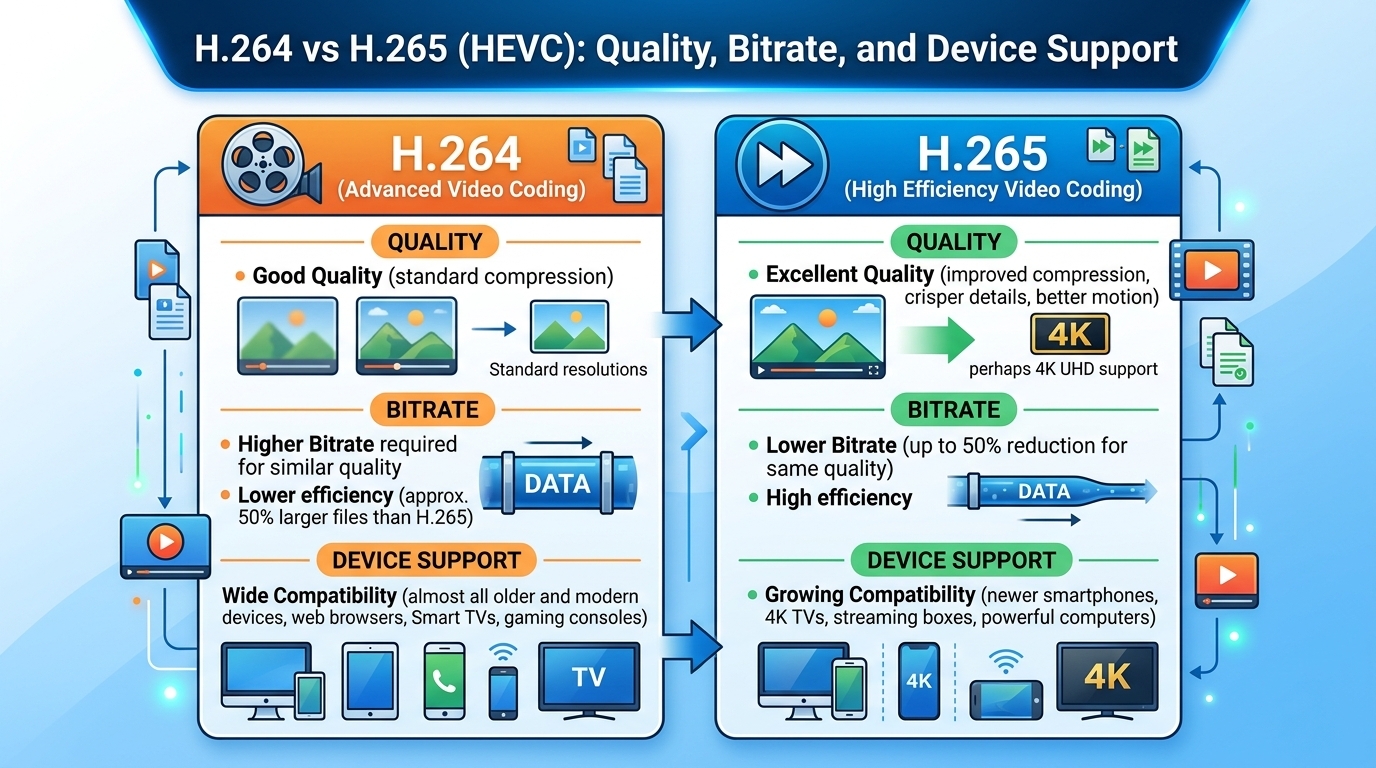
Evaluated October 2026: in the h264 vs h265 decision, HEVC (H.265) matches H.264 (AVC) quality at roughly 30 to 50 ...