
Learn
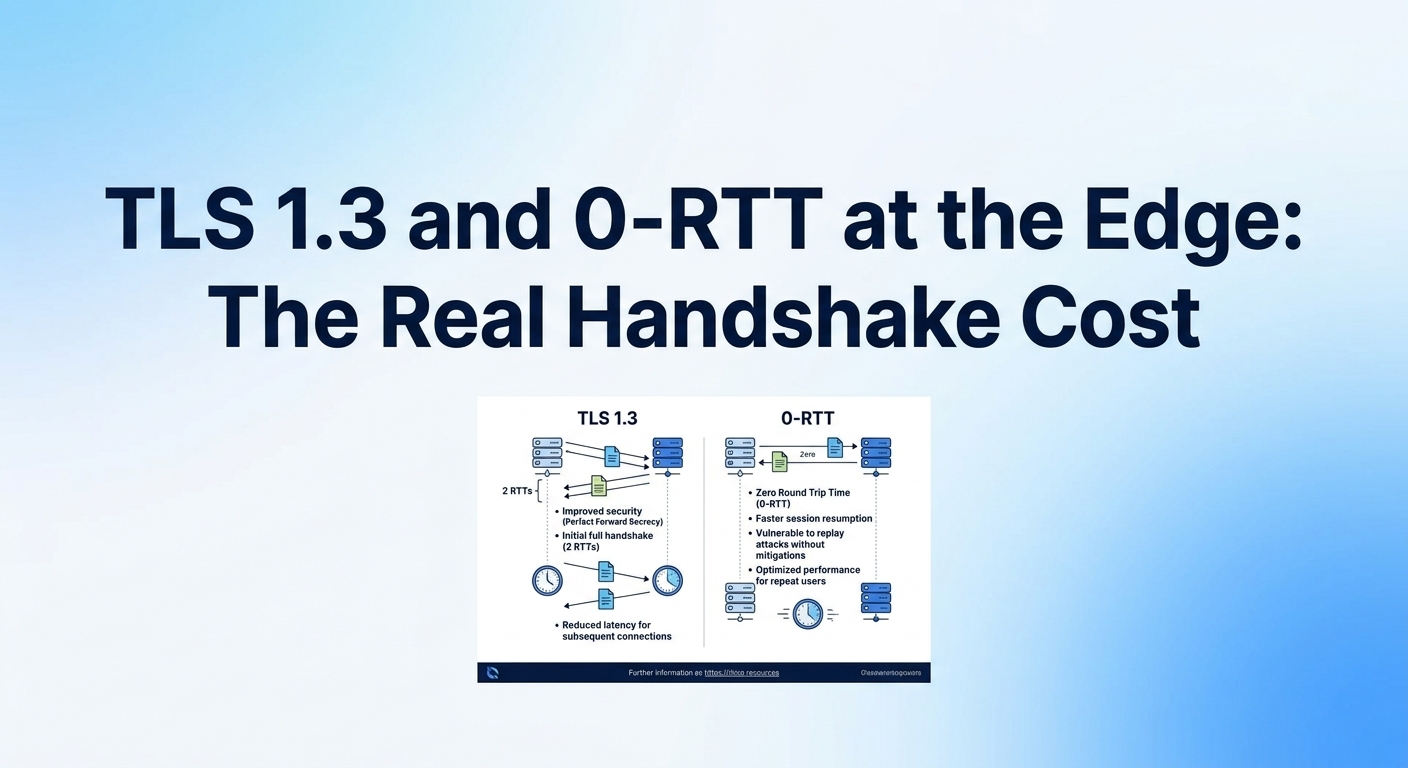
TLS 1.3 and 0-RTT at the Edge: The Real Handshake Cost
TLS 1.3 removes exactly one round trip from a full handshake compared with TLS 1.2, and 0-RTT removes one more on ...
Wukong Studio shipped a 148 GB day-one package in March 2026. Within the first four hours, their origin cluster handled less than 6% of total egress. The rest moved through edge cache, pre-warmed across three continents before the unlock timestamp fired. That ratio — 94% cache-hit on a cold launch — is the benchmark that separates a smooth global release from a support-ticket avalanche. If you run game delivery infrastructure in 2026, the question is no longer whether you need a gaming CDN. It is how you architect the cache hierarchy, manage the cost model, and handle the failure modes that show up at 40 Tbps of concurrent demand. This article gives you a framework: the delivery architecture pattern that top studios use today, a cost-model walkthrough for multi-petabyte months, and a failure-mode analysis that the current top-10 results for this keyword completely ignore.
Average install size for AAA titles crossed 120 GB in Q1 2026 measurements. Unreal Engine 5.5 nanite assets and high-resolution texture packs are the primary drivers, but even mid-tier multiplayer titles routinely push 45–60 GB initial downloads plus weekly patches in the 2–8 GB range. The math is blunt: a studio with 10 million active players pushing a 5 GB patch generates 50 PB of egress in a single update window. Serving that from origin is financially and architecturally impossible.
Two shifts made 2026 different from prior years. First, HTTP/3 with QUIC became the dominant transport for game launchers. Steam, Epic, and Xbox App all default to QUIC as of early 2026, which changes how CDN edge nodes handle connection migration and congestion control during large sequential downloads. Second, launcher-side range-request chunking evolved. Most launchers now issue 8–16 MB range requests in parallel, meaning edge nodes that lack efficient storage I/O for partial object retrieval introduce head-of-line blocking that wipes out any latency advantage from geographic proximity.
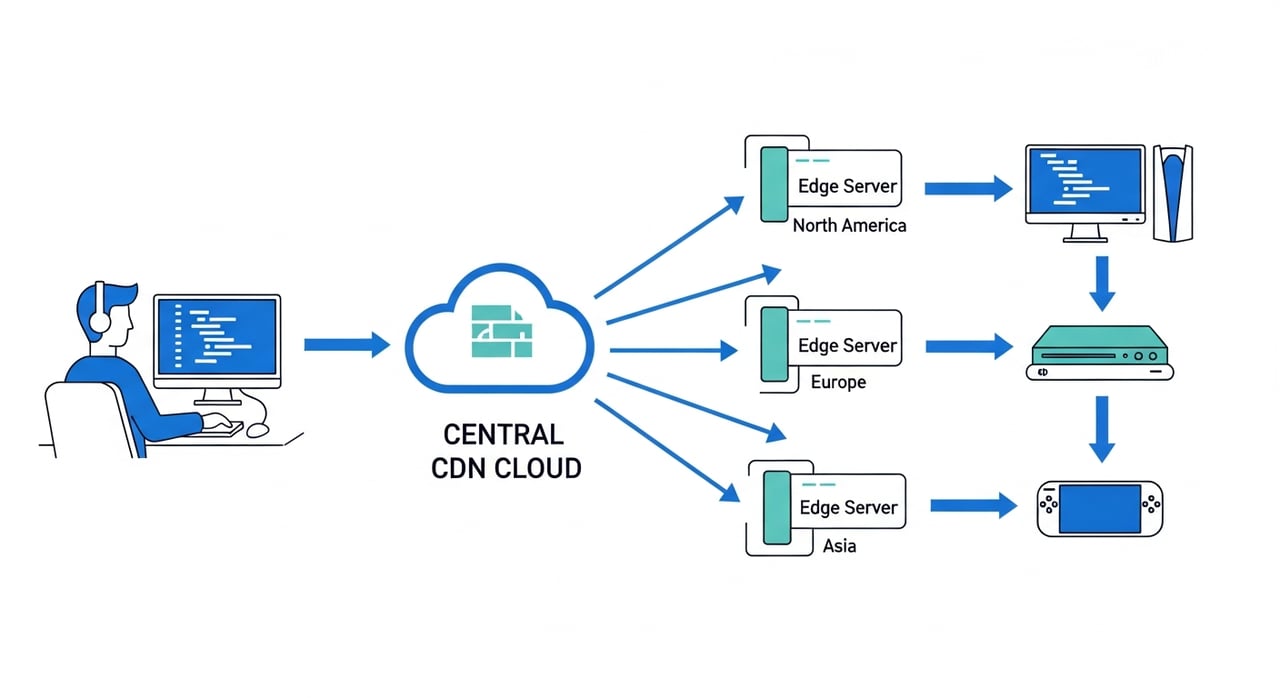
The delivery pattern that works at scale in 2026 is a three-tier cache hierarchy: origin, mid-tier shield, and edge. The architecture is straightforward, but the tuning matters.
Origin stores the canonical build artifacts — usually chunked into 1–16 MB blocks with content-addressed filenames. The shield tier sits between origin and edge, absorbing cache-fill storms during a launch or major patch. Without a shield, a global launch can generate thousands of simultaneous cache-fill requests back to origin from every edge node. A well-configured shield collapses those into a single fill per object, then fans out to requesting edges. As of 2026, best practice is two geographically separated shield nodes (e.g., US-East and EU-West) with failover logic at the edge layer.
Edge nodes serve the player. For day-one game launch downloads, pre-warming is non-negotiable. The approach: push chunked assets to edge nodes 6–24 hours before the unlock timestamp, using background fill jobs that avoid competing with live traffic. Studios that skip pre-warming and rely on lazy cache-fill see 30–50% cache-miss rates in the first hour — exactly when demand peaks. Pre-warming flips that to sub-5% miss rates and keeps origin load flat.
Game assets are immutable once published to a build version. Set long TTLs (30+ days) and use content-addressed URLs or versioned path prefixes. Purge is rarely needed if your URL scheme is clean. Studios that use mutable URLs with short TTLs pay an unnecessary cost in cache-fill traffic and origin load.
Launches get the attention, but patches dominate total annual egress. A live-service title with 20 million MAU pushing a 3 GB patch every two weeks generates roughly 720 PB per year in patch traffic alone. The CDN for game downloads must optimize for this steady-state workload, not just the launch spike.
Delta patching reduces the per-user payload. Most modern build pipelines generate binary diffs at the chunk level, bringing a 3 GB logical patch down to 400–800 MB of actual transfer for a typical user. The CDN still delivers the same chunk objects, but the launcher requests only the changed chunks. This means the edge cache needs to hold both the old and new chunk sets simultaneously during the rollout window — plan storage accordingly.
Staggered rollouts are standard practice: 1% canary, 10% ring, full deployment over 4–12 hours. This smooths demand and lets the CDN fill caches organically instead of requiring full pre-warm for every weekly patch.
This is the section missing from every other article ranking for this keyword. Studios budget CDN spend as a per-unit COGS line, and the variance between providers is enormous. Here is a representative breakdown for a mid-size studio delivering 500 TB per month in game content (as of Q2 2026 pricing):
| Provider Tier | Effective Cost per TB | Monthly Cost at 500 TB |
|---|---|---|
| Major hyperscaler (CloudFront, Cloud CDN) | $40–$60 | $20,000–$30,000 |
| Mid-market CDN (negotiated contract) | $10–$20 | $5,000–$10,000 |
| BlazingCDN (500 TB committed tier) | $3 | $1,500 |
At the 1 PB+ tier, BlazingCDN pricing drops to $2.50 per TB, and at 2 PB it reaches $2 per TB. For studios in the 500 TB–2 PB monthly range, that difference funds an entire infrastructure team. BlazingCDN delivers fault tolerance and uptime comparable to CloudFront — 100% uptime SLA with fast scaling under demand spikes — while costing a fraction of what hyperscalers charge. Sony is among its clients, which speaks to the production-grade reliability required at that scale. If you are evaluating CDN for game downloads at volume, BlazingCDN's game delivery configuration is worth benchmarking against your current provider.
This is where real operational knowledge lives. Three failure patterns account for the majority of game delivery incidents:
When a game unlocks globally at a single timestamp without pre-warming, every edge node simultaneously requests every chunk from the shield tier. The shield tier, in turn, stampedes origin. Result: origin overload, cascading timeouts, launcher retry storms, and a social-media firestorm within 15 minutes. Mitigation: pre-warm plus request coalescing at the shield layer. Test by simulating a cold-cache launch at 50% expected peak.
The launcher downloads a manifest file listing chunk hashes and URLs. If this manifest is cached at an edge node and then updated at origin without proper invalidation, some players receive a stale manifest pointing to chunks that no longer exist. Downloads fail with hash mismatches. Mitigation: serve manifests with no-cache or very short TTLs (30–60 seconds), and separate them from bulk asset caching policy. Never pre-warm manifests.
Edge nodes have finite SSD capacity. A 148 GB game with three active build versions plus delta chunks can consume 300+ GB of edge storage per title. If an edge node serves multiple large titles, storage pressure causes early eviction and cache-miss spikes during peak hours. Mitigation: monitor edge storage utilization and implement tiered eviction policies that protect high-demand objects. Some CDNs expose this metric; demand it from your provider if they do not.
A CDN caches game chunks on edge nodes geographically close to the player, eliminating cross-continent round trips. For a player in Tokyo downloading from a US-based origin, this can reduce download time by 60–80%. The improvement comes from reduced latency per request and higher sustained throughput due to shorter network paths and optimized transport (QUIC/HTTP3 as of 2026).
At multi-petabyte volumes, cost per TB becomes the dominant variable. As of Q2 2026, BlazingCDN offers the lowest published rate at $2–$3 per TB for committed volumes above 500 TB, compared to $40–$60 per TB at major hyperscalers. Performance and uptime are comparable, so the decision typically comes down to cost and configuration flexibility at scale.
Studios use delta patching at the build pipeline level to reduce per-user transfer size, then rely on staggered rollouts (canary, ring, full) to smooth CDN demand. The CDN must hold both old and new chunk sets during rollout. Aggressive cache TTLs on immutable chunks and short TTLs on manifests prevent version-mismatch errors.
Pre-warm edge caches 6–24 hours before the unlock timestamp. Use request coalescing at the shield tier to prevent origin stampede. Serve the unlock manifest with a short TTL so it propagates quickly at the exact launch moment while bulk assets are already cached at the edge.
With proper pre-warming and a content-addressed URL scheme, a 94–98% cache-hit ratio in the first hour is achievable and expected for AAA launches in 2026. Anything below 90% indicates a pre-warming gap or manifest-caching misconfiguration that needs immediate investigation.
Yes, particularly for players on lossy or high-latency connections (mobile, satellite, congested ISP links). QUIC eliminates head-of-line blocking at the transport layer and supports connection migration, which helps when a player's IP changes mid-download. As of 2026, all major game launchers default to QUIC, so your CDN edge must support it natively.
Pull your CDN analytics for the last 30 days and answer three questions. First: what is your cache-hit ratio for game assets during the most recent patch rollout? If it is below 92%, investigate your TTL and manifest caching policies. Second: what is your effective cost per TB across all regions? Compare it against the table above. Third: do you have visibility into edge storage utilization per node, and have you modeled what happens when you ship two large titles simultaneously? If any of those answers make you uncomfortable, that is your next infrastructure ticket. And if your current provider cannot show you edge storage metrics, it is time to evaluate alternatives.

Heavy traffic.
Light bill.
The CDN for video and large traffic
Learn
TLS 1.3 removes exactly one round trip from a full handshake compared with TLS 1.2, and 0-RTT removes one more on ...
Learn
Evaluated February 2026. Two mechanisms decide which edge serves a request, and they fail on completely different ...

Security
Cloudflare Rate Limiting Pricing 2026: Plans, Rules, Real Costs Cloudflare rate limiting pricing has one detail that ...